
























![Kingdom Hearts Collection [I-III] Review](https://gazettely.com/wp-content/uploads/2026/10/Kingdom-Hearts-Collection-I-III-1-360x180.webp "Kingdom Hearts Collection [I-III] Review: KHII Holds Steady as Newer Entries Fluctuate 37")





Castle Rock, Maine, lives like a mental map, a New England town where familiar porches and tidy streets sit on top of something that keeps breathing underneath. The series skips the straight line of adapting one novel and builds a home for the lingering echoes of an entire literary canon. The story kicks off with a grim find inside Shawshank State Prison.
After the warden’s suicide, staff discover a silent young man locked in a cage inside a forgotten block. He speaks one name: Henry Deaver. Henry, a death row attorney who left town under suspicion connected to his father’s death, gets pulled back toward a place that has never stopped keeping score. Castle Rock becomes a container for shared trauma, with corners and landmarks that feel loaded with old damage.
That framework lets the show stack mysteries without losing the human stakes. The setting behaves like something alive, feeding on what residents bury and what they refuse to say out loud. The prisoner’s presence turns into the hinge point, tying Henry’s personal history to the town’s darker inheritance.
Haunted Faces and Quiet Terrors
André Holland anchors the series with a performance built on heavy, stoic restraint. As Henry Deaver, he guides us through a town that meets him with resistance, and he wears the physical and emotional weight of a man carrying childhood shadows that never packed up and left. The looks he gives locals land with weary recognition, like he already knows how this conversation ends. That steadiness matters, because the surrounding events keep drifting toward the bizarre, and his grounded presence keeps the story from floating away.
Bill Skarsgård chills the air as the nameless prisoner. He uses physicality to project lurking danger while still registering as physically fragile. Wide eyes and near-total stillness do the work of a monologue, suggesting suffering without asking the audience to translate a speech. He can read as victim and predator inside the same shot, which is a neat trick for someone who barely speaks.
Sissy Spacek brings the show’s emotional center as Ruth Deaver. Her portrayal of a woman living with dementia injects heartbreaking reality into the supernatural momentum. She functions as a grounding force in a story where logic keeps slipping, and Spacek captures the frustration of a fading mind with a grace that makes Ruth feel deeply lived-in. Melanie Lynskey adds nervous, empathetic energy as Molly Strand, whose psychic sensitivities make her a pointed lens on the town’s rot. Her lifelong bond with Henry forms a knot of shared history and unspoken guilt, the kind of connection that can warm a scene and poison it at the same time.
Scott Glenn shows up as Alan Pangborn, a retired sheriff whose presence links the series to Castle Rock’s long history of oddities. He plays Pangborn with rugged weariness, like surprise became an expense he stopped paying years ago. Jane Levy rounds out the ensemble as Jackie Torrance, a figure from a self-aware generation living in the wreckage of the past. She pushes toward her own path through the chaos while leaning into the macabre legacy attached to her family name. Across the cast, each performance adds a specific texture, keeping the human drama compelling even while the mystery keeps tightening its grip.
The Art of the Slow Shiver
The series commits to a deliberate, cold atmosphere and lets dread accumulate instead of sprinting for shocks. The camera treats the landscape like a bleak, isolated world, underlining the solitude that clings to these characters. Shawshank’s industrial rot and the Deaver home’s domestic decay create two flavors of damage, and the visual language stays heavy and damp, mirroring the residents’ psychological weather.

Frames seem calibrated to make you feel the bite of a Maine winter, and the editing lets scenes linger long enough for the audience to start scanning the corners. If your eyes keep checking the shadows, the show counts that as participation.
Sound design does a lot of the quiet heavy lifting through the schisma, a high-pitched frequency that signals how thin reality has become. The ringing returns as an auditory marker, training the audience to listen for the silence between noises. It starts behaving like a character, flagging the moments when the natural world begins to fray.
The season hits a structural high point with the episode “The Queen.” The chapter shifts visual and narrative style to mirror Ruth’s fractured mind, offering a sense of time where past and present collide in a single room. Color choices and repetitive imagery create disorientation that lands as beautiful and terrifying. That pivot enriches the season by foregrounding interior lives, and it frames memory as one of the most frightening spaces the story can enter. Direction stays committed to a lingering, unsettling mood that keeps echoing after the screen goes dark.
A Puzzle Box of Literary Ghosts
The show functions like a sophisticated game for viewers who know the history of this fictional region. Locations such as the Mellow Tiger bar and Shawshank Prison carry story weight, serving as load-bearing parts of the plot rather than background decoration.

The writing picks up familiar genre staples like the psychic neighbor and the corrupt warden and gives them nuanced, contemporary motivations, which keeps the series from feeling like a simple roll call of references. Collective trauma becomes a guiding idea, with Castle Rock framed as a place where sins keep resurfacing. The town can feel like a trap that tightens around anyone who tries to get out.
Henry Deaver also brings a vital layer of identity into the narrative. As a Black man returning to an insular rural town, his homecoming carries realistic tension, and his isolation reads as social and historical in addition to supernatural. When his son Wendell arrives, the dynamic shifts again. Wendell reflects Henry’s childhood while offering a thread of connection that the town so often corrodes.
This attention to heritage and family legacies gives the eerie events extra weight. Castle Rock comes across as a physical manifestation of a past that refuses silence, hinting that geography can function like destiny, especially for people born into its darkest corners. The series looks at how stories travel through generations and how they haunt families over time. The shared-universe idea here ties to names and places, and it also ties to the specific flavor of dread that defines this patch of the world.
The Weight of the Unseen
Information arrives in fragments, and the reveals around the prisoner’s identity and Henry’s missing time ask for patience. Some viewers may feel the pace press on them. The series rewards the audience that lets details settle. The episodes ask you to sit with discomfort and the unknown, and the script holds answers at arm’s length while still respecting ambiguity. Enough threads remain loose to preserve a sense of cosmic indifference, keeping the mystery feeling vast and ancient.

A few stretches drift into side mysteries that carry less urgency than the prison’s central tension. The narrative drive tends to snap back once focus returns to the primary duo, and the slow unveiling of the prisoner’s nature builds real unease that powers the final act. The show keeps pressing the question of causality: does the town’s evil create monsters, or do monsters follow the rot that already lives there?
It studies the thin line between victim and threat. It ends by wondering if some cages should stay locked forever. Can a place like this ever be cleaned of its history? Do the final moments signal a broken cycle, or the start of the same loop with fresh paint? And seriously, would you trust a stranger who knows your name and refuses to tell you his own?
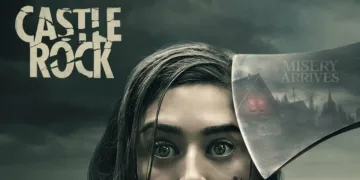
Castle Rock premiered on Hulu as a psychological horror anthology that serves as a massive intersection for the various worlds created by Stephen King. Set in the namesake town of Maine, the show functions as a reimagining that explores the themes and settings of King’s entire body of work without strictly following a single book. The first season premiered in July 2018, followed by a second season in October 2019. While the series was officially canceled in 2020 after its second installment, it remains available for streaming on Hulu and for purchase through digital retailers and physical media.
Full Credits
Title: Castle Rock
Distributor: Hulu
Release date: July 25, 2018
Rating: TV-MA
Running time: 43 to 60 minutes
Director: Michael Uppendahl, Kevin Hooks, Greg Yaitanes, Julie Anne Robinson, Andrew Bernstein, Nicole Kassell, Dan Attias, Phil Abraham, Anne Sewitsky, Craig William Macneill
Writers: Stephen King, Sam Shaw, Dustin Thomason, Marc Bernardin, Scott Brown, Lila Byock, Mark Lafferty, Gina Welch, Vinnie Wilhelm, Daria Polatin
Producers and Executive Producers: J.J. Abrams, Stephen King, Sam Shaw, Dustin Thomason, Ben Stephenson, Liz Glotzer, Mark Lafferty, Robin Sweet, Tamara Isaac
Cast: André Holland, Melanie Lynskey, Bill Skarsgård, Jane Levy, Sissy Spacek, Lizzy Caplan, Paul Sparks, Barkhad Abdi, Yusra Warsama, Elsie Fisher, Matthew Alan, Tim Robbins, Scott Glenn, Terry O’Quinn
Director of Photography (Cinematographer): Richard Rutkowski, Jeff Greeley
Editors: Matthew V. Colonna, Tom Wilson, Tanya Swerling, Trevor Baker, Kelley Dixon
Composer: Thomas Newman, Chris Westlake
The Review
Castle Rock
Castle Rock successfully escapes the gravity of simple adaptation by treating its source material as a foundation for something new. While the deliberate pacing may test the patience of viewers used to rapid frights, the atmospheric dread and masterful performances provide a steady reward. It creates a space where the supernatural feels as heavy as the human grief on display. The series is a haunting exploration of whether a town can ever outrun its history. Is the darkness a guest in Castle Rock, or is it the architect of the town itself?
PROS
- Powerhouse turns from Sissy Spacek and André Holland ground the mystery.
- The visual and sound design maintain a constant, chilling sense of unease.
- Original storytelling that honors literary themes without being derivative.
CONS
- The mid-season narrative can occasionally feel like it is treading water.
- Some viewers might find the lack of definitive answers deeply frustrating.
- Occasional easter eggs risk distracting from the primary emotional stakes.







