
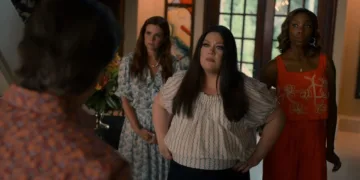

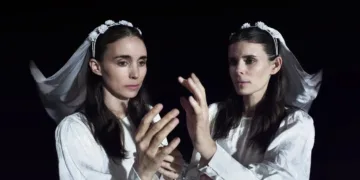
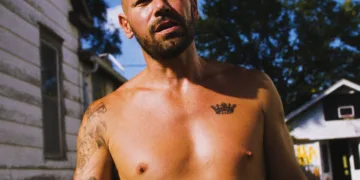
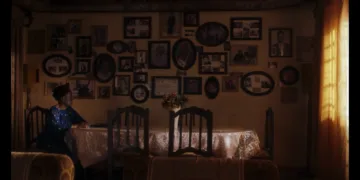

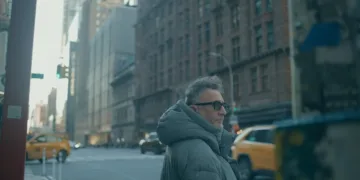









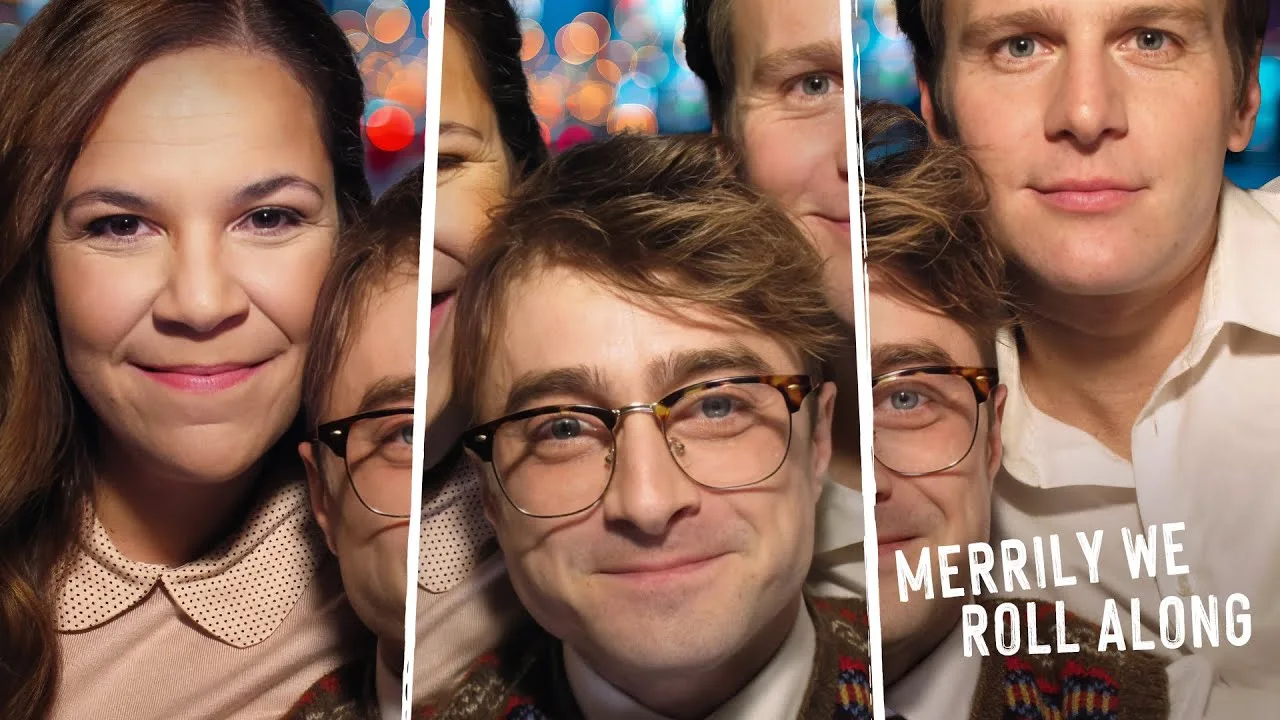

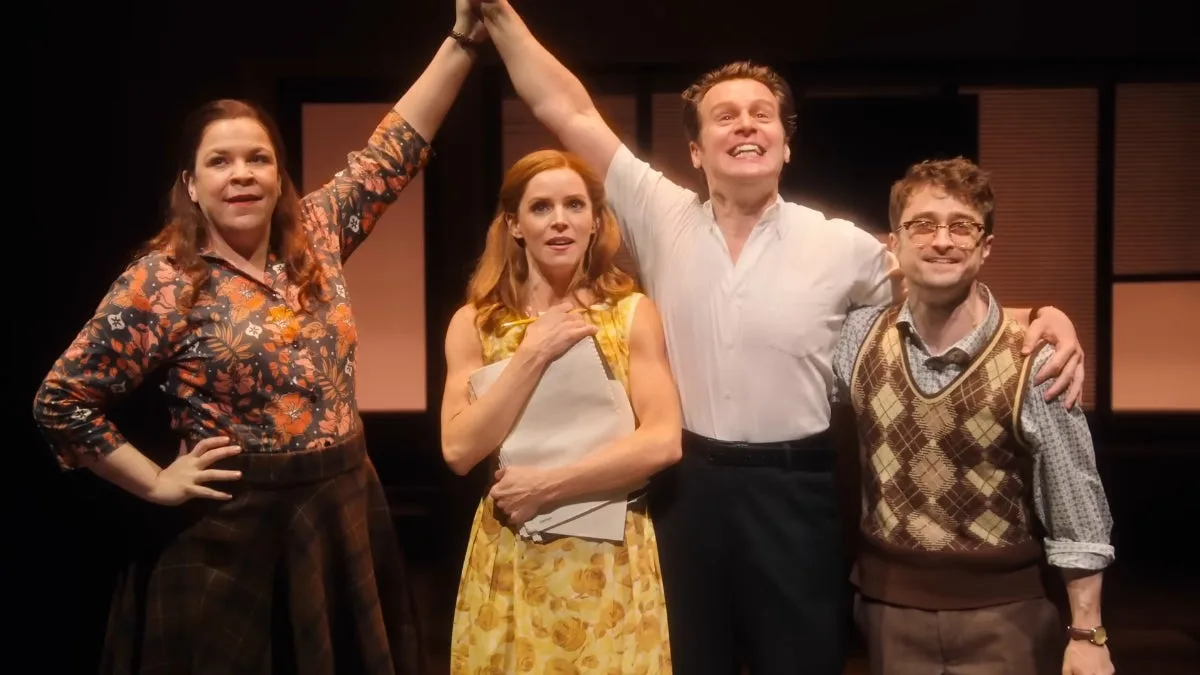
The cinematic recording of the 2023-2024 Broadway revival of Merrily We Roll Along serves as a vital document of a masterpiece finally reaching its true form. Maria Friedman directs both stage and screen, and her staging captures the landmark production led by Jonathan Groff as composer-turned-Hollywood-producer Frank Shepard, Daniel Radcliffe as lyricist partner Charley Kringas, and Lindsay Mendez as confidante Mary Flynn.
The musical uses a reverse chronological structure. It opens in the 1970s, where the trio’s friendship has dissolved amid Frank’s material success, and moves backward year by year until it arrives at their hopeful, idealistic meeting in 1957. That temporal inversion frames a study of ambition, compromise, and the painful cost of abandoning youthful ideals.
Narrative Innovation and The Intimacy of Reverse Chronology
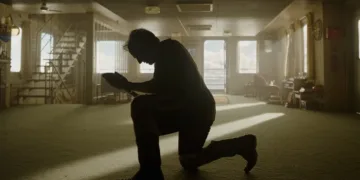
Friedman’s staging, which redeemed the show after its disastrous 1981 debut, gains clarity from the pro-shot format. This recording permits the camera to find an intimacy that live theatre often cannot match. Director of Photography Sam Levy uses careful close-ups to register nonverbal cues and those half-formed, unfinished thoughts beneath the text. In the opening Hollywood party the camera lays bare Frank’s inner state, showing grief, detachment, and the strain concealed by his posture.
The pro-shot approach turns the stage into a focused psychological space. The reverse chronological ordering functions as an emotional logic for the viewer. We first witness the trio’s catastrophic fallout in the bitter present and then watch hope and loyalty return as earlier years unfold. That progression produces a distinct kind of melancholy.
When the narrative ends with their optimistic beginning we experience heartbreak, and we retain the knowledge of the compromises and betrayals that follow. Sondheim’s score and George Furth’s book increase the thematic weight. The reprise of “Not a Day Goes By” appears first as resentment and later in its originating context as an innocent pledge of love, a change that emphasizes how time alters meaning.
As an avid watcher of independent cinema I value when a film adopts unconventional plot structures, and Merrily grounds that concept in plain feeling. Though filmed theatre can risk static composition, the visual execution here remains dynamic. The camerawork can feel rough and scrambled during the large, chaotic 1970s sequences, and it grows tighter and more refined as the ensemble contracts in earlier periods. That tightening of focus directs attention to the core relationship, and it clarifies how Frank, Charley, and Mary were once central to one another.
The Trio: Unwinding the Emotional Clock
Everything in the piece depends on the central actors committing to character arcs that run backward. Jonathan Groff gives an arresting portrait of Frank Shepard. He manages the difficult task of rendering a successful, compromised figure while keeping the viewer’s sympathy by centering Frank’s deep regret from the opening moments.
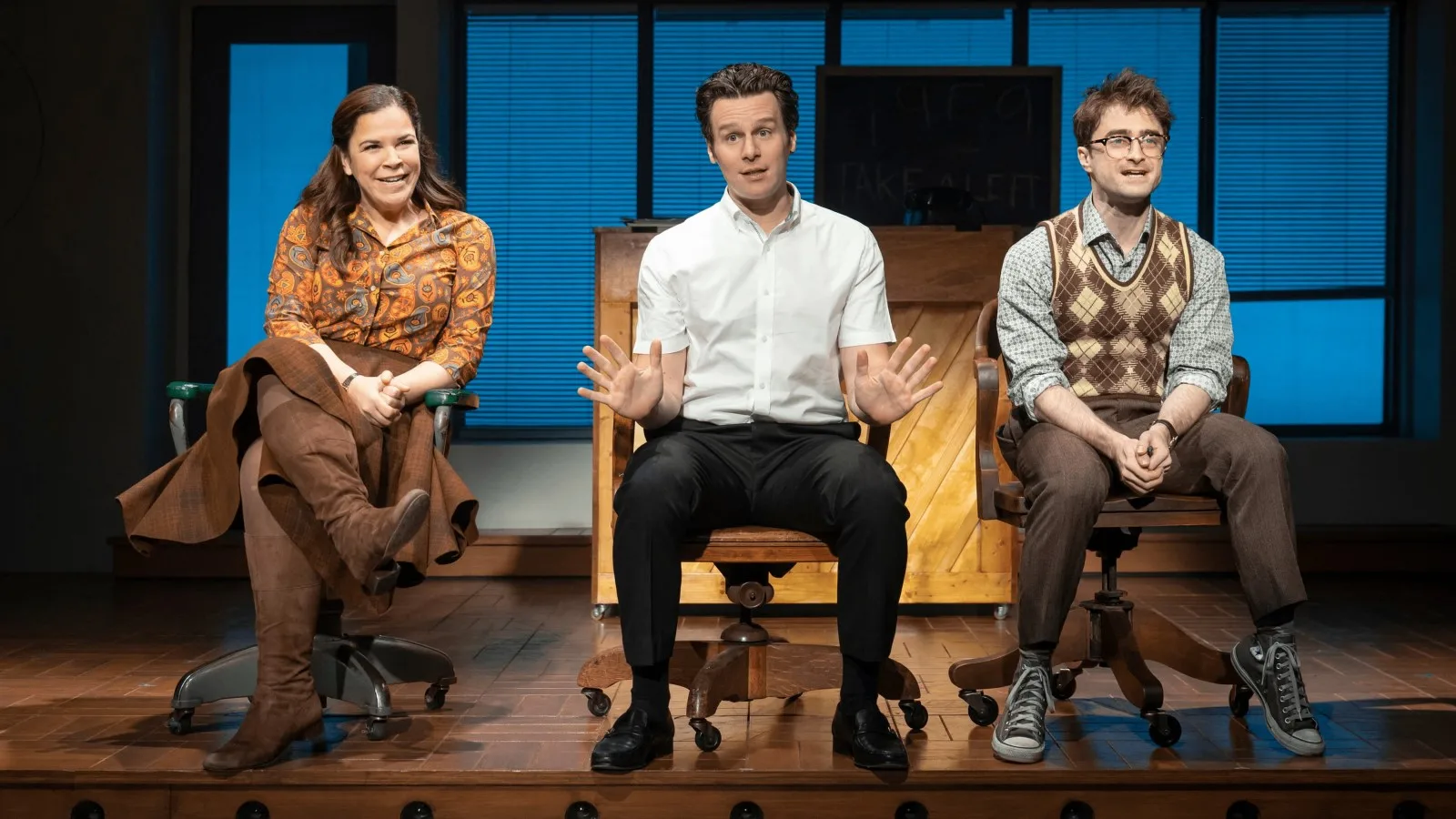
Groff begins with a guarded, strained physicality and controlled vocals suited to a cynical Hollywood power broker and then moves backward into the looser, more open young composer of the 1950s. That reverse commitment gives the audience a clear stake in how Frank drifted so far.
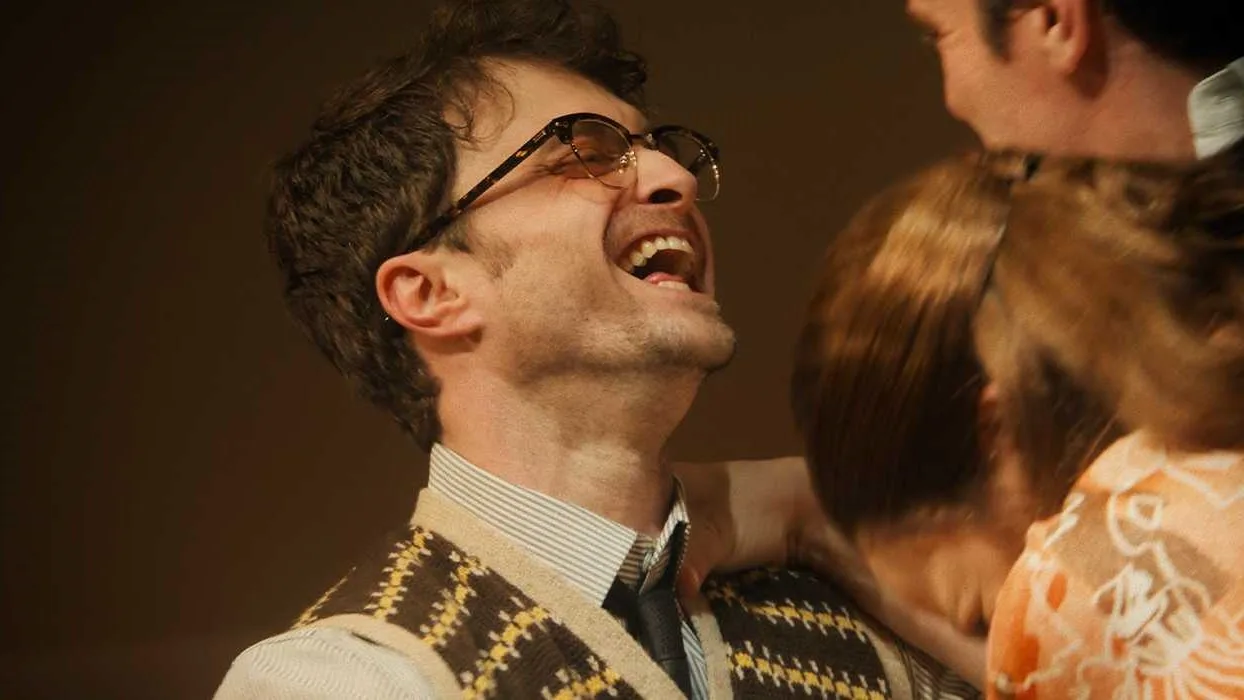
Daniel Radcliffe supplies the anxious, high-energy counterpoint as Charley Kringas, the friend who holds fast to his moral center. His anxiety builds across the reverse arc as he watches Frank’s gradual surrender to ambition. His performance of “Franklin Shepard, Inc.” serves as the emotional rupture, a raw televised meltdown that exposes betrayal and precipitates the friendship’s collapse. Radcliffe’s timing and body language convey the price of Frank’s ascent on their partnership.
Lindsay Mendez completes the trio as Mary Flynn, the tragic figure. She employs venomous wit and drunken sarcasm in the opening scene as a defensive skin that masks deep pain, unrequited love, and disappointment. Mendez’s close-ups prove essential, revealing a wounded core beneath the acidic delivery. Together the three sell the past and the heartbreak, making their shared history feel immediate and true.
Sondheim’s Density and Supporting Layers
The film demonstrates why Sondheim’s score commands such esteem, with intricate arrangements and razor-sharp lyrics. The music supplies much of the emotional and narrative scaffolding, often voicing what characters cannot speak.
Numbers such as “Opening Doors” and “Franklin Shepard, Inc.” show Sondheim’s technique: he treats typewriter keystrokes, ringing phones, singing, and humming as woven instrumental elements. That technical layering feels striking to me; it marks a cultural moment when the noise of commercial life began to compete with artistic expression.
Frank’s messy private life receives further dimension from strong supporting turns. Katie Rose Clarke as Beth embodies the piercing heartbreak of the first wife, an innocence that does not grasp how success can alter a partner. Her work in the courthouse scenes for “Not a Day Goes By” lands with quiet devastation.
Krystal Joy Brown plays Gussie Carnegie, the ambitious second wife. Gussie often functions as a catalyst for Frank’s worst choices; Brown brings enough cunning and texture to avoid a flat caricature. The reverse unfolding of Frank’s love life reveals a rhyming pattern of disastrous relationships.
Ambition’s Cost and Narrative Gaps
This revival shines in its examination of compromise, disillusionment, and the cost of turning away from those who love you. The film concentrates on the messy middle ground of human choices and shows how small decisions echo across decades. The reverse structure lays that truth bare and stands as a candid cultural reflection on the anxieties tied to ambition and the hollow promise of external success.
A few structural limits remain. The emphasis on Frank’s decline is so intense that Mary’s long, unreturned love lacks an obvious originating spark. Even with the story moving back to its starting point the precise genesis of her feelings stays a touch unclear, producing a minor emotional gap. Likewise, Gussie remains partly defined by her role as a plot spur; Brown works to add depth.
Still the film honors the story’s difficult, tender, and deeply human center. The closing rooftop scene set in 1957 is breathtaking. We watch the young trio look up at Sputnik convinced the future is wide open. That last image carries powerful melancholy because we view it with full awareness of their eventual failure.
Merrily We Roll Along is the filmed version of the successful, four-time Tony Award-winning Broadway revival of Stephen Sondheim and George Furth’s musical, which finished its acclaimed run in July 2024. The film captures the production live at the Hudson Theatre, offering audiences a cinematically intimate view of the show’s turbulent story, told in reverse chronological order. It charts the three-decade friendship of composer Franklin Shepard and his two collaborators, moving backward from their fractured, cynical adulthood to their bright-eyed, optimistic youth. The film was released theatrically worldwide starting on December 5, 2025. It will likely become available for digital viewing on platforms like Apple TV or Netflix following its limited theatrical run, as Sony Pictures Classics holds the rights.
Full Credits
Title: Merrily We Roll Along
Distributor: Sony Pictures Classics, Fathom Events
Release Date: December 5, 2025 (Theatrical, worldwide)
Rating: PG-13
Running Time: 2 hours and 25 minutes (145 minutes)
Director: Maria Friedman
Writers: Stephen Sondheim (Music and Lyrics), George Furth (Book), George S. Kaufman and Moss Hart (Original Play)
Producers and Executive Producers: Sonia Friedman, David Babani, Patrick Catullo, F. Richard Pappas, Jon Kamen, Dave Sirulnick, Meredith Bennett, No Guarantees Productions, Scott Abrams, Jonathan Corr, Mary Maggio, Jeff Romley, Tony Yurgaitis, Andrew Cohen, Amanda Lipitz, Henry Tisch, Stephanie P. McClelland
Cast: Jonathan Groff, Daniel Radcliffe, Lindsay Mendez, Krystal Joy Brown, Katie Rose Clarke, Reg Rogers, Max Rackers, Sherz Aletaha, Leana Rae Concepcion, Jim Hogan, Cory Jeacoma, Caleb Marshall-Villarreal, Ryah Nixon, Christian Probst, Talia Robinson
Director of Photography (Cinematographer): Sam Levy
Editors: Stephen Sondheim (Music and Lyrics), George Furth (Book), George S. Kaufman, Moss Hart (Original Play)
Composer: Stephen Sondheim
The Review
Merrily We Roll Along
Merrily We Roll Along is a masterclass in emotional archaeology. Maria Friedman's astute direction and the powerhouse performances of Groff, Radcliffe, and Mendez transform a complex musical into a deeply affecting cinematic experience. The reverse chronology works brilliantly, creating a unique, devastating melancholy. It is a sharp, necessary examination of the compromises that erode us, offering a definitive account of a Sondheim classic.
PROS
- The narrative device works perfectly to heighten tragedy and poignancy.
- Groff, Radcliffe, and Mendez are definitive, their reverse emotional arcs are flawless.
- Frequent use of close-ups captures subtle, raw emotions impossible to see from a balcony.
- The music and lyrics are rich, inventive, and carry the story's emotional weight.
CONS
- Flat backdrops and occasional camera shakiness sometimes remind viewers it is a filmed play.
- Mary's unrequited love and Gussie's motivations feel less developed in the script.
- The tight focus sometimes sacrifices the broader view of the stage action.