














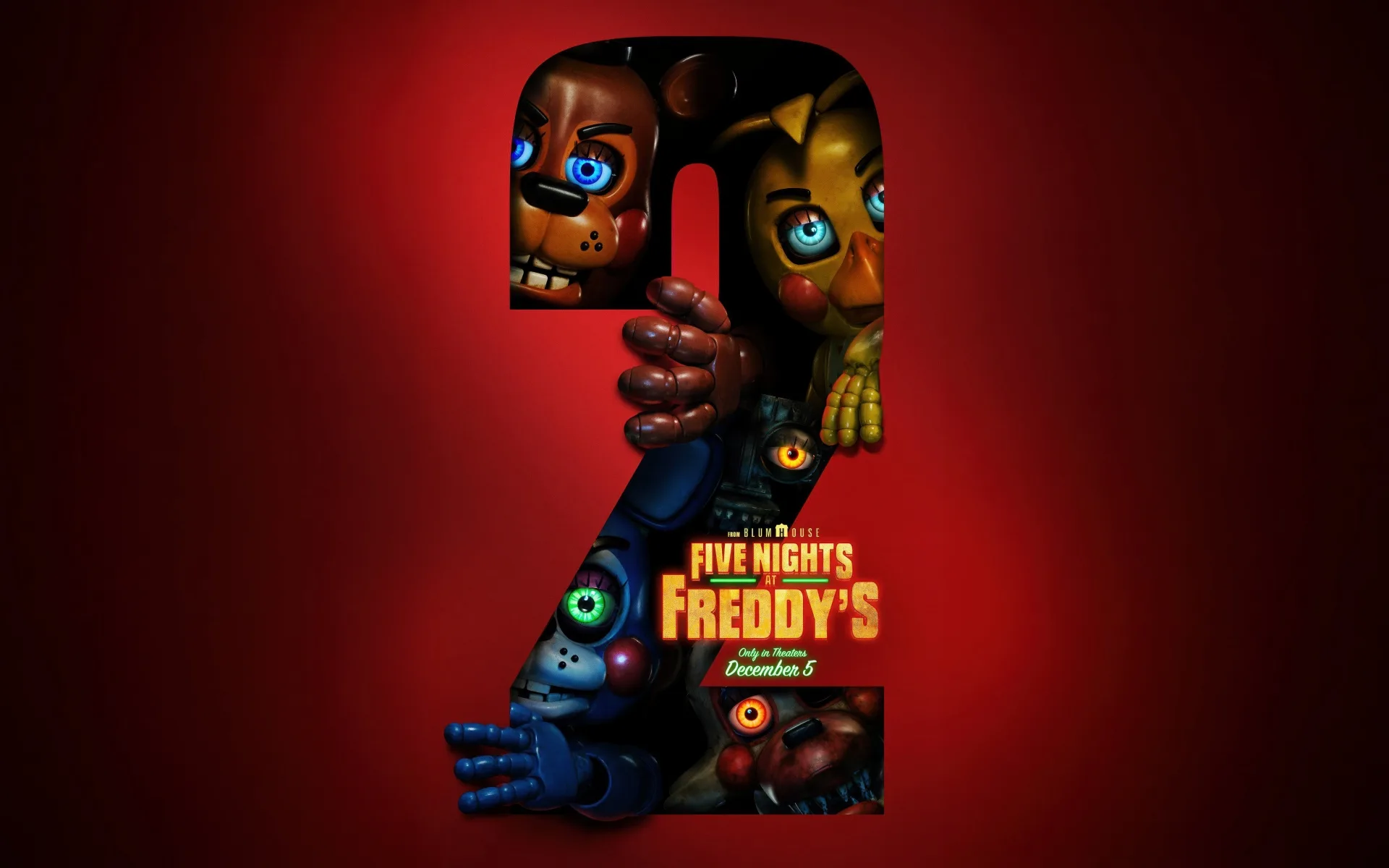

Five Nights at Freddy’s 2 arrives as a sequel to the 2023 box office juggernaut, a commercially successful adaptation of the video game series. It sits within a particular strain of mainstream horror: PG-13 spectral animism that converts childhood mascots into instruments of menace. The film insists that past trauma takes on a physical persistence, embodied by oversized mechanical mascots. The action orbits Freddy Fazbear’s Pizza, a ruined American site of cultural domesticity turned haunted ruin.
The premise widens from a contained haunting to what might be described as an animatronic diaspora. The monstrous ensemble, Freddy, Chica, Foxy, and Bonnie, leave the decayed restaurant and turn everyday places into their stage. That shift has obvious possibilities and equal risks, because it changes the shape of the film’s anxieties.
We rejoin a fractured family: Mike Schmidt, played by Josh Hutcherson, who is attempting to live with this altered reality, and his younger sister Abby, played by Piper Rubio. Vanessa, played by Elizabeth Lail, returns carrying the legacy of her father, the serial killer William Afton. The film continues to work through the consequences of the first installment’s revelations.
The Tyranny of Lore
The narrative engine runs on what the screenplay treats as exhaustive game lore. The script layers exposition in a manner that reads like a checklist for committed fans. The result is a self-referential story that often addresses its own mythology more than it addresses cinematic momentum.
A 1982 prologue supplies a formal origin point for the haunting. That sequence introduces new elements and victims, but it feels grafted on to provide causal justification for later beats. The prologue exists to supply connective tissue rather than to expand dramatic depth.
Narrative movement sometimes collapses into awkward logistical choices. Simple transitions become oddities, such as a working Wi-Fi system inside a long-shuttered children’s parlor or a late-Saturday run to a school office for keys. These moments highlight the film’s contrivances and pull attention away from suspense.
The script gestures at grief and inherited guilt through Mike’s brooding and Vanessa’s persistent despair. Those states are stated often; they are shown less frequently. Vanessa’s struggle with Afton’s legacy gets reduced to plot devices, for example when she withholds information until it best serves dramatic escalation. Emotional textures flatten under the weight of plot mechanics.
Abby’s longing to reconnect with the animatronics reads like a distorted form of attachment, a child’s wish turned eerie. That behavior borders on meta-commentary about the series’ devoted audience. Across the film, characters sometimes act in ways that serve exposition rather than character logic.
The Marionette appears as a new antagonist, introduced as a puppet-like vessel for another spirit. Its arrival registers as momentarily disturbing, but the sequence functions largely as a setup for a further chapter. The film’s present arc often feels subordinate to the promise of future installments.
The Spectacle of Inertia
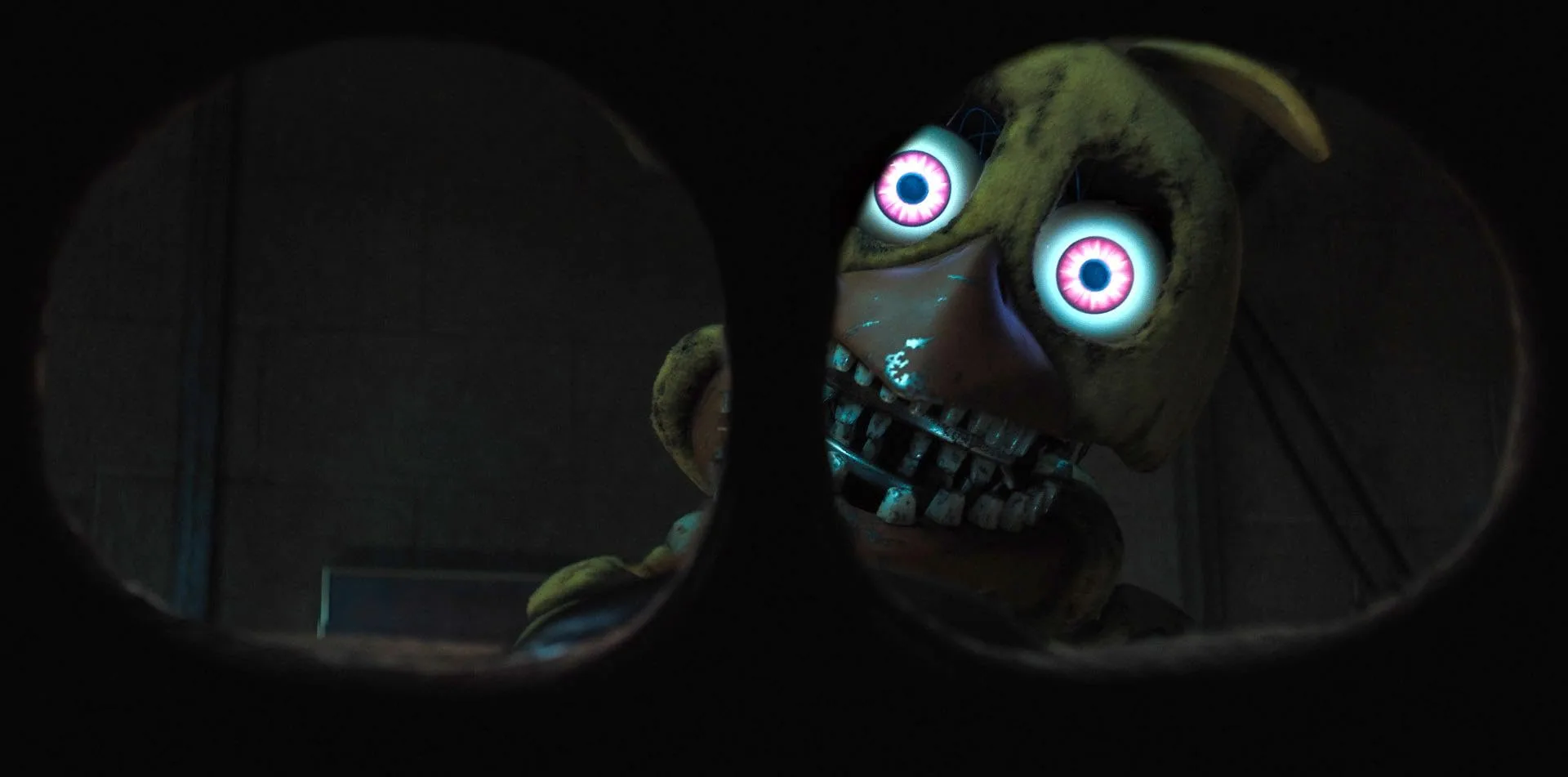
The practical creations from Jim Henson’s Creature Shop are among the film’s most effective choices. The mechanical mascots — Freddy, Chica, Foxy, Bonnie — are built with a careful, unsettling attention to detail; their lifeless gazes and worn surfaces repeatedly remind the viewer of corrupted innocence.
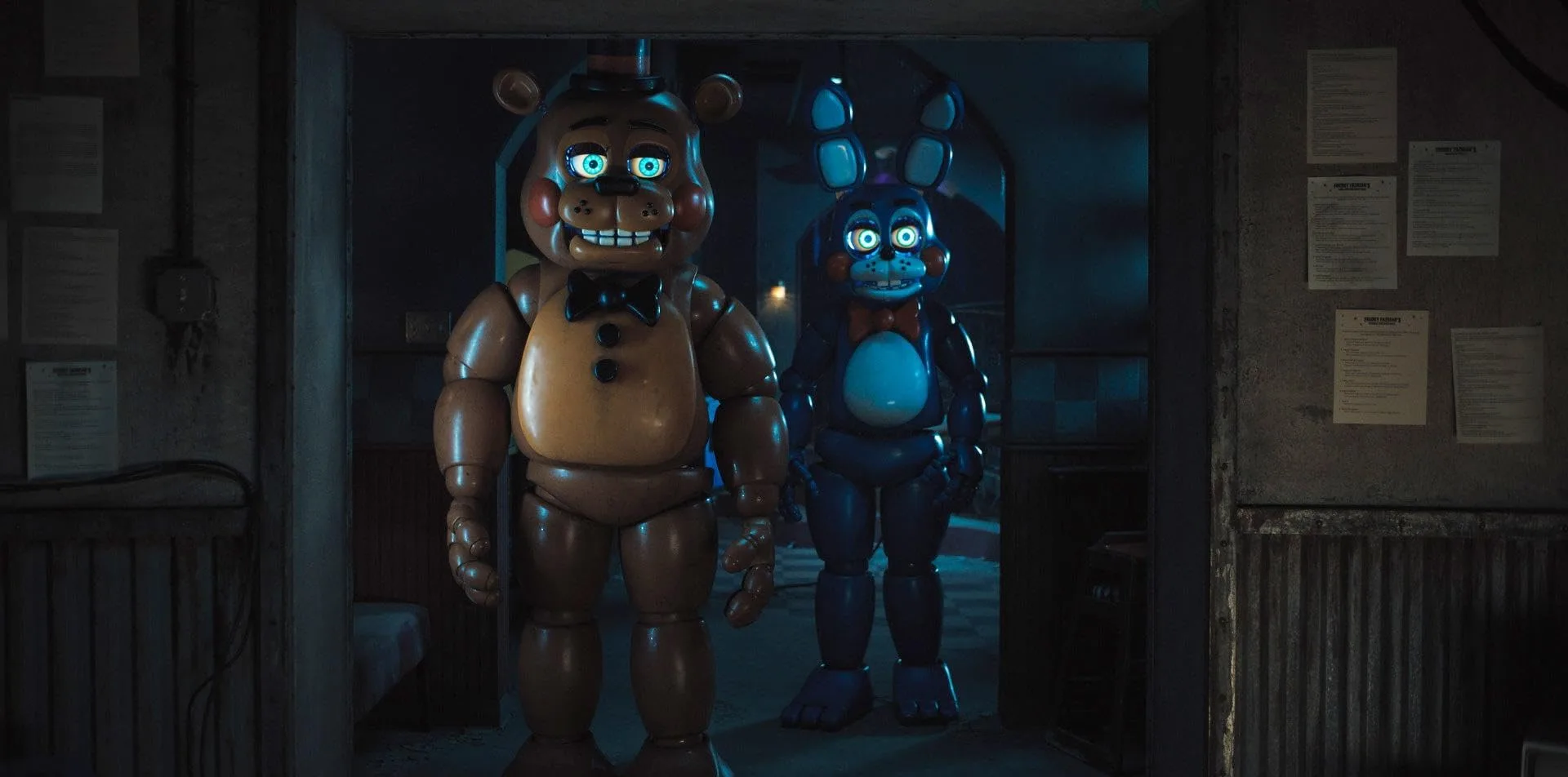
Their appearance produces unease. Their movement, however, is marked by a slow, ponderous gait. The creatures are physically imposing yet they lumber with the manner of tired stagehands. Real tension rarely emerges from their motion; it instead arises from predictable human errors, characters slipping or freezing when escape options are plainly available. That mechanism is what the review terms the Kinetic Contrivance Principle.
The film keeps a PG-13 rating and adheres to its limits. The avoidance of explicit gore or inventive mayhem creates an absence where visceral shock might have lived. The scare design depends heavily on acoustic jolts, jump scares that use sudden, loud sound to provoke a reflexive response. Those moments register as startle rather than sustained fear. The filmmakers emphasize noise over atmospheric dread.
Moving the animatronics into public settings, such as a local FazFest or an attack on a car, should create new tensions by mixing the banal with the uncanny. The film fails to take advantage of that contrast. The feeling of confinement that defined the games disappears once the creatures operate in ordinary spaces.
Outside their original habitat, the ten-foot-tall automatons resemble oversized puppets more than agents of vengeance. The sequel does not mine the scenario for its potential to combine comedy and terror. Encounters with ordinary people and everyday environments remain underused.
Aesthetics of Incompetence
Director Emma Tammi struggles to establish a consistent visual grammar or to stage action with accumulating force. Pacing often reads as cinematic lethargy; scenes proceed without building forward impetus and sometimes dissolve into dead air.
One sequence places Mike at a computer, clicking through interfaces in an attempt to shut down the mascots remotely. The scene is a literal translation of the game loop — sitting at a desk and watching monitors — and it illustrates a problem of mimicry. What functions as compelling interaction in a video game becomes a dull interlude in cinematic terms. The phrase digital mimetic failure applies when interactive tension devolves into screen-bound boredom.
The screenplay places fan-service gestures above character work. References and Easter eggs appear as priorities in place of deeper human engagement. Dialogue tends toward blunt explanation rather than revealing exchange. The language explains trauma instead of embodying it.
Structurally, the film reads like a branding exercise that meets the minimum requirement for a feature. It concludes not with resolution but with an abrupt quasi-cliffhanger that signals an intention to continue a serialized narrative. The present film’s coherence sags under that imperative.
Performances are constrained by this narrative limbo. Josh Hutcherson gives Mike a surface-level brooding. Elizabeth Lail presents Vanessa with persistent despair. Both actors maintain composure under weak material, but the script offers them limited opportunities for genuine humanity.
Piper Rubio emerges as a highlight. Her work supplies an uncanny commitment that often rings truer than the surrounding material. The appearances of veterans such as Wayne Knight, and the Scream reunion of Matthew Lillard and Skeet Ulrich, register as amusing touches that momentarily divert attention. A scene involving Knight’s teacher achieves a small completeness, closing with an act of vengeance that reads as one of the film’s few fully realized arcs.
Five Nights at Freddy’s 2 is a supernatural horror film and the sequel to the 2023 box office hit, based on the popular video game series by Scott Cawthon. The film is scheduled to be released by Universal Pictures on December 5, 2025, in wide release across the United States and other territories. Picking up one year after the events of the first film, the movie sees returning characters Mike Schmidt (Josh Hutcherson) and Abby Schmidt (Piper Rubio) confront the possessed animatronic mascots once again, this time as the creatures break free from the derelict Freddy Fazbear’s Pizza. The film is a theatrical release, but its streaming availability on platforms like Peacock (which hosted the first film) will likely follow the theatrical window.
Full Credits
Title: Five Nights at Freddy’s 2
Distributor: Universal Pictures
Release Date: December 5, 2025
Rating: PG-13 (for violent content, terror and some language)
Running Time: 105 minutes (or 1 hour 45 minutes)
Director: Emma Tammi
Writers: Scott Cawthon
Producers and Executive Producers: Jason Blum, Scott Cawthon, Emma Tammi, Beatriz Sequeira, Christopher Warner, Russell Binder, Marc Mostman
Cast: Josh Hutcherson, Elizabeth Lail, Piper Rubio, Matthew Lillard, Freddy Carter, Theodus Crane, Wayne Knight, Teo Briones, Mckenna Grace, Skeet Ulrich, Megan Fox (voice), Kellen Goff (voice)
Director of Photography (Cinematographer): Lyn Moncrief
Editors: Timothy Alverson, Derek Larsen
The Review
Five Nights at Freddy's 2
Five Nights at Freddy's 2 is primarily a fan-service vehicle, a feature-length teaser for a third installment, which undermines its own efforts at narrative coherence and genuine horror. It favors convoluted game lore over basic cinematic structure, resulting in a tedious, inert sequel. The spectacular physical artistry of the animatronics cannot salvage a script that treats its characters as plot mechanisms and its scares as unearned noise. It is an incomplete, disappointing "Lore-Gollum" that fails to capture the terror of its own concept.
PROS
- The creatures from Jim Henson’s Creature Shop are visually outstanding.
- The brief appearances, particularly Wayne Knight's arc, provide isolated highlights.
- Easter eggs and aesthetic details appeal directly to the core fandom.
CONS
- The story is bogged down by excessive, poorly explained lore.
- Scenes lack tension, resulting in a "sedate" and boring viewing experience.
- Over-reliance on loud, predictable jump scares as a substitute for dread.
- Main actors are given superficial material, and characters make illogical plot-serving decisions.
- The movie is structured as a cliffhanger, failing to deliver a satisfying third act.