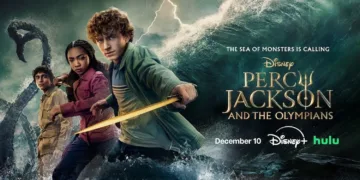












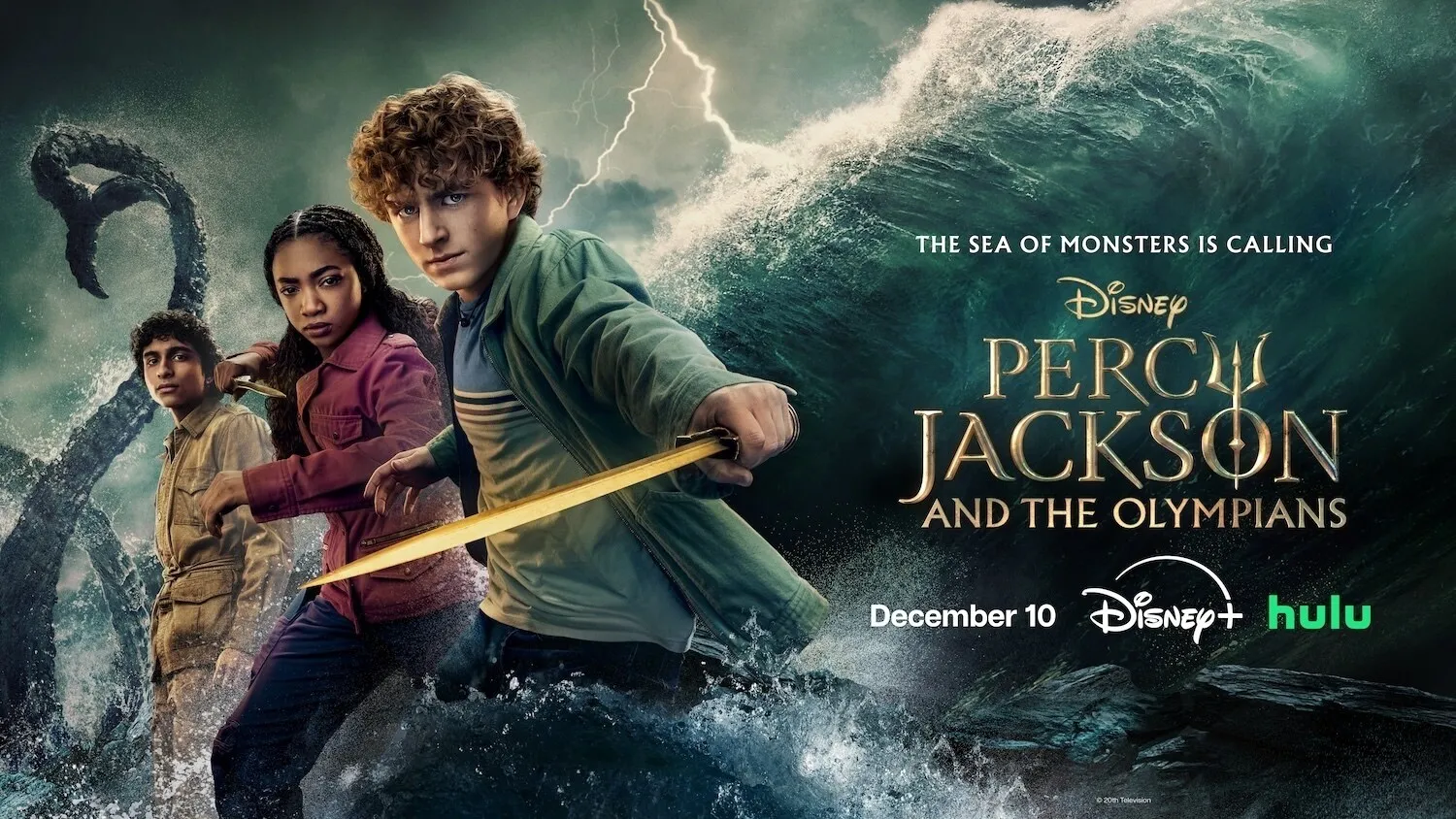

The Disney+ adaptation of Rick Riordan’s Percy Jackson and the Olympians arrives freighted with historical baggage. It carries the residue of earlier cinematic attempts, which critics almost universally dismissed for their departures from the books. This television version was presented as corrective, a faithful translation of myth for a generation that prizes strict adherence to source material. Season 1 established that foundation of fidelity. Season 2 arrives as an exciting sophomore effort that builds meaningfully on that initial, earnest premise.
This chapter, subtitled The Sea of Monsters, begins roughly a year after Percy returns the Master Bolt. The usually idyllic Camp Half-Blood is plunged quickly into crisis. Thalia’s Tree, the enchanted barrier that protects the demigods, is mysteriously poisoned. The protective field is failing and the children of the gods are exposed to external threats.
The remedy requires a dangerous voyage. Percy (Walker Scobell), Annabeth (Leah Sava’ Jeffries) and the newly discovered Cyclops, Tyson (Daniel Diemer), must sail into the Sea of Monsters to reclaim the Golden Fleece, the only artifact capable of restoring the camp’s defenses. The quest also serves as a search for their missing friend Grover (Aryan Simhadri) and as a collision course with the traitor Luke (Charlie Bushnell).
Mapping the Mythological Diaspora
On structural terms the season largely succeeds at transferring the novel’s episodic quest into a television-friendly architecture. The narrative flow carries a sense of momentum and several episodes echo original chapter titles, a small formal grace that reassures readers who care about structural fidelity. That formal consistency acts as a quiet promise to fans who wanted an adaptation that honors the text.
Pacing proves uneven. The premiere, charged with spanning a missing year and resetting the geopolitical stakes of the mythic world, feels rigid. It depends heavily on exposition, a flaw that first appeared in Season 1 and recurs here. Once the central quest is underway subsequent episodes gather speed and exchange extended explanation for kinetic, plot-driven beats.
The imaginative register expands in interesting directions. We meet new mythic figures, notably the three Gray Sisters who operate a taxi service through New York City, and the sea terrors Charybdis and Scylla. The show’s attraction rests in a kind of syncretic modernity, the unforced way ancient Greek elements are grafted onto contemporary American settings. Cruise ships host supernatural clientele. Mythic crises puncture the rhythms of pop culture. This integration reads more natural this season and anchors the fantasy in a familiar absurdity.
Tone and comedic touch vary in effectiveness. Small moments of levity hit with elegant timing, as when Mariah Carey’s music functions as a literal repellent to certain threats. Other attempts at joke-writing adopt a rapid-fire banter that interrupts the darker strands of the plot. A further concern is the series’ tendency toward mythic sanitizing. Several of the book’s mature themes receive gentler handling. The demigods’ resentment and parental neglect acquire softer edges. Percy’s early, ugly feelings toward Tyson receive softer framing than in the books, which undercuts some of the story’s emotional force.
The Inevitability of the Other
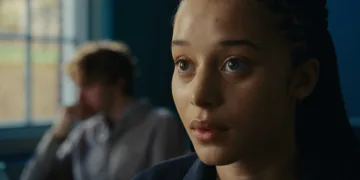
Annabeth receives expanded attention this season and functions explicitly as a co-lead. Leah Sava’ Jeffries gives Annabeth a layered performance and an inward arc that grants genuine personal stakes. The character now exists with an independently motivated trajectory.
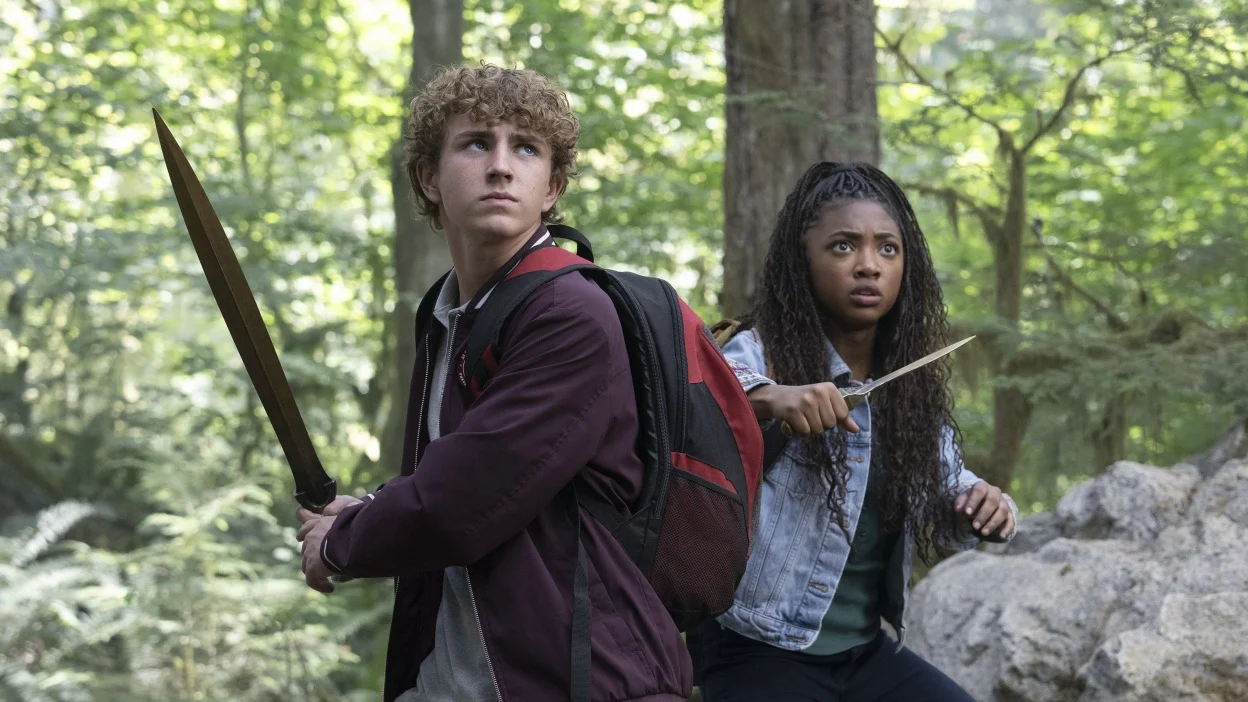
Percy (Walker Scobell) displays increased confidence. He projects a charisma appropriate for the son of Poseidon while remaining adolescent and volatile. His development is uneven; he still contends with petty rivalries and the emotional turbulence that follows demigod status.
Tyson emerges as a moral axis for the season. Daniel Diemer portrays the Cyclops with warmth and dignity, allowing Tyson to stand as a person rather than a mere source of comic effect. Tyson forces Percy to confront bias and self-doubt, accelerating Percy’s movement toward authentic maturity.
Among supporting figures Clarisse La Rue (Dior Goodjohn) acquires new texture. Her rivalry with Percy coexists with a fierce protectiveness of Camp Half-Blood. The temporary activity director Tantalus (Timothy Simons) functions as an experiment in bureaucratic irritation; he embodies incompetent divine authority with comic stubbornness and proves more grating than terrifying. His appearances sometimes hinder pacing by introducing scenes that primarily nudged Percy toward action. The guest performers provide steady ballast, with Lin-Manuel Miranda returning as Hermes and Courtney B. Vance stepping in as the new voice of Zeus.
The Spectacle of Ruin
Production values show a clear uptick. Set pieces and action sequences carry weight and offer satisfying physical stakes. Two set pieces register as true spectacles. The chariot race delivers kinetic chaos that suggests cinematic scale and the later sea battle pits the protagonists against enormous monsters on a scale that feels cinematic.
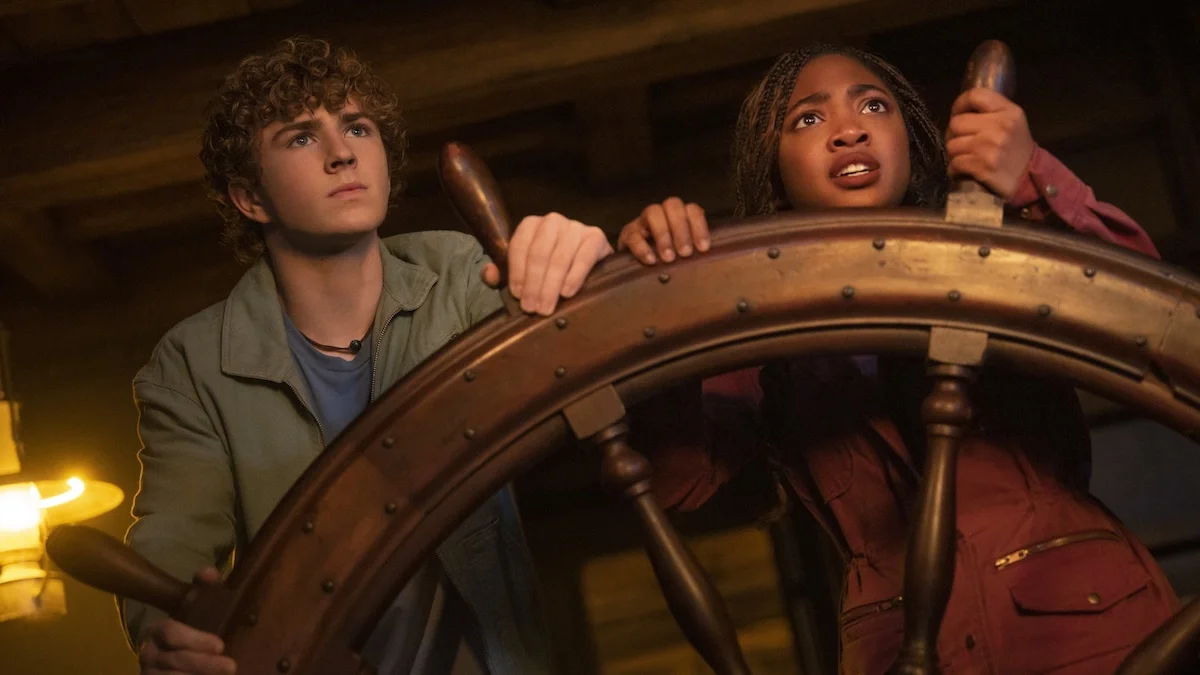
These sequences crackle with adrenaline, offering improved stunt work and visual intensity. The visual effects maintain a polished surface across the season and the team makes explicit use of StageCraft technology. Effects tied to Tyson integrate seamlessly and the Cyclops avoids slipping into an uncanny valley, which keeps attention on character rather than rendering.
Oscar-winning production designer Dan Hennah supplies the show with a sense of scale and detail. His design work links diverse realms and the armor and chariot iconography consistently signals divine parentage. A small visual complaint: some metal props can look overly synthetic at close range, which diminishes their intended mythic heft. That quibble remains minor against a generally convincing material world.
Recurrent Oedipal Traps
For all its gains the series remains hampered by a persistent habit of over-explaining. The writing often renders mythic exposition into explicit lines of dialogue where implication or staged action would serve better. That tendency flattens certain exchanges and reduces the impact of the young cast. If the writers continue to reduce complexity for ease of viewing, the series risks diminishing its emotional stakes further.

The adaptation compresses and simplifies some plot complexities in ways that reduce dramatic friction. A saga concerned with a dysfunctional Olympus requires moral and emotional roughness; when the show smooths those contours it weakens the tension that should sustain this material.
The confirmed third season, The Titan’s Curse, indicates Disney intends to adapt the entire saga, a practical commitment that is heartening. Future installments should resist the impulse to explain every divine mechanism. The series’ enduring asset is interpersonal: the gradual formation of a found family among characters abandoned by gods. Allow those relationships room to age with the cast and pare back overt narrative hand-holding, and the show can claim a meaningful place in contemporary myth-making.
Percy Jackson and the Olympians Season 2 is a highly anticipated adaptation of Rick Riordan’s second novel in the series, The Sea of Monsters. The season will premiere its first two episodes on the streaming service Disney+ on December 10, 2025, with subsequent episodes released weekly through January 2026. The story follows the young demigod Percy Jackson as he embarks on a perilous quest with his friends, Annabeth Chase and Grover Underwood, into the titular Sea of Monsters (the Bermuda Triangle) to recover the legendary Golden Fleece. This artifact is the only thing that can save Camp Half-Blood’s protective border from being permanently compromised by the forces of the Titan Kronos.
Full Credits
- Title: Percy Jackson and the Olympians Season 2
- Distributor: Disney+ (and Hulu in the US)
- Release date: December 10, 2025 (two-episode premiere)
- Rating: TV-PG
- Running time: Approximately 30–50 minutes per episode (8 episodes total)
- Director: Jet Wilkinson, Anders Engström, Catriona McKenzie (Based on Season 1)
- Writers: Rick Riordan, Jonathan E. Steinberg, Joe Tracz, Andrew Miller
- Producers and Executive Producers: Rick Riordan, Rebecca Riordan, Jonathan E. Steinberg, Dan Shotz, James Bobin, Bert Salke
- Cast: Walker Scobell, Leah Sava Jeffries, Aryan Simhadri, Dior Goodjohn, Charlie Bushnell, Daniel Diemer, Andra Day, Courtney B. Vance, Timothy Simons, Sandra Bernhard, Kristen Schaal, Margaret Cho
- Director of Photography (Cinematographer): Pierre Gill, Armando Salas (Based on Season 1)
- Editors: T. Scott Salter, Scott Dowd, Jamie Gross (Based on Season 1)
- Composer: Bear McCreary
The Review
Percy Jackson and the Olympians Season 2
The second season deepens the thematic resonance of the demigod experience, successfully expanding its mythological world and elevating its action spectacle. While the enhanced character arcs—particularly those involving Annabeth’s strategic anxiety and the complex introduction of Tyson—provide a compelling emotional core, the production consistently struggles with narrative delivery, relying too heavily on stiff, expository dialogue to advance plot. This sophomore effort is a strong, necessary, and critically important step toward fulfilling the franchise’s profound potential, provided it embraces visual storytelling over verbal explanations in future installments.
PROS
- The action sequences, including the chariot race and the ship battles in the Sea of Monsters, are grandly elevated and visually assured.
- Tyson's introduction and the intensified focus on Annabeth’s history with Luke and Thalia successfully provide complex emotional context.
- The nuanced portrayal of Percy and Tyson’s strained yet earnest brotherhood is handled with sincerity and weight.
- Production design and effective VFX create a richer, more tangible connection between the modern world and the ancient myths.
- The character of Clarisse is given compelling anti-hero depth, moving her beyond simple rivalry into a figure of tragic ambition.
CONS
- The show maintains an unfortunate overreliance on wooden dialogue and constant explanation, diminishing the impact of visual moments.
- The occasional use of forced, contemporary quips clashes sharply with the darker, more mature thematic elements of destiny and godly neglect.
- Key plot points sometimes feel rushed, attempting to juggle setup, action, and emotional beats at an erratic, breakneck clip.
- Certain antagonist figures and difficult book moments are simplified, potentially sanitizing the source material's mature edge.