


















![Kingdom Hearts Collection [I-III] Review](https://gazettely.com/wp-content/uploads/2026/10/Kingdom-Hearts-Collection-I-III-1-360x180.webp "Kingdom Hearts Collection [I-III] Review: KHII Holds Steady as Newer Entries Fluctuate 40")


Yandy Laurens’ Sore: Wife from the Future frames a philosophical trap inside the formal skin of a romantic drama. The film presents a thought experiment about determinism and free will within a transnational Indonesian production. Jonathan (Dion Wiyoko), an Indonesian photographer living abroad, drifts through the austere landscapes of Croatia.
He appears stalled, his ambitions blunted by self-destructive habits. Sore (Sheila Dara) arrives claiming to be his wife from a future timeline. Her presence functions as a precise intervention: she has come to prevent Jonathan’s premature death, and she bears the consequences when she fails.
Laurens wrote and directed the film and expanded material from his web series to a full cinematic scale, achieving notable domestic success. The film sets a strict rule: Sore must save Jonathan. Failure produces a brutal temporal reset that returns events to their origin. The device converts love into an operational problem, testing whether foresight can alter the trajectory of a life.
The Time-Loop as Existential Treadmill
Sore: Wife from the Future holds its structure in a repeating time-loop that converts a genre trick into a tool for character analysis. The film asks viewers to accept Jonathan’s initial resistance. He thinks Sore is a prank from his manager until she proves intimate knowledge of his habits and family secrets. That proof establishes her credibility and swiftly moves the plot to its painful center: each failure causes Sore to nosebleed, collapse, and reset the timeline.
The screenplay mines repetition to examine how hard genuine change is. Each cycle reads like another failed experiment. To move the romance forward the film often uses montages, brisk collages of shared moments—running, eating, flirting—that serve as cinematic shortcuts.
Those montages speed narrative progress but sometimes skim the psychological interior necessary to convince the audience that two people have formed a bond capable of resisting temporal mechanics. The viewer must accept the romantic premise on the basis of the loop’s logic as much as on interpersonal development.
A striking aspect of the film’s premise is the scale of what is at stake. Time travel here is not mobilized to stop global catastrophe. It is enlisted to correct personal failures: halting Jonathan’s drinking and smoking and helping him concentrate on his career. This domestic concentration gives the device philosophical weight. The film treats the major conflict as the quiet, intimate labor of correcting habit and choice. The arc is cyclical yet clear: from disbelief to Sore’s mission and then to the frantic race to outrun the clock.
The Thespian Paradox and The Power of Will
The film’s central tension rests in the relation between its lead performances. Sheila Dara plays Sore with a quiet, calibrated force. Her performance balances the ethereal quality of someone out of time with the resolute practicality of a wife determined to change a life. Sore functions as the film’s emotional anchor, a steady intention amid Jonathan’s disorder.
Dion Wiyoko’s Jonathan reads as arrested development, physically expressive, often clumsy and stubborn. His gestures and wide-eyed confusion signal immaturity. The differing acting choices—Dara’s stillness alongside Wiyoko’s kinetic energy—create a strain within the romance. The film asks the viewer to accept that a capable, determined woman is joined to an immature man, and the script does not always supply the connective tissue that explains why they belong together beyond the imperative of the future.
The supporting cast contributes texture. Croatian actors, including Goran Bogdan as Jonathan’s agent Karlo, give the foreign setting a grounded authenticity and occasional lightness. Livio Badurina’s Marko carries philosophical weight in the mid-loop moments.
His comments indicate a central theme: change must spring from the person who needs to change. External will, even when exerted by a wife from the future, cannot do the fundamental work for someone who has not chosen to heal. That argument shifts the film away from romantic rescue and toward a meditation on self-agency.
Visual Rhapsody and Tonal Intersections
Visually the film is accomplished, exploiting the textures of its Croatian locations and a brief far northern setting. Shooting in Croatia marks the film as uncommon within Indonesian cinema. Cinematographer Dimas Bagus Triatma Yoga uses the locales to create a polished look that elevates the material from its web series origins to greater technical finesse. A recurring red droplet functions as a haunting visual motif and sets an early mood of inward reckoning.
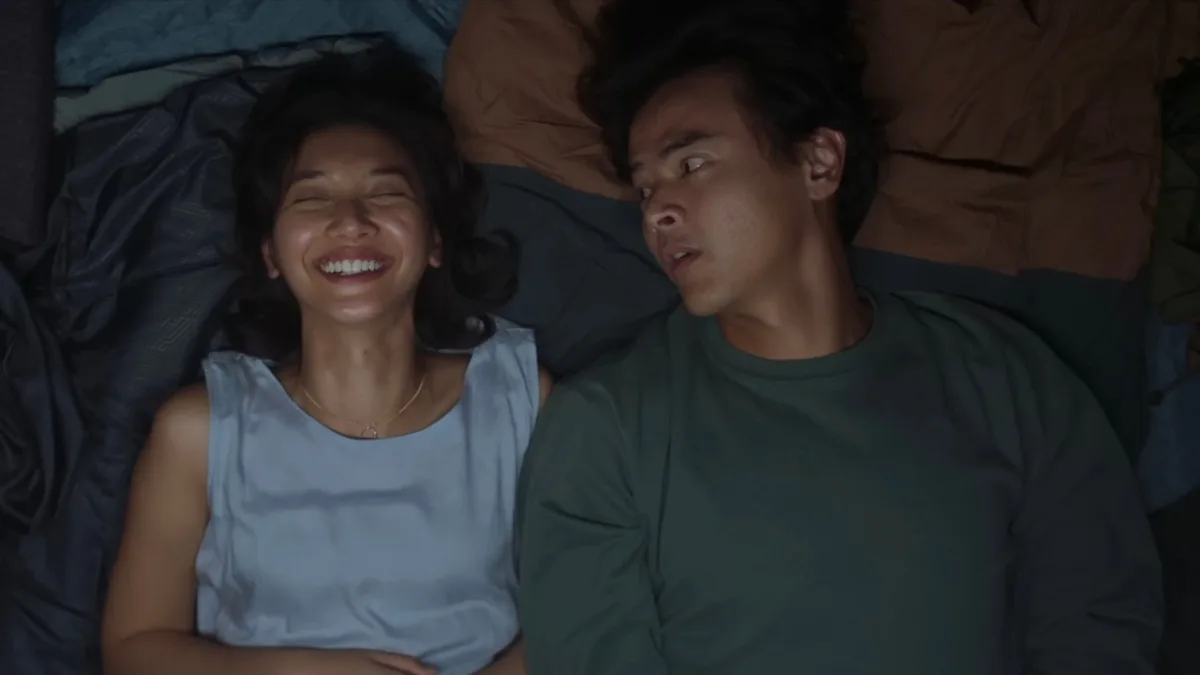
The film struggles with tone. It moves between light, rom-com breeziness—often played for slapstick, typically in scenes with Jonathan and his manager—and heavier sequences that confront mortality and the toll of Sore’s looping suffering. Those tonal shifts sometimes feel abrupt. Comedy and existential dread sit side by side and the transitions are not always seamless, producing moments when the intended rhythm stumbles.
Sound design takes an assertive role. The film uses numerous songs in sequence, including Barasuara’s “Terbuang Dalam Waktu,” to punctuate emotional beats. Music often integrates with scenes and amplifies the romantic charge; at other points it becomes a dominant element that draws attention away from the narrative.
Laurens shows a command of the hybrid genre demands even when the balance between style and story wavers. The science-fiction mechanism is handled with restraint; special effects are minimal and the time-loop feels anchored in character rather than spectacle. The film registers as an important example of a modern genre experiment within its national cinema and suggests room for further refinement in how such experiments are staged.
Sore: Wife from the Future is an Indonesian romantic science fantasy film that first captivated audiences upon its Indonesian theatrical release on July 10, 2025. Adapted from director Yandy Laurens’ own 2017 web series, the film quickly became a major box office success, earning significant acclaim and multiple nominations at the 2025 Indonesian Film Festival. It tells the story of Jonathan Riady, an Indonesian expat living in Croatia, whose self-destructive life is interrupted by the arrival of a mysterious woman named Sore, who claims to be his wife from the future sent to save him. As of today, December 16, 2025, the film has enjoyed an extended theatrical run and is the country’s official submission to the 98th Academy Awards for Best International Feature Film.
Full Credits
Title: Sore: Wife from the Future (Sore: Istri dari Masa Depan)
Distributor: Primeworks Studios (Malaysia release), Theatrical release by Cerita Films, Slingshot Pictures, Imajinari Pictures, Miles Films, Studio Artemis, Jagartha, Trinity Entertainment, Dwidaya Amadeo Gemintang (Production Companies)
Release date: July 10, 2025 (Indonesia)
Rating: 13
Running time: 119 minutes
Director: Yandy Laurens
Writers: Yandy Laurens
Producers and Executive Producers: Suryana Paramita, Agustinus Lee Martin, Asim Kemas, Fx Iwan, Yonathan Nugroho, Hotma Abigail Sirait
Cast: Sheila Dara Aisha, Dion Wiyoko, Goran Bogdan, Lara Nekić, Livio Badurina, Mathias Muchus, Maya Hasan, Borko Perić, Vanda Winter, Sandra Lončarić
Director of Photography (Cinematographer): Dimas Bagus Triatma
Editors: Hendra Adhi Susanto
Composer: Ofel Obaja Setiawan
The Review
Sore: Wife from the Future
Sore: Wife from the Future is a compelling yet flawed romantic time-loop narrative that elevates personal growth to a philosophical battleground. The film excels in its intimate focus on self-change, anchored by Sheila Dara's quiet, captivating performance. While the narrative sometimes struggles with its tone and uses cinematic shortcuts where depth is required, its aesthetic quality and insightful exploration of agency versus destiny make it a significant contribution to genre cinema. The film’s strength lies in its intellectual ambition and the simple, enduring truth that external forces cannot mandate internal change.
PROS
- Treats the time-loop not as spectacle, but as a mechanism for exploring themes of personal agency, self-destruction, and the difficulty of fundamental character change.
- Her portrayal of Sore is both ethereal and emotionally grounded, acting as the film's consistent emotional and thematic center.
- High production values, particularly the polished cinematography and effective use of the Croatian and northern European landscapes.
- A successful and rare attempt in Indonesian cinema to blend high-concept sci-fi with intimate drama and romance.
- The bold choice to domesticate the apocalyptic scale of time travel, focusing instead on saving one man's life from his own habits.
CONS
- Abrupt and jarring shifts in mood, moving sharply between slapstick comedy, light romance, and existential doom.
- Reliance on montages to establish the central romantic bond, which sometimes undercuts the believability of their transcendent connection.
- The pronounced disparity in performance styles between Dara (restrained) and Wiyoko (overtly kinetic) strains the audience's investment in their chemistry.
- Overuse of back-to-back songs, which occasionally dominates scenes rather than subtly complementing the action.