

























![Kingdom Hearts Collection [I-III] Review](https://gazettely.com/wp-content/uploads/2026/10/Kingdom-Hearts-Collection-I-III-1-360x180.webp "Kingdom Hearts Collection [I-III] Review: KHII Holds Steady as Newer Entries Fluctuate 37")



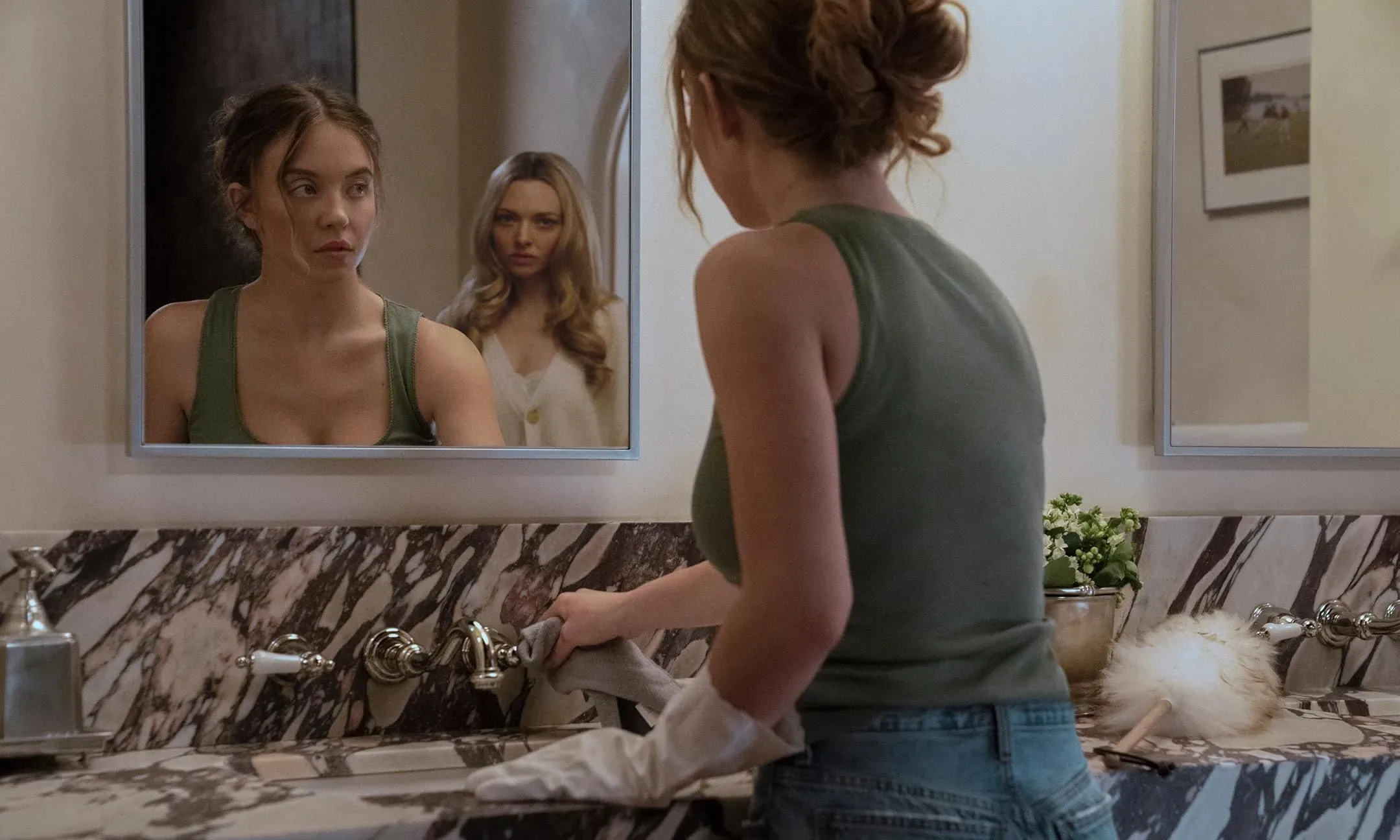

The architecture of domestic suspense rarely feels as frankly transactional as it does in The Housemaid. Directed by Paul Feig, this adaptation of Freida McFadden’s bestseller, written for the screen by Rebecca Sonnenshine, arrives as a gaudily styled psychological thriller with cash-register logic: security gets purchased, dignity gets rented, and fear comes bundled with the benefits package. It reaches back to the high-gloss, high-stakes 1990s template, that era of the affluent victim and the insidious interloper, where polished surfaces exist to be scratched. Here, wealth registers as a psychological weapon long before it reads as comfort.
The tension starts with an imbalance so steep it feels designed by a parole system. Millie (Sydney Sweeney), newly released and essentially without housing, needs a live-in housemaid job with the intensity of a person clinging to air. The position functions as survival. A professional misstep carries the weight of a return to incarceration.
Millie arrives before the Winchesters with a carefully built persona: the glasses, the shy eagerness, the calibrated presentation of harmlessness (a performance with stakes). The setting is a suburban palace of conspicuous affluence, ruled by Nina Winchester (Amanda Seyfried), whose polished exterior can’t hold back something volatile, and her husband Andrew (Brandon Sklenar), whose near-suspicious handsomeness reads like casting as warning label. Feig pitches the tone into immediate hyperbole: dark entertainment staged as spectacle, using suspense conventions to lob pointed, near-satirical commentary about privilege and class.
The Economy of Deception: Shifting the Gaze
The story begins by leaning into the expected: the dangerous outsider slipping into the stable, respectable home. The familiar “interloper-from-hell” route takes shape, then gets tossed aside as a deliberate feint, leaving the audience blinking and recalibrating. The instability sits with the employer, firmly.
Within days, Nina reveals herself as a genuinely unhinged antagonist. Her treatment of Millie becomes an ongoing barrage of erratic commands, public humiliations, and psychological torment. The gaslighting runs with methodical persistence: rules appear, then vanish; orders get issued, then denied; blame lands on Millie for messes Nina engineers herself, including the plate-smashing eruption over “lost” PTA notes.
The pressure doesn’t ease. It escalates. The cruelty operates through the simple math of disparity and vulnerability. Millie’s parole binds her to endure; her parole officer functions like an invisible hand on her shoulder, steering her back into the house. The job turns into a “life raft” that keeps taking on water, keeping her afloat while exhausting her. Millie’s suffering moves past familiar cinematic victimhood and starts to resemble a kind of state-approved psychological punishment, with the mansion serving as the sanctioned site.
Then the film hits its midsection and starts showing its seams. Nina’s abusive cycle repeats with near-mechanical regularity: command, compliance, denial, punishment. The repetition sharpens the sense of Millie’s trap, and each incident carries its own charged texture, revealing how far Nina’s derangement can stretch. The pattern also slows the thriller’s momentum, trapping the narrative in a loop that begins to feel like stasis. Feig seems caught between the material’s campy absurdity and straight suspense mechanics, and the tonal balance wobbles. The mood lingers between a knowing wink and genuine chill, leaving the viewer stranded between laughter and unease, unable to settle fully into either.
A mid-film reversal arrives through dramatic “rewind POV shifts,” a structural gamble that jolts the movie back to life. The pivot reframes everything that came before, including details that previously read as oddly motivated or simply confusing, such as the mysterious presence of the groundskeeper, Enzo. The device refreshes the genre by yanking away the familiar footing and replacing it with new meaning.
The timing, though, feels off. The revelation comes late in the runtime, and the narrative sprints toward resolution. The final act carries the sensation of a forced correction rather than an elegant turn: characters get little space to adjust to the new power arrangement before the climax crashes in. The compression thins out the psychological payoff the structural shift promises.
The Duet of Hysteria and Calculation
The film’s momentum and its final effectiveness hinge on the operatic intensity of the central performances, with Amanda Seyfried doing the heaviest lifting. Seyfried’s Nina Winchester lives at the edge of breathtaking hysteria. She plays haughty, erratic, and hypnotic, a wealthy housewife whose psychological issues seep through every refined gesture.

Nina’s rapid pivots from icy composure to scalding rage land with the shock of a slammed door in a quiet hallway. Seyfried embraces the chaos, turning Nina into the film’s most flamboyantly showy force. She embodies a brittle, affluent sociopath who treats emotional stability like a luxury item she can drop, handing the psychic bill to the people beneath her.
Sydney Sweeney takes the opposite route with Millie: quiet calculation built from necessity. Millie enters wearing a “sweetness and light” mask, then gradually reveals a sharper intelligence and stubborn grit. Sweeney plays convincingly in a homelier, working-class register, making Millie’s desperation feel raw.
In the first two acts, Millie is defined by endurance, absorbing Nina’s abuse as a grim transaction required for survival. The latter third shifts that posture. When the power dynamics change, Sweeney’s intensity rises, and Millie grows proactive, edging toward ruthlessness, suggesting a deep capacity for self-preservation that had been waiting behind the politeness.
Andrew Winchester forms the third point of the triangle. Brandon Sklenar introduces him as a sympathetic counterweight to Nina, a “soul of virtue” with pin-up looks and timely interventions that offer Millie brief relief. The film steers this apparent decency into attraction and flirtation, pointing the audience toward an obvious, neatly manufactured expectation of a dangerous affair and a Fatal Attraction-style trajectory. Andrew’s function is ambiguity. His kindness reads as cover, and the later narrative shifts expose the true calculus behind his support.
The supporting players fill out the social ecosystem around the mansion. Elizabeth Perkins brings icy domination to the mother-in-law, playing a perfect WASP archetype with brittle imperiousness. The PTA mothers operate as a gossiping, judging Greek chorus. Their backbiting chatter forms a constant hum that reinforces Nina’s reputation for instability.
Symbolic Scrims and Societal Fault Lines
The Housemaid uses genre machinery to stage ideological anxieties in miniature. The setup plays like a concentrated class war mapped onto the contemporary “New Gilded Age,” with the mansion serving as the battleground. Its grand spiral staircase and electronic gates turn the property into a citadel of privilege. The Winchesters use economic power to dehumanize and exploit Millie, and the house’s visual splendor magnifies the scale of her struggle while underlining how disposable her labor becomes inside that polished world.

The film keeps returning to the illusion of domestic perfection. The Winchester home first appears as a pristine, Martha Stewart-ready façade. That image gets stripped away piece by piece, revealing psychological warfare and squalid chaos beneath the shine. The outward image and inward reality form a central motif. Millie’s day-to-day experience becomes an extended case study in gaslighting so pervasive it nudges her toward doubting her own sanity. Disorientation functions here as control. Confusion becomes a leash.
Late in the film, the narrative pivots toward gendered exploitation. The shift introduces #MeToo elements, reframing the action around sexual violence, control, and female solidarity. The story reaches for weighty observations about gender and privilege. The attempt clashes with the film’s established taste for high-trash entertainment, producing an awkward fit. The commentary lands in broad strokes, leaning on worn provocations aimed at feminist catharsis while often feeling shallow. The film raises deeper questions than it answers, and stylistic precision can’t fully hide that gap (it can only decorate it).
The Hyperbolic Edge of Paul Feig
Feig’s direction marks a sharp turn from his familiar territory in broad comedy. Here he commits to stylization, building an extreme atmosphere that stays entertainingly gaudy. The approach functions as throwback, playing directly with the aesthetic codes of 1990s erotic noir and domestic suspense. He directs the material as straight thriller shaped by a hyperbolic edge, keeping the darkness at a controlled temperature, refusing full earnestness.
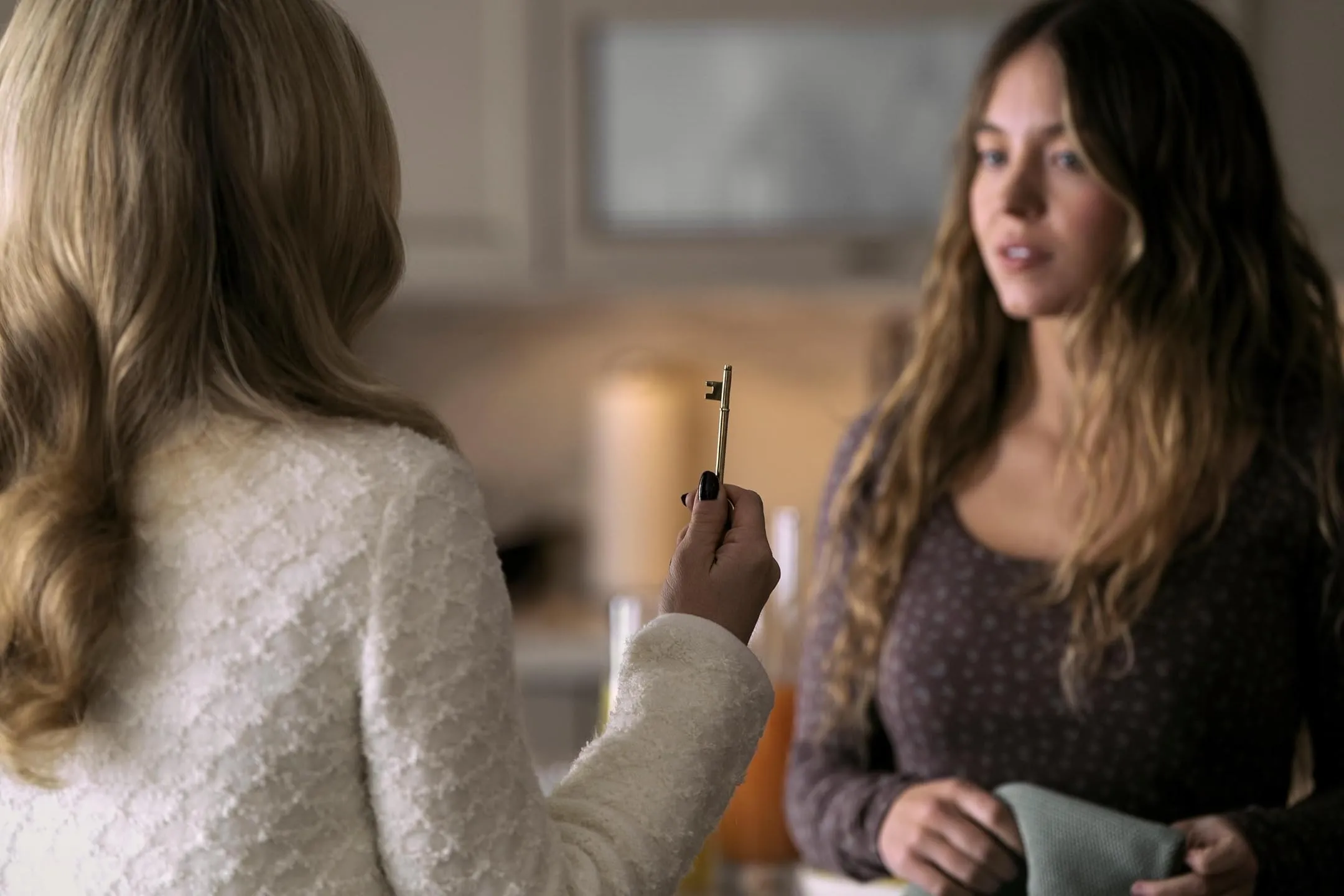
The visuals carry much of the tension. The mansion operates like a character, defined by the “chic dark-wood spiral stairway” and the sealed-off opulence behind the large electronic “W” gate. Motifs sharpen the psychological drama: the attic bedroom, claustrophobic and marked by ominous scratch marks on the door, stands as a blunt symbol of Millie’s confinement. Feig stages visual jolts for unease and dark humor, including Nina suddenly looming behind Millie like a vampire (a jump scare with a smirk). The winding staircase becomes a recurring sign of physical danger, a constant visual warning that violence hangs nearby.
Sonnenshine’s adaptation carries a winking sensibility, planting small details and allusions early that clearly aim for later payoff. The foreshadowing creates a steady anticipatory pleasure. The translation of the pulp novel’s density largely works, while the film also stumbles on pacing and length. The familiar complaint fits: the movie runs about 15 to 20 minutes too long. The stretched middle, fixated on the repeated abuse cycle, accounts for much of the bloat. The result plays as polished, stylish cinematic trash, and a tighter cut would have sharpened its bite.
The Housemaid is a thriller that plunges audiences into a twisted world of secrets and power dynamics behind the closed doors of a wealthy New York mansion. Based on Freida McFadden’s bestselling novel, the film focuses on Millie, a young woman with a troubled past who takes a live-in housemaid job for the seemingly perfect Winchester family. What begins as an opportunity for a fresh start quickly devolves into a seductive and dangerous game involving her unstable employer, Nina, and Nina’s handsome husband, Andrew. The film, directed by Paul Feig, is scheduled to be released in US theaters by Lionsgate on December 19, 2025. It is rated R for strong/bloody violent content, sexual assault, sexual content, nudity, and language.
Full Credits
Title: The Housemaid
Distributor: Lionsgate
Release date: December 19, 2025
Rating: R
Running time: 131 minutes
Director: Paul Feig
Writers: Rebecca Sonnenshine, Freida McFadden (Based on the book by)
Producers and Executive Producers: Todd Lieberman, Paul Feig, Laura Fischer, Carly Kleinbart Elter, Sydney Sweeney (Executive Producer), Amanda Seyfried (Executive Producer), Freida McFadden (Executive Producer), Alex Young (Executive Producer)
Cast: Sydney Sweeney, Amanda Seyfried, Brandon Sklenar, Michele Morrone, Elizabeth Perkins, Indiana Elle
Director of Photography (Cinematographer): John Schwartzman
Composer: Theodore Shapiro
The Review
The Housemaid
The Housemaid is a high-concept, highly stylized domestic thriller that operates effectively as modern cinematic pulp. It succeeds due to the manic energy of Amanda Seyfried and the compelling trajectory of Sydney Sweeney's character. While the narrative is occasionally hobbled by a bloated middle section and a rushed ideological pivot in the final act, it is consistently entertaining. The film is a glossy, exaggerated dissection of class and exploitation, delivering dark thrills even when its thematic ambitions exceed its structural capacity.
PROS
- Exceptional, high-energy performance from Amanda Seyfried. Sydney Sweeney offers a compelling portrayal of grit and cunning.
- Effective initial plot twist (the reversal of power dynamics). Stylized and hyperbolic tone sustains dark entertainment.
- Paul Feig's direction creates an entertainingly gaudy, high-gloss atmosphere. Visually rich setting and symbolic architectural motifs.
- Sharp satirical commentary on class warfare and the illusion of wealth. Addresses themes of gaslighting and exploitation.
CONS
- Sweeney’s character is overly passive in the lengthy middle section.
- Repetitive middle act slows momentum. Final act feels rushed, undermining the significant narrative pivot.
- Tonal balance is inconsistent, hovering awkwardly between camp and genuine suspense.
- Thematic exploration of gender and sexual violence feels shallow and underdeveloped in the final rush.







