

























The appeal of a high-altitude thriller comes from a blunt, almost prehistoric setup: put fragile people in a tight space and lift that space thousands of feet above anything that can help them. Turbulence, from director Claudio Fäh and screenwriter Andy Mayson, commits to that equation with a clean hook. A small group is packed into the rattan basket of a hot air balloon meant to float peacefully over Italy’s Dolomites. The trip turns into a pressure cooker for conflict the moment the passenger list changes.
The film introduces Zach (Jeremy Irvine), a businessman newly enriched through hard-line corporate calls, and his wife, Emmy (Hera Hilmar). The balloon ride is framed as a belated honeymoon and a last-ditch effort to repair a marriage worn down by trauma and distance. Then Julia (Olga Kurylenko) shows up as an uninvited third passenger and shifts the tone from scenic getaway to blackmail.
Overseeing this uneasy group is Harry (Kelsey Grammer), the seasoned pilot with an easy friendliness that feels a little too casual for what the story is loading into his basket. Fäh and Mayson set up two kinds of danger early: the psychological warfare unfolding at arm’s length and the physical threat that grows harsher with every rise in altitude. The film wants its vertical setting to expose human cracks as much as it wants to make viewers afraid of gravity.
The Duel Between Drama and Danger
Mayson’s script opens on quiet friction: domestic strain mixed with the aftertaste of corporate ruthlessness. The burners can wait. Before the balloon leaves the launch site, the narrative spends time arranging a personal tragedy and assigning each character a wound. Zach carries the ethical fallout of his success, with past decisions that have damaged other lives. Emmy carries grief from a recent loss and the emotional distance it has carved into their relationship. It’s the kind of groundwork meant to turn a genre setup into a character test.
Julia is the hinge that turns that groundwork into active conflict. Her intrusion brings a compact mystery the film leans on hard. She demands a fortune from Zach and claims the two had an encounter. The story keeps Zach’s faithfulness in suspension, inviting Emmy and the audience to read every glance and denial like evidence. Zach’s answers could signal betrayal. They could signal panic under an accusation. Julia could be telling the truth. She could be running a carefully engineered con. That uncertainty is positioned as the drama engine, with the marital crisis treated as the film’s main question.
Once the balloon rises and the confrontation becomes unavoidable, the story changes gears fast. Julia’s demands intensify, and the basket turns into a mid-air negotiation with real leverage. The internal pressure breaks into violence, including a frantic struggle over a knife and a fire inside the basket. At that point, the film’s structure pivots from contained drama to survival thriller, and it does so with a sense of urgency that plays to the premise’s strengths.
The outside world then starts throwing its weight around. Altitude becomes an active threat, with thin air leading to blackouts that endanger anyone attempting risky moves beyond the basket’s edge. The script keeps adding structural and atmospheric problems: sudden weather, damage to the craft, and a constant sense that the next mistake will be final. This escalation provides steady momentum, and it gives the film a clear pacing rhythm: crisis, patch, worse crisis, repeat.
The character drama struggles to keep equal footing. Zach’s guilt and Emmy’s turmoil take up time, yet the writing gives them limited dimension beyond their immediate function in the plot. The most gripping moments come from the physical reality of height and the practical terror of surviving in open air. The film keeps reaching for balance between interpersonal conflict and survival mechanics, and that balance tilts toward the mechanics almost every time.
The Mechanics of Visual Execution
A thriller set thousands of feet up lives or dies by belief. The film needs to make the viewer feel suspended in cold, empty space, with the ground far below and nothing stable within reach. Turbulence aims for that sensation, and the technical presentation undercuts it often.
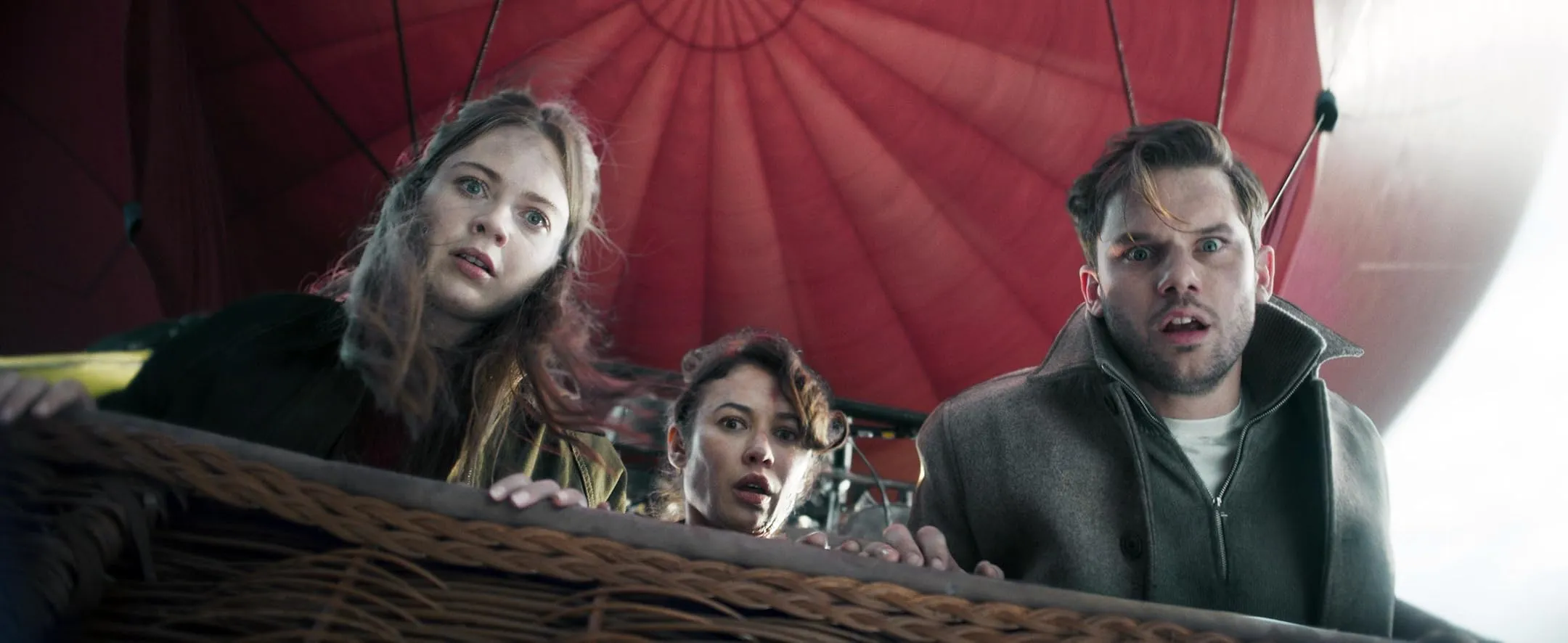
Much of the movie appears staged in controlled environments with heavy green screen work. The visual effects frequently fail to sell the illusion of altitude over the Italian countryside, and that lack of conviction softens the fear baked into the premise. When the image reads like a set, the drop stops feeling immediate.
The film still lands a few sharp visual beats. Certain moments are framed well enough to trigger real vertigo, especially when characters peer over the basket’s edge or cling to rigging while trying to steady themselves on a narrow rim. In those shots, the cinematography and effects line up long enough to restore the story’s most primal tool: the awareness that a tiny platform is hanging over hard ground.
As the plot continues, the film layers danger with aggressive frequency. The threats rotate from bodily vulnerability to mechanical failure. Characters face blackouts from oxygen-depleted air. They face structural damage like a compromised basket floor. They face fire. They face tears in the balloon’s fabric. Each new problem forces a different kind of survival move, keeping the action sequences varied and giving the film a clear sense of forward motion.
Fäh’s direction pushes this momentum, yet it also leans on character choices that feel impulsive in ways the script does not earn. The story asks for a wide suspension of disbelief, and several developments play as low-logic necessities designed to keep tension climbing. Genre fans may accept the trade. The film’s strongest stretches arrive when it trusts the setting to do the heavy lifting.
Character and Lasting Impression
The cast puts in work, even as the script holds them at arm’s length. Jeremy Irvine plays Zach with a useful split: entitlement and moral compromise on one side, panic and inexperience on the other, especially once the situation moves beyond anything money or confidence can fix.
Hera Hilmar gives Emmy a sympathetic core, communicating the strain of a spouse trapped between suspected betrayal and a shared fight to survive. Olga Kurylenko approaches Julia with an effort toward nuance, hinting at layers beyond the blackmailer function, though the writing rarely follows her into that complexity. Kelsey Grammer fits well as Harry, the experienced pilot with a genial, slightly eccentric air, and the narrative cuts his involvement short once the story’s main pressure points lock in.
The film’s major narrative problem sits in character construction. The people in the basket are built to serve roles: a guilty figure, a wounded partner, an antagonist. That approach makes emotional investment harder than it should be, because the screenplay rarely gives them depth beyond utility. The actors sell intensity and keep scenes readable, yet the personal drama stays flatter than the scenario demands.
Turbulence delivers basic airborne thrills and becomes intermittently engaging during its most frantic survival passages. Its vertical concept carries real promise, and its execution lands unevenly due to the reliance on thin internal melodrama, inconsistent visuals, and plotting that depends on strained character behavior. The result plays like a competent mid-tier genre exercise that flashes genuine terror when it remembers what the premise already provides.
Turbulence is a high-altitude psychological thriller that follows a married couple, Zach and Emmy, whose romantic hot air balloon trip over the Italian Dolomites takes a terrifying turn. Their attempt to repair their strained relationship is hijacked by an unexpected third passenger, leading to a brutal survival battle high in the sky. Directed by Claudio Fäh and starring Kelsey Grammer, Olga Kurylenko, Jeremy Irvine, and Hera Hilmar, the film is set for release on December 12, 2025. It will be available in theaters, On Demand, and digital platforms in the United States.
Full Credits
Title: Turbulence
Distributor: Lionsgate
Release date: December 12, 2025
Rating: R
Running time: 91 minutes
Director: Claudio Fäh
Writers: Andy Mayson
Producers and Executive Producers: Andy Mayson, Molly Conners, Amanda Bowers
Cast: Hera Hilmar, Jeremy Irvine, Kelsey Grammer, Olga Kurylenko
Director of Photography (Cinematographer): Jaime Reynoso
Editors: Richard Mettler
Composer: Klaus Badelt
The Review
Turbulence
Turbulence presents a compelling high-concept setting—a thriller confined to a hot air balloon basket—which yields moments of genuine, visceral peril. However, the film struggles to maintain altitude due to its poorly developed characters and their overwrought relationship drama, which consistently takes precedence over the more exciting survival scenario. Inconsistent visual effects further diminish the spectacle. It functions as an engaging, yet ultimately disposable, exercise in confined-space survival.
PROS
- The film utilizes its unique, confined-space setting (hot air balloon) to create inherent tension and escalating physical dangers.
- Sequences focusing on clinging to the basket's exterior or repairing the craft generate genuine, primal fear of heights and falling.
- The plot continually introduces new and inventive physical threats (altitude sickness, fire, structural damage) to maintain momentum.
CONS
- The main characters are superficial and poorly defined, making it difficult to invest in their personal crisis or survival.
- The heavy reliance on green screen is often unconvincing, which diminishes the illusion of high altitude and neutralizes the film's core suspense.
- The movie spends too much time on a shallow, unearned melodrama, detracting from the more thrilling and effective survival narrative.
- The screenplay frequently depends on preposterous or spontaneous character actions to drive the conflict forward.