
























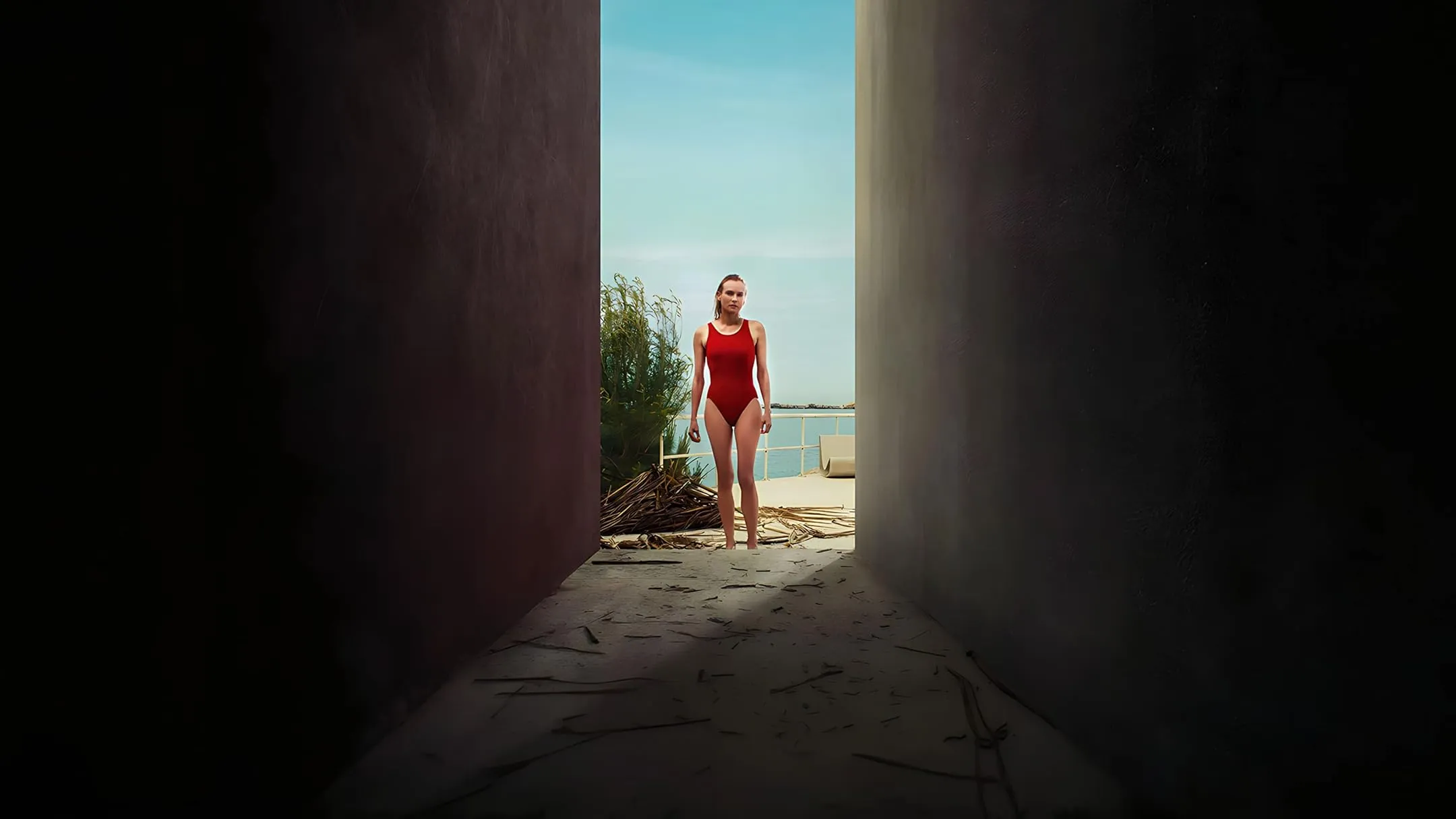

Director Yann Gozlan opens Visions by dropping the viewer into a sleek, tightly regulated world where professional mastery sits alongside private strain. The film introduces Estelle (Diane Kruger), a high-achieving airline captain whose life looks engineered for stability and status. She lives with her husband, Guillaume (Mathieu Kassovitz), a respected surgeon, in an elegant villa on the French Riviera, a backdrop of smooth surfaces and modern luxury.
The affluence and discipline associated with European thrillers about the privileged class becomes a refined trap. Estelle’s grip on order keeps slipping; chronic insomnia wears her down, and the rare moments of sleep arrive with violent premonitions and cockpit nightmares tied to her work.
That fragile calm breaks with the return of Ana (Marta Nieto), a passionate artist and a former lover. Ana signals spontaneity and emotional exposure, a life Estelle left behind in favor of certainty. Their chance reunion destabilizes the careful emotional structure Estelle has maintained for years and accelerates the collapse of the line separating her present from what she has tried to bury. From the opening stretch, Gozlan locks the film into a mood of polished restraint under pressure, with tension held tight enough to snap.
The Psychological Game and Its Limits
The film’s main conflict plays as an internal fight, with Estelle pulled between two incompatible selves. On one side sits the ordered life she has built with Guillaume, anchored in routine and future planning. On the other stands the volatile desire embodied by Ana. Gozlan frames this familiar tension between security and longing through a heavily stylized approach that keeps surfaces pristine while emotions turn feral underneath.
The story picks up speed when Ana vanishes soon after their affair resumes, with no clear explanation. That disappearance shifts the film from domestic rupture into full psychological thriller mode, feeding Estelle’s paranoia and intensifying the visions that already haunt her. Reality, projection, and traumatic recollection begin to blend until she can no longer separate what happened from what her mind invents.
The film makes these disturbances feel bodily. Estelle jolts awake from nightmares with sensations that suggest proof, like the certainty of a bruise from being choked, then watches the evidence evaporate moments later. The repeated image of a mark that refuses to stay turns perception into a moving target and keeps the audience stuck inside Estelle’s panic. Gozlan builds the plot like an intricate puzzle designed to keep viewers guessing, a strategy familiar across international thrillers that range from Hollywood noir to Bollywood’s more experimental variations. The structure keeps information in flux and treats ambiguity as a core device, with scenes arranged to make certainty feel temporary.
At times, that complexity starts to hide a simpler engine. Viewers used to psychological films that place character logic above plot trickery may find the final explanation less rich than the setup promises. The movie leans hard on sleek momentum and disorientation, trusting the swirl of doubt to carry attention past the possibility of a conventional underlying answer. From early on, Visions declares its interest in manipulating perception, then commits to that game by making clarity feel like a threat to the experience.
Aesthetic and Atmospheric Rigidity
Gozlan’s strongest tool is control of image and sound. His direction favors a glossy, tightly managed style built on smooth textures, exact framing, and cool, distant lighting. The aesthetic directly expresses Estelle’s inner life, shaped by a relentless need for rigidity and emotional order. The camera returns again and again to sterile, modern spaces: immaculate cockpits, high-tech flight simulators, the spare elegance of the seaside villa. Each location emphasizes isolation and symmetry, turning architecture into a visual argument about how fragile a life becomes when it depends on repression and precision.

The cold perfection of these environments also echoes a strain in global cinema that studies prosperity as a source of anxiety. The Riviera villa reads like a showroom built to impress, yet it also functions like a sealed chamber where private fears ricochet off clean walls. In the cockpit and simulator, the geometry of control carries a different weight. These spaces reflect mastery and training, yet they also become the stage for Estelle’s dread, linking professional competence to a kind of self-erasure.
Sound design deepens that psychological drift. Philippe Rombi’s ominous score presses down on scenes with a steady sense of threat, while distortions, echoes, and carefully timed cues chart Estelle’s disorientation. One standout sequence has Estelle focusing on a strange voice message and identifying specific sounds, footfalls and machinery, then reconstructing the imagined event step by step.
The suspense comes from process: listening, isolating details, replaying them, turning sound engineering into character action. The film also leans into visual motifs, especially repeated close-ups of eyes and recurring references to being watched. The result is a persistent sense of surveillance and exposure, setting up a story obsessed with sight, perception, and inner vision from the opening credits. The technical craft sustains a deeply unsettling mood, even as the narrative keeps shifting in ways that test coherence.
Performance as the Anchor of Ambiguity
Diane Kruger carries Visions through its uncertainty. Her Estelle is defined by restraint at first, with composure that reads as practiced, then gradually reveals despair and emotional turmoil. Kruger builds the breakdown through controlled details: tight gestures, tense pauses, measured reactions that let dread collect without tipping into melodrama. As Estelle loses her footing, the collapse feels earned because the performance treats it as erosion, not a switch flipped for effect. That grounding gives the film emotional gravity and keeps the character’s pain from being swallowed by plot mechanics.
The supporting cast works as a set of stabilizers and accelerants around her. Mathieu Kassovitz plays Guillaume as solid and rational, a figure of calm that makes the life Estelle risks feel concrete. His steadiness reinforces the sense of a real world Estelle could return to, which makes her choices and panic register with sharper stakes. Marta Nieto gives Ana a disruptive force defined by chaotic energy and unpredictability. Her re-entry complicates Estelle’s life on contact, reigniting desire and uncertainty with a presence that feels like a threat to order.
The film also invites a critique of those secondary roles. Even with committed performances, the characters can feel thinly drawn, functioning as symbols of competing paths rather than fully realized people. Visions succeeds most as a character-driven psychological study, focused on Estelle’s identity crisis and her confrontation with suppressed desire. The resolution of the external mystery matters less than the experience of watching her sense of self fracture, and Kruger’s layered work keeps the film absorbing even when the plot knots itself into deliberate confusion or slips toward predictability.
Visions is a French psychological thriller that explores the psychological and emotional unraveling of a highly controlled woman whose past resurfaces to shatter her carefully constructed present. The movie premiered at the Angoulême Francophone Film Festival on August 24, 2023, before its general French release on September 6, 2023. As of today, December 15, 2025, the film may be available for rent or purchase through various Video On Demand (VOD) platforms such as Amazon Video and Apple TV, depending on your geographic region.
Full Credits
Title: Visions
Distributor: SND (Société Nouvelle de Distribution) Films
Release date: September 6, 2023 (France)
Running time: 123 minutes
Director: Yann Gozlan
Writers: Jean-Baptiste Delafon, Yann Gozlan, Aurélie Valat, Michel Fessler, Audrey Diwan (collaboration)
Producers and Executive Producers: Thibault Gast, Éric Nebot, Matthias Weber
Cast: Diane Kruger, Mathieu Kassovitz, Marta Nieto, Amira Casar, Grégory Fitoussi, Élodie Navarre
Director of Photography (Cinematographer): Antoine Sanier
Editors: Valentin Féron
Composer: Philippe Rombi
The Review
Visions
Visions is a stylish, technically proficient thriller anchored by Diane Kruger’s intense central performance. The film excels at establishing a pervasive mood of psychological erosion through controlled direction, polished cinematography, and effective sound design. While the narrative's heavy reliance on ambiguity can occasionally make the central mystery feel thin or predictable, Kruger successfully grounds the character's internal conflict, making her descent into paranoia compelling. It is an engaging study of self-suppression and identity that prioritizes atmosphere and performance over pure plot originality.
PROS
- A highly effective, restrained portrayal that anchors the film's emotional weight.
- Yann Gozlan creates a sleek, controlled atmosphere using cool lighting and symmetrical settings.
- Excellent use of sound design and visual motifs (like the eyes) effectively builds suspense and paranoia.
- The film successfully focuses on the internal destabilization and identity crisis of the protagonist.
CONS
- The central mystery and its resolution may feel shallow or conventional to seasoned thriller viewers.
- Supporting roles, particularly the husband and the lover, sometimes function more as symbolic foils than fully developed individuals.
- The overuse of blurring lines between reality, dream, and memory can occasionally feel like a structural strategy to disguise a lack of narrative depth.
- The deliberate pacing, especially in sequences reinforcing the protagonist's disorientation, may occasionally feel slow.