


























A particular strain of tension comes from watching a safe interior space fail. Oy to the World! opens on that crack in the drywall, then widens it into a premise: Temple Beth-Am suffers a structural problem, a burst water line, and the congregation suddenly needs somewhere else to gather.
Their refuge is St. Joseph’s Episcopal Church, a location that reads, at first glance, like a visual contradiction. The film lands an early expressionistic gesture here. Two communities end up sharing walls, air, and routines, and the camera treats that proximity as an ethical problem before it treats it as a holiday contrivance.
The plot tightens its screw with a calendar alignment that carries its own quiet pressure: the last night of Hanukkah coincides with Christmas Eve. Timing becomes destiny, and destiny becomes logistics. A shared service stops being a nice thought and becomes a requirement, which is where the film finds its most persuasive vulnerability. Community is exposed, in public, under fluorescent planning meetings and soft sanctuary light.
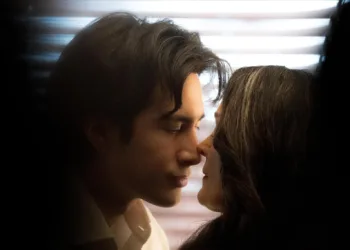
That forced collaboration pulls two familiar antagonists into the same frame. Nikki Roberts (Brooke D’Orsay) runs the church’s youth choir. Jake Cohen (Jake Epstein) steps in as the temple’s substitute director. They bring along a shared teenage rivalry, the kind that can sit dormant for years and then flare up the moment someone re-enters your eyeline with a music stand and an opinion.
Their task is simple on paper: build one unified musical program and pull off a fundraising effort aimed at the temple’s repair. The script sets its stakes in practical terms, then lets them reverberate. This is about keeping a place of worship standing. It is also about the uneasy act of sharing sacred space through song, with pride and history sitting in the pews like extra parishioners.
The Architecture of Conflict and Character
The film builds its psychological scaffolding around Nikki and Jake, and it does so with a sense of pressure applied from the outside. Their identities feel established, even protected, until circumstance forces contact. D’Orsay plays Nikki as capable and steady, visibly committed to her choir and her community, with old high school insecurities still humming under the surface. That undercurrent matters. It gives her competence texture and gives her jokes a slight edge, the kind that arrives a half-beat before a wince.
Jake, by design, becomes her counterweight. Epstein gives him an earnestness that reads as real musical investment, paired with a polite competitiveness that hints at a professional sensitivity he keeps tucked away. His humor lands sharp, then softens. The performance suggests warmth behind the barbs, which is a useful calibration for a holiday film that wants banter without cruelty. Jake can needle Nikki, then show up for the work, and the film keeps both impulses in view.
Their conflict has a clear origin point: a half-remembered slight from a school performance years earlier. The point is less the historical record and more the way people file themselves into permanent roles. Rival. Threat. Someone who made you feel small. The film tracks their shift with patience, letting intimacy grow out of shared effort rather than sheer proximity. They argue over arrangements. They run rehearsals. They pick up the vocabulary and ritual logic of the other tradition because the program demands it. The romantic trajectory becomes an engineering problem: trust has to be built, plank by plank, while both parties keep trying to protect their pride from splinters.
That approach feeds the film’s philosophical angle on identity. Nikki and Jake carry versions of themselves formed in adolescence, then discover the limits of those old scripts under adult responsibility. The question becomes one of self-authorship. Are they bound to the roles they inherited from youth, or can they revise the story with intention? The film frames that revision as labor. A little romantic, a little administrative. Nothing glamorous, which is part of the point. Ethical change often looks like someone staying late after rehearsal.
The supporting characters help keep the tone buoyant without flattening the premise. The clergy, the Reverend and the Rabbi, are drawn with agency and with a willingness to take real cultural risk for the joint service. They show doubt, then vision, and the film treats that posture as mature courage rather than a sentimental shortcut. Jake’s grandmother, the person he is substituting for, supplies the kind of wry, well-timed humor that keeps earnestness from hardening into a lecture. Her presence reads like a gentle reminder that tradition can carry wit along with weight. Saints and sages can still roll their eyes.
Harmony, Ambiguity, and the Expression of Faith
The film’s philosophical engine runs on interfaith unity, with musical composition serving as its testing ground. The script keeps its focus on specificity. Ritual and need remain visible on both sides, which gives the idea of solidarity a practical texture instead of a seasonal slogan. Hanukkah’s final night and the Christmas Eve service each receive careful attention in the writing, and the story’s sense of plausibility grows from those details.
Music functions as a narrative actor here, pushing the characters into compromise and exposing their instincts for control. The blended arrangements, Hebrew prayers alongside Christmas carols, carry an inventiveness that still respects the material. The film leans into the mechanics of harmony: distinct melodies can share a structure and create a fuller sonic shape.
That becomes the story’s clearest metaphor for shared space. It is also a mild provocation. The idea that different traditions might sound better together can be thrilling, and slightly unsettling, depending on where you sit. The film allows that ambiguity to linger. It does not rush to sanitize it.
The soundtrack emphasizes thematic echoes between the traditions, pointing to shared ideas like light, hope, and deliverance through cadence and lyrical resonance. That mirroring works on an audience-psychology level. Familiar tunes lower defenses. Unfamiliar phrases raise attention. The film uses that push and pull to keep viewers leaning forward, listening for how the next line will resolve.
The children’s choir sequences give the film its most credible emotional gravity. The staging treats the kids as lively and imperfect participants in a collective project. They bicker. They miss lines. They test patience. Then they land moments of genuine unity that feel earned through repetition and correction. Those scenes root the film’s loftier themes in the messy, ordinary work of making something together. The effort shows on their faces, which reads as truth.
All of that pressure funnels into the final joint performance and fundraiser. The gathering places both congregations under one roof, and the scene carries multiple tensions at once: nervous children, adults watching for cultural missteps, and the very real stakes attached to raising money. The pacing slows long enough for anticipation to settle into the room, then the music takes control.
The crescendo becomes the story’s release valve, a rhythmic ratchet that turns stress into catharsis. Applause and shared singing arrive as payoff for sustained compromise, staged with enough restraint to feel earned rather than forced. The film presents shared celebration as radical listening, an act that requires attention and humility before it requires joy. Joy comes later. It always does.
Cinematography and the Shadow of Imperfection
The film’s visual language quietly argues alongside its dialogue. Production design does careful work in showing artifacts from both traditions coexisting in the same space: stained glass warmth near the menorah’s light, textures and symbols sitting adjacent without turning into a museum display. Cinematography supports that idea through a deliberate mapping of emotional territory. Warm golden tones bathe the church setting, while cooler, softer blues tend to mark the temple’s crisis and the characters’ private strain. Light becomes a kind of moral geometry, placing comfort and anxiety on different ends of the palette.
There is a noir-adjacent pleasure in watching this film use illumination to imply interior conflict, even within a holiday frame. Expressionistic touches show up in the way the camera delineates spaces of safety and spaces of exposure. A sanctuary can feel protective in one scene and interrogative in the next, depending on angle and glow. The imagery hints at the thriller tradition’s obsession with divided selves: public composure versus private fear, goodwill versus control. The film does this gently, with the soft edges of seasonal cinema, yet the technique still registers.
Dialogue keeps a sprightly rhythm that helps serious conversations about tradition and community meaning play without sinking into syrup. Lines tend to be efficient, leaving room for actors to shape emotion in pauses and glances. The humor sits like seasoning, and the best moments feel tossed off with a little sideways grin. The film knows that earnest people can still be funny, and funny people can still take faith seriously. That balance matters.
Structural issues do surface in the middle stretch. Pacing loosens, and the director leans on montage to move pieces into place quickly. The shorthand keeps the story moving, yet it trims away some friction that could have deepened the emotional turns. A few shifts in the central relationship arrive faster than the earlier patience suggests.
The fundraising subplot carries the most noticeable compression. It drives the need for the joint effort, yet it remains largely functional, treated as a mechanism that propels scenes forward. The narrative would carry heavier ethical weight with more attention to what those funds mean in lived, communal terms for the temple itself. The film gestures toward that urgency, then steps past it, heading back to rehearsal. A practical choice. A slightly frustrating one.
Oy to the World! is a holiday-themed romantic comedy film that premiered on Sunday, December 14, 2025, on the Hallmark Channel. The movie centers on Nikki Roberts, the youth choir director at St. Joseph’s Episcopal Church, and Jake Cohen, the substitute choir director at Temple Beth-Am, who are forced to collaborate on a joint Christmas-Hanukkah service after a burst pipe damages the temple. Their shared mission requires them to overcome a high school rivalry and lead a fundraising effort, finding unity through music and eventually, romance. Viewers can watch the movie on the Hallmark Channel, as part of its “Countdown to Christmas” programming, and it is available for streaming on the Hallmark Channel’s associated platforms.
Full Credits
Title: Oy to the World!
Distributor: Hallmark Channel
Release date: December 14, 2025
Rating: TV-G
Running time: Approximately 84 minutes
Writers: Rick Garman, Genna Ryan
Producers and Executive Producers: Unknown
Cast: Brooke D’Orsay, Jake Epstein, David Julian Hirsh, Patti Allan, Stellina Rusich, Harrison Coe, Curtis Lovell, Shaye Quinn
Composer: Jeff Tymoschuk
The Review
Oy to the World!
Oy to the World! succeeds as a thoughtful entry into the holiday genre. It approaches its interfaith subject with respect and nuance, establishing an ethical stage where character growth is earned through shared professional labor. The music functions beautifully as a metaphor for unity, culminating in an authentically moving climax. While the pacing and some subplots lack necessary depth, the film offers genuine warmth, intelligent performances, and a sophisticated take on communal harmony. It is a satisfying, well-executed holiday film.
PROS
- Handles both Episcopal and Jewish traditions with specific respect and equal weight.
- The romance develops slowly through shared work, lending realism to the relationship.
- Inventive soundtrack uses blended arrangements as an active, effective metaphor for unity and compromise.
- Brooke D'Orsay and Jake Epstein anchor the film, supported by humanized clergy figures.
CONS
- The second act relies heavily on montage, causing some emotional transitions to feel rushed.
- The critical fundraising subplot is handled as a device; its emotional and communal importance could have been deepened.
- Some supporting character arcs are implied, lacking a necessary concluding beat.