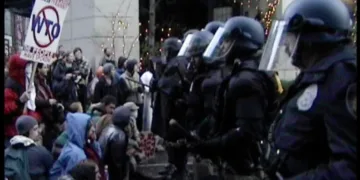































For many viewers who grew up watching politics speed up during the late 1990s, the four days of protest against the World Trade Organization’s Ministerial Conference in Seattle feel less like a distant chapter and more like a warning that kept echoing. Ian Bell’s documentary WTO/99 approaches “The Battle of Seattle” as a vital, present-tense cinematic reconstruction. The film throws us into the collision of global trade policy and street-level anger.
Working with co-editors Alex Magaro and Laura Tatham, Bell builds the entire feature from archival material: local news reports, security footage, and, most strikingly, rough, intimate images captured by protesters on home camcorders. That structural decision removes the safety of hindsight and pulls us into the raw tension of a conflict that helped define an era. More than 40,000 protesters gather on screen, an extraordinary cross-section of groups that ranges from powerful union blocs to young, globally conscious activists, all focused on the perceived damage caused by accelerated economic globalization.
The film carefully follows the way events slide from organized civil disobedience into one of the most significant and violent confrontations between citizens and police in modern American history. The past appears here as a live current, a moment that insists on constant attention and refuses to become a closed case.
Technical Merit: The Power of First-Hand Footage and Unfiltered Form
The documentary’s defining strength lies in its immersion, built entirely from a bold commitment to the found footage approach. This design gives WTO/99 its clearest technical power and its emotional charge. By leaning on first-hand recordings from amateur cameras, especially those carried by protesters, the film sidesteps the polished framing of corporate news outlets.

It places the audience on the pavement, where bodies press together and the sound of chants fills the air, and that choice creates a physical sense of presence that no chorus of expert talking heads would match. Anyone who has joined a march or sat in a public square during a rally will recognize the mix of shared energy and sudden fear that moves through a crowd. WTO/99 amplifies that feeling to an intense level. We stand beside activists in moments of hope and high spirits, and then share the shock seconds later as tear gas clouds roll in and rubber bullets slice through the noise.
This method becomes a significant artistic and technical accomplishment. The uneven visual surface of the film, with crisp television segments cut together with grainy handheld tapes, creates a rough, handmade texture that feels true to the chaos of the streets. That broad pool of sources demands patient, precise editing from Bell and Magaro to shape a coherent storyline out of viewpoints that appear at first glance to be scattered. Their work arranges the footage in chronological order while preserving a spontaneous, decentralized rhythm that reflects the leaderless structure of the protest itself.
The raw presentation also sharpens the gap between public promises and what unfolds in the streets. Early statements from Seattle Mayor Paul Schell and Police Chief Norm Stamper promise respect for constitutional rights and a measured law enforcement strategy. The material collected inside the film pushes back against those assurances, recording a fast, disproportionate police escalation that brings riot armor, concussion grenades, and extensive use of chemical agents and rubber bullets against largely nonviolent demonstrators. WTO/99 lets the archival record speak with blunt force.
A Cultural Artifact: The Echoes of Discontent and Media Framing
Viewed as a cultural artifact, WTO/99 documents a protest while tracking the rise of anxieties that keep shaping life in a globalized economy. The protesters’ goals rest on ethical alarm: opposition to the WTO’s role in global labor exploitation, environmental destruction, and the erosion of domestic jobs and workers’ protections. The Seattle action stands as an important early marker for the anti-globalization movement.
The film’s focus on real-time documentation works as a corrective to an established story line. At the time, much of the corporate press devoted its attention to scattered episodes of property damage, often linked to a small group of anarchists, and used that focus as the primary lens that justified a sharp escalation by state forces. WTO/99 strongly suggests that the most aggressive police tactics set off and intensified much of the wider disorder on the streets.
That record of state response places Seattle inside a long pattern in United States political life. Images of armored police units confronting demonstrators call up earlier conflicts, from the 1968 Democratic National Convention in Chicago through later civil rights and social justice struggles. The documentary reminds viewers that methods of control and the basic shape of the clash between public protest and state power can persist across decades, no matter which specific policy drives the crowd’s demands.
The film underlines that, in this regard, the “songs remain the same.” At the same time, WTO/99 captures the immediate political setting, with figures like President Bill Clinton speaking at the summit and an early, unsettling appearance from political operative Roger Stone. That archival frame shows how the frustration and skepticism toward global institutions visible in Seattle would later grow and be repurposed by new political currents in the twenty first century. The film presents political conditions as the accumulation of long running grievances, not sudden eruptions.
Narrative Structure and Limitations
Bell’s decision to use an unconventional narrative form, built around the strict absence of voiceover or reflective commentary, gives WTO/99 its central structural strength. The editing team shapes momentum with remarkable control, cutting among vantage points to build tension across the four days of protest. This strategy confronts the viewer with unfiltered political argument and emotional intensity, without the softening effect of explanation from a later era. WTO/99 plays as a piece of immediate cinema that steps away from traditional documentary habits and searches for a more direct contact with events.
That same commitment also defines the film’s main structural limitation. Because the footage comes from so many cameras and organizing clusters, the documentary never settles into a clear focus on a single demonstrator or a small core group. The choice mirrors the decentralized, grassroots shape of the protest, yet it leaves the film without a consistent personal anchor, so the many perspectives never fully cohere around one story. Street scenes keep their grip as engrossing, visceral records of conflict, but the viewer rarely grows deeply attached to the fate of any specific individual.
WTO/99 concentrates on the spectacle of mass protest, the surges of action and confrontation, and gives less attention to the intricate work of political planning and community organizing that precedes and sustains such uprisings. That design slightly limits its usefulness as a step by step guide for current activists, while its strength as a cinematic witness to history remains unshaken.
WTO/99 is a feature-length documentary directed by Ian Bell that vividly reconstructs the “Battle of Seattle,” the massive four-day protest against the World Trade Organization’s Ministerial Conference that took place from November 30 to December 3, 1999. The film distinguishes itself by relying entirely on archival and found footage—including local news broadcasts, security camera recordings, and over 1,000 hours of footage captured by protesters—eschewing contemporary voiceover and expert talking heads to provide an immediate, unfiltered look at the event. It documents the rapid escalation from peaceful civil disobedience by over 40,000 activists to chaotic and often violent clashes with the Seattle Police Department. After a successful run at film festivals throughout 2025, the film is set for a limited U.S. release on December 5, 2025, distributed by Foghorn Features.
Full Credits
- Title: WTO/99
- Distributor: Foghorn Features
- Release date: December 5, 2025 (Limited U.S. Release)
- Running time: Approximately 106 minutes
- Director: Ian Bell
- Producers and Executive Producers: Alex Megaro, Laura Tatham, Rachel Price, Gavin P. Sullivan, Debra McClutchy
- Editors: Ian Bell, Alex Megaro
- Composer: Third Coast Percussion
The Review
WTO/99
The film's rigorous commitment to its archival method creates a fierce, immediate confrontation with history, capturing the chaotic energy of the 1999 Seattle protests without narration. While the decentralized form prevents deep emotional attachment to a single figure, the technical achievement of the editing and the raw urgency of the footage make this a necessary and compelling document. It powerfully reframes the narrative of state aggression versus citizen dissent, serving as an important artifact for understanding modern political friction.
PROS
- Strict use of archival footage creates immediacy and authentic energy.
- Expert pacing and cross-cutting build narrative tension over the four days.
- Successfully challenges the prevailing media narrative of the event.
- Provides a powerful, unfiltered experience of the on-the-ground protest.
- Offers strong contemporary relevance to current patterns of political dissent and state response.
CONS
- The lack of a central protagonist limits deep emotional investment for the viewer.
- The focus remains on the spectacle of the conflict over the organizational work behind the movement.
- The scattered viewpoints prevent the film from achieving a singular, focused narrative shape.







