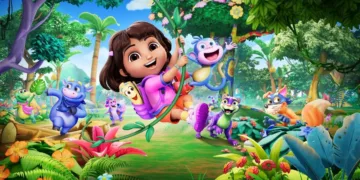
























Dora: Rainforest Rescue lands as a notable moment for a long-running preschool franchise. Developed by Artax Games and published by Outright Games, the release lines up with the series’ twenty-fifth anniversary. It brings Dora and her cast to modern platforms, including Xbox Series X, with a clear goal: give young children a basic, approachable first game.
The story tracks Dora and Boots as they work to stop Swiper from meddling with the magical Alebrije Tree. Saving the rainforest means tracking down six stolen Alebrije pods scattered across different environments. The design stakes out a non-violent take on 3D platforming that leans on exploration and bilingual learning.
It fits kids getting comfortable with a controller for the first time, keeping the educational tone of the TV show intact through Spanish lessons that flow through the moment-to-moment play. Accessibility stays front-facing, keeping the intended audience moving, listening, and building basic coordination.
Foundations of 3D Navigation
As an introductory 3D platformer, the game does its work by stripping away the usual punishment loop. The biggest safety net is the bubble rescue system. Miss a jump, fall off a ledge, and a bubble returns Dora to solid ground right away. That choice removes game over screens and sidesteps the stress that comes with losing lives.
The difficulty curve starts at a crawl, beginning with stationary logs that ask for a single button press. From there, it adds floating platforms, moving platforms, and platforms that disappear, spaced out in a way that supports steady improvement. The cadence echoes the approachable structure of Super Mario 3D World, with a much lower skill requirement at the start.
Threats in the environment follow the same gentle logic. Hopping frogs and similar enemies help fill the space, and contact triggers a short stun on Dora instead of dealing damage, turning them into small interruptions. Spanish vocabulary remains threaded through play, showing up through dialogue and character interactions without feeling bolted on. Map functions as the built-in guide, stepping in with directions and hints whenever a player loses their bearings. The result keeps the emphasis on moving forward and checking corners, not wrestling with confusion.
Environmental Design and Progressive Abilities
The world is split into a set of biomes, including the Nutty Forest, Green Hills, and the Musical Forest. The labels signal variety, and the presentation stays tied to a single forest look that keeps the terrain feeling familiar across levels.

The more interesting wrinkle comes from light Metroidvania design. Each new area introduces a power-up that Dora can use to reveal hidden routes in earlier stages. That structure pushes kids back into old spaces with fresh tools, rewarding replay with secrets and giving the game a layer of depth that does not show up often in projects aimed at this age range.
On the technical side, the visuals keep things bright and functional, putting performance ahead of detailed texture work. The game runs smoothly on modern hardware, which matters for holding a child’s focus during basic movement and jumping.
The core loop stays consistent from start to finish, and the limited environmental change can wear on parents helping from the couch. The main story moves quickly, taking about two to three hours to finish. Chasing every collectible and putting every power-up to use stretches the runtime, adding extra hours for players who want full completion.
Cooperative Mechanics and Interactive Diversions
Local split-screen supports two players, letting a second person control Boots and explore next to Dora. Co-op is built into the design through simple puzzles, including moments where both characters need to stand on switches at the same time.

For parents, that second controller can function as a steadying hand, keeping a younger player from getting stuck or missing a step. Beyond standard platforming, the game rotates in a handful of interactive diversions. The Troll’s Quiz uses educational riddles as a gate to cross bridges, and Swiper Swipe challenges focus on quick reactions to stop the fox from stealing items.
Vehicle segments also show up, including a karting activity and a cloud-chasing mini-game. They shift the tempo, even if some vehicle handling feels heavy. Progress still revolves around the six Alebrije pods in each level, supported by side collectibles like golden leaves placed in sequences to guide movement, plus Alebrije kittens that act as bonus rescues.
For older players sitting in, the biggest friction point is dialogue length. Conversations run long and the game does not let you skip them. Kids may enjoy the constant chatter from Dora’s group, and repeated exchanges can make the pacing feel slow for adults.
The Review
Dora: Rainforest Rescue
Dora: Rainforest Rescue succeeds as a tailored entry point for preschool gamers. The mechanics prioritize confidence by removing failure states. Bilingual elements stay true to the brand. Repetitive environments and slow dialogue might test the patience of older players. Local co-op provides a helpful way for families to play together. The game offers a safe and educational adventure that balances simple platforming with recognizable charm.
PROS
- Forgiving bubble rescue system
- Helpful local co-op mode
- Effective Spanish language integration
- Stable performance on modern consoles
CONS
- Repetitive level design
- Unskippable dialogue segments
- Uneven mini-game quality