





























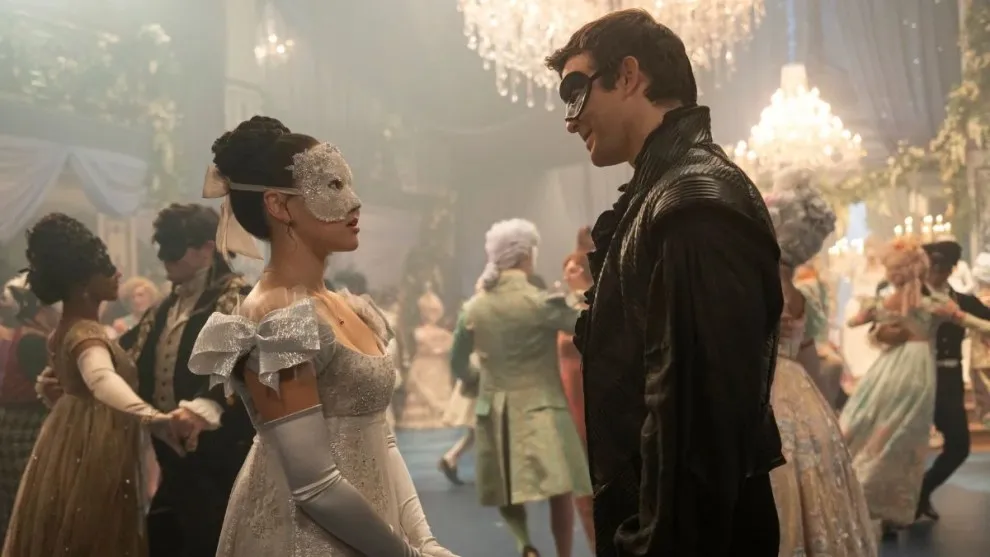

Bridgerton returns to London for a fourth season with Benedict Bridgerton stepping into the spotlight. The second son of the family has spent years dodging the marriage market, choosing art and a comfortable bachelor routine instead. That refusal starts to look less charming once Lady Violet decides the family’s standing needs a settled son, and she presses him to find a wife.
The season opens with a lavish masquerade ball, every guest hidden behind a mask. Benedict meets a mysterious woman dressed in silver and fixes on her at once. He does not know she is Sophie Baek, a servant who slipped into the party. Their connection drives a story that moves between glittering high society and the workers who keep it running.
The season adapts Julia Quinn’s third book and leans into a fairytale framework to examine class and identity. The first four episodes lay the groundwork for the romance while keeping tabs on other Bridgertons. The look stays lush, packed with colorful costumes and grand estates, while Benedict faces a choice between family duty and the life he wants.
The Architecture of a Regency Fairytale
Benedict Bridgerton finally takes the mantle of romantic lead, shifting from playful supporting presence to the central figure in a Cinderella-shaped plot. Luke Thompson plays him with an easy charm that still carries the history of a rake, now paired with a sharper sense of vulnerability. His search for the Lady in Silver powers the early episodes, and his inability to recognize the woman near him becomes a story engine in its own right. The show treats that blindness as personal flaw and social condition, a reminder that the era trained its elites to look past the people closest to their comfort.
Yerin Ha arrives as Sophie Baek and gives the season its clearest view from the margins. Sophie lives on unstable ground, always one mistake away from punishment. As the illegitimate daughter of an Earl who ends up working as a housemaid, she holds noble blood and forced servitude in the same body, and the show uses that tension to keep the romance from floating off into pure fantasy. Her brief, bright joy at the ball gives way to the grind of labor and the constant math of survival. Keeping her identity hidden reads as strategy, not coyness. Sophie knows the ball’s dream collapses the moment her status becomes visible.
Benedict and Sophie’s chemistry anchors the season. A private dance lesson lands as a key emotional beat, charged by the physical closeness and the social danger wrapped around it. Their bond grows during time at a country cottage, where distance from London’s rules creates space for feeling to breathe.
The mid-season breaking point comes when Benedict, acting on privilege he rarely has to name, proposes Sophie become his mistress. The offer hits with real weight because the show has already shown what it costs to live as a secret in someone else’s story. Sophie refuses. The decision protects her and rejects a dynamic that asks her to accept invisibility as the price of love.
The Invisible Labor of the Ton
This season brings a shift in viewpoint by sending the camera below the stairs and into servants’ quarters. The series lingers on the work that makes high-society life look effortless, exposing exhaustion, risk, and routine discipline. New faces like Alfie and the seasoned Mrs. Crabtree put names and bodies to a workforce the aristocracy tends to treat as background. Their presence pushes the audience to see what the Ton refuses to see: luxury depends on labor, and that labor comes with physical cost.
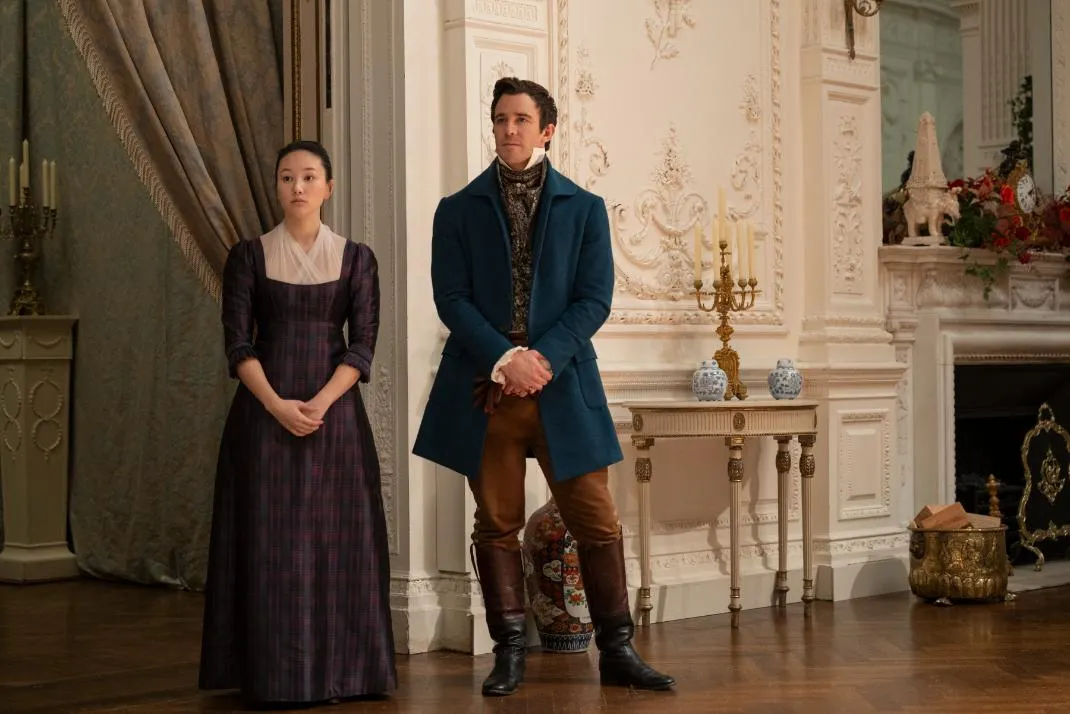
The Penwood household supplies the season’s harshest conflict. Katie Leung plays Lady Araminta Gun with cold precision, presenting a wicked stepmother figure whose cruelty carries personal motive and social force. Her hostility toward Sophie connects to what Sophie represents inside the house, a living reminder of a husband’s infidelity and a threat to the story the household wants to tell about itself. Sophie’s job stays fragile, constantly at risk, and her eventual dismissal lands as a clear signal of how little agency the working class holds in this world.
The season uses these relationships to make power feel immediate. The imbalance between master and servant hangs over everyday interactions as a constant threat. Sophie takes steps to protect others from lecherous employers and faces the possibility of violence herself.
The Bridgertons appear as kinder employers, yet that kindness functions as a luxury their rank can afford. Class expectations do not sit at the edge of the romance. They set the terms of what each person can risk. Benedict gets space to dream because the system cushions him. Sophie survives by reading danger early and choosing realism over wishful thinking.
Expanding the Regency Universe
The season keeps its ensemble busy, using side stories to broaden the social picture around Benedict and Sophie. Violet Bridgerton moves toward romance with Lord Marcus Anderson, and their storyline reflects a different phase of desire: companionship later in life, shaped by experience and restraint. Ruth Gemmell and Daniel Francis share a grounded chemistry that gives the subplot a steadier emotional temperature than the debutante pageantry that usually defines this world.
Eloise continues her effort to shape an identity outside the marriage market. She returns from Scotland with renewed independence and becomes a confidante to Benedict, putting her wit to practical use in a story that often rewards conformity. She also forms a stronger bond with her younger sister Hyacinth, and their scenes point toward female solidarity as a lived practice, not a slogan, pushing back against a culture that frames women as rivals for social survival.
Newlyweds Penelope and Colin face the fallout of their scandal while Penelope meets a fresh challenge tied to Queen Charlotte. The Queen positions herself as a demanding fan of Lady Whistledown, creating pressure over authorship and control. Penelope has to juggle marriage with the demands of a secret career that keeps pulling her back into public consequences.
Francesca and John Stirling return to London and confront the quieter textures of married life, played with an inward, subdued tone. The introduction of Michaela Stirling points toward complications ahead for the couple. The Queen and Lady Danbury continue their layered friendship, mixing comedy with flashes of real vulnerability. The Queen’s hunger for gossip keeps the social stakes high, and the season treats rumor as currency that can bruise anyone, especially those with the least protection.
The Visual Language of Class and Desire
The production design remains one of the season’s strengths, using spectacle to serve meaning. The silver dress at the masquerade becomes a central symbol, carrying the dream of equality that exists only under a mask. Disguises echo the season’s fixation on hidden identity, from Sophie’s secret to the social performances everyone maintains in public. The visual split between glowing ballrooms and shadowed work areas turns class hierarchy into architecture, reminding viewers that the same house can hold fantasy upstairs and strain downstairs.
Cinematography leans dreamlike during the ball sequences, then shifts toward a closer, more isolated style during the country house episodes. The lake scene is filmed for beauty and tension at once, using light and open space to mirror the couple’s emotional risk. Music stays a signature element, built around a string-heavy score and modern song covers that connect the historical setting to contemporary feeling.
The split-season format shapes pacing, stretching suspense around the central conflict while leaving room for the series’ many supporting threads. The show manages to keep the main romance intense without losing track of the wider cast, and the structure keeps the Ton feeling busy, watchful, and alive.
The fourth season of Bridgerton arrived on Netflix on January 29, 2026. This chapter follows the story of Benedict Bridgerton and his search for a mysterious woman he met at a masquerade ball. The production split the season into two parts to maintain momentum throughout the winter. Fans can access the first half of the season on the streaming platform immediately. The final episodes arrive next month to finish this specific romantic arc.
Full Credits
Title: Bridgerton
Distributor: Netflix
Release date: January 29, 2026 (Part 1), February 26, 2026 (Part 2)
Rating: TV-MA
Running time: 60 minutes
Director: Tom Verica, Tricia Brock, Alex Pillai, Alrick Riley, Bille Woodruff, Cheryl Dunye, Sheree Folkson, Julie Anne Robinson, Jaffar Mahmood
Writers: Chris Van Dusen, Jess Brownell, Julia Quinn, Abby McDonald, Daniel Robinson, Sarah L. Thompson, Leila Cohan-Miccio, Azia Squire, Sarah Dollard, Eli Wilson Pelton, Janet Lin
Producers and Executive Producers: Shonda Rhimes, Betsy Beers, Tom Verica, Chris Van Dusen, Jess Brownell, Sarada McDermott, Holden Chang
Cast: Luke Thompson, Yerin Ha, Nicola Coughlan, Luke Newton, Claudia Jessie, Ruth Gemmell, Golda Rosheuvel, Adjoa Andoh, Jonathan Bailey, Simone Ashley, Katie Leung, Hannah Dodd, Victor Alli, Masali Baduza
Director of Photography (Cinematographer): Jeffrey Jur, Alicia Robbins
Editors: Jim Flynn, Kyle Bond, Gregory T. Evans, Bridget Durnford, Matt Pevic, Eli Nilsen, Amy K. Bostrom, Jessie Marion
Composer: Kris Bowers
The Review
Bridgerton Season 4
Season 4 revitalizes the Bridgerton formula by grounding its romantic fantasy in the grit of the working class. While the Cinderella narrative occasionally leans too heavily on familiar tropes, the undeniable chemistry between Thompson and Ha elevates the material. The shift "downstairs" offers a necessary expansion of the show's social scope, proving that even a well-worn fairytale can find new life through thoughtful representation. It remains a visually stunning, addictive anchor of the streaming landscape.
PROS
- Luke Thompson and Yerin Ha deliver a central romance that feels both tender and potent.
- The "downstairs" focus on servant life adds a layer of depth and social realism previously missing.
- Yerin Ha is a standout addition, bringing both grit and grace to the role of Sophie Baek.
- The exploration of Lady Violet’s own romantic awakening provides a moving, mature counterpoint to the younger leads.
- The natural integration of diverse backgrounds and physical abilities continues to set a high bar for the genre.
CONS
- The rigid adherence to the Cinderella structure can make the primary arc feel overly familiar.
- Numerous side stories occasionally distract from the development of the main couple.
- The reliance on the "hidden identity" trope risks stretching the viewer's suspension of disbelief.
- The mid-season cliffhanger creates a disjointed experience for those seeking a singular, cohesive journey.