


























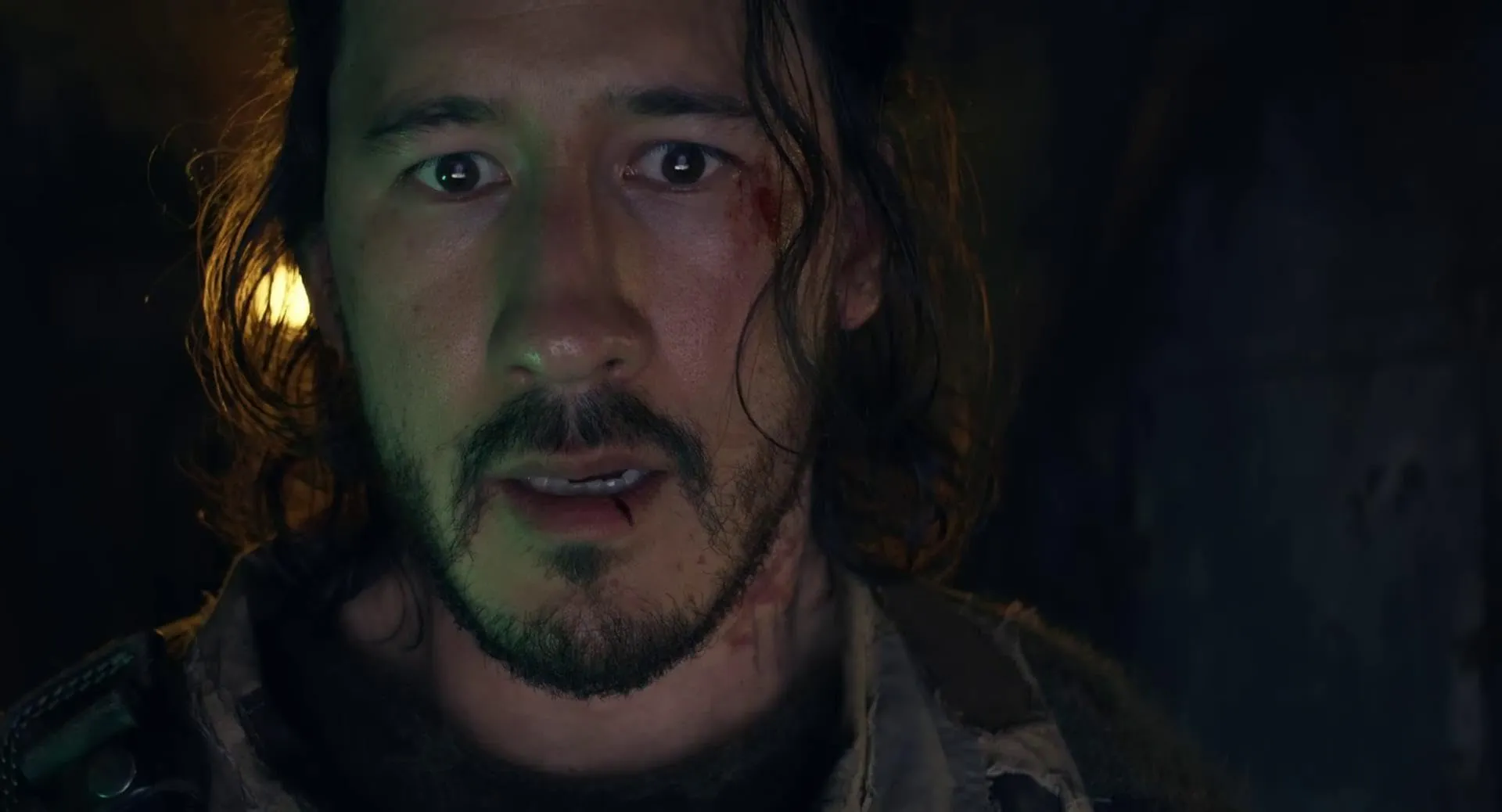

The Quiet Rapture plays like a cosmic deletion key. The premise is pure nightmare logic: the universe decides it is done hosting life, stars winking out while humanity bunches up on rotting space stations, moths circling a bulb that has started to sputter. Simon, a convict hunting for a little mercy, ends up bolted inside the Iron Lung.
The vessel reads as a mobile sarcophagus, a machine built to keep you sealed, sweating, and obedient. His assignment is simple in wording and obscene in practice: steer through an ocean of blood on a dead moon, fire off photographs of a lightless seabed, and hunt resources for what remains of our species.
The film clings to the mechanical fact of being buried alive. Space travel loses any romance and turns into wet, heavy claustrophobia, a liquid grave pressing from every direction. Simon’s smallest movements carry stakes. A turn, a reach, a pause. Each choice feels like a wager placed against metal fatigue and bad luck.
The mission becomes a high-stress grind, the kind that fits a civilization scraping along near extinction. By locking the viewpoint inside one room, the story keeps insisting on scale: one human body, one tiny box, one endless sea of gore outside. Human life shrinks fast when you measure it against that kind of horizon. Isolation turns into mass. We watch a man try to survive the impossible while haunted by the afterimage of a world that has already vanished.
The Industrial Grotesque
Iron Lung runs on a design ethic I’ll call “ferrous-fatalism.” The interior looks like grime given architecture. Every surface carries a slick sheen, condensation mixed with oil, suggesting a machine in the slow act of digesting itself. Practical effects give the set weight and texture. Rust feels close enough to taste. The look tracks the film’s post-apocalyptic human condition, a species living in the wreckage of its own ambition (and still pretending the wreckage can be managed). The low-fidelity tech, the clunky buttons, the paper binders, all of it feels bluntly truthful. Sleek futurism would lie here. This is closer to a Cold War bunker sunk into a nightmare.
Lighting does the real storytelling. The cabin sits under a sickly green monitor glow, a color that reads like illness and stagnant water. Darkness takes on appetite. When the power flickers, the screen drops into full black, and the viewer gets forced into the same dependence as Simon: that sudden, violent camera flash. Visibility arrives in bursts, then disappears. Flash, abyss, void. Repeat. It builds a visual panic that no digital creature feature can match, because the monster is the absence itself, timed like a malfunctioning pulse.
The camerawork stays inventive inside this cramped box. Tight angles underline Simon’s struggle with his environment. Close-ups on manuals and gauges anchor the experience in the labor of survival, the small bureaucratic rituals you perform while the universe tries to crush you. Watching starts to feel like clocking in for a brutal shift at a terminal. The framing regularly pins Simon to corners of the screen, the hull’s scale pressing inward, turning the vessel into a constant threat. The film’s visual grammar keeps making one point: the environment is the antagonist, and it never needs to speak.
The Anatomy of a Convict
Simon becomes a case study in “reactive-desperation.” The performance leans hard on physicality. With no one beside him, fear has to travel through muscle and reflex: a hand twitching, eyes snapping toward each fresh groan in the metal, a posture that never fully relaxes. The expletives land because they feel like honest punctuation, the sounds a person makes after prayers stop working. The portrayal stays gritty and unvarnished, a human being boiled down to survival instinct. It’s oddly bracing to spend time with a character whose body never learns heroic composure.
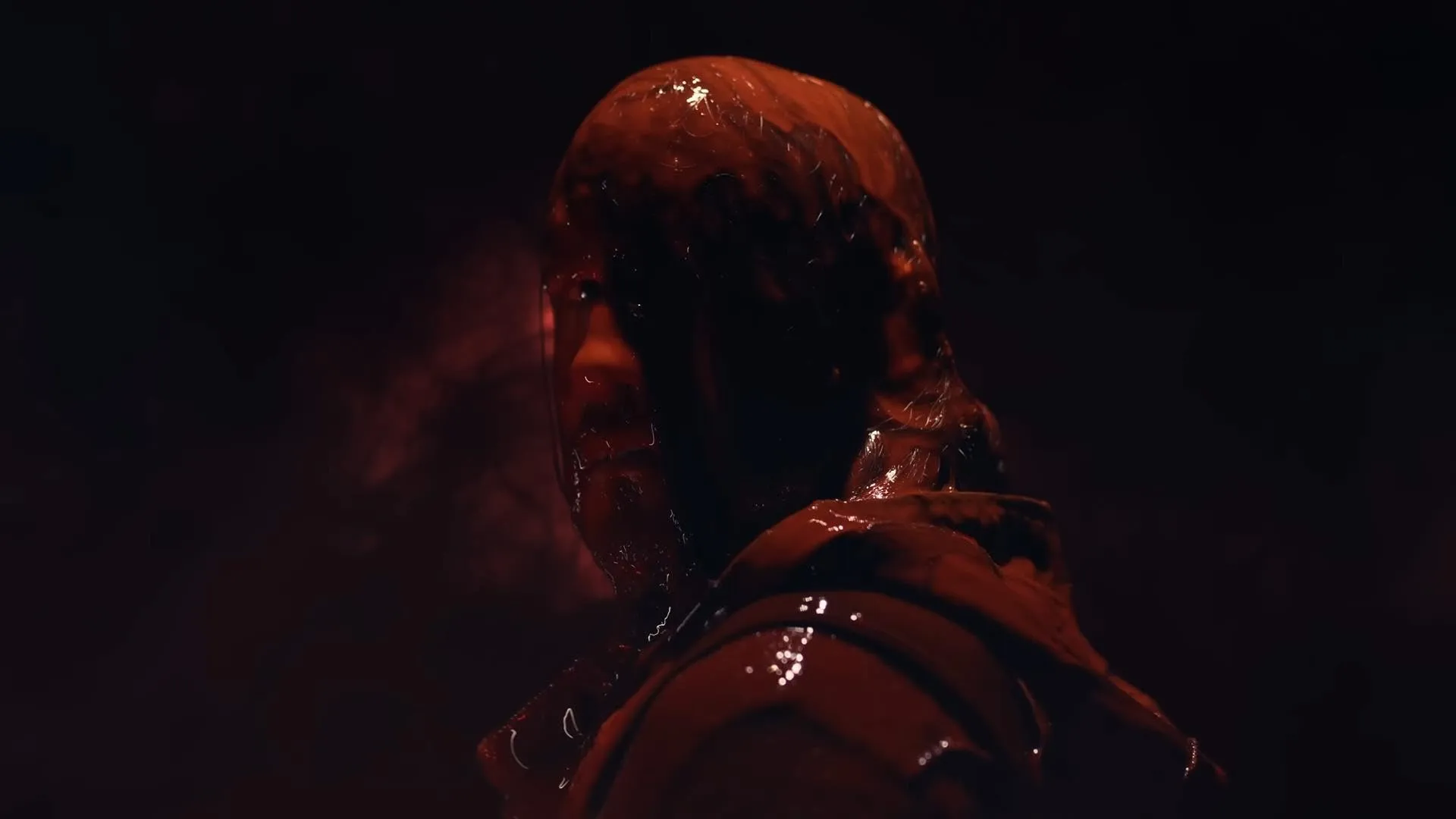
His isolation deepens the psychology. Simon mutters to himself. He shouts at disembodied, “crunchy” intercom voices, arguing with ghosts made of bad audio. That behavior maps the slow erosion of sanity in real time. The film gradually moves him from nameless prisoner to a specific, grieving man. The shift matters. The experience stops feeling like a technical exercise and starts carrying the shape of tragedy. We are watching the last lonely hours of someone discarded by his own kind, left to do work that benefits a species that has already decided he is expendable.
The script drops jagged shards of backstory tied to Filament Station. Those fragments hint at a past life and make Simon’s guilt feel as heavy as the ocean above him. His identity sits in dual form (victim of the Rapture, perpetrator of a forgotten crime), and the film refuses to sand down that contradiction. Hallucinations and flashbacks cut into the present and turn the Iron Lung into a mental prison as much as a physical one. His mind collapses at the same rate as the vessel. He survives while losing his reason for surviving, which feels like a painfully current condition: persistence without meaning, endurance treated as virtue even after the purpose leaks out.
Sonic Oppression
The soundscape forms an industrial symphony of failure. The hull groans. Blood drips outside with rhythmic insistence. Those sounds produce a constant “pressure-anxiety,” a sense that the audio itself has weight. The mix feels thick, almost suffocating, like it thins the air in the theater. The muffled hush of the blood ocean sits against the violent metallic cacophony inside the vessel, and that friction keeps the audience locked in alertness. Silence becomes ominous. Noise becomes predatory. Either way, the film refuses comfort.
Dialogue arrives with deliberate opacity. Transmissions from the Eden space station come through distorted and distant, and the choice does more than add flavor. It widens the space between Simon and everyone else alive. The intercom voices start sounding like echoes from a previous life, voices that belong to humanity’s past tense. The desperation in the voice acting comes through, and the technical crunch of the audio stops any full connection. The viewer remains stranded with him. Loneliness becomes a shared condition, imposed by design.
Andrew Hulshult’s score avoids cheap horror jolts and leans into synth-heavy industrial drones that vibrate in the chest. The music moves with the submarine’s slow progress, tightening tension as Simon approaches his coordinates. It refuses to hand out instructions about fear. It behaves like a warning that arrived late, a message you should have received ten minutes earlier. The score functions as a heartbeat for the machine, and that heartbeat starts missing beats as the descent continues.
Mythologies of the Hematic Deep
Turning a first-person game into a film demands “narrative-unfolding” that does more than stack jumpscares. The movie thickens the lore by introducing factions like the COI and sketching the moon’s history. The world-building gives the Quiet Rapture heft, taking what the source material hinted at and shaping it into something you can feel pressing on the frame. Shifting to a third-person perspective allows the camera to track what this environment does to a body. The film becomes documentation of a dying world, an artifact of collapse captured from inside the coffin.
The pacing stays intentionally sluggish, honoring the “methodical-monotony” of the mission. The film lingers as Simon repeats tasks, and that repetition builds a specific dread, the kind that grows through routine rather than surprise. The non-linear structure uses memories to interrupt the present and creates breathing room that still tastes bitter. Loss remains visible, even during pauses. The choice to never leave the submarine plays as a bold commitment. It forces the audience to accept the limits of Simon’s reality, and it forces the film to find variation inside constraint, the way a mind does when it has nowhere left to go.
Philosophically, the film asks a blunt question: does survival carry value after the universe has already ended? Simon finds purpose inside a death sentence, working like meaning can be manufactured through repetition. The blood ocean stands as a potent symbol for existence in its raw, violent state, the stuff beneath the stories we tell ourselves.
The unknown wears two faces here: monsters in the dark, and the cosmic scale of human irrelevance. The Quiet Rapture reads like an “end of history,” a point where human struggle stops registering as important. Simon keeps taking the photos. He keeps plotting his course through that red void. That small, stubborn refusal to stop becomes the film’s most haunting idea, and I admit it left me impressed even as part of me wanted to argue with it.
Premiering today, January 30, 2026, Iron Lung is a visceral science fiction horror film that serves as the feature directorial debut for Mark Fischbach, widely known as Markiplier. Based on the 2022 indie game of the same name, the narrative plunges viewers into a post-apocalyptic future where the stars have vanished, leaving survivors to explore a literal ocean of blood on a desolate moon. The film is a significant independent milestone, having been self-financed by Fischbach and self-distributed across more than 2,500 theaters. You can watch it in cinemas nationwide starting today, marking a major transition for creator-led cinema into the traditional theatrical landscape.
Full Credits
Title: Iron Lung
Distributor: Markiplier Studios, Piece of Magic Entertainment
Release date: January 30, 2026
Rating: R
Running time: 127 minutes
Director: Mark Fischbach
Writers: Mark Fischbach, David Szymanski
Producers and Executive Producers: Mark Fischbach, Will Hyde, Jeff Guerrero, Amy Nelson
Cast: Mark Fischbach, Caroline Rose Kaplan, Seán McLoughlin, Troy Baker, Elsie Lovelock, Isaac McKee, David Szymanski, Elle LaMont, Kazuki Jalal, Valkyrae
Director of Photography (Cinematographer): Philip Roy
Editors: Mark Fischbach
Composer: Andrew Hulshult
The Review
Iron Lung
Iron Lung is a claustrophobic masterclass in "industrial-dread" that proves how much can be achieved within a single, rusted box. It succeeds by treating its mechanical constraints as a narrative strength, turning a simple mission into a heavy, tactile exploration of cosmic despair. While the pacing occasionally mimics the sluggishness of a deep-sea descent, the visual and auditory texture creates an experience that feels genuinely visceral. It is a stubborn, defiant piece of independent filmmaking that prioritizes atmosphere over easy catharsis.
PROS
- Exceptional use of practical effects and tactile set design.
- Inventive lighting that utilizes darkness as a primary narrative tool.
- A haunting, industrial score that heightens the psychological pressure.
- Bold commitment to a single-location narrative without pandering to the audience.
CONS
- The methodical pacing may feel punishingly slow for some viewers.
- Distorted audio transmissions can make key lore details difficult to parse.
- Occasional over-reliance on expletives instead of nuanced dialogue.