























![Kingdom Hearts Collection [I-III] Review](https://gazettely.com/wp-content/uploads/2026/10/Kingdom-Hearts-Collection-I-III-1-360x180.webp "Kingdom Hearts Collection [I-III] Review: KHII Holds Steady as Newer Entries Fluctuate 37")





In Etrudia, fate has weight you can feel. Temirana runs beneath the watchful gaze of Vorntahl, a god tied to luck and fortune, and the rules of that faith reach into daily life with blunt force. Your birth month decides your social rank and the work you are expected to do.
For Cecilia Farias Temirana, the third princess, that system becomes personal and public. A clear birthmark on her head turns her into a living sign of misfortune in the eyes of the court. Her own family treats her as cursed and keeps her in a separate residence, away from the royal center and its rituals.
Cecilia carries another truth in secret: the Light of Good Fortune. It flares as a blinding radiance at moments of real danger or real opportunity, like the story is giving her a mechanic that triggers on high stakes. During the Helis Duelm tournament, that mechanic fires in a way she cannot ignore.
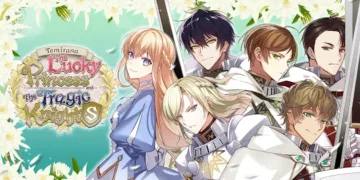
She sees five men lit by the same glow. Cecilia reads that sight as a signal of shared destiny and makes a choice that finally gives her agency inside a world built to trap her. She recruits them into a knight order of her own, turning a passive label into an active plan, and taking her first step toward challenging the superstition that has shaped her life since birth.
A Collective Strength Born from Hardship
Cecilia lands as a strong protagonist for this genre because she behaves like a lead who understands her own route structure. She does not wait for the plot to rescue her. She pushes forward, speaks first, and takes responsibility for the people pulled into her orbit. The script sometimes lets her sword training fade into the background, so her influence comes through less as physical dominance and more as leadership. She reads the room, keeps the group moving, and turns a set of isolated outcasts into a unit that can actually function.
Each recruit arrives with baggage that the story treats as both character hook and emotional pressure point. Josephy Cornelhild Zondarig, a fallen prince of Zondarig, hides his pride behind the bright cover of a traveling circus. His ego fills the space like armor, and it reads as someone trying to claw back a legacy he believes he deserves. Adel Narest plays a different note.
He is the oldest son of a poor farmer, responsible for nine siblings, and the writing ties his kindness to the stories he has absorbed from books. His dream of knighthood feels sincere because it grows out of care and duty. Tobias Harbeck Frey shifts the mood again. As the last member of a noble house, he lives with chronic illness and collapses often, which makes his wish to protect others hit with a particular sting. The game frames him as someone built for tenderness and tragedy at the same time.
Milan Herring adds friction the party needs. He is a perfectionist blacksmith, and his temper comes off like a shield for a deeper need to understand what happened with his adopted family. Then there is Kiya Nelty, a young orphan with a severe memory disorder that resets every morning. He relies on wooden tags around his neck to hold onto his identity, which turns something as basic as “who am I” into a daily gameplay loop for him as a character.
Around them, supporting figures help the order feel lived-in: Nilda, the strict maid who protects Cecilia with hard edges, and Benetti, a divine beast that looks like a stuffed animal. The emotional throughline is simple and effective. Each man finds belonging through Cecilia because she recognizes what it means to be treated as a social outsider. Her leadership converts private pain into shared purpose, and the story frames her supposed curse as the source of her empathy for people the stars have abandoned.
The Bonds of a Found Family
The pacing makes a clear statement about priorities. This visual novel asks for long-term emotional buy-in by stretching the common route across five to six chapters, which stands out next to many other titles in the space. That extra runway matters because it gives the group time to become a group.
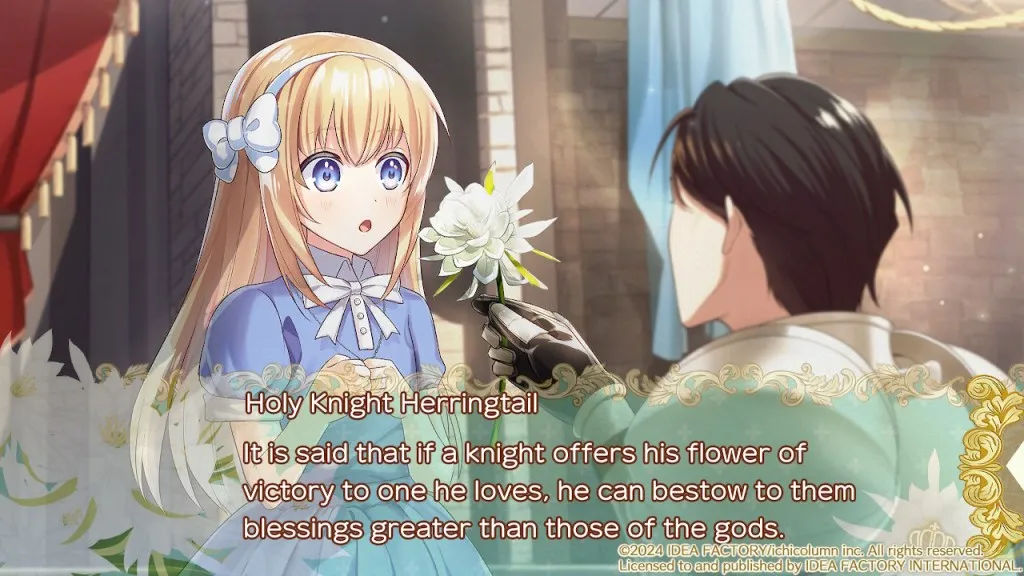
Instead of rushing to lock in a single pairing, the story spends hours letting six strangers learn each other’s rhythms: who flinches at praise, who hides behind jokes, who bristles at authority, who needs routines to feel safe. Before any branching happens, the player gets to watch trust form through repetition, small choices, and shared scenes that build familiarity.
After a knight becomes head of the order, the structure tightens into shorter character routes. The shift in length changes the emotional camera angle. The common route feels like building a base camp; the branches feel like stepping into one person’s interior world and seeing how that person steers the order’s direction. That design keeps the core relationship web intact, even as the focus narrows.
A mysterious calamity hangs over Temirana, described in vague terms through history books, and that threat works as a narrative anchor across every path. Each route offers a different angle on what stopping it might require, which encourages multiple playthroughs as a form of perspective gathering rather than simple completionism. Romance is present, and the writing treats it as a smaller layer next to the growth of the knight order.
The strongest resonance comes from the bonds inside the group and the way they choose each other. Finishing all five main stories unlocks a final secret route that ties the narrative threads together. The structure keeps pointing back to the same idea: the collective experience matters, and the group’s unity is the thing that can face an uncertain future. Across several runs, the tone shifts gradually from light group comedy into a higher-stakes mystery, and that escalation keeps momentum without breaking the found-family foundation the early chapters worked to earn.
Technical Performance and Artistic Choices
On the presentation side, the aesthetic work from Ichicolumn signals a different taste than the big, familiar releases many players associate with the genre. Character designs lean on angular lines, and the wardrobe choices feel more grounded, which fits a story that wants its characters to read as people shaped by social rules and private hardship.
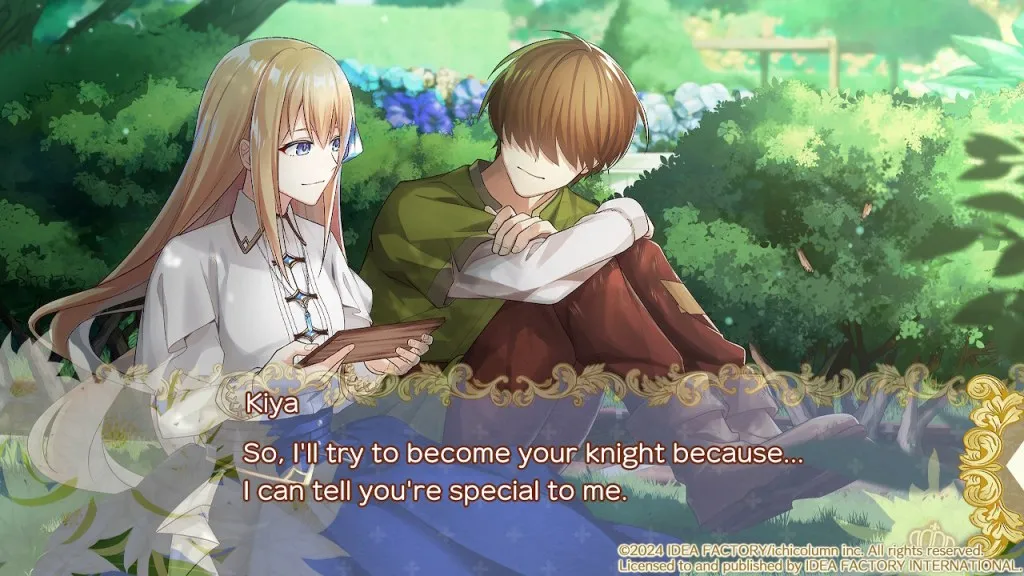
The art looks professional, and the game leans heavily on static backgrounds for visual storytelling. The CG illustration count, though, feels lighter than expected for a release at this scale, so the moments that want a big visual punctuation sometimes have to rely on writing and voice performance to land.
Japanese voice acting does a lot of heavy lifting. Every character, including minor NPCs, is fully voiced, and that decision gives Temirana texture that pure text struggles to supply on its own. When a scene cannot move visually, voice can still shift the temperature: exhaustion in a breath, pride clipped into consonants, fear tucked behind a too-calm line read.
Mechanically, the interface supports comfort and customization. Players can swap text box designs and tune transparency, which matters in a medium where hours of reading can turn small UI annoyances into real fatigue. Choice design stays straightforward. Decisions sometimes trigger silver streaks or sparkles that signal the best path, and those cues help players manage the Danger Choices that can lead to abrupt endings. It is a simple guidance system, and it fits the game’s interest in reducing friction during repeat runs.
The most noticeable technical issue sits in the English localization. Spelling and grammar errors appear frequently across the script, and that can break flow in a format defined by reading. When the writing asks for emotional focus, a typo can yank attention away at the worst moment.
Even with those stumbles, the package still offers a solid experience for genre fans, especially players who value character-first pacing and a party that grows through shared time. The physical Plus Edition adds collector appeal with a 37-track soundtrack and an audio drama, extending the story’s mood beyond the screen and reinforcing the sense that Etrudia is a place worth spending time in.
The Review
Temirana The Lucky Princess and The Tragic Knights
Temirana: The Lucky Princess and the Tragic Knights succeeds as an engaging "found family" fantasy that prioritizes character growth over typical tropes. Cecilia’s proactive leadership and the genuine camaraderie among her knights provide a refreshing take on the genre. While the lower frequency of CG art and frequent localization errors hamper the polish, the depth of world-building and strong voice acting make it a journey worth taking. It is a heartfelt experience for those who appreciate narrative substance and an active protagonist who defies fate.
PROS
- Proactive and capable female protagonist.
- Strong focus on group dynamics and "found family" themes.
- Deep world-building with an intriguing political backdrop.
- Full Japanese voice acting for almost all characters.
CONS
- Frequent spelling and grammar mistakes in the English translation.
- Lower volume of CG illustrations compared to similar high-budget titles.
- Long common route might feel slow for players seeking immediate romance.