

























![Kingdom Hearts Collection [I-III] Review](https://gazettely.com/wp-content/uploads/2026/10/Kingdom-Hearts-Collection-I-III-1-360x180.webp "Kingdom Hearts Collection [I-III] Review: KHII Holds Steady as Newer Entries Fluctuate 37")





Leonardo da Vinci imagined machines that could shrug off gravity, even if his designs never escaped the paper that held them. Code Violet opens by quoting him, a grab for Renaissance authority that sits beside its appetite for speculative pulp. It drops Violet Sinclair into a collision of time periods: the airless chill of space pressed against the raw violence of a prehistoric threat. As a PlayStation 5 exclusive, it sells itself as the next link in a dormant line of reptilian horror, asking players to survive a high-fidelity nightmare built from metal corridors and genetic ambition.
Violet wakes in her underwear and runs before she can even take stock of where she is. A predator has already consumed her companion, and that initial shock becomes the spark for a roughly six-hour push through a research station defined by claustrophobic steel and experiments that have clearly outrun restraint.
The loop blends resource management with third-person shooting. You scavenge for gear, juggle what you can carry, and try to avoid becoming the next body in the hallway. The game aims for survival-horror tension dressed in modern spectacle, staging a facility where past and future slam together with a blunt, violent rhythm.
Archetypal Friction and the Narrative of Passivity
Violet Sinclair enters the story as an empty container, short on inner momentum and without a clear set of beliefs to steer her choices. The game gestures toward the lineage of survivor icons like Lara Croft or Jill Valentine, figures whose appeal travels across borders because they project intent even when the world turns hostile. Violet rarely projects intent.
She ricochets from crisis to crisis with persistent confusion, and her frequent tears during emergencies cut against the hardened protagonist image suggested by the game’s marketing. Her presence reads less like a person shaping events and more like a body pushed through set pieces by voices outside the frame. She moves through scenarios she barely understands, with little sense that her decisions matter.
The narrative scaffolding leans on familiar science-fiction furniture: far-future colonization paired with clandestine genetic experimentation. The pieces read like a collage assembled from sci-fi cinema, stitched together without a strong guiding idea that feels specific to this setting. The plot’s momentum accelerates at the worst time, with final revelations arriving in a rush that robs them of weight.
Much of the most grounded world building sits in journal entries left beside corpses, a secondary channel that carries texture and specificity the primary cutscenes often fail to deliver. Those cutscenes can feel hurried and derivative, and the supporting cast rarely rises above function. Jason exists mainly as a conduit for exposition, and his death on a random floor lands with a thud because the game never builds the emotional bond required to make that moment sting.
Performance and presentation add another layer of distance. The vocal work plays everything straight, with a solemn intensity that insists the story is heavy even as the premise leans into space dinosaurs. That seriousness could have worked as intentional camp in the spirit of mid-century genre cinema, where sincerity and absurdity can share the same frame. Here, the tone carries little self-awareness, so the earnest delivery clashes with the pulpy setup in a way that feels accidental.
Animation compounds the problem. Violet’s voice can sell panic, grief, and strain, yet her face often stays locked in place, leaving emotion stranded in the audio. The player is asked to invest in a protagonist who seems disconnected from her own trauma, and that disconnect blocks the game from reaching the narrative depth it wants to borrow from the classics it keeps echoing.
Mechanical Instability and the Logic of the Predator
The third-person shooting lacks the physical punch expected from contemporary action design. Guns feel weightless in use, and the shotgun never delivers the resonant boom that should make each blast feel dangerous. Its report lands closer to someone blowing through a paper straw wrapper, a sound that drains tension instead of building it.
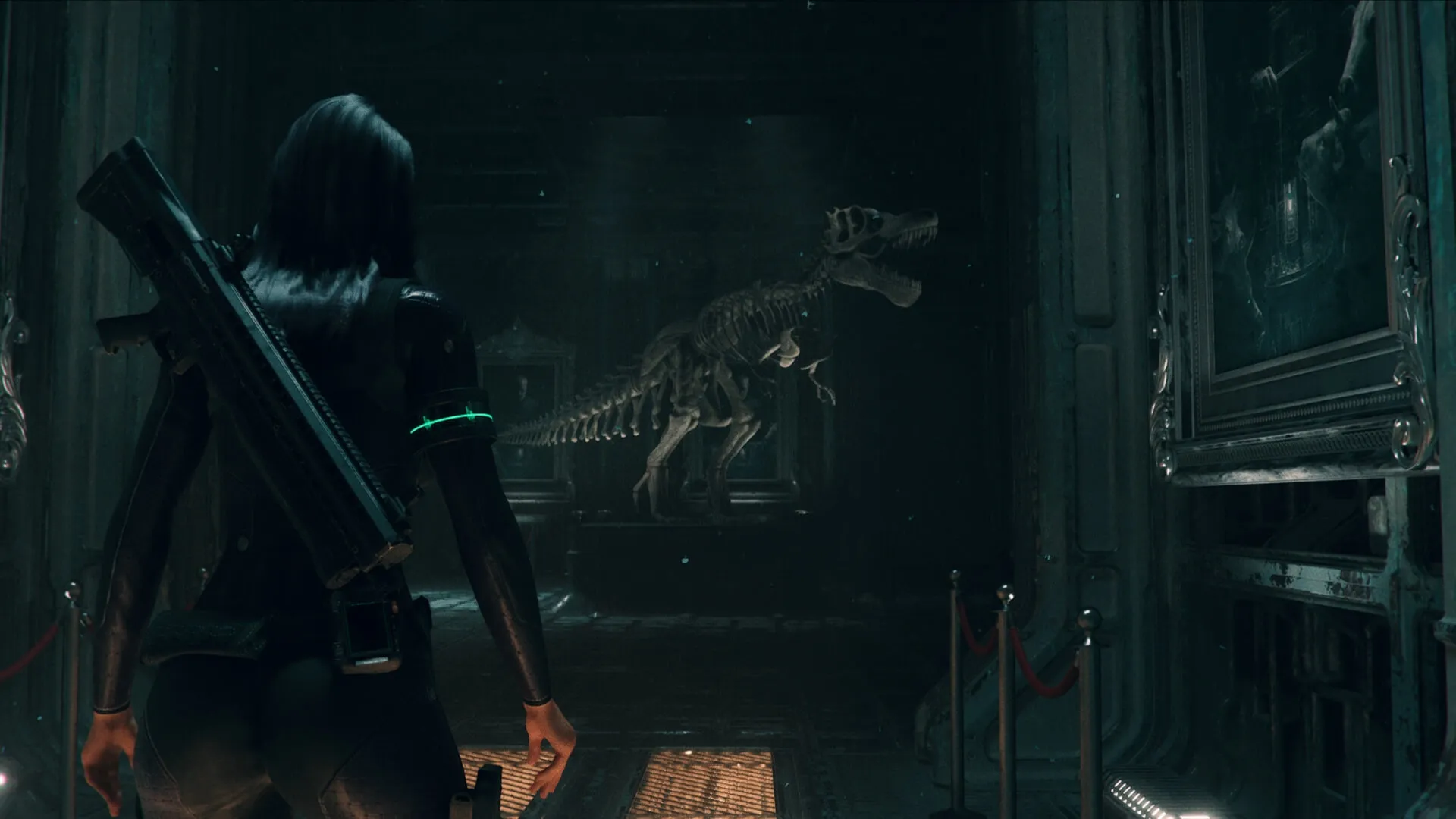
Combat also suffers from unreliable interaction. Hitboxes behave erratically, so even a clean line on a target can leave you uncertain about whether a shot connected. Visual feedback stays thin, and the game often withholds confirmation until a creature abruptly collapses. That absence of clear “game feel” turns encounters into chores, with the player spending energy parsing the system instead of riding the fear the scenario wants to create.
Enemy behavior swings between extremes. Dinosaurs can detect Violet instantly, independent of what sightlines or noise would suggest, as if the AI reads her presence from the script rather than the space. Then that awareness evaporates, with raptors running in circles or ignoring her completely. Spitters and smaller reptiles fall into predictable patterns, and fights settle into a rote routine of stepping backward and firing into a steady approach. The AI does not react to player tactics, so the dinosaurs function like moving barriers more than hunters. For a game leaning on predator fantasy, the enemies rarely feel like agents with intent.
The GlassVeil invisibility suit further destabilizes the experience. Activating it can make bosses stand still and wait for Violet to reappear, a stealth mechanic that collapses enemy responses and turns major encounters into waiting games. With that tool in play, careful movement loses meaning, and the remaining challenge comes down to repetition. Boss fights lack the strategic texture associated with strong examples in the genre.
These enemies behave as massive pools of health that reward persistence and patience. Many battles reduce to circling a room and keeping distance, which exposes how little the combat system asks of the player beyond endurance. The horror premise and the action mechanics fail to support each other. The player ends up fighting technical limitations and brittle systems, and the prehistoric threats start to read like glitches wearing dinosaur skins.
Structural Repetition and the Architecture of the Void
The facility’s layout relies on a relentless run of metallic halls and indistinguishable laboratories. Spaces blur together, and landmarks are scarce, so movement becomes guesswork rather than exploration. The lack of a map forces blind wandering through corridors that share the same surfaces, the same lighting, the same dead-end geometry.

Outdoor segments offer a brief shift in palette, yet they function as long, empty passages lined with tall grass. These stretches provide little environmental storytelling, and the world carries a sterile, uninhabited quality that keeps the station from feeling like a place where people lived and worked before everything fell apart.
Puzzle design leans backward in complexity. Valve turns and button sequences feel like relics of an older convention, presented without the satisfaction of a meaningful mental payoff. The tasks exist mainly to gate progress until the correct sequence happens.
The game also leans heavily on keycards hidden in dark corners, turning exploration into a hunt for pixels rather than a process of understanding space. Systems are rarely explained, so players spend time guessing how to use equipment and interpreting menus through trial and error. Confusion becomes part of the texture, and frustration hangs over the experience because the game offers few tools to learn its own rules.
Management and inventory systems add more friction. Weapons require manual equipping through a menu that rarely feels intuitive, and the game pushes frequent returns to storage boxes. Flow breaks every time the player is pulled into another inventory cycle, another swap, another trip to stow items. Upgrades such as inventory expansions can be missed easily, punishing anyone who does not examine every repeated room.
Backtracking through empty halls becomes a defining part of the loop, often triggered by a forgotten item or a keycard tucked into a familiar corner. The station’s repetition drains discovery of pleasure, and the time it demands does not feel respected. Room after room reads like an echo of the last, stripping the setting of identity and any sense of history embedded in architecture.
The Fidelity Gap and the Technical Uncanny
Visually, Code Violet carries a split personality. From a distance, creative skyboxes and floating islands suggest a grand science-fiction vision, and those vistas offer rare moments of beauty that hint at what the game wants to be. Step closer and the illusion frays.
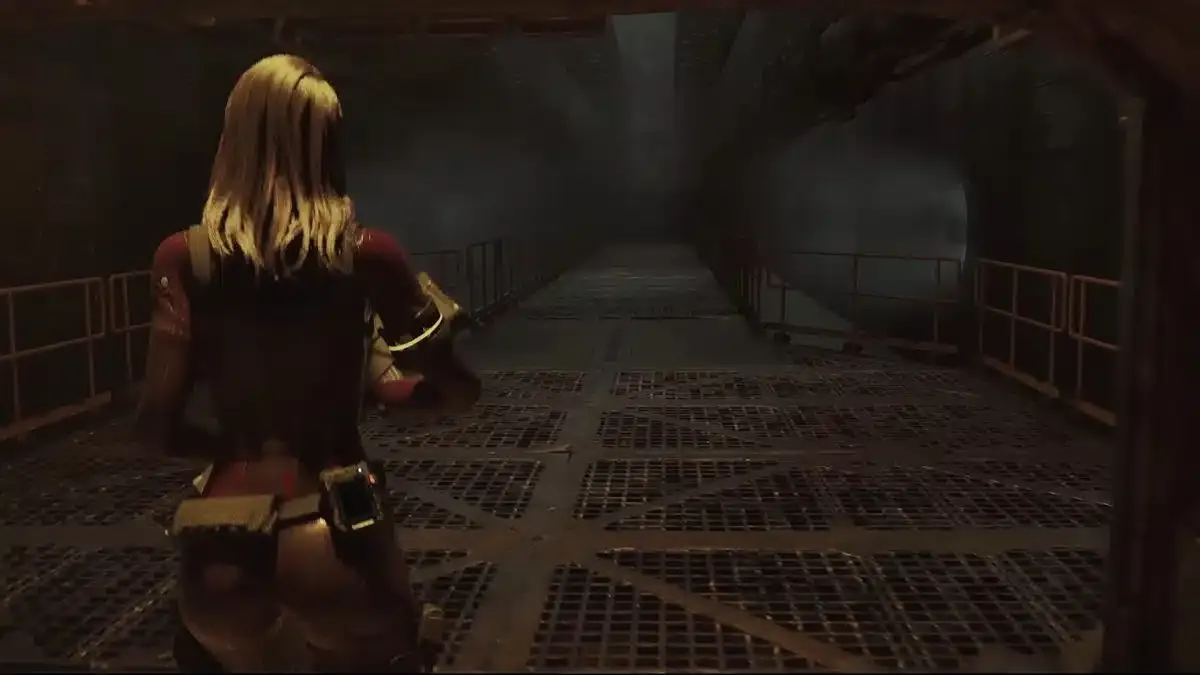
Textures turn muddy, and metallic surfaces reflect light in gaudy, unnatural ways that feel disconnected from the grime the art direction aims for. Dirt and decay read as flat smears instead of tactile detail. The promise of high fidelity collapses the moment the player pauses to look at a wall or a floor, and the inconsistency makes the world feel unfinished and cheap.
On PlayStation 5, technical instability cuts into play at a constant, practical level. Weapons can disappear, ammo displays can show the wrong information, and crashes can arrive without warning. Lighting frequently breaks, causing assets to vanish or fail to load, and the result suggests a release that never reached a stable state.
Performance stutters interrupt high-intensity scenes, weakening immersion at the moments where the game most needs confidence. Some props, like soda machines or paintings, have an oddly synthetic look, like assets produced by an algorithm instead of designed with intention. That impression deepens the uncanny feel of a station that already struggles to convince as a lived-in space.
Audio design fails to hold the atmosphere together. The mix can glitch, with music or dialogue dropping out during story beats that depend on timing and emphasis. Ambient dinosaur noises also mislead, suggesting enemies that are not present. The player learns distrust of the game’s cues, and fear turns into irritation.
Hardware features like DualSense haptics appear in a basic way, and the triggers avoid the variable resistance that could have made different weapons feel distinct. Even the armband HUD that displays health reads like a surface-level immersion device, since the rest of the game rarely supports that idea with consistent tactile feedback. These failures do not read as minor bugs. They shape the feel of nearly every moment, from combat to traversal to narrative delivery.
The Gaze of the Machine and Tonal Fragmentation
The camera creates an ongoing fight between player intent and spatial awareness. It clings to Violet’s body and regularly sacrifices visibility. In tight corridors, the camera collides with walls and turns encounters into unreadable motion, leading to deaths that feel arbitrary because threats remain offscreen.

The framing behaves like a voyeuristic lens, prioritizing angles that flatter the character model over angles that communicate danger. That choice lands sharply in a game positioning itself as serious survival horror, where clarity is part of the contract between player and designer.
Costume options further complicate tone. The game offers a range of revealing outfits, letting players dress Violet as a pin-up or a “sexy secretary” even as the script pushes grief and endurance. Those outfits sit beside a protagonist who remains dour and humorless, and the mismatch produces unintentional comedy.
Violet can mourn a fallen comrade while wearing cowgirl chaps, and the moment collapses under the weight of its own staging. The developers encourage an aesthetic that feels detached from the earnest narrative they wrote, and the tension between these impulses keeps the game from holding a steady emotional register.
This gap between ambition and execution defines the experience. The game reaches for the status of cultural landmarks, yet it stays trapped in technical and artistic jank. The sexualized presentation of the lead character reads archaic next to the nuanced portrayals common in modern global media, and that dated gaze clashes with the story’s attempt at sincerity.
The systems never form a coherent whole, and the game’s attempt to occupy multiple cultural spaces leaves it scattered. What remains is a pile of broken ideas held together by a camera that refuses to look away from its protagonist, a project that values surface over substance and leaves the player with exhaustion instead of accomplishment.
The Review
Code Violet
Code Violet is an ambitious but fundamentally flawed tribute to the survival horror genre. It struggles with a profound identity crisis, clashing a somber narrative against an archaic, voyeuristic aesthetic. The weightless combat, erratic artificial intelligence, and persistent technical failures create a loop defined by frustration rather than tension. While its occasional vistas hint at a grander vision, the execution remains trapped in a cycle of repetition and mechanical jank. This experience serves as a reminder that visual fidelity cannot mask a lack of structural substance.
PROS
- Striking skybox designs and creative outdoor environments.
- High-fidelity hair physics and character modeling.
- Interesting world-building hidden within environmental journals.
- Occasional moments of unintentional B-movie humor.
CONS
- Weightless gunplay with poor audio and visual feedback.
- Unreliable camera that obstructs visibility in tight spaces.
- Repetitive level design and simplistic puzzle mechanics.
- Numerous technical bugs, including crashes and asset glitches.
- Significant tonal disconnect between the story and character customization.







