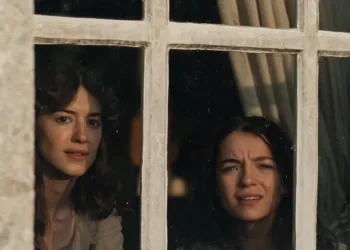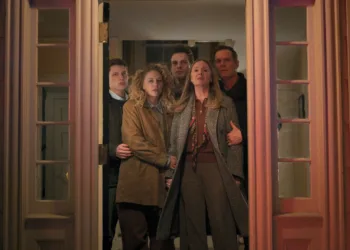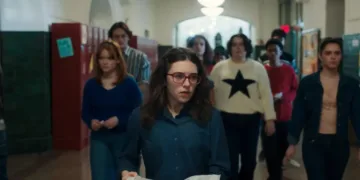
















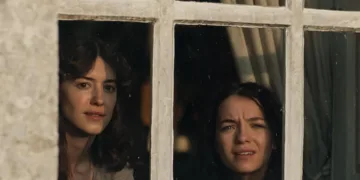










Run Amok introduces Meg, a thirteen year old freshman whose silhouette is inseparable from the massive harp she drags through the corridors of Lincoln High School. The instrument reads as craft and constraint at once, a shining barricade of sound inside a building still marked by a decade-old tragedy. Ten years earlier, a mass shooting took the life of Meg’s mother, a beloved art teacher.
As the administration prepares a polished tenth anniversary memorial, Meg refuses the script. She pushes for a musical that restages the violence with blunt specificity, denying the soothing closure that a traditional ceremony promises. That choice puts her on a collision course with Principal Linda, whose management style relies on enforced optimism and carefully sanded edges. Meg finds an unlikely partner in Mr. Shelby, a music teacher celebrated as the hero who stopped the original massacre.
The story tracks the friction between Meg’s insistence on raw truth and an institution trained to package grief into something presentable. It watches a community trying to live with its history while the younger generation asks for a clear reckoning with the world left behind. Meg pulls her cousin Penny and a circle of peers into the project, turning horror into melody and exposing the gap between adult evasion and adolescent lucidity.
Weight, Grace, and the Performance of Grief
Alyssa Marvin gives Meg a startling physical presence. The performance sketches a socially isolated misfit whose wardrobe and gestures suggest a girl misaligned with her own era, clutching pencils with a strained intensity that borders on ritual. The recurring image of Meg hauling the harp becomes the film’s plainspoken symbol for accumulated, unprocessed trauma: something heavy, awkward, impossible to carry gracefully, and still carried every day.
Across from her, Patrick Wilson shapes Mr. Shelby into a layered figure whose softness carries hairline fractures. He first registers as a gentle mentor, then slowly shows a psyche split by what he survived. His evolution into someone fixated on militant safety measures maps the lingering contamination of survival, the way heroism can curdle into control.
Margaret Cho plays Principal Linda as an administrative barricade, embodying the adult impulse to protect an uplifting narrative from the intrusion of painful detail. That public battle echoes the private chill Meg meets at home. Molly Ringwald’s Aunt Val holds herself with stony distance, a reserve that leaves Meg stranded inside her own family, surrounded by relatives and still without warmth. Sophia Torres, playing the popular cousin Penny, supplies a needed counterweight.
Penny becomes the connective tissue between Meg’s consuming fixation and the broader student body, lending her presence to a production she barely understands and joining the work anyway. The film moves through sharply different acting registers, sliding from quiet realism into broad, high energy satire. The lack of a single, uniform mode mirrors a world that feels knocked off balance, where grief refuses to behave consistently from one room to the next.
The Satirical Catharsis of the Heart Enema
The film twists the familiar “let’s put on a show” framework into something harsher and stranger, using the high school musical as an engine for excavating deep seated trauma. Meg names her goal with deliberately crude clarity: a heart enema, a complete and painful evacuation of grief that has hardened inside the community. That desire for catharsis sits inside a pointed satire of American school safety culture.
The Parent Teacher Arms Association, or PTAA, operates as a grotesque parody of public debate, a civic costume that makes extremity look procedural. Adults patrolling hallways with rubber bullets turns the school into a grim cartoon, and the cartoon lands because the film keeps its eyes on the children forced to absorb it.
Meg further complicates the moral geometry by meeting Nancy, the shooter’s mother. The encounter grants the perpetrator’s family a human face, introducing a discomfort many people work hard to avoid. The script repeatedly returns to a bleak suggestion: the kids speak with clearer honesty than the adults, who retreat into empty language like “thoughts and prayers” as if repetition could substitute for responsibility.
Humor becomes the blade that exposes the surreal logic of active shooter drills, treating routine preparation as a symptom of collective sickness. The musical takes shape as protest through practice, a project that lets students repossess their own hallways and recast a place of victimization into a stage where they can assert agency.
A Chaotic Symphony of Truth and Style
Director NB Mager expands her original short film into a feature that thrives on instability. The work embraces tonal risk, placing slapstick comedy in the same frame as visceral tragedy and letting the seam show. The soundtrack becomes a central part of that strategy.
Pop standards from Britney Spears and Roberta Flack lose their Top 40 sheen and return as haunting orchestral arrangements, familiar melodies repurposed into instruments of unease. The film’s emotional high point arrives in a hallway reenactment where students meticulously map the movements of the victims. The sequence functions as the movie’s fixed point, shifting the air from acidic satire to an unblinking, grim reality.
A running eccentric detail appears through the janitor character’s efforts to hunt squirrels, a comic note that also marks a person knocked loose by memory. The visuals lean into retro cars and dated home decor, giving the setting a slightly unmoored, time-displaced quality that makes the story feel timeless and suggests an enduring American cycle of violence and remembrance.
The second half grows crowded with competing ideas and overlapping themes, and the structure carries that clutter openly. The pacing stumbles as the narrative reaches toward a larger statement, and the film still holds to a certain candor about its subject, presenting fracture as an honest shape for a problem that refuses neat resolution.
Run Amok premiered on January 19, 2026, as part of the U.S. Dramatic Competition at the Sundance Film Festival. Based on the 2023 short film of the same name, this feature-length debut from NB Mager explores the intersections of trauma and creative catharsis through the lens of a high school musical. As of today, February 1, 2026, the film is continuing its festival circuit run. While a wide theatrical or streaming release date has yet to be announced by a major distributor, it remains one of the most discussed titles of the current festival season.
Full Credits
Title: Run Amok
Distributor: Sundance Film Festival (U.S. Dramatic Competition Premiere)
Release date: January 19, 2026
Running time: 103 minutes
Director: NB Mager
Writers: NB Mager
Producers and Executive Producers: Julie Christeas, Frank Hall Green, Patrick Wilson
Cast: Alyssa Marvin, Patrick Wilson, Sophia Torres, Molly Ringwald, Margaret Cho, Yul Vazquez, Bill Camp, Elizabeth Marvel
Director of Photography (Cinematographer): Greta Zozula
Editors: NB Mager, Jarrah Gurrie
Composer: Ariel Loh
The Review
Run Amok
Run Amok is a jagged piece of cinema that refuses to look away from the wreckage of the American school experience. It succeeds by allowing a teenager to reclaim the narrative of her survival through the medium of art. While the tonal shifts are sometimes jarring and the script occasionally loses its focus, the raw power of the central performance remains undeniable. It is a messy work that mirrors the chaos of its subject.
PROS
- Alyssa Marvin provides a visceral and haunting lead performance.
- The film offers a sharp, necessary satire of modern safety measures.
- Musical numbers provide a raw way to confront historical trauma.
- The script successfully subverts traditional ideas of heroism.
CONS
- The shifts between slapstick humor and grim reality feel disjointed.
- Secondary characters are often played with a distracting level of exaggeration.
- The final act struggles under a heavy load of competing ideas.