


























In the wake of academic completion, Elliot drifts into the orbit of Erika Tracy. She is a visual artist whose notoriety rests on provocations that command high prices. Erika establishes a clear hierarchy and casts the aimless young man as her private submissive. Elliot attempts to maintain a frayed connection with Minerva, a medical student whose rigorous schedule precludes intimacy.
The film uses a traditional flashback mechanism. It begins with a startling image of Elliot in distress at a gated estate. A title card then rewinds the clock nine weeks to reconstruct the events. The story examines the mechanics of consent and the performative nature of contemporary creativity. It moves through highly stylized environments while tracking a workplace liaison that disregards every standard professional limit.
Shot composition reduces bodies to objects and the camera’s gaze privileges surface; the camera often lingers on material finish and staged poses. This is a study of power dynamics masked as a carnal lark. The narrative structure suggests a fatalistic loop. We begin with the wreckage and spend the duration of the film identifying the debris.
The Scenography of Exploitation
Erika Tracy’s studio functions as a high-concept factory. Assistants engage in the repetitive labor of chewing gum to construct a labia-shaped canvas. Vikktor manages this “hipster sweatshop” with a glacial, deadpan efficiency that strips the process of any romantic notion of creation. Erika herself admits that her field rests on a foundation of deception.
She posits that the actual skill involves persuading a gullible public that a collection of papier-mâché phalluses holds profound meaning. The initial interview between Erika and Elliot serves as a masterclass in psychological destabilization. She begins by accusing him of inappropriate staring, a tactic designed to manufacture guilt and strip him of his defensive footing.
Once he is sufficiently off-balance, she offers a sexual proposition. This arrangement is guarded by a legal non-disclosure agreement. Such a document formalizes the erasure of professional limits and establishes a space where corporate hierarchy and private fetishism become indistinguishable. The physical objects produced in the studio mirror the carnal nature of their pact.
Also Read





The creation of anatomical sculptures provides a tactile representation of the way Erika commodifies human desire. The art is the transaction. The transaction is the power. It is a cynical loop where the labor of the assistants produces the very symbols of their own subjugation. The studio serves as a cage gilded in neon, where the production of “meaning” is merely a cover for the assertion of will.
Ideological Collisions and the Relief of Submission
The film presents a sharp opposition between Erika’s uninhibited aggression and the cautious approach of Elliot’s contemporaries. Elliot explains the hesitation of his peers as a response to a world of digital surveillance and a global health crisis. He describes a generation that prefers rigid rules of engagement to avoid the risk of actual vulnerability.

Erika treats this perspective with open contempt. She labels it as a form of “retro sex negativity” and accuses the young of being too terrified to reveal their true selves. Minerva embodies this antiseptic modern existence. Her life is a series of clinical demands that leave no room for the messy unpredictability of physical passion. She exists as a shadow of a partner.
The film probes free will and identity through these arrangements; relinquished choice answers modern anxieties about selfhood and ethical gray zones accumulate around each transaction. Erika offers a dangerous but vivid alternative. Apple observes this transformation with growing alarm. Her participation in a three-way encounter marks a shift in the film’s moral weight. It reveals the genuine damage caused by Erika’s calculated games. For Elliot, the arrangement provides an unexpected existential peace.
By relinquishing his agency, he finds a respite from the burden of choice. Being a submissive allows him to bypass the anxiety of moving through a complex social landscape. He trades his autonomy for the simple clarity of an order. It reads as a Faustian bargain in which the lack of freedom converts into a brittle form of liberation. He finds comfort in being a tool; personhood loses its appeal.
Chromatic Saturation and Noir Constraints
The film operates within a rigid framing device. Scenes of police interrogation provide a somber anchor to the narrative. Detectives portrayed by Johnny Knoxville and Margaret Cho use a stern, grounded delivery to ground the story in a legal reality. Their gray, austere environment provides a visual palate cleanser against the neon chaos of Elliot’s memories. Once the story shifts back to the flashbacks, the screen radiates with high-saturation color.
Bright pink captions and artificial lighting choices suggest a pop-art sensibility that borders on the surreal. The production design utilizes a palette that feels both appetizing and aggressive. The film borrows formal devices associated with noir, such as sharp light–dark contrasts and expressionistic framing, while infusing them with neon pop saturation.
Costume design serves as a vital tool for characterization. Erika moves through the frame in latex power suits and translucent dresses. Her clothing choices transform every office into a stage for her dominance. The film shifts between the cadences of a workplace comedy and the tension of a psychological thriller. This tonal instability keeps the viewer in a state of constant readjustment. It mirrors Elliot’s own disorientation as his erotic education becomes a potential crime scene.
Animated inserts and stylized outtakes during the credits maintain a sense of playful irreverence. These edits and tonal shifts manipulate pacing and viewer expectation, and sound cues at key beats underline the film’s artifice. These elements prevent the film from becoming a heavy-handed morality play. The visual language suggests that in this world, appearance is the only reliable truth. The camera lingers on the sheen of the latex, insisting that surface is where meaning registers.
The Evolution of the Puppet and the Puppeteer
Olivia Wilde inhabits the role of Erika with a campy, imperious energy. She avoids any pretense of subtle emotion to present a woman who treats vanity as a professional requirement. Her performance relies on sharp line delivery and a total lack of empathy. Cooper Hoffman provides the necessary counterbalance through a display of poignancy and guileless enthusiasm.
He begins the film as a blank slate. As the narrative progresses, his initial innocence curdles into a desperate obsession. He struggles to reconcile his physical servitude with a burgeoning emotional need. This confusion between lust and love defines his descent.
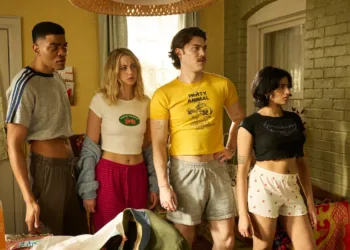
The supporting cast adds depth to this fractured social circle. Charli XCX portrays Minerva with a chilling detachment. She represents a partner whose absence is felt even when she is physically present. Chase Sui Wonders brings a grounded warmth to Apple. She acts as the moral compass of the film, highlighting the cruelty hidden within Erika’s “freedom.” Daveed Diggs and Mason Gooding provide dry comedic relief.
Gooding’s portrayal of Zap offers a worldly perspective on the carnal politics of the studio. The final act tracks a significant shift in the central dynamic. The arrangement was designed to be purely transactional. As feelings infect the pact, the structure collapses into a messy entanglement. The “sex slave” becomes a figure of genuine grievance. The puppeteer loses interest once the puppet begins to speak back.
I Want Your Sex premiered at the Sundance Film Festival on January 23, 2026, marking a bold return for director Gregg Araki. The film stars Olivia Wilde as Erika Tracy, a provocative artist who enters into a complex, erotic power struggle with her young assistant, Elliot, portrayed by Cooper Hoffman. As of January 26, 2026, the movie is finishing its festival circuit run and is currently seeking wide theatrical and streaming distribution in the United States.
Full Credits
Title: I Want Your Sex
Distributor: Black Bear Pictures, Elevation Pictures
Release date: January 23, 2026
Rating: TV-MA (Adult Content)
Running time: 90 minutes
Director: Gregg Araki
Writers: Gregg Araki, Karley Sciortino
Producers and Executive Producers: Seth Caplan, Michael Heimler, Teddy Schwarzman, Karley Sciortino, Gregg Araki, John Friedberg, Andrew Golov, Courtney L. Cunniff, Joanne Roberts Wiles
Cast: Olivia Wilde, Cooper Hoffman, Charli XCX, Mason Gooding, Chase Sui Wonders, Daveed Diggs, Johnny Knoxville, Margaret Cho, Roxane Mesquida
Director of Photography (Cinematographer): Tucker Korte
Editors: Gregg Araki, Victor de la Parra
The Review
I Want Your Sex
I Want Your Sex functions as a vivid interrogation of modern intimacy. It strips away the pretense of professional ethics to reveal a raw struggle for dominance. While the narrative occasionally falters under its own stylistic weight, the performances remain sharp. The project offers a cynical look at the price of relinquishing agency for a fleeting sense of security. It stands as a loud entry in the canon of erotic thrillers.
PROS
- Striking visual palette and pop-art aesthetic
- Sharp, committed performances from the lead actors
- Biting satire regarding the contemporary art market
CONS
- Thin character development in the second half
- Distracting mystery framework
- Occasional shifts into a didactic tone