






















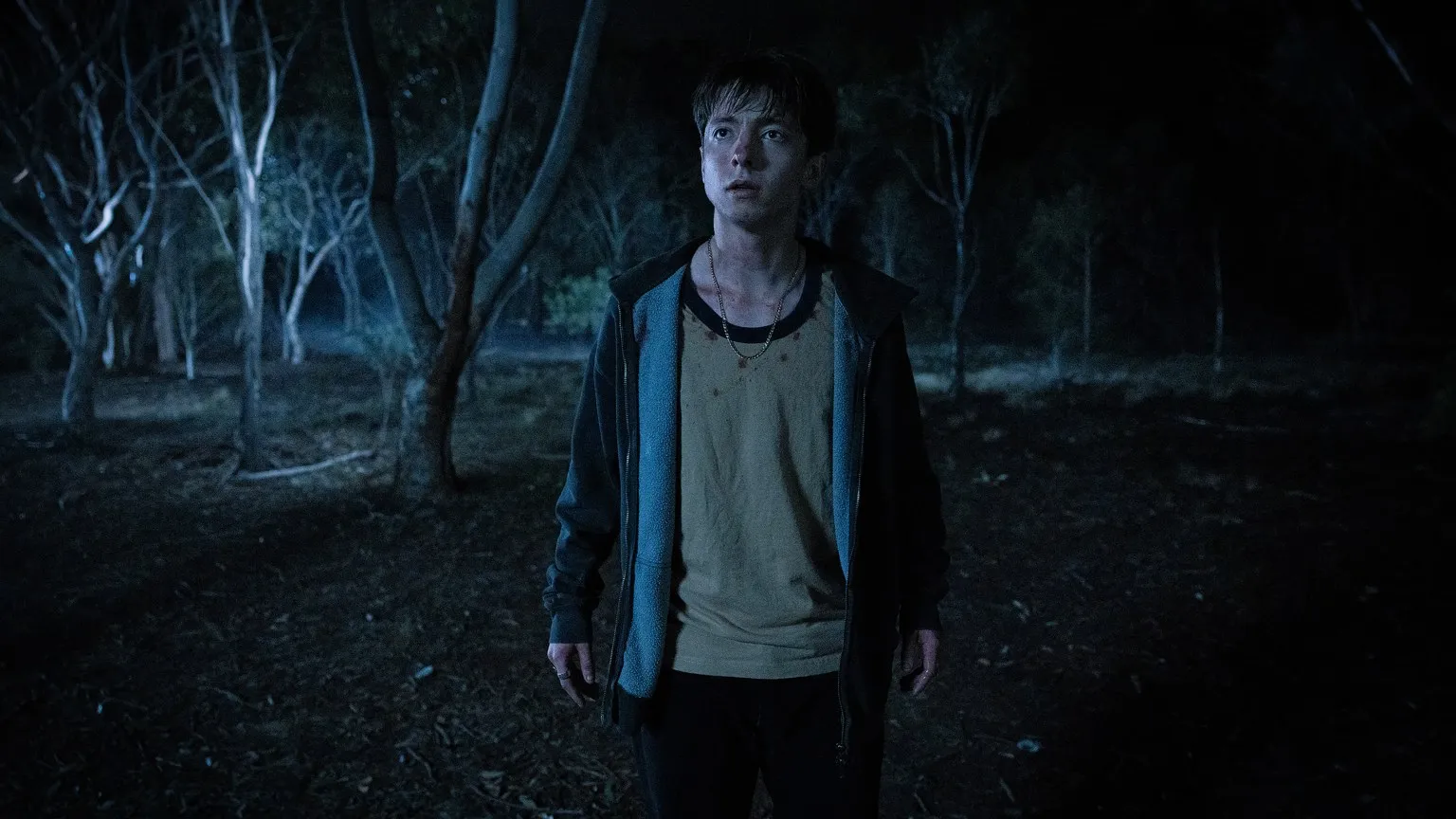

The Australian industrial landscape gives Adrian Chiarella’s feature debut, Leviticus, its harsh foundation. The film locks in its look through a gray, weathered suburb in Victoria, a place where the air seems thick with rules that no one bothers to say out loud. Naim, a quiet teenager played by Joe Bird, arrives with his mother after she seeks spiritual shelter inside a rigid Christian congregation. Mia Wasikowska plays her with an icy remove, and that distance matters. It plants the family inside a community where faith operates as an instrument of control, measured in compliance and punishment.
Naim reads as isolated from the first beat, and the film does not rush to soften that. Relief comes through Ryan, a local student whose roughness covers a need for closeness he cannot admit in public. Their connection becomes a private refuge, built against the town’s suffocating moral posture.
Chiarella takes his time here. The early passages favor atmosphere over jump-scare momentum, setting the story in a recognizable social reality before the supernatural turn arrives. The initial danger is simple and sharp: social exile, enforced by parents, peers, and the church. When the horror escalates, it lands like the next step in a cruelty the town already knows how to practice.
Sanctuaries and the Price of Betrayal
Naim and Ryan carve out their freedom inside the rusted frame of an abandoned mill. The mill sits beyond the gaze of parents and the congregation, giving them room to test an identity that would draw condemnation anywhere else in town. Their bond begins under the cover of teenage performance.

They hurl heavy scrap metal. They wrestle, turning physical contact into something that can pass as aggression. Chiarella pays attention to the precise instant that pose falls away. A pinned hold shifts into genuine tenderness, and a kiss on the cold floor lands with a feeling of risk that the scene never tries to romanticize into safety.
To keep the mill as their territory, the boys invent a small language. “Been to the mill” becomes a code phrase, a way to name their meetings without naming them. It is a smart detail because it shows how secrecy turns into daily logistics. The film treats concealment as labor, and it lets the audience feel the strain of keeping a private life intact in a town built to police it.
That secrecy remains fragile because Ryan is terrified of exposure. His fear shapes the relationship into a power imbalance that Naim eventually cannot tolerate. When Naim sees Ryan sharing a similar moment with the pastor’s son, jealousy hits with the blunt force of adolescence.
Naim does not confront Ryan. He goes to the pastor’s home and reports what he witnessed. The story pivots on that choice. It marks Naim’s shift from someone crushed by a restrictive system to someone who helps it do its work. The betrayal functions as a key narrative switch, sending the film into its horror mode while keeping the cause rooted in emotional desperation that turns corrosive.
The Mechanics of Supernatural Shame
The film’s move into full horror arrives during a public deliverance ritual led by a visiting faith healer. Chiarella dodges familiar exorcism beats by staging the process as something that resembles infection. The healer uses fire and religious rhetoric to push the boys into violent physical collapse. They convulse. They foam at the mouth. The imagery suggests bodies reacting against “sins” the church has named and targeted. The ritual does not erase their desire. It turns that desire into a weapon aimed straight back at them by attaching a parasitic curse.
The curse takes the form of a shape-shifter that wears the face of the person the victim loves most. The haunting follows clear rules that make it feel engineered for humiliation. The entity appears only when the victim is alone. It waits for vulnerability. It speaks in gentle words, using a lover’s familiar face to lure the victim into an embrace, then it attacks with sudden brutality. The setup is cruelly efficient. It transforms intimacy into a trigger, turning the longing that once made the mill feel like shelter into a constant threat.
That creature operates as a literal version of internalized self-hatred, and the film makes the isolation complete by keeping it invisible to everyone else. The victims suffer in private, and the community stays free to explain away what it refuses to see. Injuries get dismissed as bullying or accidental self-harm.
That decision anchors the supernatural in something painfully plausible: the world around these boys has plenty of practice minimizing their pain. The film argues that being told your love equals death can build a monster that exists for you alone. The violence in these sequences is direct and unflinching, stripping away the mill’s early romance and replacing it with a lethal distrust that never fully loosens its grip.
The Architecture of Isolation
Much of the horror in Leviticus comes from adult complicity, and Mia Wasikowska’s work is central to that effect. She avoids the theatrics of a stock villain. Her performance presents Naim’s mother as someone who believes she is rescuing her son’s soul while actively dismantling his life.
Her participation in the ritual reflects a form of parental abandonment where ideology ranks higher than a child’s physical safety. A specific decision she makes in the final act closes off any route back to ordinary life for Naim, and it seals her place as a primary engine of the film’s tragedy.
The Victorian setting amplifies the sense of abandonment. The camera lingers on wide, empty night skies that seem to swallow the industrial town. That visual emptiness mirrors the boys’ social reality. Seeking help becomes another risk, and escape routes keep narrowing.
In one sequence, they run from the supernatural threat and end up cornered by a group of local men in an isolated field. The moment draws a sharp comparison between physical homophobic violence and the demon’s psychological assault. The town functions like a cage, and the parents serve as wardens who cannot recognize the harm they inflict because their worldview has already labeled that harm as righteousness.
Crafting a Modern Horror Fable
Joe Bird gives Naim a grounded emotional logic, capturing the ache of a teenager trying to locate himself in a hostile environment. That grounding matters most in the betrayal. Bird makes it play as a plausible, disastrous mistake instead of a convenient plot lever. Stacy Clausen provides a strong counterpoint as Ryan, taking the jock frame and filling it with fear that leaks through the bravado. Their chemistry drives the film’s emotional engine, which is why the later distrust lands with real pain rather than melodrama.
The craft choices reinforce that emotional pressure. Jed Kurzel’s score leans on industrial clanks and metallic bangs that echo the mill, creating a mechanical dread that keeps humming even in quieter passages. The cinematography favors shadowed corners of the Australian landscape, keeping the entity’s presence hovering near the edge of the frame, like something waiting to be acknowledged. Chiarella balances the tenderness of first love with the hard shocks of a slasher film, and the film keeps both in play without letting one swallow the other.
The pacing stays tight, helped by a short runtime that keeps the metaphor from wearing out its welcome. By the time the story hits its grim final stretch, the supernatural escalation reads as the natural extension of what these characters have been taught to fear about themselves. The film treats the emotional stakes with the same seriousness it gives the monster, and that commitment is what makes the horror sting.
Leviticus made its world premiere at the Sundance Film Festival on January 24, 2026, as a featured selection in the Midnight program. Produced by Causeway Films, the Australian production company responsible for the global success of Talk to Me, this supernatural thriller explores the dark intersections of faith and identity. Following its successful festival debut, the film has sparked significant interest from major distributors, with Neon currently in exclusive negotiations for global rights. While it is not yet available for general streaming, audiences can expect a theatrical release and a subsequent digital premiere on platforms like MUBI later this year.
Full Credits
Title: Leviticus
Distributor: Maslow Entertainment, Neon
Release date: January 24, 2026
Running time: 94 minutes
Director: Adrian Chiarella
Writers: Adrian Chiarella
Producers and Executive Producers: Hannah Ngo, Samantha Jennings, Kristina Ceyton, Mia Wasikowska
Cast: Joe Bird, Stacy Clausen, Mia Wasikowska, Jeremy Blewitt
Director of Photography (Cinematographer): Ben Saunders
Composer: Jed Kurzel
The Review
Leviticus
Leviticus uses the horror genre to explore the weight of social and religious pressure. Adrian Chiarella turns internal shame into a physical threat, creating a story that feels both personal and terrifying. The performances from Joe Bird and Stacy Clausen provide a necessary emotional anchor against the bleak Victorian backdrop. While the logic of the supernatural entity occasionally falters, the film remains a sharp, unsettling look at the costs of conformity. It is a confident debut that prioritizes atmosphere and psychological depth.
PROS
- Grounded lead performances from Bird and Clausen.
- Oppressive industrial atmosphere.
- Creative and cruel monster mechanics.
- Jed Kurzel’s haunting metallic score.
CONS
- Inconsistent rules regarding the entity.
- Abrupt narrative resolution.
- Underdeveloped supporting characters.