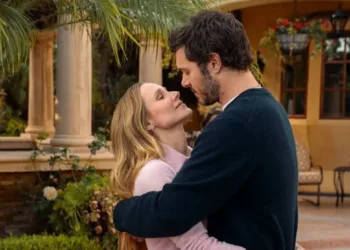












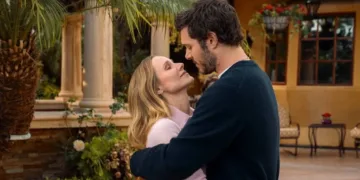











Seth Rogen stands in a doorway, struggling with a folding bicycle that refuses to lock into place. The moment is awkward and faintly pathetic, a piece of physical business that defines Joe before language enters the scene. Olivia Wilde directs The Invite, a comedy staged inside the polished, high-ceilinged interior of a San Francisco apartment. Angela and Joe host the evening, a couple whose shared life has narrowed into constant bickering and mutual irritation.
They prepare for dinner with their upstairs neighbors, Pina and Hawk, people they barely know beyond the unmistakable sounds of their nightly intimacy drifting through the ceiling. Angela reaches for validation through imported cheeses and a newly purchased rug. Joe clings to withdrawal and sarcasm. The night pivots once the guests disclose their non-monogamous relationship and extend a proposal that strips away social performance.
The film treats the apartment’s geometry as an emotional map, its rooms marking distance rather than comfort. Rashida Jones and Will McCormack’s script sharpens the dialogue with biting humor and exposed feeling, studying the space between public masks and private desire.
Domestic Friction and the Social Facade
Joe works as a music teacher at a Berkeley conservatory. His life carries the residue of a stalled indie-rock career that never found permanence. He lives in an apartment he inherited, a circumstance that leaves him unmoored, as if he occupies someone else’s success. Angela exists in constant social unease.
She renovates the apartment with aspirations shaped by an art school education that never solidified into a profession. Their arguments repeat with ritual precision. They argue over furniture placement. They argue over pickles. This pattern of minor conflict functions as insulation, keeping deeper intimacy at a distance.
Pina and Hawk embody a different domestic rhythm. Hawk, a retired firefighter, projects the calm assurance of a West Coast spiritual guide. Pina, a Spanish sexologist, speaks with a direct clarity that unsettles Joe. Their audible intimacy upstairs serves as a reminder of a vitality missing from the hosts’ relationship. The evening opens with an uncomfortable exchange involving Spanish jamón prepared by Angela, which Pina cannot eat.
The misstep sets the tone. The guests recognize the tension immediately. They heard the arguments before knocking. Hawk introduces the principle of radical honesty and applies it to dismantle the formal politeness Angela attempts to preserve. This candor cuts cleanly through years of accumulated resentment. One couple exists inside shared history and irritation. The other moves through life with openness and flexibility.
The Visual Language of Entrapment
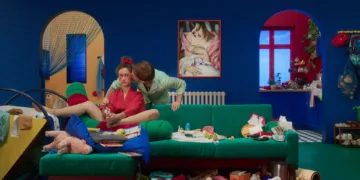
Wilde steps away from the expansive scale of her earlier work and commits to the discipline of a single setting. Shot on 35mm, the image carries a tactile weight that grounds the performances. The camera frequently observes characters through mirrors and narrow corridors, producing a feeling of confinement. The apartment carries elegance alongside pressure. Its design takes on agency, reflecting Joe’s sense of inadequacy within a space he never earned.
Devonté Hynes’ score leans into jazz textures and discordant rhythms that sharpen the verbal exchanges. The music agitates rather than calms. Sound functions as a structural device. The noise from above ignites the conflict and signals a freedom Joe and Angela struggle to articulate.
The building’s architecture permits these intrusions and traps the characters together. The visual design emphasizes artifice. Designer furniture sits beside simmering anger. The apartment stands as a symbol of Angela’s aspirational life and Joe’s stalled escape.
The Proposal and the Tonal Fracture
The evening changes once Pina and Hawk describe their relationship openly. They frame their animal sounds as an expression of freedom and present non-monogamy as a coherent way of living. Their offer places Joe and Angela inside the conversation. The dinner party dissolves into a truth exercise.

Joe retreats into sarcasm, his practiced defense. Angela responds with measured curiosity weighted by fear. The film shifts from brittle comedy toward a sober examination of isolation. The script refuses to trivialize the sexual proposition and assigns it emotional gravity equal to the characters’ need. The invitation opens a possible exit from a marriage locked in stasis and introduces the risk of collapse.
Angela’s unmet longings move into focus. Her fascination with the neighbors reflects a fixation on abandoned ambition. The evening sheds its polite trappings and becomes an autopsy of a relationship that has stopped evolving. Humor remains present, now colored by the acknowledgment of failure.
Performative Decay and the Lead Quartet
Seth Rogen grounds his performance in corrosive despair, channeling his comedic timing into expressions of long-held frustration. Joe appears as a man shaped by disappointment, a curmudgeon echoing the lineage of Larry David.
His humor signals resignation. Olivia Wilde counters him with a performance anchored in physical comedy that gives form to Angela’s nervous energy. Her portrayal moves from frantic hospitality toward confrontation with lost dreams, her face registering desire alongside dissatisfaction.
Edward Norton and Penélope Cruz complete the quartet with precision. Norton’s Hawk carries Zen-inflected certainty, sensitive in posture and deeply pretentious in tone, his guru persona worn into the body. Cruz deploys charm as provocation, igniting envy and drawing out honesty the hosts struggle to manage.
Dialogue overlaps in rhythms that resemble jazz improvisation. The four performances collide through social friction and settle into an escalating tension that feels plausible. Their combined work grounds the theatrical structure and supplies distinct energies within the apartment.
The Internal Ruins of Domesticity
The narrative reaches clarity as Joe and Angela confront the source of their dissatisfaction. Their neighbors function as reflection rather than cause. The film argues that some relationships require collapse to make space for renewal. Jones and McCormack’s script maintains its edge through recurring jokes about rugs and decor, using these details as emotional currency. Such trivial concerns become the language of a marriage in decline.
The movement from sharp humor toward earnest resolution carries risk and finds footing through character authenticity. The film mirrors familiar domestic rituals and exposes the cost of sustaining appearances.
The final passages carry a restrained sadness, easing away from the early barbs toward recognition. The invitation grows beyond a social event into a confrontation with personal wreckage. The closing moments rest in damage and offer a modest sense of repair born from collapse.
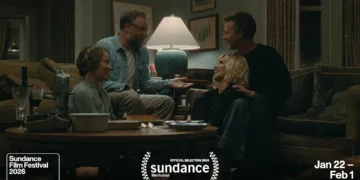
The Invite is a biting American comedy-drama that premiered at the Sundance Film Festival on January 24, 2026. Directed by Olivia Wilde, the film serves as an English-language remake of the 2020 Spanish hit The People Upstairs (Sentimental). The story centers on a long-married couple, played by Wilde and Seth Rogen, whose evening with their adventurous upstairs neighbors (Penélope Cruz and Edward Norton) descends into a series of awkward revelations regarding sex, honesty, and the state of their own relationship. Following its acclaimed festival debut, the film was the subject of a high-profile bidding war, ultimately securing distribution through A24 and Focus Features. It is currently expanding its theatrical presence throughout early 2026.
Full Credits
Title: The Invite
Distributor: A24, Universal Pictures, Focus Features
Release date: January 24, 2026
Rating: R
Running time: 107 minutes
Director: Olivia Wilde
Writers: Rashida Jones, Will McCormack, Cesc Gay
Producers and Executive Producers: Ben Browning, Megan Ellison, David Permut, Saul Germaine, Patrick Chu, Shayne Fiske Goldner, Glen Basner, Andy Kim, Alex G. Scott, Alex Astrachan
Cast: Seth Rogen, Olivia Wilde, Penélope Cruz, Edward Norton, Skip Howland, Rachel Thurow, Mario Valdez, Mel Powell
Director of Photography (Cinematographer): Adam Newport-Berra
Editors: Anthony Boys, Yorgos Mavropsaridis
Composer: Devonté Hynes
The Review
The Invite
The Invite succeeds as a sharp, claustrophobic look at the quiet failures of long-term partnership. Olivia Wilde balances the brittle humor of a disastrous dinner party with a somber exploration of marital stagnation. The film avoids easy resolutions. It chooses to let its characters sit in the wreckage of their own choices. While the tonal shift toward the end feels heavy, the performances ground the drama in a recognizable reality. It serves as a stylish, uncomfortable mirror for anyone who has ever used bickering as a shield.
PROS
- Taut, 35mm cinematography that emphasizes domestic entrapment.
- Sharp, realistic dialogue by Jones and McCormack.
- Rogen and Wilde provide strong dramatic work.
- The script treats the central sexual proposal with maturity.
CONS
- The final act’s earnestness feels slightly disconnected from the earlier wit.
- The heavy use of the score occasionally crowds the dialogue.
- The theatrical origin is sometimes apparent in the long monologues.