
























![Kingdom Hearts Collection [I-III] Review](https://gazettely.com/wp-content/uploads/2026/10/Kingdom-Hearts-Collection-I-III-1-360x180.webp "Kingdom Hearts Collection [I-III] Review: KHII Holds Steady as Newer Entries Fluctuate 37")





World of Wonder, the production house led by filmmakers Randy Barbato and Fenton Bailey, presents a haunting two-part documentary titled Murder in Glitterball City. This true-crime exploration centers on the 2010 killing of James “Jamie” Carroll, a drag performer in Louisville, Kentucky.
The series begins with a chilling webcam recording of Joey Banis. He reads a suicide note, claims responsibility for a death, and speaks as his partner, Jeffrey Mundt, sleeps in the background. The moment lands like a trapdoor opening. It pulls the viewer in, then refuses to settle, because the accusations widen to include Mundt.
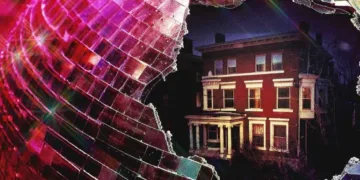
Adapted from the book A Dark Room in Glitter Ball City by David Dominé, the documentary follows the discovery of a body hidden inside a Victorian home in Belgravia Court. The neighborhood is presented as a historic sanctuary for the LGBTQ+ community and is known for disco ball production.
The central conflict turns on a grim, almost surreal fact pattern: both men acknowledge a body in their basement, and each points to the other as the person responsible. Barbato and Bailey frame the setting as a polished queer haven with rot underneath, and the documentary keeps pushing the audience to look past surface charm toward the darker reality the case exposes.
The Haunting Aura of Louisville
The documentary uses Louisville’s physical landscape to generate a thick sense of dread. The city’s “Glitterball City” nickname, tied to disco ball manufacturing, places the story in a space associated with craft, nightlife, and performance. The series also shows the streets as a place where drag performers move through public life with a measure of ease. That public energy sits beside the private nightmare associated with 1435 S. Fourth St., the stately Victorian residence where the crime’s most disturbing details concentrate.
The house carries a heavy reputation in the documentary’s telling. It once housed a sanatorium where a doctor allegedly performed cruel experiments. Neighbors speak of Belgravia Court as a place saturated with ghost stories and local legends. The series then anchors its horror in something concrete: the basement discovery, described as more frightening than the supernatural folklore that circulates around the block.
Barbato and Bailey build this atmosphere through interviews with local drag queens and residents, shaping a community portrait that makes the crime feel like a rupture in shared safety. The accounts underline the bitter irony of a refined, historic district containing a body crammed into a plastic container and covered in lime.
Cinematography lingers on Belgravia Court’s architectural beauty, then lets testimony drag the viewer back to the violence beneath it. The effect recalls a tactic familiar in Indian parallel cinema, where ordinary rooms and domestic facades become pressure chambers for social tension. Here, the Victorian home becomes a symbol with two faces: civic pride on the outside, concealed brutality within. The focus on local voices keeps the story rooted in place, and that specificity gives the discovery the weight of a cultural violation, not a remote true-crime puzzle.
A Mirror of Conflicting Truths
The trial narrative hinges on the shifting dynamic between Joey Banis and Jeffrey Mundt. The filmmakers study two sharply different presentations. Mundt comes across as corporate and conventional. Banis registers through a rebellious aesthetic marked by tattoos and a mohawk. The documentary sustains ambiguity by letting the men trade positions in the viewer’s imagination, moment by moment, scene by scene. One episode can frame one man as threatened; the next can recast the same relationship through a different lens.
A key sequence uses side-by-side footage from their separate trials. Each man gives a version of the night that sounds almost identical in its outline, and each casts himself as witness and the other as killer. The structure becomes the argument. By placing the testimonies in parallel, the series forces the audience to confront how quickly assumptions form around appearance, demeanor, and role-playing in court. It becomes a study in perception as much as evidence.
Early material includes a panicked 911 call from Mundt, which suggests fear of Banis inside the home. Later segments introduce a history of manipulation that complicates the emotional math. The series treats their relationship as a toxic knot that outsiders struggle to untangle, especially once the door closes and private behavior replaces public performance.
This is where the documentary starts to feel in conversation with global true-crime trends that favor psychological ambiguity over neat moral sorting. The editing supports that approach. It keeps returning to uncertainty, withholding the easy release of a definitive moral ledger. The result is a portrait of power inside intimacy, and of how public personas can conceal volatility that only becomes visible after catastrophe.
Honor Amidst the Chaos
Barbato and Bailey make creative choices that allow brief moments of levity without losing respect for the person who died. A recurring motif has legal figures and friends read passages from David Dominé’s book. The readings sometimes land with a dry, human awkwardness, such as attorney Ryane Conroy reacting with humorous skepticism to flowery prose that describes her own actions. These scenes puncture the heaviness for a beat, and they also underline how storytelling can stylize real people in ways that feel strange to the people being described.
The series briefly mentions cameras from The First 48 and refers to certain unused autopsy data. Those elements appear as small threads beside the documentary’s main concern, which stays trained on the human consequences of the killing. As the episodes move toward the end, attention turns away from sensational procedure and back toward Jamie Carroll’s memory. The community steps in to speak for someone who no longer can.
One of the documentary’s most affecting moments comes through a statement from a friend in Carroll’s hometown. He rejects the idea of supernatural evil and points to a darker human explanation: people create their own monsters through poor choices and dishonest living.
The thought reframes the story away from haunted-house imagery and toward accountability, with grief as the grounding force. By centering the queer community’s loss, the documentary keeps Jamie’s life present even as the legal battle between his accusers remains unresolved.
Murder in Glitterball City premiered on HBO on February 19, 2026. This production from World of Wonder examines a 2010 murder in a Victorian neighborhood of Louisville. The series follows the investigation of Jeffrey Mundt and Joey Banis after the discovery of a body in their home. Both parts are currently available for streaming on HBO Max.
Where to Watch Murder in Glitterball City Online


Full Credits
Title: Murder in Glitterball City
Distributor: HBO, HBO Max
Release date: February 19, 2026
Rating: TV-MA
Running time: 80 – 90 minutes per episode
Director: Fenton Bailey, Randy Barbato
Writers: David Dominé
Producers and Executive Producers: Nancy Abraham, Lisa Heller, Sara Rodriguez, Fenton Bailey, Randy Barbato, Mona Card, Derek Dodge
Cast: David Dominé, Joey Banis, Jeffrey Mundt, Ryane Conroy, Lexi Love, Kevin, Erika
Director of Photography (Cinematographer): Huy Truong
Editors: Johanna Gavard, Francy Kachler
Composer: David Benjamin Steinberg
The Review
Murder in Glitterball City
Murder in Glitterball City serves as a psychological study of deception and community grief. The documentary avoids easy answers, favoring a layered look at the uncertainty of truth. While some investigative details receive less focus, the emphasis on the Louisville setting and the memory of Jamie Carroll provides a grounded perspective. It offers a gripping look at how violence can disrupt even the most curated safe spaces. The filmmakers handle the sensitive subject matter with a balance of tension and respect for the victim.
PROS
- Effective use of local atmospheric details to build tension.
- Compelling side-by-side trial footage that highlights conflicting accounts.
- Respectful focus on the humanity of the victim through community interviews.
CONS
- Insufficient exploration of forensic reports and autopsy data.
- Limited investigation into the involvement of other television productions.







