






















“Strip Law” opens in a Las Vegas that plays like a Grand Theft Auto radio bit made flesh. Neon excess runs the place. Magicians and animals hold annual cage matches. The mayor is George Wallace, playing himself. The series plants its flag in a city where spectacle sets the tone before a single case even begins.
The show’s focus is Lincoln Gumb, voiced by Adam Scott. Lincoln has the legal brain of a scholar and the screen presence of a spreadsheet. He is trying to keep Gumblegal afloat, a firm he inherited from his late mother, and he keeps learning the same painful lesson: technical competence means little to juries who want the kind of showmanship they can get a few blocks away on the Strip.
That gap leads him to Sheila Flambé, voiced by Janelle James, a street magician who describes herself as a three-year all-county sex champion. Lincoln brings her in to supply the theatrical voltage he cannot generate on his own.
The background keeps feeding the premise. Storefront jokes flash by, including a “Sexual Grocery Store” and billboards advertising “Circumcision by Elvis.” The setting carries a “Rockstar-flavored” attitude that treats absurdity as the local weather. It frames a world where legal victory comes from performance and persuasion, with a judge as the audience. The writing leans into that idea, turning each courtroom into a stage and letting reason fight for airtime in the glare of the bit.
The Gumblegal Personnel File
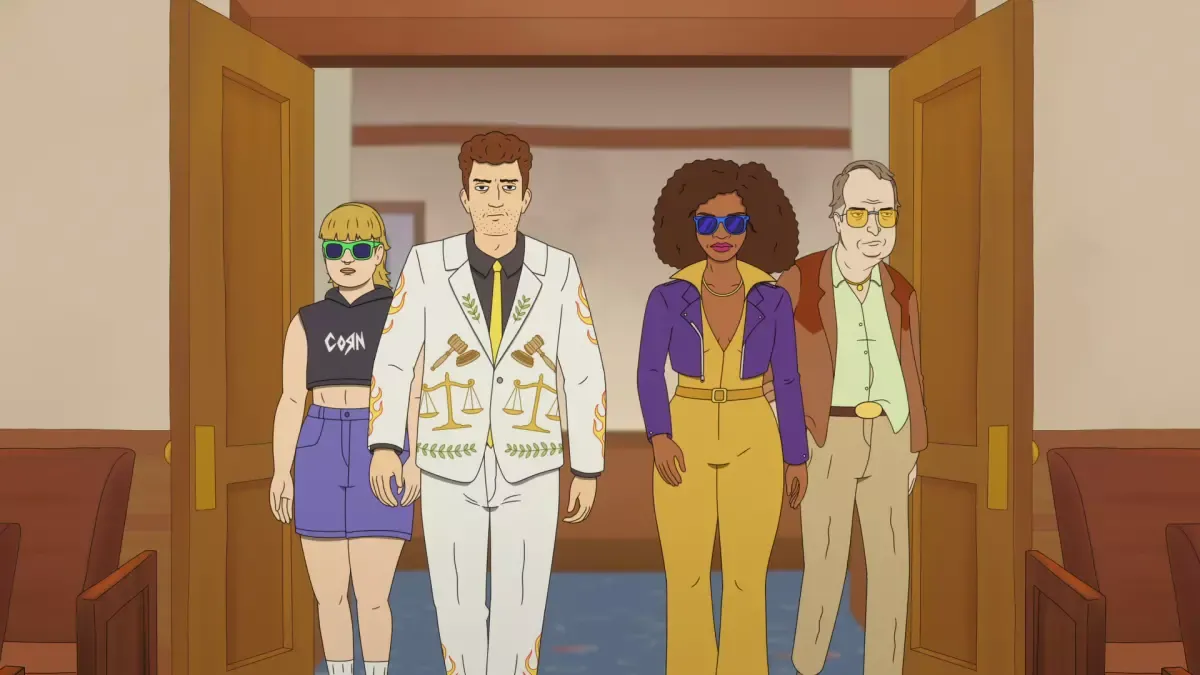
The series runs on an ensemble of misfits built from clashing anxieties and mismatched coping strategies. Lincoln is the beaten-down straight man, burdened with a specific “Pete Buttigieg energy” that marks him as easy prey for Nevada’s louder personalities. His arc stays tethered to his mother’s legacy. He carries it like a professional inheritance and a private accusation, and that pressure shapes his sense of inadequacy in every room he enters.
Sheila Flambé works as the firm’s catalytic force. She acts on impulse, chases the win, and embraces physical extremes, including self-electrocution, if that is what the moment demands. Her dynamic with Lincoln steers the series into a more chaotic register, since her instincts push every situation toward escalation.
Irene, Lincoln’s 16-year-old niece, serves as the firm’s investigator. She is a muscle-bound teen who wears an “Underage” blindfold in bars, a gag that captures the show’s commitment to surreal logic as a daily operating system. Then there is Glem Blorchman, the unpredictable eccentric in the corner.
He is a disbarred lawyer who claims a past in the punk band Bikini Kill, and he spends his time mixing gin with marshmallows. Stephen Root’s vocal performance gives Glem a strange credibility. He delivers gin talk with flat, matter-of-fact sincerity, and that steady tone makes even the wildest claims land with an odd plausibility.
Stevie Nichols, played by Keith David, brings a steadier kind of threat. Nichols was Lincoln’s mother’s partner, and his presence becomes a walking measurement of the success Lincoln has yet to touch. The group’s constant friction keeps the workplace from drifting into sentimentality. The show prefers irritation, rivalry, and bruised egos to any easy “found family” comfort.
High-Velocity Gags and Hand-Drawn Satire
The comedy runs on density. Silence has little space to breathe. The series behaves like a mile-a-minute joke engine, firing non-sequiturs and puns in quick succession, then moving on before the laugh can fully settle. A vein of meta-humor keeps tapping the form itself. The pilot’s title, “Finally, a Show About Lawyers,” signals the intent, and the scripts keep winking at the machinery of television writing.
Pop culture references function as a secondary language. The Simpsons nods show up often, from “frosty chocolate milkshakes” to visual riffs on the Gracie Films logo. Other touchstones jump from Austin Powers to The Mighty Ducks, tapping into a very specific Xennial frequency.
Visually, the series chooses a thin-lined, precise look. The animation stays clean and resists the crowded messiness common to many adult cartoons. A title card proudly declares that it was made by “real, non-computer human beings,” a phrase that matches the show’s skeptical posture toward modern technology. The pacing can get frantic and flirt with pure noise, yet the voice cast keeps the comedy anchored through timing and control. Titmouse’s work helps, too, preserving clarity even when scenes sprint into chaos.
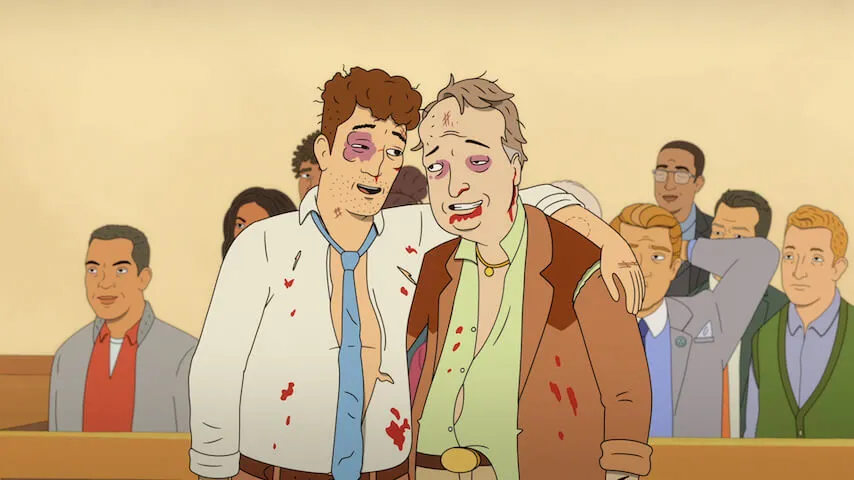
The courtroom spaces show the same care. Benches look bizarre. Background figures run silent, surreal micro-plots that reward attention without stealing the scene. The legal procedural frame becomes a sandbox for visual play, and the show occasionally shifts its look to mimic anime or to drop into live-action segments.
Legacy, Atheism, and the Evolution of a Parody
Under the shouting and the sex jokes, the series finds its emotional footing in Lincoln’s search for identity. His mother was a legal titan and a lackluster parent, and that history gives the season a weight strong enough to support its wildest turns. The storytelling hits hardest when it commits to high-concept premises. “We Need to Talk About Heaven” stands out by focusing on a boy who claims he has seen the afterlife, a setup that opens space for spiritual doubt and parental manipulation inside the show’s cartoon logic.
Another episode takes aim at New Atheist culture, including a recreation of Ricky Gervais’s religious photoshoot. The series also thrives on hyper-specific absurdity. A VR seminar gets hosted by a digital composite of the Rat Pack. A riot breaks out over the redesign of sexualized “Nevada Dates” raisins. That Nevada Dates thread plays as a pointed jab at consumer culture and canon obsession, and the fury over character redesigns echoes real-world fan entitlement. The satire becomes sharper here, since the jokes come with a clear eye for how easily people build identities around brands.
Across the season, the structure starts loosening its grip on a straightforward case-of-the-week rhythm. The later episodes grow more experimental, and the finale lands as a deranged parody of Franklin & Bash. The show’s confidence rises along the way, and the first ten episodes chart a shift from a Las Vegas spoof toward a wider commentary on storytelling conventions and the performance baked into legal theater.
Strip Law premiered on Netflix on February 20, 2026, as a new addition to the platform’s adult animation lineup. The series follows Lincoln Gumb, an uptight attorney struggling to make a name for himself in the chaotic environment of Las Vegas, who eventually partners with a flamboyant street magician to handle the city’s most eccentric and surreal legal cases. All ten episodes of the debut season are currently available for streaming exclusively on Netflix.
Where to Watch Strip Law Online


Full Credits
Title: Strip Law
Distributor: Netflix
Release date: February 20, 2026
Rating: TV-MA
Running time: 30 minutes
Director: Cullen Crawford
Writers: Cullen Crawford, Daniel Kibblesmith, Branson Reese, Lauren McGuire
Producers and Executive Producers: Chris Prynoski, Trevor Engelson, Ben Kalina, Antonio Canobbio, Shannon Prynoski, Steven Fisher, Cullen Crawford
Cast: Adam Scott, Janelle James, Stephen Root, Shannon Gisela, Keith David, Joel McHale, Ikechukwu Ufomadu, Aimee Garcia, Matt Apodaca
Director of Photography (Cinematographer): Antonio Canobbio
Editors: Various
Composer: Bob Destiny
The Review
Strip Law
Strip Law functions as a hyperactive exercise in style and satire. While the barrage of jokes can occasionally feel like noise, the show succeeds when it anchors its absurdity in Lincoln Gumb’s search for professional and personal identity. It is a loud, unapologetic tribute to the Xennial experience that manages to find humanity behind the neon.
PROS
- Sharp, high-density writing that rewards repeated viewings.
- A formidable voice cast led by the impeccable timing of Adam Scott and Janelle James.
- Creative visual experimentation that goes beyond standard sitcom animation.
- Effective use of its Las Vegas setting as a character rather than a backdrop.
CONS
- Reliance on dated pop culture references may alienate younger viewers.
- Character depth is sometimes sacrificed for the sake of a quick gag.
- The frantic pacing occasionally prevents emotional beats from landing.