






















Mary starts out as a ghost living in her own apartment. After her husband, John, is killed on their porch over gambling debts, she inherits a title deed and nothing she can spend. The Brooklyn around her feels wet and hostile, all tight alleys and trash bags that seem to sweat through the night. Work exists in theory. In practice, it keeps slipping away. She hears that she is too old or underqualified, soft language for the harder point: society has filed her under expendable.
That rejection corners her into motion. Grief turns practical, then tactical. Mary becomes a wheelwoman for her husband’s former associates, a job defined by timing and nerve. A botched bank job marks the threshold. She grabs a weapon to clear an escape route, and the tabloids slap a name on her: Machine Gun Mary.
It does not play like a coronation. It plays like survival with grit under the fingernails. The city barely reacts. It watches her values erode with the same vacant stare it gives to broken streetlights. Rent begins to matter more than the person she used to be.
The Transfiguration of Machine Gun Mary
Tina Benko builds Mary out of quiet pressure. The performance sits in a steely reserve, then tightens into calculated pragmatism. Early scenes sketch a woman damaged by an abusive marriage, and the damage never evaporates. It compresses into something functional. A strength has been there for a long time, buried, waiting for a reason to stand upright.
Once Mary folds into the heist crew, her competence becomes the film’s bluntest punchline. The men around her behave like buffoons. She keeps the machine running. Benko makes the shift legible in her posture and her gaze, the way she seems to measure a room before she occupies it.
The film tracks a psychological slide where Mary’s criminal self spills into her civilian routines. Parent-teacher conferences get the same cold, unsentimental stare she later brings to holding up an art gallery. Identity turns into a practical costume, then stops feeling like a costume at all.
The maternal pressure stays in the foreground. Benko keeps Mary grounded in desperation even as she starts to chase the heist’s adrenaline. She reads like a human volcano, containing heat until the story demands eruption. The rage lands with weight. It feels like parental madness, the kind that sets the world on fire to keep a child warm. Dark, sure. The film does allow a wry little laugh at the men who keep mistaking swagger for skill.
Shadows and Static
Director Kerry Ann Enright commits to neo-noir textures and does not flinch. The cinematography leans on chiaroscuro, carving faces out of darkness and leaving the edges to rot. Light becomes a moral instrument here. It exposes just enough to make a choice visible, then withdraws before anyone can pretend they chose cleanly. Darkness behaves like a character, present, patient, never impressed.

The settings carry the same attitude. Locations look lived-in and discarded, with apartments that seem to hold their breath. The frame often feels boxed by doorways, corners, and cramped interiors, the geometry of a life that has run out of exits. This is visual storytelling that treats space as pressure, not scenery.
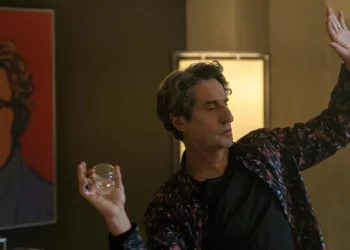
Max Casella serves as a necessary foil as Eddie, and the film’s most intimate rhythms arrive during their meetings at a dimly lit French restaurant. The scenes flirt with romance as a performance, a practiced pose worn while plotting the next caper. Enright stages these moments with a steady hand, letting the mood do the talking. The air hums with possibility and risk, then settles back into shadow.
The supporting ensemble wobbles. Several characters register as cardboard cutouts beside the detail given to Mary. A third accomplice during the art gallery heist becomes a particularly grating presence, a note that keeps landing sharp when the film wants gravity. The federal agents feel thin too, and their ineffectiveness points toward the film’s cynicism. Law operates like a bystander in this world, a figure standing near the wreckage with empty hands.
The score works like mood glue, smoldering under scenes without pleading for attention. It stays functional, brooding, and tuned to street-level tension. The sound keeps the viewer’s nerves slightly ahead of the plot, which is exactly the trick a thriller likes to pull.
The Friction of the System
The script frames ethics as a luxury item reserved for people who can afford clean choices. Mary comes through as necessity made flesh. She never reads as a noble outlaw. She reads as someone cornered, improvising, sometimes cruel. The robbery of a restaurant owner lands cold, stripped of sentiment. The film refuses the comfort of making harm feel righteous.
At 94 minutes, the pacing runs hot. It moves with frantic urgency, like a panic attack stretched into feature length. That compression has a cost. Certain character beats get traded away for momentum. The subplot involving Mary’s son plays underdeveloped, even with its importance as motivation, since it does not receive enough time to land with full force.
The dialogue sometimes reaches for clever zingers and stumbles. Those lines feel forced, and the effect undercuts the raw energy that drives the heist sequences. Then the final act pivots into a confusing black comedy tone. The film seems to stare straight at the audience and announce a thesis on misogyny. It is a big swing. The grip slips at points. Still, the refusal to provide a moral compass holds firm. The movie offers wreckage and asks the viewer to sit inside it, eyes open, no comfort provided.
Nobody Wants to Shoot a Woman is a gritty neo-noir thriller that made its world premiere at the Dances with Films festival on June 25, 2024. Following its successful run on the international festival circuit, the film was acquired by Freestyle Digital Media and released for North American audiences on January 2, 2026. As of today, February 8, 2026, the movie is available for streaming and purchase on various digital HD platforms, including Apple TV, Amazon Prime Video, and Fandango at Home, as well as on most major cable and satellite VOD services.
Full Credits
Title: Nobody Wants to Shoot a Woman
Distributor: Freestyle Digital Media, Freestyle Releasing
Release date: June 25, 2024 (World Premiere), January 2, 2026 (Digital Release)
Running time: 94 minutes
Director: Kerry Ann Enright
Writers: Kerry Ann Enright
Producers and Executive Producers: Kerry Ann Enright, Marissa Velez, Cheyanne Kane
Cast: Tina Benko, Max Casella, Lev Gorn, Michael Godere, Karl Bury, Cheyanne Kane, Sean Mahon, Lucas Dixon
Director of Photography (Cinematographer): Joel Froome
Editors: Fernando Epstein, Manuel Rilla
Composer: Billy Martin
The Review
Nobody Wants to Shoot a Woman
The film operates as a biting, street-level autopsy of survival within a decaying system. While the narrative occasionally stumbles over its own urgency and thin supporting archetypes, the central performance remains a jagged, undeniable force. It is a bleak, effective exploration of a woman reclaiming agency through the very violence that once confined her. The result is a work that values raw friction over polished resolution, offering a cinematic experience that feels like a bar fight in a tailored jacket.
PROS
- Tina Benko’s transformative, steely lead performance.
- Authentic, gritty Brooklyn atmosphere and noir lighting.
- Unsentimental approach to moral ambiguity and crime.
- Tense, well-executed heist sequences.
CONS
- Uneven supporting cast and "cardboard" secondary characters.
- Jarring tonal shifts into black comedy in the final act.
- Underdeveloped subplots, particularly the maternal arc.
- Forced dialogue and occasional awkward "zingers."