

























![Kingdom Hearts Collection [I-III] Review](https://gazettely.com/wp-content/uploads/2026/10/Kingdom-Hearts-Collection-I-III-1-360x180.webp "Kingdom Hearts Collection [I-III] Review: KHII Holds Steady as Newer Entries Fluctuate 37")



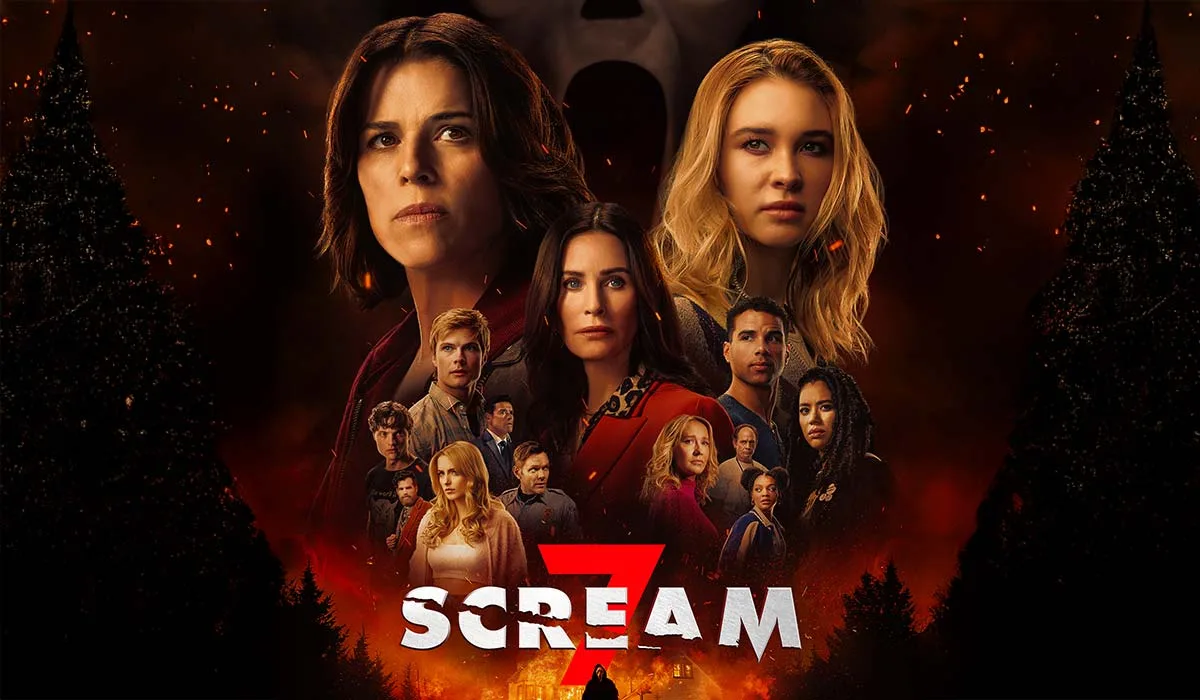

Scream has always promised two pleasures at once: the clean mechanics of a whodunit and the messy joy of hearing horror culture argue with itself while someone bleeds on the carpet. In Scream 7, that promise returns with a narrower focus, like the series has decided to shut the door, lower the blinds, and see what happens when the mythology stops roaming and starts stalking the living room again.
Sidney Prescott is back at the center, older, sharper, and trying to play a role the franchise rarely lets its survivors keep: parent. She has traded the public theater of past chapters for Pine Grove, a small-town calm that looks steady right up until it starts to feel staged, like a set built to be destroyed. Ghostface returns anyway, and the danger shifts from spectacle to intrusion, turning Sidney’s home life into the new crime scene.
The hook arrives early: threatening videos tied to Stu Macher, a name that carries its own greasy fingerprint on the franchise’s first bloodstain. The film talks about AI and deepfakes, then asks a blunt question in a softer voice: if images can lie, what is a “memory” worth?
The emotional engine runs on a mother and teenage daughter locked in a familiar argument with unfamiliar stakes: what Sidney refuses to say, what Tatum demands to hear, and what violence forces them to learn together.
Murder Tourism and Small-Town Geometry
The cold open is the film at its most pointed and its most playful. Stu Macher’s house has become a true-crime attraction, a “psycho killer” sleepover for people who treat tragedy like themed lodging. The décor leans into the joke: memorabilia, staged history, a life-size Ghostface figure that turns its head when you move (consumer horror as motion sensor). It is clever, then it turns nasty, as if the franchise is punishing the audience surrogate for buying a ticket to the museum. The scene understands something bleak about pop culture: we build shrines to violence, then act shocked when the shrine starts asking for a sacrifice.
Then Pine Grove takes over, and the film swaps iconic haunted suburbia for a new town that plays like a stack of familiar rooms: coffee shop, school spaces, homes, a bar, then back to the coffee shop (routine as itinerary). The story escalates through attacks and regrouping, the classic heartbeat of this franchise: a spike of panic, a reset of suspicion, a new round of side-eye. Sidney slips back into survival mode with a practiced speed that feels both heroic and sad, like watching a veteran put on an old uniform that still fits.
A practical choice keeps her younger kids out of town, which tightens the scenario around Sidney and Tatum. It also makes the film’s “family” theme feel more like a spotlight than a household.
Midway, the movie hits a strong domestic setpiece: Sidney and Tatum inch along a catwalk behind a living-room wall while Ghostface stabs from the other side, the blade turning drywall into a confession. They spill out into the street, and a car smashes into the killer with absurd timing and perfect franchise timing. Funny. Brutal. A little “contractual chaos,” in the best way.
The final act simplifies into cat-and-mouse, mother and daughter working together toward a big finish. The motion is solid. The unmasking arrives with less force than the setpieces that deliver it.
The Family Final Girl Problem
Sidney Prescott has been through enough sequels to qualify as a historical period. Scream 7 tries to turn that longevity into character material: she wants quiet, yet her instincts keep her vigilant, guarded, ready to read a room like it is a threat assessment seminar. Neve Campbell plays her with a confidence that can pivot from dead serious to wry self-awareness inside a single exchange, and it rarely feels false. Sidney is the franchise’s moral weather vane, even when the script blows in odd directions.
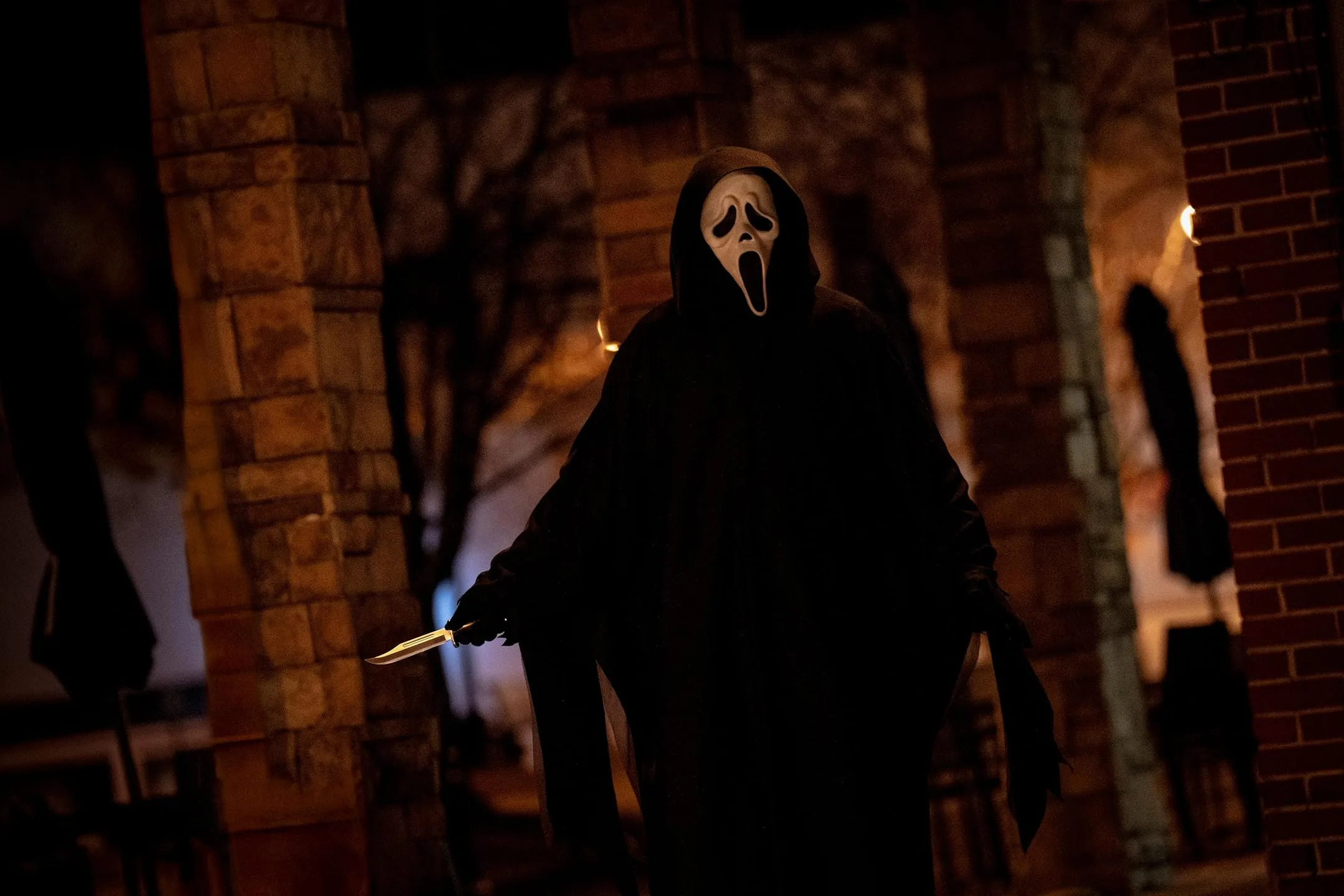
Tatum, her teenage daughter, carries the newest kind of horror inheritance: being famous for something she did not live through. She knows her mother’s story exists in books and interviews, yet it feels withheld at home. That friction gives the film its most human scenes. Tatum wants direct truth. Sidney chooses protection through silence. Violence punishes that choice in real time.
Isabel May sells the hurt in that dynamic without drifting into caricature, and the film needs that restraint. Still, outside the mother-daughter tension, Tatum can read as under-defined, surrounded by teen archetypes that signal function more than personality. The frustration is that the movie gestures at “Final Girl in Training” energy, then gives her fewer moments of ingenuity than the premise begs for.
Gale Weathers returns as the franchise’s sharp-tongued witness, a reminder that survival here has always been part grit, part storytelling control. Courteney Cox gets a crowd-pleasing entrance that feels engineered to make audiences clap, and it works because Gale remains built for entrances. The Sidney–Gale relationship still has lived-in bite: decades of mutual irritation, respect, and shared scars.
Chad and Mindy’s presence is a strange fit without the rest of their established circle, yet both actors bring needed spark. Mindy’s push-pull with “the rules” lands as comedy and as compulsion (genre analysis as a nervous tic). Their placement near Gale’s orbit gives them a job to do, even if the film never fully decides why they are here.
The new ensemble offers a neighbor, a true-crime obsessed kid, a drama teacher, a boyfriend, and a friend group built for suspicion. Some feel like red herrings. Some feel like body count math.
Williamson’s Return, Plus the Problem of Place
Kevin Williamson directing a Scream film carries an aura of auteur homecoming, and the movie wants that aura to read as authority. You can feel his strengths: a sense of slasher rhythm, a knack for witty exchanges, and a few staged moments that pop with confidence. There is atmosphere here that his lone earlier directing credit never quite managed, and the movie occasionally frames Ghostface with the patience of someone who knows the mask works best when it waits.
The violence leans “operatic” in its staging, favoring setpieces that build toward grotesque images. Early on, a victim is trapped in a helpless situation that turns suspense into dread through sheer limitation. The high-school theater sequence pushes spectacle: a rehearsal attack leaves a body suspended above the stage, a grim decoration that feels designed to haunt the room. Later, a knife-through-skull shot holds long enough to sting, and a beer tap kill hits with nasty immediacy, the kind of gag that makes you wince and laugh a second later (horror’s oldest handshake). There is also a more sadistic, showy moment that pushes Ghostface into heightened cruelty, flirting with a different clownish brutality than the franchise usually prefers.
Yet the craft has friction. Pine Grove can feel like a chain of dim interiors without a memorable map. Geography matters in a whodunit slasher because tension relies on movement, sightlines, and consequence. Here, deaths can vanish into the gloom without reshaping the social space, and clues lose bite when the world does not feel like it remembers.
Editing sometimes flattens the peaks it should sharpen. Sound design swings from choral eeriness to dead silence to pulsing synth, and the shifts can disrupt rhythm rather than tighten it.
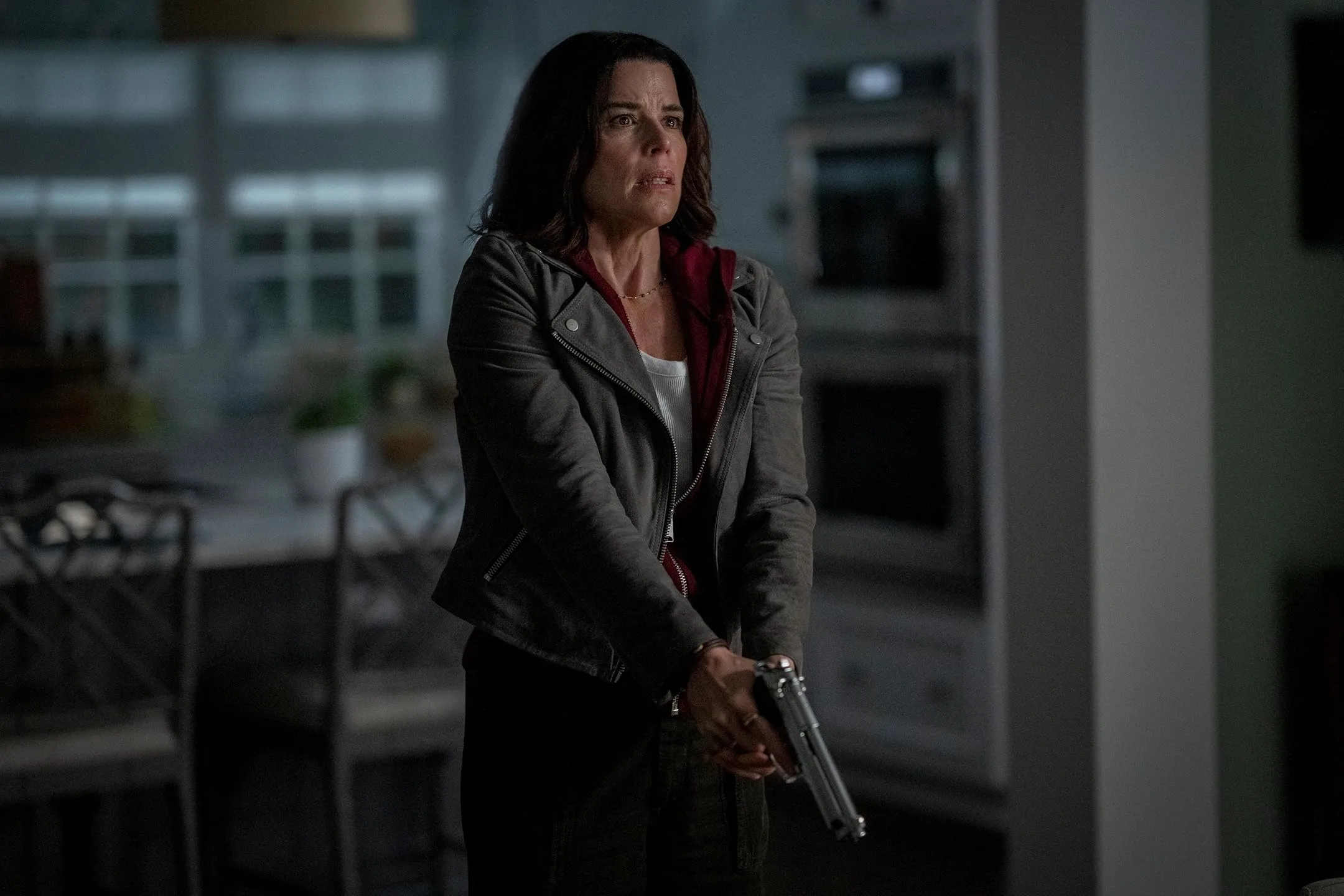
A few “hiding in plain sight” nods echo classic slasher staging, with Ghostface lurking like a background mistake you notice too late. Those moments work. They remind you the mask is still a strong symbol.
Deepfake Ghosts, Nostalgia Armor, and an Unsteady Unmasking
Early dialogue name-checks deepfakes and AI, setting up a story about trust and manufactured proof. It is a smart modern anxiety to bring into Scream: the franchise has always treated media as both weapon and mirror, and deepfake culture turns the mirror into a funhouse. The film uses the idea to seed doubt, to make characters second-guess what they see and what “evidence” even means. Screens become haunted objects. Video becomes a form of possession.
Then the idea starts to thin out. The tech paranoia raises questions, but the story struggles to turn them into a dramatic engine with clear payoff. The series’ self-awareness shifts into something softer, closer to comfort beats than provocation. You can feel a “brand-safety reflex” humming under the mask, as if the movie is worried the audience might turn on it for making the wrong joke. Satire needs nerve. This chapter has nerve in its kills, less in its commentary.
Nostalgia becomes the loudest driver. Stu’s house is the loudest symbol: a relic, a shrine, a tourist trap, then a crime scene again. The film circles “where it all began” with artifacts and callbacks, and it sometimes confuses reverence with meaning. Nostalgia works as a franchise ingredient, especially here. As a theme, it needs sharper teeth. Too often it reads as armor.
The Stu video angle is the cleanest expression of the film’s “real vs fake” game: threats delivered through live chats and taunting clips, leaving room for literal return, manufactured illusion, or some hybrid of the two. It is a solid premise for a series that thrives on uncertainty. It also invites the audience to play detective in a new way: not “who is under the mask,” but “what is the mask made of.”
Cameos and returning faces add texture and suspicion, casting long shadows over scenes, yet the film’s suspect web can feel stitched rather than woven. The reveal suffers most. The motive stretches credibility. Key explanations feel thin. Earlier scenes gain less retroactive meaning than a good Scream ending usually supplies. The identity risks that dreaded reaction: a pause, then a mental file search, then “oh, right.”
Still, baseline pleasures remain. Ghostface is an effective silhouette. Roger L. Jackson’s voice keeps its oily charm. The push-pull between fear and franchise playfulness still flickers, even when the movie looks unsure of what it wants to say about the culture that keeps buying tickets to the shrine.
Scream 7 is the latest installment in the iconic slasher franchise, marking a significant “homecoming” for the series as original writer Kevin Williamson steps into the director’s chair. The film premiered yesterday, February 25, 2026, at the Paramount Pictures studio lot and is scheduled for its wide theatrical release tomorrow, February 27, 2026. Following the departure of several previous cast members, this entry focuses on the legacy of Sidney Prescott (Neve Campbell) as she faces a new Ghostface threat that targets her family, specifically her daughter played by Isabel May. Fans can catch the movie exclusively in theaters starting this Friday, with a subsequent streaming release expected on Paramount+ later this year.
Where to Watch Scream 7 (2026) Online







Full Credits
Title: Scream 7
Distributor: Paramount Pictures
Release date: February 27, 2026
Rating: R
Running time: 114 minutes
Director: Kevin Williamson
Writers: Kevin Williamson, Guy Busick, James Vanderbilt
Producers and Executive Producers: William Sherak, James Vanderbilt, Paul Neinstein, Matt Bettinelli-Olpin, Tyler Gillett, Chad Villela
Cast: Neve Campbell, Courteney Cox, Isabel May, Jasmin Savoy Brown, Mason Gooding, Anna Camp, David Arquette, Michelle Randolph, Jimmy Tatro, Mckenna Grace, Asa Germann, Celeste O’Connor, Sam Rechner, Mark Consuelos, Tim Simons, Matthew Lillard, Joel McHale
Director of Photography (Cinematographer): Ramsey Nickell
Editors: Jim Page
Composer: Marco Beltrami
The Review
Scream 7
Scream 7 lands as a serviceable return to Sidney, with a few nasty, well-staged setpieces and a mother-daughter strain that gives the murders some emotional voltage. Its smartest idea, AI-era doubt, gets raised and then underused, while nostalgia keeps tugging the film back toward familiar furniture. The pace stays lively, the mask still works, yet the mystery payback feels thin and oddly weightless.
PROS
- Strong cold open at Stu’s house attraction
- Several memorable kills and setups
- Neve Campbell anchors the film with steady presence
- Sidney and Tatum tension adds stakes
- Roger L. Jackson’s Ghostface voice remains a weapon
CONS
- Killer reveal and motive lack punch
- Tech paranoia theme rarely pays off
- Pine Grove geography feels generic and foggy
- New ensemble feels sketchy, uneven chemistry
- Craft choices in edit and sound can blunt tension







