





















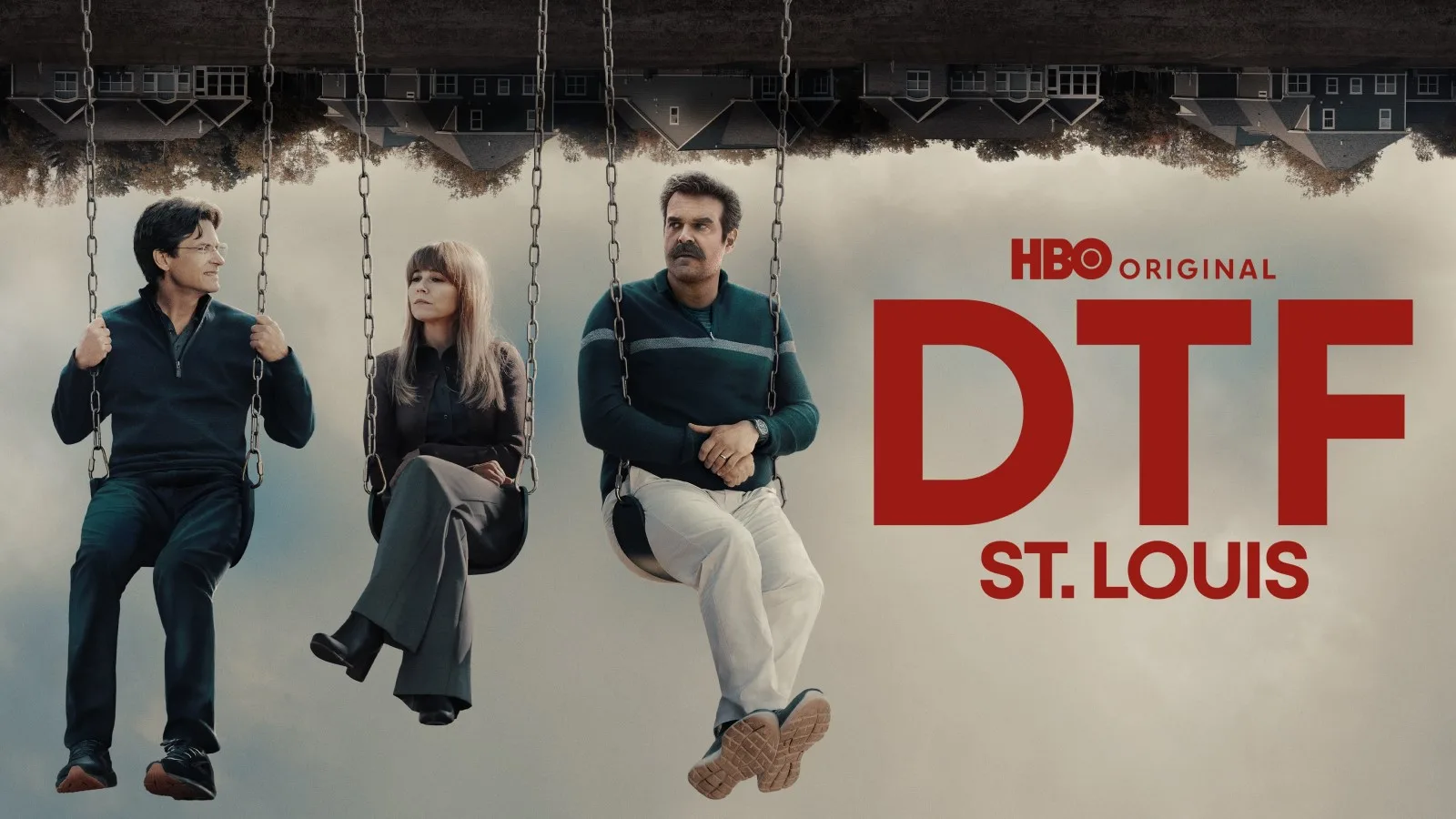

“DTF St. Louis” arrives wearing its acronym like a dare, a joke you expect to regret repeating out loud. Then the opening music pours in with a strange sincerity, and the joke starts to feel like a door. Steven Conrad’s seven-episode limited series, set in and around St. Louis in 2018, plants a dead man at the center and asks you to keep looking anyway.
The dead man is Floyd Smernitch, an ASL interpreter at a local TV station, played with disarming sweetness by David Harbour. His closest new friend is Clark Forrest, a Channel 10 weatherman and suburban father, played by Jason Bateman with that familiar calm that can pass for decency until it doesn’t. Floyd’s wife, Carol Love-Smernitch, played by Linda Cardellini, moves through their orbit with a tension that reads like heat trapped under winter clothing. A hookup app for married adults becomes the spark, or the excuse, and the story folds back in time to show how routine becomes risk, how the desire to feel alive can bruise the people closest to you.
Conrad builds a dark comedy with a mystery engine, then uses both to test empathy. The series invites laughter at awkwardness, then refuses to treat shame as a punchline.
A Murder Shown Early, A Life Explained Late
The first move “DTF St. Louis” makes is almost rude in its confidence: it shows you the death and dares you to care about the living. Floyd’s body appears after a jump forward, the scene decorated with objects that feel like punchlines until they start to read like symptoms. An empty Bloody Mary can. An image of a nude man dressed like Indiana Jones. Evidence that can be misread, then weaponized by assumption. You can feel the show asking a quiet question beneath the procedural posture: how many lives get simplified into a story that fits in a file folder.
From there, the series works in fragments. The investigation presses forward in the present while the past keeps interrupting it, not to stall suspense, but to contaminate certainty. You watch the friendship between Clark and Floyd grow through cornhole games, workouts, chain-restaurant rituals, and small talk that spirals into weird specificity. Time leaps and gaps show up with a deliberate awkwardness, leaving you to sit in what is missing. That missing space becomes its own kind of character, the negative image of what the show refuses to hand you on schedule.
The investigators form a familiar pairing with a twist of temperament. Detective Donoghue Homer, played by Richard Jenkins, arrives with the confidence of a man who has mistaken repetition for wisdom. Special Crimes Officer Jodie Plumb, played by Joy Sunday, keeps her gaze on what the room is trying to hide. Their interrogations act like narrative gates. At their best, they heighten tension and reveal character through pressure. At their weakest, they can feel like a mechanical pause button, holding back information long enough for the next episode to justify itself.
Still, the series keeps returning to a deeper test than “who did it.” Motive hovers like a moral fog. Guilt refuses to behave like a tidy label. The question becomes harder: can you claim to know what happened if you refuse to know why someone wanted anything in the first place. Each new discovery in the case doubles as a small confession about the trio, a private ache peeking through a suburban mask. The show finds pleasure in recontextualization, in scenes that look one way and then look different after a new piece of truth is allowed in. It also risks irritation when it repeats points, restates evidence, or lingers too long on reveals the audience can already feel coming. The pacing tightens, loosens, tightens again, like someone telling a secret and then swallowing half the sentence.
Three Adults, One Hunger, Many Lies
Clark Forrest is built like a respectable silhouette. He is a husband, a father of two, the man who “does the weather,” the sort of public face people invite into their kitchens without thinking about it. Bateman plays him as practiced normality, the smile of someone who understands optics. Clark introduces the app as a marital tune-up, a spice packet shaken into a bland routine. Yet his actions keep hinting at a different appetite. The show drops clues in the way he talks around topics, the way silence becomes a tactic, the way he leans on family life as camouflage when scrutiny tightens. He can read as calculating, then read as frightened, then read as both in the same minute. Conrad keeps him in moral twilight, forcing you to track the distance between what Clark says he wants and what his body keeps moving toward.
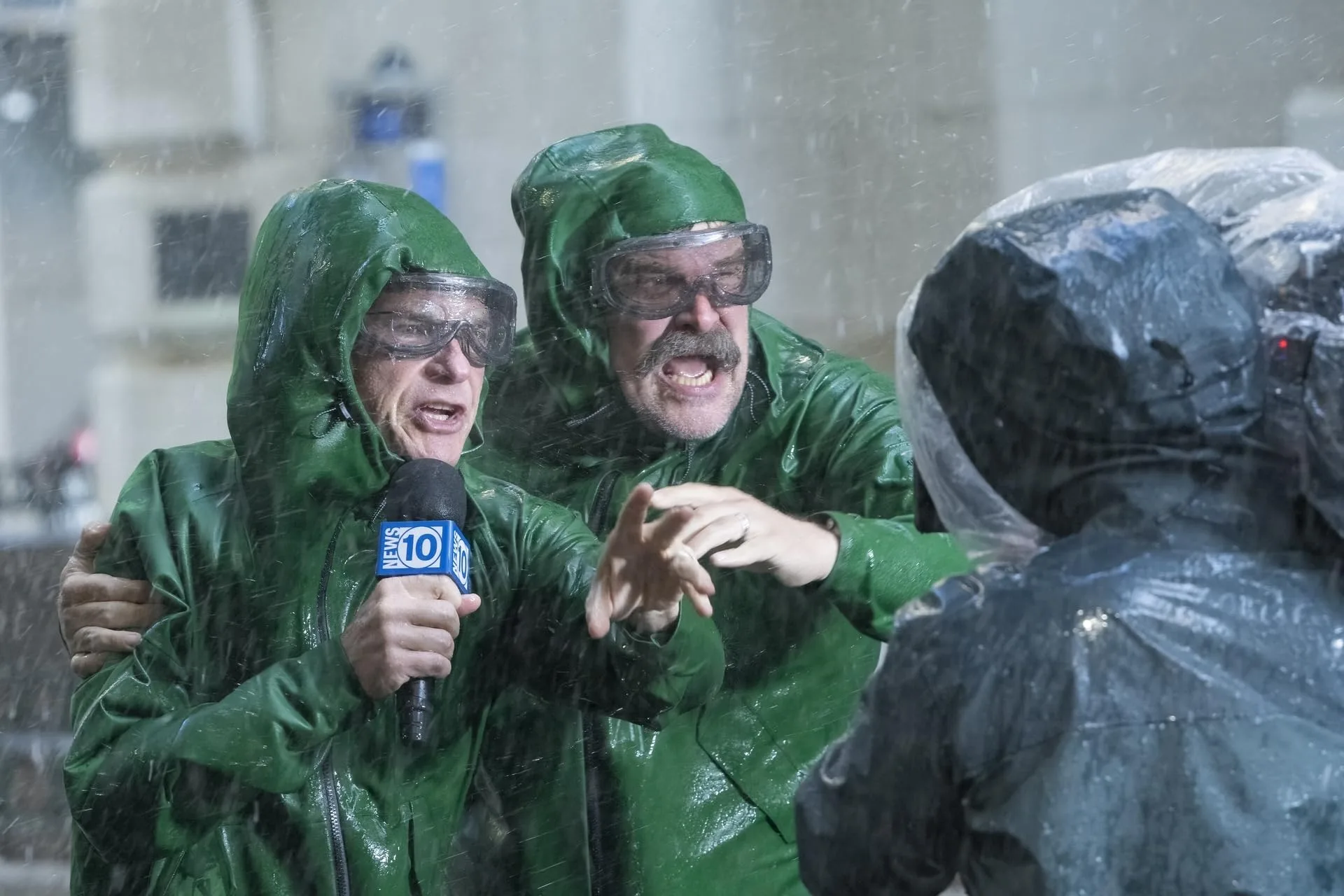
Floyd Smernitch is the emotional pulse the series keeps returning to, even after he is gone. Harbour plays him with a bright, almost childlike earnestness that makes his loneliness land with extra weight. Floyd cares hard. He commits to therapy with his stepson, Richard. He takes dance lessons so he can feel music in his body while translating it for others. He works out, shoots hoops, hikes, and obsesses over weight with a desperation that feels less like vanity than a plea to be desired again. His sexual insecurity, his awkwardness, his gullibility, his need for a friend, all of it becomes fuel for the plot and an invitation to pity that slowly turns into empathy. The series can tilt toward making him a virtuous teddy bear in death, a symbol of kindness crushed by cynical forces. Yet the show also remembers that Floyd signed up for the app, arranged a meet-up, and stepped toward betrayal with the same sincerity he gives everything. That contradiction makes him feel human. Warmth does not cancel desire. Decency does not erase need.
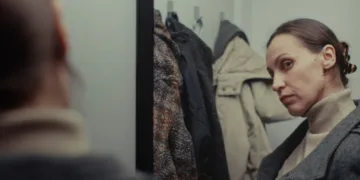
Carol Love-Smernitch lives under pressure and seems to have learned how to turn pressure into posture. Cardellini plays her with reserve that carries sharpness at the edges, the energy of someone who has been ignored long enough to stop asking politely. Money problems haunt the house. Parenting stress hangs over the family, tied to Richard’s schooling and behavior. Carol moonlights as a little-league umpire, a detail that reads like a joke until it becomes a portrait of survival. She can come off abrasive, the type who demands the manager, then gets told to get lost. Under that surface is a hunger for agency, for respect, for intimacy that does not treat her like an appliance.
Her position in the triangle is where the series gets most dangerous. Clark brings fantasy, escape, and a new kind of control game. Floyd offers familiarity, tenderness, and a longing to be chosen as “Dad” by Richard. Carol’s choices move between those gravitational pulls, and the show keeps probing how easily a woman becomes a story told by men. Clark sees a fantasy woman. Floyd sees a sexless nag. Cardellini finds space between those projections and lets Carol’s inner life leak through in moments that sting.
The triangle plays like a study of shame. Friendship turns into secrecy. Secrecy turns into jealousy. Fantasy turns into bargaining. The characters’ attempts at seduction carry a tragic lack of grace, rizz-less flirting and corny games, motel scenes that can be funny and sad in the same breath. The series treats their uncoolness as both comedy and pathos. Repressed wants do not stay quiet forever. They sour. They leak. They find exits.
Actors as Weather Systems
Bateman’s performance is a lesson in controlled drift. He brings dry humor to Clark’s understated scumminess, then uses tiny pauses to suggest the panic underneath. The way he deflects questions, the way he holds silence a beat too long, the way he tries to look harmless while behaving like a mess, all of it turns Clark into a riddle that feels lived-in rather than scripted. There is a particular cruelty in making a weatherman the man who keeps changing the forecast. Bateman understands that cruelty and keeps it subtle.
Harbour is the show’s open wound and its soft light. He commits to physical comedy without self-protection, willing to look like a dork, a loser, a man whose body has betrayed him and whose confidence never grew back. He also plays Floyd’s decency without turning it into a saintly performance. His scenes with Richard have a tenderness that feels earned, two odd souls trying to build a small shelter inside a cold world. Harbour can carry long comedic sequences through sheer conviction, then pivot to a quiet moment that hits like a whispered apology.
Cardellini’s work is quieter in volume, louder in implication. She avoids caricature even when the story threatens to reduce Carol into a set of tropes. In scenes built around desire and role-play, she lets Carol’s need for control read as survival rather than gimmick. When the mask cracks, the character becomes sharper, sadder, more complicated. Cardellini makes Carol feel like the person least interested in being understood, then makes you want to understand her anyway.
The investigators provide a counter-rhythm that keeps the show from floating away into pure tone. Jenkins plays Homer as prematurely certain, a man who speaks like he has reached the end of thought. He can drift into small philosophical asides, then miss what is right in front of him. Sunday’s Plumb is patient and observant, a quick reader of people and evidence, pushing the case forward through attention rather than ego. Their partnership shifts from friction into a kind of reluctant respect, and the show acknowledges the social reality of their contrast without turning it into a lecture.
Peter Sarsgaard arrives later with broad, playful energy, a character whose knowledge of the case feels possible and whose presence expands the show’s gallery of oddness. He enters like a cartoon, then gets treated with an unexpected gentleness, as if Conrad refuses to leave anyone trapped inside a first impression.
Cold Light, Warm Bodies, Strange Music
“DTF St. Louis” begins in a register that can repel. The early dialogue flattens into repetition. Conversations circle mundane topics until they feel like they are mocking your attention. The show toys with an anti-comedy rhythm, daring you to laugh at how unfunny it sounds. If you stay, a pivot happens. The cringe loosens. A kindness rises through the awkwardness. What first feels like condescension becomes curiosity, then becomes something close to care.
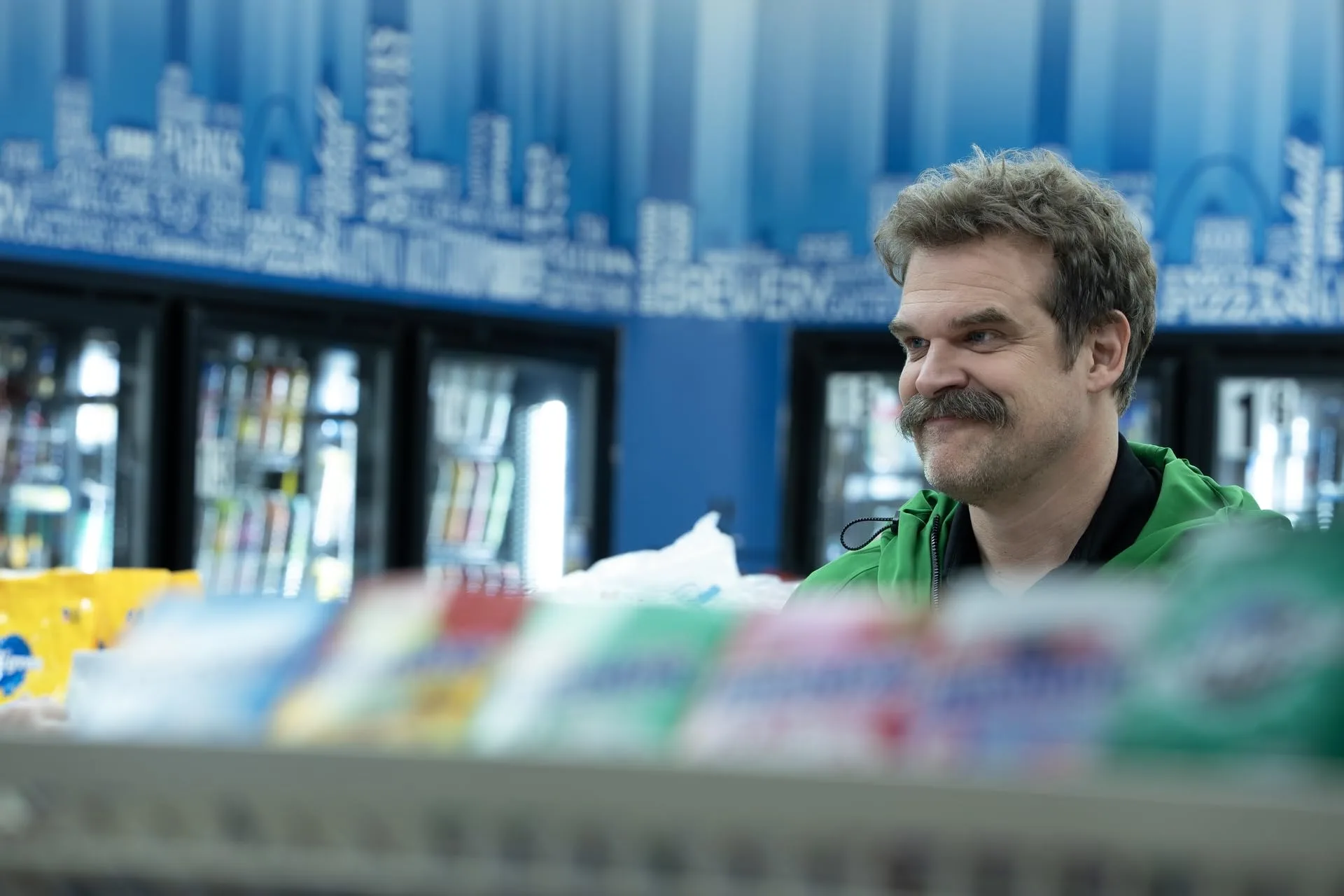
The comedy often grows out of setting and behavior. Suburban digressions stretch into tiny epics. Meetings get planned in places that feel spiritually unsexy, smoothie rendezvous and chain restaurants, whispered talks in improbable bathrooms. There is a particular hilarity in watching adultery treated like an errand, scheduled with the same energy as picking up groceries. “Peak loser” energy becomes the point, and the show refuses to punish that energy with contempt.
Sex, here, rarely aims for heat. The app functions as a narrative accelerant, a permission slip for midlife longing. The sex scenes lean toward the lightly humorous and dreamlike, with role-play and fantasy exposing need more than arousal. Clark and Carol’s games reveal the shape of what is missing at home: control, surrender, validation, the desire to feel seen without judgement. The series carries a sex-positive spirit while still honoring the terror that comes with wanting something out loud.
The noir element comes from betrayal, double crosses, secrets, and moral compromise, planted in daylight. Violence and deception erupt in places built to promise safety, swing sets, lawns, neighborhood parties, a city that can look ordinary from the street and feel haunted up close. The show keeps returning to a recurring thought spoken aloud in different forms: normal is often a distance effect. Step closer and you find rituals hiding wounds.
Visually, the world runs cold. Overcast grays and blue tones turn St. Louis into a muted stage where desire looks like a fever under glass. The police building carries a harsh, almost dystopian weight, its architecture pressing down on everyone who enters. Conrad’s camera often starts low, on pavement or neglected grass, then tilts upward, as if the series is searching the ground for the thing people have dropped and refused to pick up again.
Music acts like an argument with the images. “Aquarius/Let the Sunshine In” floods the opening with hope that feels reckless, then the series keeps asking where that sunshine went. Needle drops pop up like weather reports from another emotional climate, offering irony, comfort, and a reminder that these characters keep reaching for light while living inside their own shadow.
DTF St. Louis is an HBO Original dark comedy limited series that premiered on March 1, 2026. The seven-part miniseries explores a complex and deadly love triangle involving a local weatherman, his sign language interpreter, and the interpreter’s wife, all triggered by a niche dating app for married couples. The show features a high-profile cast led by Jason Bateman, David Harbour, and Linda Cardellini. Viewers can watch the series on the HBO cable network or stream it via HBO Max, with new episodes releasing on a weekly basis through mid-April.
Where to Watch DTF St. Louis Online





Full Credits
Title: DTF St. Louis
Distributor: HBO, HBO Max
Release date: March 1, 2026
Rating: TV-MA
Running time: 60 minutes
Director: Steven Conrad
Writers: Steven Conrad
Producers and Executive Producers: Steven Conrad, Jason Bateman, David Harbour, James Lasdun, Todd Black, Jason Blumenthal, Steve Tisch, Molly Allen, Bruce Terris, Michael Costigan, Kristina Wenson, Christina M. Fitzgerald
Cast: Jason Bateman, David Harbour, Linda Cardellini, Joy Sunday, Richard Jenkins, Peter Sarsgaard, Arlan Ruf, Chris Perfetti, Wynn Everett, Chastity Dotson, Asher Miles Fallica, Steven Rho, E-Kan Soong
Director of Photography (Cinematographer): Tina Rowden
Editors: To Be Announced
Composer: Alex Wurman
The Review
DTF St. Louis
“DTF St. Louis” turns a crude premise into a chilly, compassionate puzzle about desire, shame, and the stories we tell to survive ourselves. Its non-linear design can feel stubborn, yet the odd rhythms, bleak suburban daylight, and quiet tenderness keep pulling you closer. The central trio lands as flawed, painfully human, and the investigators add dry tension without flattening the tone. When the series hits, it feels like laughing in a gray room and realizing the laugh is a kind of prayer.
PROS
- Strong lead performances with real emotional texture
- Dark comedy that grows warmer over time
- Memorable atmosphere, music, and visual motifs
- Mystery reframes character choices effectively
CONS
- Fragmented structure can frustrate
- Some repetition and dragged-out withholding
- Pacing occasionally feels stretched






terrific review of a compelling show. Best insight I’ve seen among several reviewers