
























![Kingdom Hearts Collection [I-III] Review](https://gazettely.com/wp-content/uploads/2026/10/Kingdom-Hearts-Collection-I-III-1-360x180.webp "Kingdom Hearts Collection [I-III] Review: KHII Holds Steady as Newer Entries Fluctuate 37")



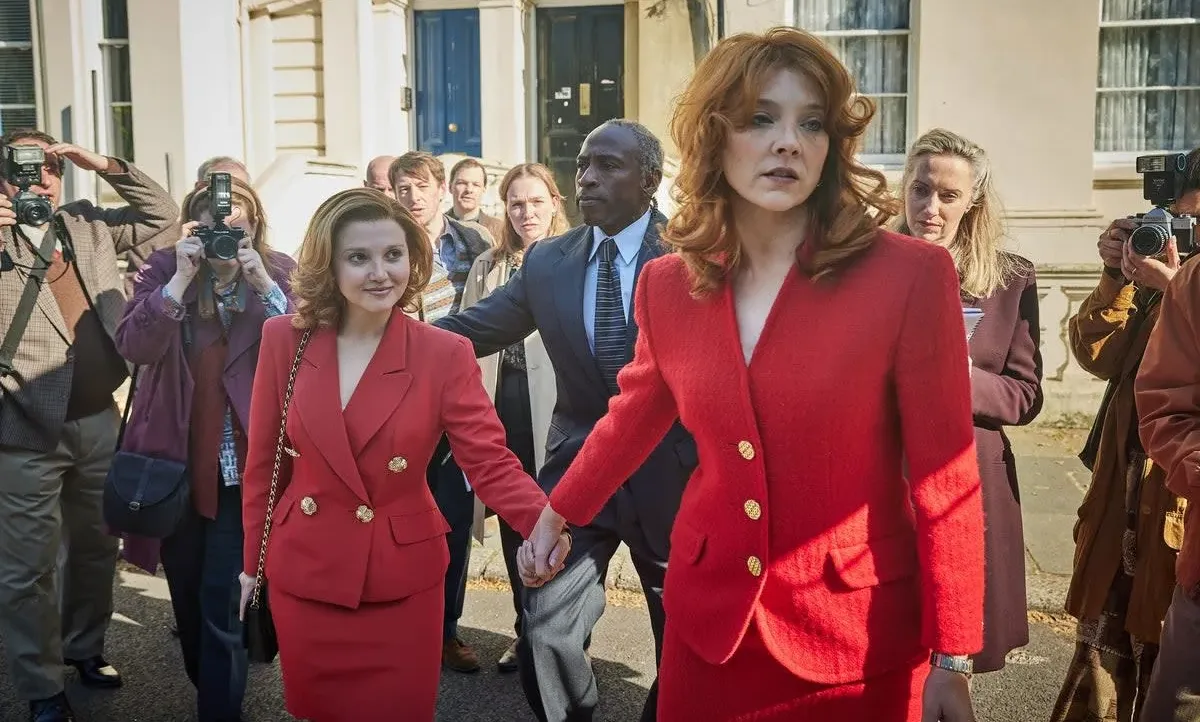

A queasy, off-kilter piano stumbles through the opening credits of The Lady, and the message lands fast: this is playing in psychological-thriller territory, not the usual royal pageant. Before anyone speaks, the screen throws up a disclaimer about characters being created and merged for dramatic purposes.
The phrasing has the stiff earnestness of a school theatre note, yet it introduces a glossy ITV miniseries about the brutal fall of Jane Andrews. The drama tracks Andrews from her start as a Marks & Spencer employee in Grimsby to the high-stakes job of dresser for Sarah Ferguson. The case ends in a murder conviction that helped reshape tabloid fixation around the turn of the millennium.
By centering the decade before the death of Thomas Cressman, the series tries to weld high-society period drama to gritty true crime. Left Bank Pictures brings the same sheen it has used on the House of Windsor elsewhere, and that sheen matters here because the hook leans hard on royal proximity. The palace becomes the viewing lens for a mind coming apart under the pressure of class aspiration.
Cleethorpes to Buckingham Palace: The Brittle Ascent
Jane Andrews arrives as someone determined to outrun the grey horizons of her Lincolnshire upbringing. Her climb plays like a warped rags-to-riches story. Early on, she reads as fragile, clutching at the hope of a job in the capital. A friend’s snide remark about her boyfriend being on benefits and her Marks & Spencer job lights the fuse for reinvention. Once she lands the palace position, the change turns absolute.
She scrubs away her northern vowels with the same clinical care she applies to choosing silk scarves for the Duchess. Mia McKenna-Bruce sells the shift with a performance that feels jagged and prismatic, catching Jane’s wide-eyed ingénue mode while letting a dangerous edge flicker through the smile.
The script camps out in the machinery of her ambition. We watch Jane adopt the “Sloane Ranger” look, while the porcelain surface of her new life keeps splintering. Her history of mental health struggles and adolescent suicide attempts threads into her palace routines. She builds an unhealthy fixation on her employer, copying the Duchess’s style and mannerisms until the two start to smear together.
The series does not shape Jane into an easy sell. She comes across vain, angry, and duplicitous, and the show asks you to stay with her anyway. Her “Cinderella” surge runs on a hollow need for status, and that need drives scenes as much as plot does. Her vulnerability lands as real, and it also comes packaged with manipulation. Relationships collapse around her, and brittleness becomes the defining feature. The show keeps returning to one pressure point: what happens to someone who has worked this hard to build a posh persona once reality starts taking a hammer to it?
The Haughty Sun in a Gilded Sky
Natalie Dormer avoids a straight impersonation of Sarah Ferguson. She plays a Duchess who reads as an insecure prima donna, powered by financial anxiety and a constant appetite for validation. This “Fergie” breaks from the bouncy, fun-loving 1990s caricature.
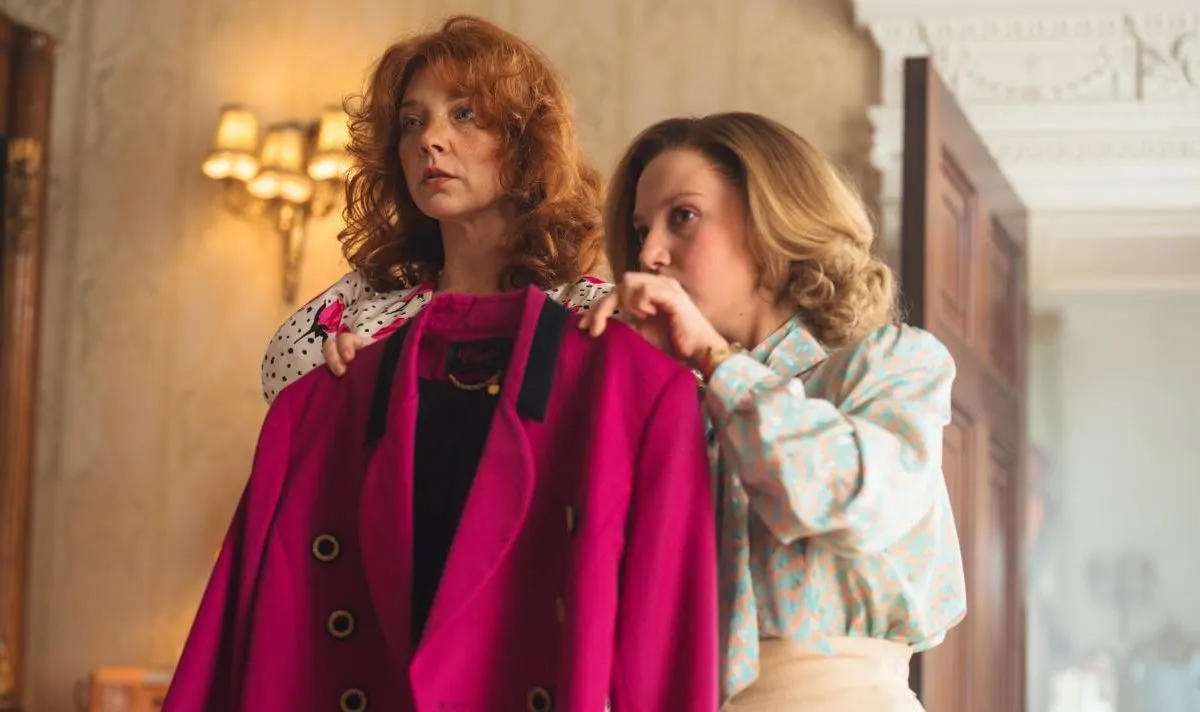
She is haughty and capable of cruelty, and the show gives her a sharp entrance: she asks Jane if she found it “too grim oop north” during their first meeting. The bond between the two women becomes a fascinating toxic mess. They share outsider status within “The Firm,” and the class divide stays firmly in place. The Duchess shifts Jane between trusted confidante and household staff depending on mood, moment, and need.
Dormer’s grip on the screen gets so strong that the murder investigation can start to feel like it is fighting for oxygen. Her obsession with the press and her rivalry with the Princess of Wales inject a soap-opera charge that sits awkwardly beside the grisly crime plot. The production leans on the Yorks’ scandalous history to keep the engine running, and the Duchess’s shadow grows large enough that Jane’s legal stakes can slide into second position.
The series also carries an external weight: Dormer declined to promote the show after real-world revelations about Ferguson’s associations. That choice hangs over the drama with a modern cynicism that the script itself cannot ignore. Then the show hands the Duchess a brutal little piece of advice for Jane: the best way to get over an ex is to get under someone better. It plays as a punchline with teeth, and it captures the shallow, transactional world Jane has been so desperate to enter.
The Weary Raincoat and the Cricket Bat
The structure runs on a dual timeline, and the constant switching creates tonal whiplash. One strand lives in champagne receptions and palace corridors. The other lives on the blood-stained carpet of a London flat. Philip Glenister plays DCI Jim Dickie as a man who has seen too many “textbook domestic” scenes, and he brings a grounded, weary presence that cuts through the opulent flashbacks.
His investigation into the murder of Thomas Cressman plays as a straight pursuit of justice, stripped of the romantic fog that clings to the royal years. Ed Speleers turns Cressman into a seedy, somewhat unlikeable figure, complicating the victim-perpetrator dynamic without smoothing any of it out. The relationship between Jane and Cressman becomes a chain of crushing emotional blows, with his insults landing as brutal and destabilising against Jane’s already fragile psyche.
The transitions between worlds hit like a door slammed mid-sentence. One moment, it is a Pretty Woman-style hat-trying montage. The next moment, the camera is down at the bloodied feet of a victim. The jolt is part of the point: fantasy invites reality in, then reality kicks the furniture over. The courtroom scenes go for maximum discomfort.
The series includes allegations of rape and domestic abuse used in Jane’s defense, while also stating that the original jury rejected those claims. That creates a sticky ethical unease. The show wants the salacious detail of a famous trial, and it also wants you to remember that real lives were wrecked. Glenister becomes the anchor in those moments, keeping the focus on the bleak, upsetting crime sitting under the palace glitter.
Eighties Excess and Palace Parody
The production design turns The Lady into a carefully built trip through the late 20th century. It catches the Thatcher-era economic weight of Lincolnshire, then explodes into the neon and gold of 1980s London. Period music does heavy lifting.
Tracks from Depeche Mode and Blondie bounce through scenes, pumping up the era’s pulse. Those upbeat songs often play across Jane’s growing instability, and the effect lands as haunting. The visual approach aims for the same prestige gloss seen in other Left Bank work, and some palace scenes do hit that sense of grandeur and seclusion.
The series also trips into something closer to a ropey seaside wax museum. Certain royal-household dialogue plays like a high-society sketch, with talk of “bagging viscounts” and going out for “champers.” That tonal wobble creates friction between serious drama and high-camp soap.
Direction leans into the era’s visual language through shopping montages and slow-motion shots, selling the seduction of Jane’s new lifestyle. The choice tracks with Jane’s own self-image: she frames herself as the star of a glossy film while the story around her curdles toward tragedy. Editing underlines that fantasy by cutting between palace brightness and the muted, rain-soaked palette of the investigation.
The Price of the Royal Ploy
The question hovering over The Lady is simple: does the crime call for this level of lavish dramatisation? Critics of the series have argued that the murder had nothing to do with Jane’s palace job. Her time as a dresser functions as a marketing hook aimed at viewers with an appetite for royal scandal.
Remove the House of Windsor link, and the shape that remains is a tragic domestic homicide in a mundane setting. The series returns to Jane’s story because her royal association carries “dark glamour,” and that choice stirs ethical worries about privacy for the people involved.
The victim’s family has objected to the project, and the show’s emphasis on the “Cinderella” framing plays like an extension of the tabloid machine that drove the headlines the first time around. The drama puts on display a collective hunger for justice as entertainment. It reflects a slice of British history marked by sleazy journalism and voyeuristic interest in elite private lives.
The performances land, and the period detail hits with real force, while the series keeps circling its prurient starting point. It asks the audience to enjoy the scandal while keeping one eye on the human cost, which is a brutal balancing act for true crime on prime-time television. So what is the royal intrigue doing here: sharpening the social point, or sweetening the pill so the audience swallows a horrible crime with fewer questions?
The Lady premiered on February 22, 2026, on ITV1, with all four episodes becoming available for streaming immediately on ITVX. International viewers can access the series through BritBox starting in March 2026. The drama focuses on the real-life trajectory of Jane Andrews, exploring her transition from a royal dresser for Sarah Ferguson to a convicted murderer, set against the backdrop of the late 80s and 90s.
Full Credits
Title: The Lady
Distributor: ITV1, ITVX, BritBox, Sony Pictures Television
Release date: February 22, 2026
Rating: TV-MA
Running time: 47 minutes
Director: Lee Haven Jones
Writers: Debbie O’Malley
Producers and Executive Producers: Florence Haddon-Cave, Polly Hill, Stephen Nye, Debbie O’Malley, Sian McWilliams, Andy Harries, Rebecca Hodgson, Jess O’Riordan, Robert Schildhouse
Cast: Mia McKenna-Bruce, Natalie Dormer, Ed Speleers, Philip Glenister, Claire Skinner, Laura Aikman, Ophelia Lovibond, Mark Stanley, Daniel Ryan, Sean Teale
Director of Photography (Cinematographer): Bryan Gavigan
Editors: Oliver Parker, Agnieszka Liggett
Composer: Chris Roe
The Review
The Lady
The Lady succeeds as a showcase for Mia McKenna-Bruce’s chillingly precise performance, but it struggles to justify its own existence beyond its proximity to royalty. By leaning so heavily on the "Fergie" connection, the narrative often prioritizes tabloid-style sensationalism over a deep, meaningful exploration of the central tragedy. It is a visually polished, propulsive watch that ultimately feels more like a prurient marketing ploy than a necessary piece of social commentary. While the period detail and acting are top-tier, the series leaves behind a lingering sense of ethical discomfort.
PROS
- A masterclass in portraying brittle, shifting volatility.
- Impeccable 80s and 90s production design and soundtrack.
- Bingeable and propulsive, keeping the narrative momentum high.
CONS
- Jarring transitions between "royal soap" and "gritty procedural."
- Dramatizes unproven claims against the wishes of the victim's family.
- The Windsor link feels like a hook for an otherwise standard crime.







