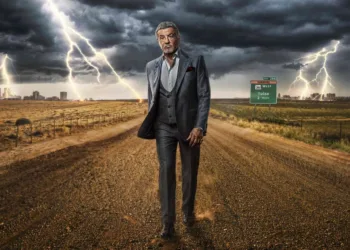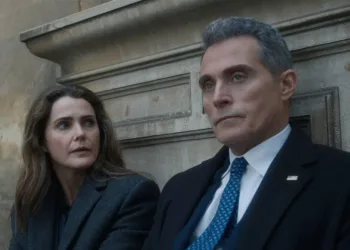

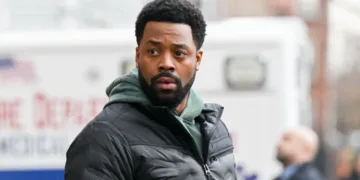
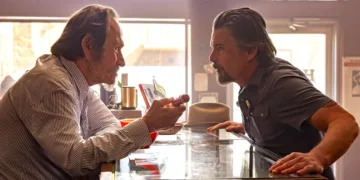









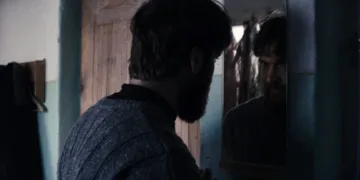














Marshals extends the Montana-set saga that began with the Dutton family. Set fifteen months after the previous series, it follows Kayce Dutton, played by Luke Grimes. Kayce has stepped away from the weight of the family ranch and lives in East Camp with his son, Tate. The story kicks off after a violent bombing on the Broken Rock Indian Reservation pulls him back toward law enforcement.
He signs on with an elite U.S. Marshals unit led by an old friend from his Navy SEAL days. Showrunner Spencer Hudnut redirects the franchise from a sprawling family epic into a fast-paced CBS police procedural. Montana’s rugged terrain remains, yet the storytelling now revolves around a unit and its workflow.
The series tracks Kayce as he tries to keep faith with the tribal community and show up for his son while pursuing fugitives across the region. It positions him at a fresh point in his long-running struggle to live between two worlds.
The Rebirth of the Prodigal Son
Kayce Dutton moves through quiet mourning, living with a personal reality that has pulled his old certainties out from under him. Monica’s absence leaves a clear void, pushing him into a stoic solitude where his identity no longer hangs on his father’s expectations or the constant friction with his siblings. He is a widower facing a world that asks for a version of him he once tried to leave behind.
The show expresses this shift through wardrobe and equipment. Kayce leaves the ranch’s cowboy hat behind and wears a tactical baseball cap on Marshal duty. The change reads as a practical signal of compartmentalization, a visible attempt to keep the cattleman separate from the federal agent.
Tate anchors the emotional center of this chapter. He is a teenager now, with interests that drift away from a single track toward ranch life, and that gives Kayce room to shape a different kind of fatherhood than the John Dutton model. Kayce wants to protect his son from the generational violence attached to their name, even while he accepts a badge tied to force. That contradiction sits on him like a weight.
As he joins the unit, his deadliness as a former soldier becomes his defining advantage. He handles combat with frightening efficiency, yet the cost of that efficiency stays present in his eyes. The series holds two possibilities in the same frame: a man finding a professional purpose, and a man slipping back into the familiar comfort of killing for a cause.
Diversity Within the Badge
The U.S. Marshals unit brings a group dynamic that shifts the series away from the solitary gravity of the Dutton ranch. Pete Calvin, played by Logan Marshall-Green, drives that change. He connects Kayce’s military history to his civilian present and functions as the hinge for this new life. The team includes Belle Skinner, an undercover specialist carrying her own history of trauma, and Andrea Cruz, whose sharp, disciplined focus steadies the group.

Miles Kittle adds a needed angle as the younger member who understands the complications tied to the tribal community. Together they become a new kind of family for Kayce, built on mission planning, trust under pressure, and tactical precision instead of bloodline and land. Scenes of the team unwinding at a local watering hole after a shift hint at a social rhythm Kayce never fully learned on the ranch.
The series keeps Thomas Rainwater and Mo central to the story, and their presence matters to what Marshals chooses to treat as urgent. They carry the Broken Rock Reservation’s interests and offer a paternal guidance that lands as more genuine than the manipulation Kayce lived with before. Keeping them active in the narrative keeps tribal sovereignty in view as an ongoing theme, tied to power and jurisdiction rather than background color.
That forward motion meets resistance through Harry Gifford, whose deep-seated distrust of the Dutton legacy turns into constant institutional pressure. Kayce has to prove his loyalty to the law again and again, episode by episode, pushing against a reputation for lawlessness that arrived before he did.
The Transformation of Western Storytelling
A case-of-the-week structure reshapes how this universe plays out on screen. With 42-minute episodes, Marshals adopts the tempo of a network procedural, usually wrapping a specific fugitive pursuit or crime inside a single hour. The rhythm differs sharply from the slow, serialized pacing associated with prestige cable drama.
The show still carries its history, but it handles it through lighter touchpoints: references to the “Train Station” and the sale of the family ranch, treated as a shadow hanging over the present without taking over every plotline. Conflict stays rooted in material stakes, including a government mine on reservation land, which becomes a contemporary backdrop for the team’s investigations.
The move to CBS also reshapes the show’s language of intensity. Graphic violence and abrasive dialogue are pared back to meet broadcast standards. Tension shifts into high-stakes physical action and extended chase work.
That recalibration speaks to a television moment where franchise storytelling is being refit for a wider, more traditional audience, even when the source brand was built on harsher edges. Marshals argues for a western that can run on competence, procedure, and problem-solving instead of constant shock. The result is a reframing of “range justice” as something legible to a broad demographic, built from professional craft and weekly structure.
Utah as the New Montana Frontier
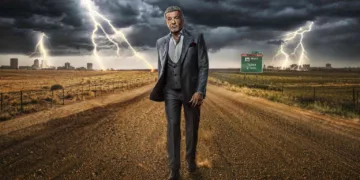
The series keeps its visual polish, using Utah locations to stand in for Montana wilderness. Wide shots of the American West maintain the franchise’s cinematic scale, letting the landscape’s beauty sit beside the grim realities of federal law enforcement work.
Directors such as Christopher Chulack and Greg Yaitanes bring experience in military and high-stakes drama, and that background shows up in action staging that feels explosive while staying tactically coherent. Gunfights and foot chases play with a precision that lifts the material above standard network staging.
Music strengthens the sense of place. Brian Taylor and Breton Vivian deliver a score that merges classic western textures with the urgency of a modern thriller. Country music in bar scenes keeps the local cultural flavor present and helps the setting feel lived-in.
Even the opening sequence, with its intricate visuals and prestige sheen, signals that the production values remain intact under the new format. Marshals lands as a broadcast series that preserves a high-budget visual vocabulary while shifting its storytelling into a weekly, procedural framework.
Marshals is set to premier on CBS and Paramount+ on March 1, 2026, serving as the first network-television procedural in the expansive Yellowstone universe. Reprising his role as Kayce Dutton, Luke Grimes leads the series as a former Navy SEAL who joins an elite U.S. Marshals unit to bring range justice to the rugged landscape of Montana. The show airs weekly on Sunday nights on the CBS Television Network and is available to stream live and on-demand for Paramount+ subscribers. Filmed primarily in Utah, the series blends high-stakes crime investigations with the complex personal legacy of the Dutton family.
Where to Watch Marshals Online










Full Credits
Title: Marshals
Distributor: CBS, Paramount+
Release date: March 1, 2026
Rating: TV-14
Running time: 60 minutes
Director: Greg Yaitanes, Christopher Chulack
Writers: Spencer Hudnut, Taylor Sheridan, Tom Mularz, Dan Mazer, Abi Morgan, Craig Thomas
Producers and Executive Producers: Taylor Sheridan, David C. Glasser, John Linson, Art Linson, Spencer Hudnut, Luke Grimes, Ron Burkle, David Hutkin, Bob Yari, Michael Friedman
Cast: Luke Grimes, Gil Birmingham, Mo Brings Plenty, Brecken Merrill, Arielle Kebbel, Ash Santos, Tatanka Means, Logan Marshall-Green, Brett Cullen
Director of Photography (Cinematographer): Ben Richardson
Editors: Orlando Machado Jr., Terry Cafaro, Ann M. Parish
Composer: Brian Tyler, Breton Vivian
The Review
Marshals
Marshals successfully translates a sprawling cable epic into a sharp, tactical procedural without losing its visual soul. While the shift to a case-of-the-week format and broadcast standards softens the original’s jagged edges, the series finds new strength in Kayce Dutton’s quiet evolution and a capable supporting ensemble. It is a polished, professional reimagining that trades soap-opera dramatics for structured action, offering a accessible entry point into this rugged universe while honoring the weight of its history.
PROS
- Luke Grimes brings a matured, stoic depth to Kayce as he navigates fatherhood and a new professional identity.
- The cinematic cinematography and tactical action sequences maintain a prestige feel rare for network television.
- The addition of Logan Marshall-Green and the rest of the unit provides a fresh, collaborative energy.
- Integrating Thomas Rainwater and Mo ensures the series remains grounded in tribal sovereignty and regional politics.
CONS
- The procedural "case of the week" format can occasionally feel repetitive compared to serialized storytelling.
- Broadcast standards result in some clunky exposition and a loss of the original's gritty linguistic texture.
- Some viewers may find Kayce’s sudden return to lethal efficiency at odds with his previous arc of redemption.