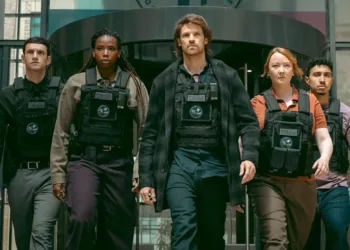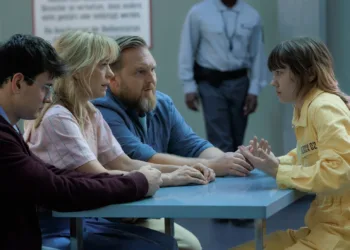


























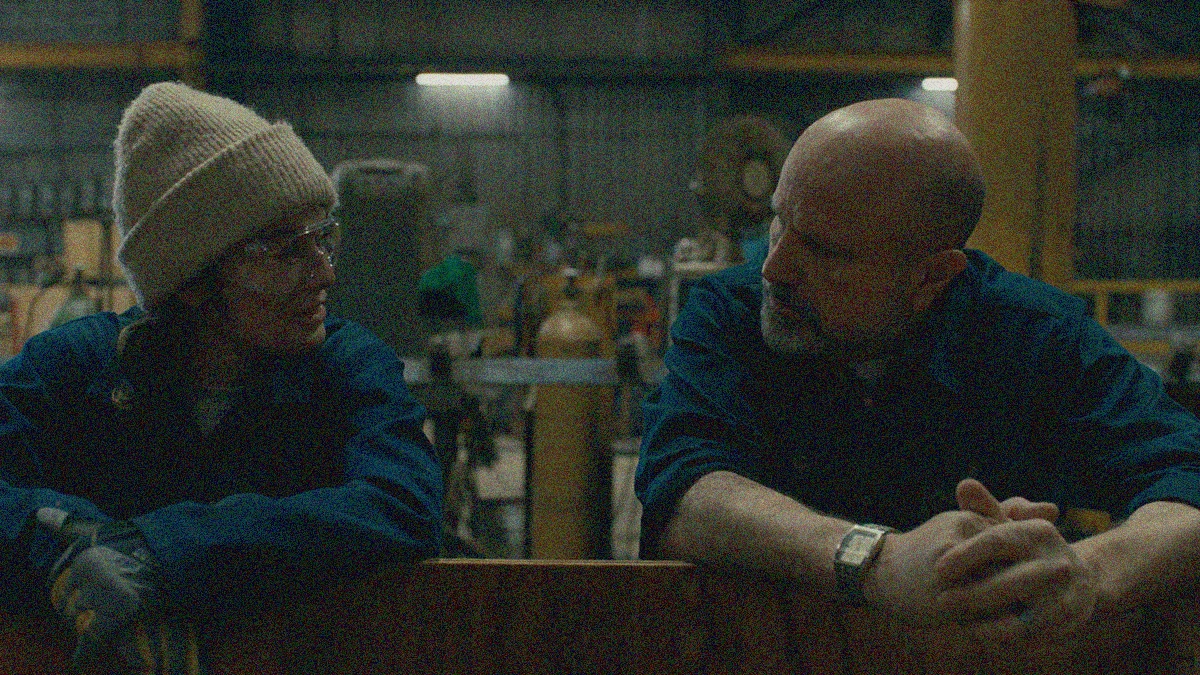

The American rust belt emerges here as a place where distant wars are built into everyday labor. Nance Redfield lives inside that system through her job at a local munitions factory. She understands herself through work, through care for her family, and through her place inside a national defense structure that gives moral cover to the town’s industry.
The steady manufacture of small arms rounds shapes daily life, and Nance handles that work with quiet discipline. At home, she shares a fragile sense of order with her son Jesse and his pregnant wife Diana. That order begins to crack when Jesse signs up for service in Afghanistan and leaves the factory for a war he scarcely understands.
His absence alters the house immediately, forcing Nance and Diana into a strained waiting period built on uncertainty. Their last contact comes through a video call, and that thin digital connection soon gives way to the visit every military family fears.
A uniformed officer arrives at Nance’s door, and the abstractions of foreign policy step straight into her home. Safety, which her labor once seemed to guarantee, collapses in an instant. The town itself starts to feel haunted, filled with grief and shadowed by the weapons its residents produce.
The Forensic Evidence of Systemic Betrayal
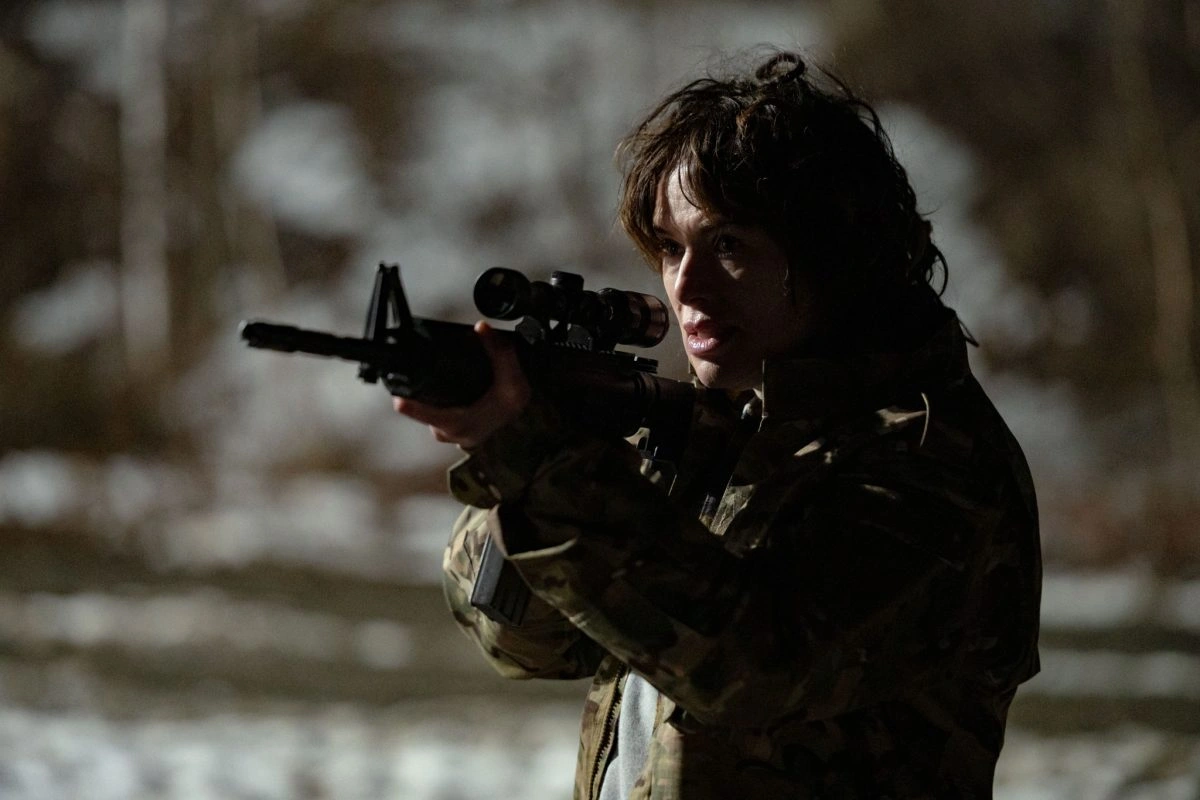
Nance rejects the official account of Jesse’s death almost as soon as she hears it. Her doubt grows from the knowledge she carries in her own body as a factory worker who knows the products passing through her hands each day. That suspicion pushes her into a reckless act inside the morgue, where she breaks through military procedure and retrieves the metal fragment buried in Jesse’s chest.
The bullet becomes the film’s most brutal symbol. It carries the markings of her own factory, pointing to the possibility that Jesse died from American-made ammunition. A statistical claim deepens the horror, suggesting that close to 30 percent of fallen service members return home with domestic rounds inside them. That figure opens a view onto a weapons pipeline shaped by leakage, black markets, and official failure, where arms meant for allies circle back through enemy hands.
Nance begins writing names on the skin of her hand, turning her body into a record of blame. The gesture gives physical form to her need for accountability. She sees her employer and the military liaison as pieces of a profit-driven structure willing to consume its own young.
Her search for someone to punish becomes a search for coherence inside a system built on distance, transaction, and denial. The bullet connects factory labor, military policy, and maternal grief with terrifying clarity. From that point on, mourning hardens into investigation, and the film’s political critique takes shape through an object small enough to fit in a palm.
Emotional Volatility and the Projection of Guilt
Lena Headey gives Nance no easy path to audience sympathy. Her grief arrives in sharp, abrasive form, and the performance keeps sanding away any sentimental reading of the character. Nance lashes out at people who try to comfort her, turning sorrow into aggression with almost frightening speed.
Her harshest attacks fall on Kahlil, an Afghan immigrant who runs a local support group. She speaks to him through xenophobic assumptions and wild accusations, exposing the prejudice embedded in her panic. These outbursts reveal a woman trying to push guilt away from herself. She cannot bear the thought that her own labor may have played a part in the ammunition that killed Jesse.
Kahlil stands in quiet contrast through his steadiness and patience, carrying a wider understanding of loss that Nance cannot yet face. He brings an international dimension to the film’s grief, linking American suffering to the suffering exported abroad. Diana also absorbs the damage caused by Nance’s unraveling, left isolated during pregnancy by the very person who should offer support. The care shown by the people around Nance throws her collapse into harsher relief.
She treats compassion like an intrusion because compassion asks for honesty. Her behavior suggests a mind shaped by radicalized media and by a desperate hunger for an enemy she can identify and confront. Trauma here does not stay internal. It spills outward and lands on those with less protection. Nance’s hostility becomes a method of survival, and each outburst erodes what remained of her earlier self.
Structural Decay and the Machineries of Conflict
The film frames global warfare through local economic decline, presenting the defense industry as a source of income for people given little shelter from its costs. Chad Faust looks closely at workers near the bottom of that structure, people who keep the machinery running yet receive none of the security promised by patriotic language.
As the plot develops, the film edges toward revenge-thriller territory, though it never supplies the release such stories usually promise. Nance’s thinking is shaped by extremist podcasts that feed her paranoia and give form to her rage. That turn speaks to a larger social condition, showing how neglected rural communities can become fertile ground for conspiracy thinking when institutions offer no credible answers.
Her encounters with the army recruiter and factory management deepen that view. Bureaucracy appears cold, procedural, and untouched by personal grief. Jesse’s death registers as another acceptable loss inside a larger chain of production and deployment.
The film’s 90-minute runtime pushes events forward quickly, which leaves some secondary figures, especially Diana, with reduced agency as attention stays fixed on Nance’s unstable pursuit. Even so, the film keeps its central irony in full view. This community survives by manufacturing the tools that help destroy it. Accountability never appears within any formal system, and every official channel seems designed to absorb blame and return silence.
By the final act, Nance has been consumed by the apparatus she once served through routine labor and familial duty. The film presents the arms trade as a cold mechanism, impersonal in design and devastating in effect. Its portrait of modern combat reaches back into the factory, the household, and the grieving body, binding them together with relentless logic.
Ballistic premiered at the Cinéfest Sudbury International Film Festival in September 2025. It arrived for the public in the United States yesterday, April 17, 2026. You can watch the movie on digital services like Google Play and other video on demand storefronts. The story follows a woman who uncovers a connection between her employment at a munitions factory and the death of her son.
Where to Watch Ballistic (2025) Online
Full Credits
Title: Ballistic
Distributor: Brainstorm Media, Photon Films
Release date: April 17, 2026
Rating: R
Running time: 91 minutes
Director: Chad Faust
Writers: Chad Faust
Producers and Executive Producers: Thomas Michael, David Tish, Lee Nelson, Roman Kopelevich, Crystal Hill
Cast: Lena Headey, Amybeth McNulty, Enrico Colantoni, Amanda Brugel, Hamza Haq, Jordan Kronis, Chad Faust
Director of Photography (Cinematographer): Kristofer Bonnell
Editors: Mariana Urrutia
Composer: Dillon Baldassero
The Review
Ballistic
The film functions as a cold examination of the domestic cost inherent in global defense manufacturing. It avoids the gratifications of a standard thriller to focus on the jagged psychological results of systemic betrayal. Lena Headey’s performance anchors the story even when the script faces challenges with its own pacing. While the critique of the military industrial complex stays sharp, the execution feels uneven and occasionally imitates familiar tropes. It provides a bleak look at how institutional machines consume the people who support them from the bottom up.
PROS
- Intense, committed acting by Lena Headey.
- Sharp social analysis of the domestic arms trade.
- Focus on the tension between rural work and global war.
- Refusal to romanticize military recruitment.
CONS
- Inconsistent pacing in the final segments.
- Story logic occasionally yields to genre clichés.
- Limited screen time for important supporting characters.
- The grim atmosphere provides few moments of emotional relief.