
















The prophecy guiding Daemons of the Shadow Realm states that twins born at the exact meeting point of day and night will gain the authority to command spiritual entities. Yuru lives in an isolated mountain village, serving his community as a provider. He hunts so his people can survive. His sister, Asa, remains locked in a cell under the gaze of elders who refuse to explain her confinement.
That pastoral order rests on a carefully sustained fiction. The arrival of modern military forces breaks the village wards and reveals a reality Yuru had never imagined. His life, he learns, was constructed to protect his identity, while the truth of his family remained buried beyond the peaks.
The story shifts from folk tale into brutal supernatural conflict, with automatic weapons colliding against ancient spirits. Yuru escapes his home to uncover the truth about his parents. Left and Right, two powerful guardians awakened through a mysterious medallion, accompany him. The series builds its mystery around siblings drawn to opposing sides of a hidden war, where folklore and modernity meet with deadly force.
The Fractured Reality of the Mountain
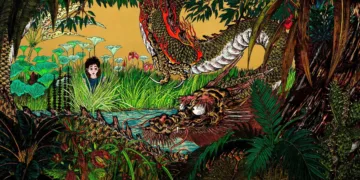
The village Yuru calls home operates like a sealed pocket of history, a place where time appears frozen. That isolation is a deception. The legendary dragons seen by the villagers in the sky are later revealed as condensation trails from high altitude aircraft.

The movement from fantasy forest to modern Japanese urban sprawl lands with sensory force. The protective wards sustaining the mountain illusion form a barrier between an invented past and a cold technological present. Helicopters and soldiers in tactical gear descend on the village, and the collision feels instant, brutal, and bodily.
The series treats its supernatural material with a calm, matter of fact confidence. It favors grounded magical realism over heavy exposition. The practical realities of the characters give the fantasy a physical density. Dera and Hana must secure a contemporary apartment and pose as a married couple to preserve their cover.
These domestic episodes sharpen the friction between ancient spirits and modern social codes. The humor arises from the daemons’ bewilderment before skyscrapers, speeding cars, and other ordinary features of the world beyond the mountain.
The prophecy concerning the twins remains the central mystery. Their birth at the crossing of light and dark grants them enormous power. The discovery that the Asa who grew up with Yuru was a decoy turns his awakening into an act of betrayal. The real Asa appears alongside the invading forces, and her arrival alters the family dynamic with uneasy force. This collision of worlds demands that Yuru adjust to a reality where the mountain’s rules have lost their authority. The narrative withholds simple answers about the nature of this divided world.
Tactical Hunters and Gray Moralities
Yuru is shaped by the discipline of a hunter. He is alert, practical, and emotionally contained. He lacks the awestruck quality often assigned to a chosen hero. Survival depends on his capacity to read terrain, sense danger, and respond with quiet efficiency. That grounded temperament defines his bond with Left and Right. He treats them as autonomous beings and asks for their aid. This respect differs sharply from the controlling tactics used by Jin and other enemies.
Yuru carries a muted grief after learning that his parents abandoned him while taking his sister. His restraint conceals a deep injury. The antagonists possess similar moral texture. Asa first appears as a cold executioner. Later exchanges reveal sincere affection for Yuru, making her motives hard to fix in place. Gabby offers another expression of ethical ambiguity. She is merciless toward soldiers and villagers, yet protective toward children. Pure villainy has little room here. Alliances shift, loyalties blur, and every bond carries danger.
The series studies competing philosophies of power. Yuru gives his spirits agency, while his enemies treat power as something transactional. His adjustment to the modern world gives the action a vital rhythm. He tastes store bought onigiri for the first time. He learns to use technology while standing small against a vast urban setting. These fish out of water moments never soften his lethality. He remains a gifted tracker who transfers the lessons of the mountain into the concrete canyons of the city.
His ability to preserve his identity as his world expands gives the story its emotional anchor. The characters have a tangible presence, which makes each decision feel consequential. Every exchange exposes some hidden piece of their past. The story resists tidy categorization of its cast.
The Physicality of the Unseen
The series’ visual identity carries the recognizable aesthetic of Hiromu Arakawa. The character designs feel sturdy and grounded. Facial expressions convey precise emotional shifts without relying on dialogue. The daemons appear in many forms. Some resemble stone statues, while others take the shape of animals or strange artistic inventions.
Studio Bones brings strong technical control to the fight sequences. The animation captures the weight of each encounter. A strike carries kinetic force. A body reacting to gravity feels believable. The direction lingers on tactile details: the exact movement of a daemon’s hand, the tension in a character’s muscles during a struggle, the simple act of opening a plastic food container. Small gestures gain sensory texture.
The series uses 3D models for certain large scale threats, integrating them carefully with the hand drawn backgrounds. The pacing is restless and unpredictable. Quiet domestic comedy can give way to casual violence with startling speed. This tonal instability keeps the viewer unsettled. The story rarely settles into one emotional register for long. It repeatedly breaks apart its own premises to keep the mystery in motion.
The shifts between idyllic mountain life and the harsher reality of urban combat feel smooth. The artistic style connects the fantastical with the ordinary. The result is a visual experience that feels familiar and strangely renewed. The animation carries the story’s weight, allowing the supernatural elements to occupy the physical world with conviction.
The Logic of the Daemon Bond
Daemons are spiritual beings tied to human masters through blood and ancient artifacts. They are physical entities with personalities, limits, and presence. Left and Right serve as guardians in the form of stone statues. Kotetsu and Jiro appear as a domestic cat and dog. Their powers unfold in ways that recall supernatural avatars, yet the series grounds them in touch, mass, and tactical constraint.
The combat system depends on tactile energy. Daemons have weight. Physical barriers can block them. They interact with their surroundings in ways that require careful judgment from their masters. Summoning involves medallions and spilled blood to create a connection. Environment matters in battle. Light, shadow, and terrain affect visibility and movement. Yuru displays his tactical intelligence by destroying light sources, giving his daemons an advantage in darkness.
The connection between master and spirit reaches beyond simple command. Left and Right have playful, protective personalities that operate beyond Yuru’s direct orders. They are curious about the modern world. Their attempts to understand cars or gaming consoles carry a gentle irony. This bond brings warmth into a violent story. The daemons function as characters with their own temperaments. Their loyalty is earned through relationship, trust, and action.
The magic system feels grounded in history and physical law. It creates clear stakes, where combat depends on intelligence, positioning, and mutual trust. The series makes these spectral beings feel essential to the modern landscape, giving ancient spirits a believable place among apartments, streets, weapons, and city light.
Daemons of the Shadow Realm premiered on April 4, 2026, as one of the most anticipated anime adaptations of the year, bringing the work of Fullmetal Alchemist creator Hiromu Arakawa to the screen. Produced by the acclaimed Studio BONES, the series is currently available for streaming globally on Crunchyroll. As of late April 2026, the show has already released its first four episodes, establishing a complex narrative of supernatural twins and modern military conflict that has captivated international audiences.
Where to Watch Daemons of the Shadow Realm Online








Full Credits
Title: Daemons of the Shadow Realm
Distributor: Crunchyroll, Prime Video, Aniplex
Release date: April 4, 2026
Rating: TV-MA
Running time: 23 minutes
Director: Masahiro Ando, Shawn Gann
Writers: Noboru Takagi, Matthew Greenbaum, Hiromu Arakawa
Producers and Executive Producers: Susie Nixon, Aniplex, BONES
Cast: Kensho Ono, Yume Miyamoto, Misaki Kuno, Junichi Suwabe, Takako Honda, Rikiya Koyama, Yuichi Nakamura, Miyuri Shimabukuro
Director of Photography (Cinematographer): Yingying Zhang
Editors: Ayumu Takahashi
Composer: Kenichiro Suehiro
The Review
Daemons of the Shadow Realm
The series balances ancient mythology with a cold, urban reality. It provides a sharp look at familial betrayal and the cost of hidden truths. Arakawa creates a world where every spirit has a personality and every choice has a physical weight. The narrative moves with a speed that prevents comfort. It offers a grounded perspective on the supernatural. This story rewards those who appreciate moral complexity and tactical combat. It stands as a powerful return for a master storyteller.
PROS
- Strong character designs with expressive facial work.
- Kinetic and physically grounded animation style.
- Original approach to the spirit-master dynamic.
- Sharp, unpredictable narrative pivots.
- Detailed worldbuilding merging folklore with technology.
CONS
- Occasional tonal friction between humor and violence.
- Brief uses of jarring 3D models.
- Rapid pacing that leaves some details feeling hurried.