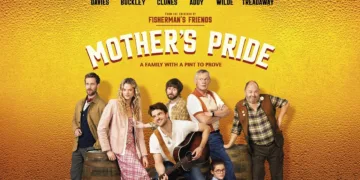






















To treat the British public house as a basic ethanol dispensary is to misread the sacred plumbing of rural life. In Mother’s Pride, the fictional Somerset village of Birchbury becomes a sociopolitical brewing vat for the survival of local spirit. The Drovers Arms stands as a cultural infirmary for the mirth-starved, a spit-and-sawdust sanctuary run by Mick Harley, played by Martin Clunes with jagged, weather-beaten belligerence.
Debt and corporate gastro-colonization have their fingers around the pub’s throat. The stakes have meat on them: bailiffs hover near a temple of tradition, and Mick protects it with the grim stamina of a widower whose world has shrunk to the diameter of a beer mat.
The plot’s spark arrives through Cal, played by Jonno Davies, Mick’s estranged son and a one-hit-wonder casualty whose pop career has dried into fiscal dust. His return has the air of defeat, a surrender-homecoming with an ale-soaked rebellion hidden in its pockets. Across the cobbles sits The George Inn, a high-end gastropub owned by the villainous Pritchard, played by Luke Treadaway.
He embodies the polished vacancy of corporate brewing empires, all sheen and appetite. After Cal discovers his grandfather’s old recipe book, the film shifts from rural lament to yeast-powered uprising. He persuades his suspicious father to stake their remaining dignity on a distinctive mild ale, aiming at a regional competition that becomes their final survival test.
The Alchemy of Estrangement and Biceps
The film’s emotional balance depends on a strain of curmudgeon-craft that Martin Clunes has sharpened across decades. Mick is a study in grief packed under the floorboards. Clunes gives the film weight, keeping it from floating into pure whimsy. He plays silence as armor. His gradual thaw feels earned, partly because every softened glance looks dragged from him by forceps.
Jonno Davies brings Cal a bodily kind of desperation. I might call it a biceps-based performance, meaning a physical projection of strength where a musical career has failed to provide any. His arc, from prodigal pop-up to committed heritage brewer, carries an unexpectedly grounded sincerity. The film could have treated him as a joke with a gym membership. It gives him a bruised sense of purpose.
James Buckley supplies the film’s strongest maturation as Jake, the loyal son and single parent. He sheds the puerile skin of his earlier iconic roles and offers weary, grounded wisdom, while still serving as the main delivery system for sharp-edged zingers. The supporting ensemble works like a folkloric chorus, complete with its own local mythology and pint-stained ritual logic.
Mark Addy’s Paxman is a barfly archetype of such florid biological force that he seems bolted to the pub’s furniture. Luke Treadaway’s Pritchard, dressed in designer-gilet villainy, is a pantomime figure of predatory capitalism. Subtlety has left the building, possibly for a craft IPA next door, yet the film needs his gleaming awfulness as a foil for the Drovers’ ragtag crew. Gabriella Wilde’s Abi and Josie Lawrence’s saucy local help round out a cast that finds chemistry inside the haphazard plotting of Somerset social order.
The Yeasty Ferment of Social Hemorrhage
Under the chocolate-box surface sits a sobering figure: thirty-seven British pubs vanish every week. Mother’s Pride works as a cinematic preservative against that cultural hemorrhage. Its anxiety comes from the clash between heritage-hoarding and the sterile spread of chain culture.

The film is fixated on the untidy communal, the messy local room where gossip, grief, bad jokes, old grudges, and half-decent beer create a social immune system. The loss of the local local becomes a sign of wider societal atomization. Small places disappear first. Then people wonder why loneliness has started charging rent.
The script is over-hopped with heavy material. It tries to ferment grief, ADHD, mental health crises, and single parenthood into one ninety-minute brew. This narrative congestion can produce soapy melodrama that jars against the film’s comic aims. The gears grind. The sentiment swells. Someone in the editing room seems to have trusted the emotional equivalent of a pub lock-in.
Still, the homebrewing metaphor has force. Creation becomes a method of disenfranchised reclamation. The characters are making beer, and they are also recovering agency in a world that has filed them under obsolete. The symbolism is plain, perhaps aggressively plain, yet it has sturdy appeal. Grain, water, yeast, memory: the ingredients become a folk grammar of survival.
The film’s gentle traditionalism celebrates Morris dancing and green valleys as sheltering rituals against metropolitan indifference. Its view of community spirit is simple, maybe too simple, yet its well-meaning earnestness feels rare in an age of cynical blockbusters. That sincerity gives the film a cultural usefulness, a reminder that local customs can carry emotional infrastructure long after official institutions have forgotten the address.
Retropop-Folklorism and the Light Ale Aesthetic
Nick Moorcroft works within a regional-uplift template he has refined into a recognizable, predictable subgenre. He swaps the sea shanties of his earlier work for Somerset ale culture, creating a hop-infused cinematic digestif. The visual language leans into saturated escapist-bucolicism, a fantasy England where sunlight appears contractually obliged to hit every pint glass at a flattering angle. It is pretty, sentimental, and occasionally so polished that the mud seems to have signed a waiver.
The comedy is proudly uncle-centric. Dad gags and references to dogging arrive like relics from pre-digital humor, creaking into the room with full confidence. These comic beats can sit awkwardly beside the film’s tender material about familial fracture. One minute, the film studies emotional estrangement. The next, it reaches for a gag that smells faintly of a pub quiz in 2007. I objected, then laughed once, then objected again. Such is the critic’s burden, or minor digestive complaint.
The film’s peak of harrowing eccentricity arrives in a sequence where characters perform Morris dancing to seventies funk hits such as “Daddy Cool.” It is a moment of cultural syncretism, baffling and amusing in equal measure. The scene feels like rural England briefly trapped inside a disco ball, which may qualify as a new national psychosis: retropop-folklorism. The pacing follows a zigzag path, moving from homebrew hangover to the solemnity of a Crown Court, then toward a bright-lights-big-city finale in London. The tonal jolts are real. The film lurches, recovers, grins, and pours again.
The experience resembles an inoffensive light ale: gentle, accessible, and carrying a sincere aftertaste. Mother’s Pride has no desire to reinvent the keg. It wants to remind us that venerable traditions require stubborn custodians, sentimental fools, and the occasional recipe book with near-mystical timing. The result is well-intentioned nonsense that slips down easier than the bitter reality it tries to soften.
Mother’s Pride is a heartwarming British comedy-drama that premiered in UK cinemas on March 6, 2026. Directed by Nick Moorcroft, the film follows the grieving Harley family as they attempt to save their failing Somerset pub, The Drovers Arms, by rediscovering a family brewing recipe and entering the Great British Beer Awards. The story is a “love letter” to British pub culture and explores themes of community resilience and reconciliation. Currently, the film is primarily available to watch in theaters across the UK and Ireland, with digital and streaming platform releases expected later in the year.
Full Credits
Title: Mother’s Pride
Distributor: Entertainment Film Distributors
Release date: March 6, 2026
Rating: 12A
Running time: 93 minutes
Director: Nick Moorcroft
Writers: Meg Leonard, Nick Moorcroft, Natalie Malla
Producers and Executive Producers: James Spring, Shereen Ali, Meg Leonard, David Gilbery, Marlon Vogelgesang, Charles Dorfman, Katherine Pomfret
Cast: Jonno Davies, Martin Clunes, James Buckley, Mark Addy, Gabriella Wilde, Luke Treadaway, Josie Lawrence, Miles Jupp, Karl Collins, Emily Lloyd-Saini
Director of Photography (Cinematographer): Toby Moore
Editors: Johnny Dalkes
Composer: Simon Boswell
The Review
Mother’s Pride
Mother’s Pride functions as a "malt-heavy" piece of "escapist-bucolicism" (a necessary tonic for the "tradition-starved"). While it lacks the "fermenting-audacity" of the Ealing classics it seeks to emulate, it offers a "sincere-warmth" that transcends its "template-driven" origins. This is a "well-meaning-nonsense" that celebrates the "untidy-communal" over the "sterility-of-the-chain." It is a pleasant, if unchallenging, "cinematic-digestif."
PROS
- A grounded, weight-bearing performance that anchors the film’s emotional stakes.
- The inclusion of "pub-closure-statistics" adds a layer of necessary urgency to the whimsy.
- James Buckley displays a refreshing "puerile-free" maturity as the loyal son.
- A moment of pure, "harrowing-eccentricity" that provides genuine comedic levity.
CONS
- An attempt to ferment too many "societal-ills" (from ADHD to suicide) into a light comedy.
- Pritchard serves as a "cartoon-heel" devoid of any redeeming "human-nuance."
- Occasional "uncle-centric" gags about dogging feel like "relics-of-the-past."
- The "zigzag-trajectory" offers few surprises for those familiar with the "regional-uplift" genre.