




























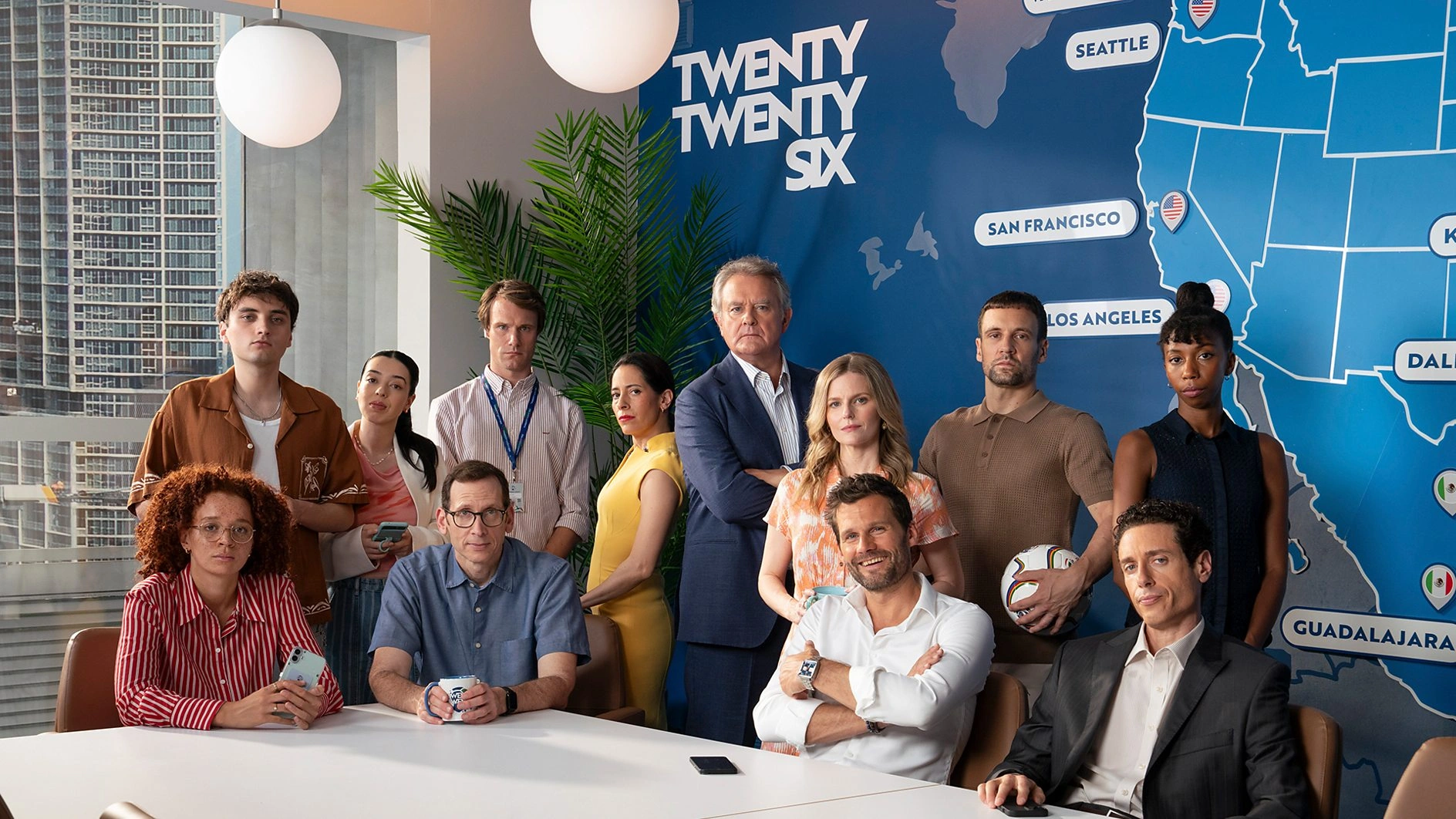

The air in Miami has a particular density, part ocean salt, part corporate sterility, the kind of atmosphere where language arrives polished and leaves hollow. Ian Fletcher sits inside a glass office in this humid landscape, surrounded by potted palms that supply the executive suite with its faintest suggestion of life.
His job title, Director of Integrity, works like institutional camouflage for a global football organization living under constant legal tension. David Tennant returns as the unseen observer, his narration broken by sharp electronic bleeps that erase the names of the sport’s governing body and its premier tournament. The joke is simple and sharp: reality itself has become a liability.
The Strategic Operations Group assembles to manage a massive North American event, and its work immediately sinks into ritualized drift. Early episodes revolve around the urgent selection of host cities for the semi-finals, a task that exposes the modern committee as a machine built to avoid motion.
The setting has moved to the United States, and the show keeps its eye on the professional class, its rituals, its cowardice, and its astonishing talent for dressing emptiness in official language. Fletcher remains the exhausted architect of this paralysis, moving through a system where titles conceal an absence of purpose.
The Weary Faces of Upward Failure
Ian Fletcher’s face now looks like a field report on organizational exhaustion. Hugh Bonneville plays him as a man physically weighed down by a career spent failing upward. He is grizzlier and far wearier than he was during his time at the London Olympics or the BBC. His current post carries a grim backstory, since he occupies a vacancy left by a predecessor who jumped from a skyscraper. That detail casts a long shadow over the office farce, giving every petty exchange a faint odor of existential panic. Corporate culture, ever generous, has found a way to make despair administratively tidy.
Fletcher survives through language designed to keep him safe. His conditional agreements, especially “no-yes,” allow him to sound cooperative and remain committed to nothing. The phrase becomes a survival mechanism in a workplace that demands consensus without conviction. It also captures the show’s view of power in modern institutions: authority often speaks in evasions, then calls the evasions strategy.
Will Humphries’s arrival in Miami gives the group a different form of emptiness. Hugh Skinner plays the assistant as pure vacuity with a smile attached. Will’s vocabulary barely moves beyond “Yeah,” “No,” and “Crap.” He becomes a human blank space, so deeply incompetent that his presence brings a strange comic order. The other executives wrap foolishness in management jargon. Will offers the clean version. His emptiness has no decorative packaging, which may be the closest anyone in the room comes to honesty.
The international oversight team turns incompetence into a cross-border condition. Eric Van Depuytrens, the “mostly Belgian” attaché, represents a recognizable species of European bureaucrat. He calls himself a “conduit” and speaks in gnomic phrases that deliver almost nothing.
His presence mocks the senior officials who float through international sport with impressive titles and limited practical use. Nick Castellano brings a hard New York legal sensibility into the room. He reads the world through business and litigation, and he appears to be the single person present who understands words literally.
Sarah Campbell, the Vice President of Sustainability, reflects a different American type. She projects relentless Californian positivity that hides a complete lack of scientific understanding. Her confusion around carbon sequestration becomes a recurring joke about corporate environmentalism as performance.
Phil Plank, a former player, leans on athletic clichés like “Hundred per cent” to cover his confusion about basic measurements. Owen Mitchell contributes a polite, ineffective Canadian perspective. Gabriela De La Rosa’s fiery Mexican temperament sends her into Spanish once the group’s stupidity becomes unbearable. The characters form a gallery of regional types, used to expose the friction built into international collaboration.
The Strategic Operations of Empty Speech
The Strategic Operations Group, or SOG, operates as a factory for nothingness. Its mandate covers “Logistics and Execution,” and its members spend their days in meetings meant to plan future meetings. That circular design gives the series its rhythm. The semi-final city-selection plot captures the paralysis built into committee culture. Decisions stall because the act of deciding would end the useful performance of work. The show understands a common workplace truth with brutal clarity: a process can become a shelter from responsibility.

A social media team hovers around these discussions, speaking in a language alien to the established leadership. Their presence points to an entertainment and sports industry desperate to seem fluent in digital culture. The older executives want relevance, yet they barely understand the audience they hope to reach. The generational gap becomes part of the show’s social portrait, especially in an era where streaming, branding, and online visibility reshape how institutions perform public virtue.
The bleeping of the organization’s name remains the sharpest satirical device. It turns the governing body’s title into accidental profanity, a tiny sonic scandal that says plenty about global football’s damaged reputation. It also reminds the viewer that major institutions often operate inside legal minefields of their own making. The script leans heavily on management doublespeak to create linguistic vertigo. Phrases such as “going forward” and “process management” appear as replacements for actual thought.
Minor office grievances give the farce a sting of petty realism. The executives fight over desk sizes and office proximity to power. One absurd thread involves wooden condoms, framed as a sustainability solution to a nonexistent problem and created to satisfy branding needs. The joke lands because the logic feels painfully familiar. Corporate virtue can become a product line before it becomes a principle, which is the sort of sentence that should embarrass everyone involved and probably would appear on a conference lanyard by Monday.
The team’s dealings with cultural icons such as David Beckham reveal celebrity managed as sterile commodity. Beckham is treated as a brand asset for strategic photoshoots. The social media team’s struggle to find Americans who recognize the word “soccer” exposes the cultural disconnect driving the project. A global event is being hosted in a territory that remains largely indifferent to the sport, creating a steady state of irony. The series captures institutions devoted to the appearance of success, with tangible results treated as optional paperwork.
The Visual Grammar of the Awkward Pause
The mockumentary aesthetic gives this institutional decay a precise visual grammar. Handheld camera work and jittery movements create the feeling of unscripted chaos. The camera snaps into sudden zooms on whiteboards filled with meaningless diagrams or on ordinary office objects, forcing attention onto the vacancy of the space.
In tense moments, it circles the characters and tightens the room around them. The method captures the bodily discomfort of people trapped with their own incompetence, which may be the most accurate workplace representation television has achieved lately. A small victory for social realism, if a depressing one.
David Tennant’s narration remains the show’s intellectual anchor. His deadpan delivery cuts against the frantic energy of the Miami office. He supplies dry descriptions, including the line about an expert being a “microbiologist both by training and by temperament.” The commentary sharpens the absurdity without breaking the mockumentary frame. His voiceover becomes an authoritative guide through a workplace where logic has been abandoned and everyone keeps the calendar invites active.
The pacing runs on social cringe. Humor emerges from long silences, missed connections, and the inability of characters to complete any meaningful exchange. Non sequiturs disrupt the flow of normal logic. The show rejects conventional sitcom structure.
Punchlines rarely arrive cleanly, and resolutions barely exist. Scenes drift into silence or cut to another useless gathering. That refusal of closure matches bureaucratic reality. Problems are managed until they can be renamed, reassigned, or folded into a new working group. The production style reinforces the series’ bleakest insight: within this corporate ecosystem, the performance of work carries greater value than work itself.
Regional Archetypes and the Mirage of Progress
The move to Miami gives the satire a strong fish-out-of-water charge. Ian Fletcher’s British self-deprecation collides with the bright, sunlit confidence of his American colleagues. They treat his reserve as a quaint national trait, gasping “So British” at his basic requests for order.
The humor grows from cultural friction between UK quiet desperation and US performative confidence. The series uses regional archetypes to examine the strain inside global sporting events. The Canadian logistics chief expresses subtle contempt for American culture. The “mostly Belgian” Eric stands in for distant bureaucrats who shape international sport from a lofty remove.
The show sidesteps the actual political scandals tied to global football and concentrates on the widely shared experience of corporate idiocy. That focus makes the satire available to anyone who has sat through a large organization’s meeting and felt life leaving the room by agenda item three.
The irony of a British man bringing “integrity” to an American-led project stays constant. Fletcher lacks fluency in the finer points of his new environment, yet he carries responsibility for its morality. The gap reflects how global organizations try to impose standardized values across regions with very different habits, histories, and power structures.
The series suggests that accents and locations change while patterns of incompetence persist. Fourteen years of “process management” have produced the same circular meetings and the same empty jargon. The North American setting reveals corporate absurdity as a global language, one spoken fluently by people with badges, titles, and no clear reason to gather. Ian Fletcher keeps failing upward, proving that modern institutions often reward the appearance of competence above its reality. The series mirrors a society obsessed with optics and allergic to progress.
Twenty Twenty Six premiered on April 8, 2026, on BBC Two and BBC iPlayer in the United Kingdom. As of today, the six-part mockumentary is available for streaming on the BBC iPlayer platform. It serves as a direct follow-up to the acclaimed satires Twenty Twelve and W1A, relocating the bumbling Ian Fletcher to Miami, Florida, to manage the complex logistics and “integrity” of the upcoming global football tournament. The series is also scheduled to make its North American debut on the streaming service BritBox on May 1, 2026.
Where to Watch Twenty Twenty Six Online








Full Credits
Title: Twenty Twenty Six
Distributor: BBC Two, BBC iPlayer
Release date: April 8, 2026
Rating: 15
Running time: 30 minutes
Director: John Morton
Writers: John Morton
Producers and Executive Producers: Catherine Gosling Fuller, Paul Schlesinger, Nerys Evans, John Morton
Cast: David Tennant, Hugh Bonneville, Hugh Skinner, Alexis Michalik, Chelsey Crisp, Nick Blood, Paulo Costanzo, Stephen Kunken, Jimena Larraguivel, Erin Kellyman
Director of Photography (Cinematographer): Matt Wicks
Editors: Robin Hill
Composer: Perez Prado
The Review
Twenty Twenty Six
Twenty Twenty Six offers a sharp study of institutional stagnation. Hugh Bonneville’s return as Ian Fletcher provides a comforting anchor for the series. The humor relies heavily on the recognizable absurdity of modern bureaucracy and the linguistic gymnastics of the corporate world. While some international characters feel underwritten, the interplay between Fletcher and Will Humphries remains a highlight. The show succeeds as a mirror for a society focused on the management of optics over tangible progress. It is a cynical, witty, and relatable exploration of professional entropy in an increasingly globalized world.
PROS
- Hugh Bonneville’s definitive performance as the weary Ian Fletcher.
- The return of Will Humphries and his brand of productive vacuity.
- David Tennant’s deadpan narration and dry comedic timing.
- Effective satire of corporate doublespeak and management jargon.
- The shift in setting highlights cultural friction between regions.
CONS
- Some supporting characters lean too heavily on regional stereotypes.
- The absence of PR icon Siobhan Sharpe is occasionally felt.
- Pacing can drift into aimlessness during longer office interactions.
- The script avoids more biting political critiques of global sporting institutions.
- Certain satirical gags feel like echoes of previous series.