



























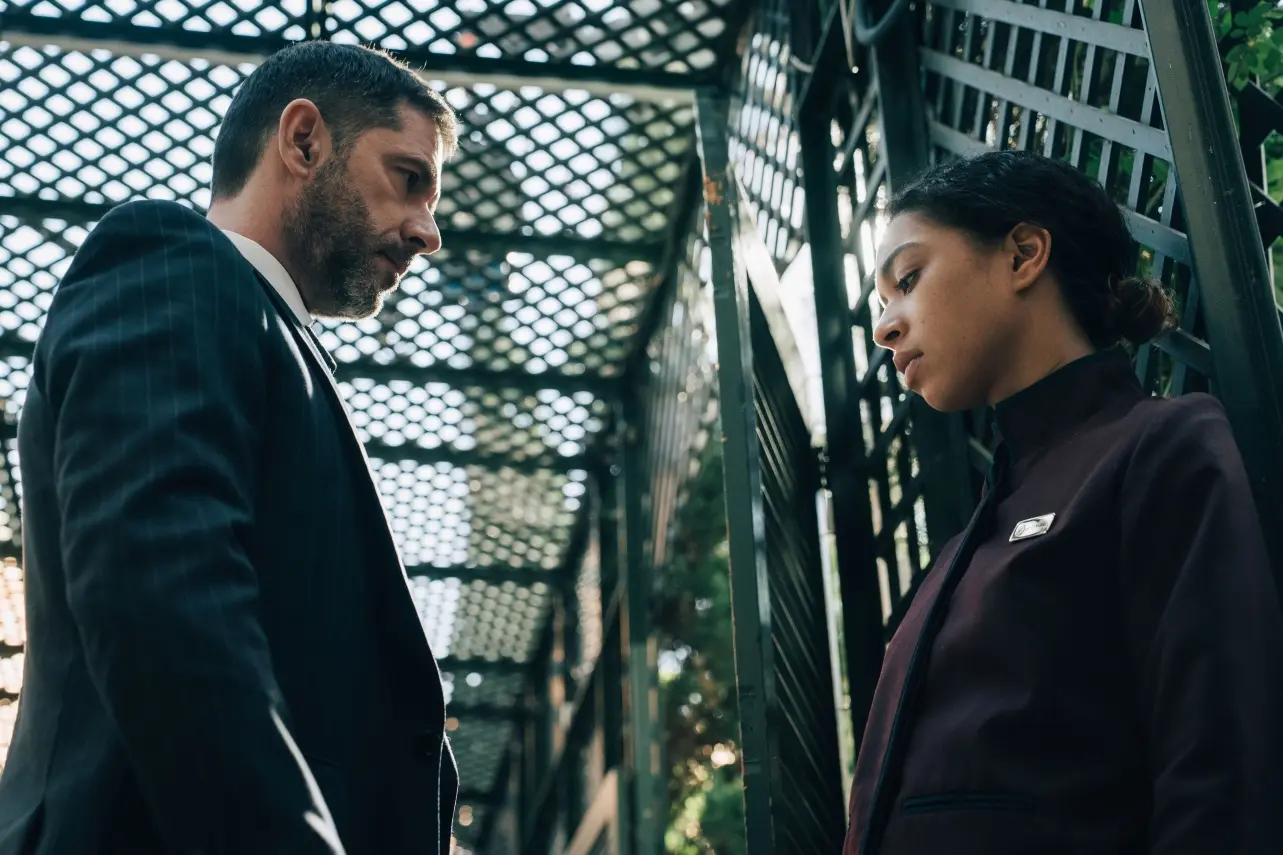

Privileges (2026), the French drama now streaming on HBO Max, opens with a deceptively simple premise. Le Citadel is a five-star hotel in Paris, the kind of place where the thread count of the sheets probably costs more than most people’s monthly rent. It also runs a prison work-release program, which means that among the staff ferrying luggage and managing the impossible demands of the ultra-wealthy, there is Adèle Charki (Manon Bresch), a young woman serving time for attempted murder.
Directed by Marie Monge and Vladimir de Fontenay, the series is rooted in the aesthetic traditions of modern French urban cinema: raw, socially precise, and visually restrained. The collision of worlds is the point. Adèle must return to her cell every night at 8 PM sharp, spending her days in a palace and her nights in a cell. The show is interested in what that does to a person, and what it reveals about both systems. Power, class, and survival sit at the operational center of everything Privileges wants to say.
The Citadel and Its Double Life
Le Citadel is constructed with real care as a setting. The hotel functions as a self-contained social order, with its own hierarchy, its own unwritten codes, and its own logic of consequences. The polished surfaces and the silent choreography of the service staff project an image of effortless perfection, but the series is far more interested in the machinery underneath. Departmental rivalries simmer. Power struggles play out in corridor conversations. The staff operates under a pressure that never quite lifts.
Monge and de Fontenay reinforce this through visual choices that feel considered rather than merely stylish. Inside the hotel, the compositions are ordered, almost geometric, as if the camera itself has been briefed on maintaining appearances. Follow Adèle outside those walls and the camera shifts: handheld, urgent, less composed. The contrast is doing narrative work, not purely aesthetic work.
The show’s structural engine is the daily commute Adèle makes between the Citadel and the correctional facility. Every evening at 8 PM, the clock runs out, and she trades marble floors for a prison cell. This rhythm is the dramatic spine of the series, a constant reminder that she is operating in borrowed time, in a borrowed world.
The guests who populate that world arrive with their own complications. A pop star with an entourage capable of clearing a hotel floor. A PSG footballer killing time in his suite. International politicians conducting discreet business. Each presses against the hotel’s infrastructure in different ways, and each encounter reveals something about the nature of the service they expect. The reintegration program that brought Adèle there is presented as structurally ambivalent: staff are skeptical, inmates routinely fail to stay, and the program itself seems less designed to help its participants than to absorb them into a system that was never built with them in mind.
Paris itself bleeds into the margins of the story. The streets Adèle races through, the communities she comes from, the texture of a city that contains both the Citadel’s world and her world without reconciling them. The show earns its urban authenticity rather than borrowing it.
Characters Who Earn Their Complications
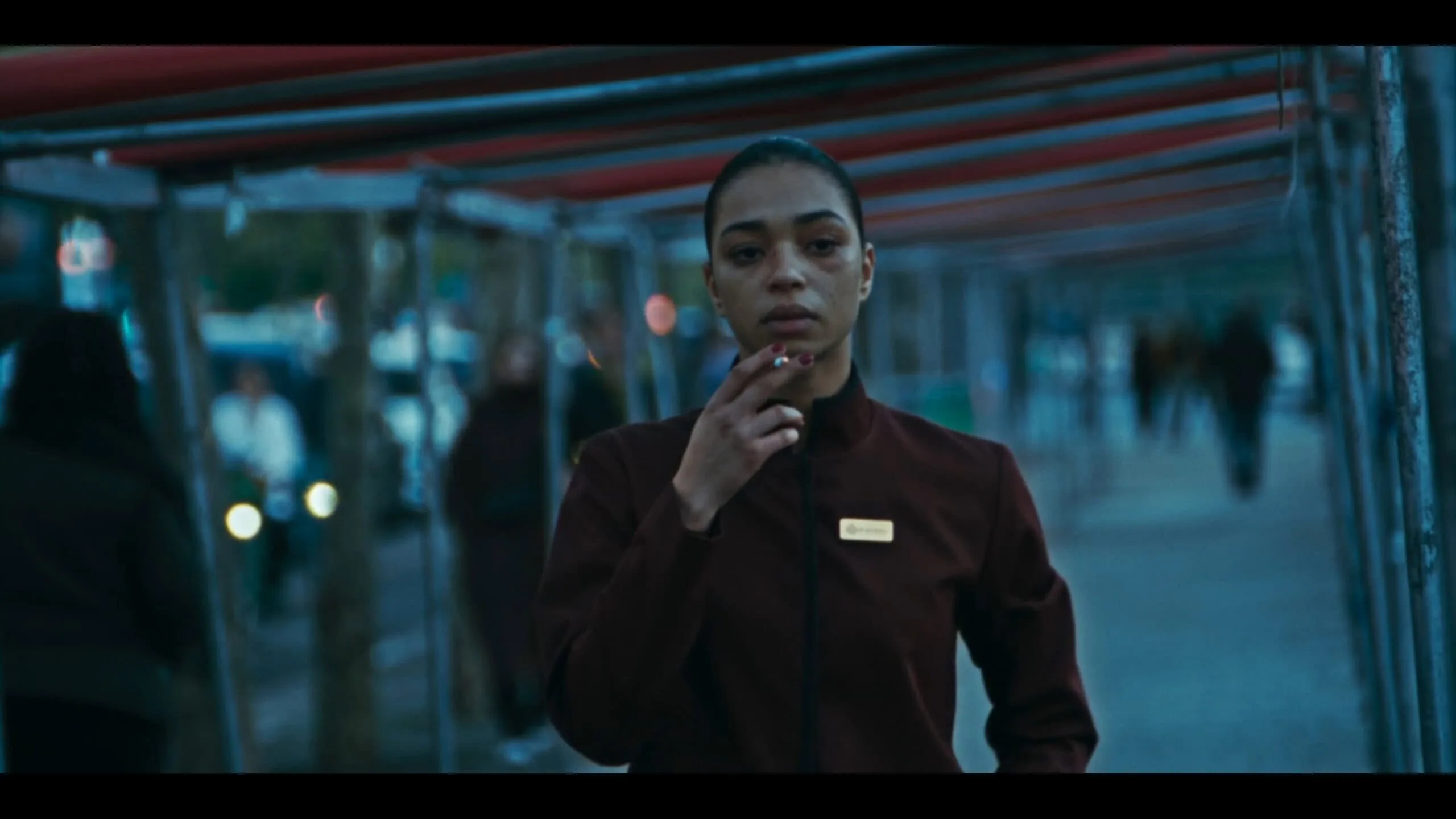
Adèle Charki is introduced without sentimentality. The series opens on her body in a prison shower: tattoos, scars, a physical history the camera reads as plainly as a document. Manon Bresch plays her with a stillness that carries real weight. There is determination in Adèle, and resourcefulness, but the performance is careful not to sand down the edges that make her genuinely ambiguous. She is serving time for attempted murder, and the show does not rush to explain that away. The strategic withholding of her backstory is one of the early season’s smarter decisions: it keeps the audience leaning toward her without fully trusting that lean.
What makes Adèle unusual as a protagonist is that she is told, on her first day, to be invisible. Do not interact with guests. Do not make your presence known. She immediately and consistently ignores this instruction, and the show’s central irony is that her refusal to comply is precisely what earns her advancement. Which raises a question the series is wise to leave open: what does the Citadel actually reward?
Melvil Poupaud’s Édouard Galzain is the show’s most carefully calibrated creation. He is the hotel’s general manager, and his surface is all elegance and competence, the kind of man who can produce a boa constrictor for a pop star within hours and treat it as an ordinary Tuesday. His interest in Adèle is framed, at first, as recognition of her initiative. But Esther’s sharp objection when Édouard moves to fast-track Adèle’s training introduces the essential shadow: this has happened before. There were other young women from the work-release program, and the outcomes were damaging. Édouard neither confirms nor denies this, which is exactly the right move. Poupaud plays the ambiguity with a surface warmth that never quite reassures.
The supporting cast is assembled with intelligence. Anne Azoulay’s Esther de Louvey is the show’s institutional memory and its de facto moral compass, though she is not without her own rigidities. Sandor Funtek’s Yan, a fellow work-release employee, delivers the season’s most chilling piece of exposition: that a predecessor trusted Édouard with small favors and ended up with her sentence doubled when things went wrong. Édouard did not intervene. That single detail reframes everything. Déborah (Eva Huault), Adèle’s girlfriend, begins to drift once Édouard’s orbit expands, and the show handles this shift with quiet economy. Mark Pepo, the American fiancé of the hotel owner’s sister, arrives as a disruptive force from above, his ambitions threatening the power structure Édouard has spent years managing.
The Rules Are the Rules, Except When They Aren’t
Privileges is, at its operating level, a show about power: who has it, how it circulates, and what it costs to get close to it. The arrangement between Édouard and Adèle mirrors the hotel’s relationship with its guests. Generosity flows freely, but the strings are never truly invisible, only unspoken. Édouard creates opportunity for Adèle in ways that look like mentorship but function as leverage. The reintegration program follows the same logic, extending a hand to people in desperate circumstances before positioning them within a system where they remain dependent and expendable.
Mark Pepo’s arrival sharpens this dynamic considerably. His disruption operates from above the institutional order, channeling ownership capital against Édouard’s carefully maintained domain. The series builds several layers of power conflict: guests over staff, management over workers, new money over established management, and it does so without flattening any of them into simple antagonism.
The class dynamics are handled with a confident, unflinching hand. The hotel’s entire operating philosophy is built on the premise that good service is imperceptible, that staff are expected to absorb humiliation as a professional standard. The scene in which a guest accuses Adèle of stealing his watch, with no evidence, and the hotel defaults to the guest’s version of events, is among the sharpest statements the show makes early on. Class here is about more than wealth. It is encoded in whose account of reality gets treated as fact.
Adèle’s decision-making sits outside conventional moral frameworks, and the series is smart enough not to punish her for it. She steals a snake, breaks parole, lifts items from a footballer’s room. These are survival decisions, made by someone with no safety net who has identified that the official rules and the actual rules are different things. Édouard told her as much on her first day: there are no rules when the guests need to be kept happy. She simply applies that logic more broadly than he intended.
The genre tension in Privileges is real and worth acknowledging. When operating as a grounded social drama, tracking character and institutional dynamics with precision, the show is at its best. The sequence in which Adèle races through Paris on a stolen dirt bike with a boa constrictor escaping her uniform tips into an entirely different register. It is not badly executed, but it sits awkwardly against a series that otherwise trusts quieter mechanics to generate tension. The most effective scenes are the conversational ones: Esther and Adèle in a standoff, Édouard decoding a new guest’s needs before the guest has articulated them.
A French Grammar of Unease
Monge and de Fontenay have constructed a visual language that treats the hotel as a controlled surface and shoots it accordingly. The compositions inside the Citadel are precise and geometric, maintaining the fiction of order. Outside, the camera loosens. Following Adèle through the city, the show shifts into a more kinetic register, physically representing the instability of her position.
The aesthetic is cold by design. The hotel’s spaces are rendered as beautiful but alienating, not aspirational. This is a considered choice that pushes against the genre default of luxury-as-seduction. Privileges has no interest in making the Citadel feel like somewhere you would want to work or stay. It is a machine, and it reads like one.
The writing is economical in the ways that count. Dialogue is functional and unadorned, characters speaking in the idiom of people under sustained pressure. Exposition is embedded in behavior rather than stated directly. When Esther references “the last time” a work-release employee was fast-tracked by Édouard, the line carries an entire history the show never bothers to fully unpack, trusting the audience to absorb its implications.
The pilot manages multiple interlocking storylines without visible strain. The influence of modern French urban cinema is evident throughout: socially engaged, aesthetically restrained, grounded in physical and institutional realism. That cultural specificity gives Privileges an identity distinct from comparable prestige television set in luxury spaces.
“Privileges” is a gripping French thriller series that recently premiered on March 27, 2026. The narrative delves into a world of mystery and social tension, consisting of a six-episode first season. As of today, April 22, 2026, the series is currently available for streaming on HBO Max, where it has quickly garnered attention for its atmospheric cinematography and complex character dynamics.
Where to Watch Privileges Online


Full Credits
Title: Privileges
Distributor: HBO Max
Release date: March 27, 2026
Rating: TV-MA
Running time: Approximately 49 minutes per episode
Director: David Cailley
Writers: Hugo Gélin, Clémence Aubry
Producers and Executive Producers: Hugo Gélin, Laetitia Galitzine
Cast: Manon Bresch, Melvil Poupaud, Nina Zem, Adèle Charki, Édouard Galzain, Anne Azoulay, Zar Amir Ebrahimi, Sandor Funtek, Joseph Olivennes, Stephanie Atala, Lili Aubry, Nadia Benzakour
Director of Photography (Cinematographer): David Cailley
Editors: Valentin Féron
Composer: Rob (Robin Coudert)
The Review
Privileges
Privileges is a sharp, socially alert French drama that earns its tension through character and context rather than manufactured plot. Manon Bresch anchors the series with a performance that is raw and carefully calibrated, and Melvil Poupaud makes Édouard genuinely unsettling precisely because he is so plausible. The hotel setting works as both backdrop and argument. Some thriller mechanics feel forced against the show's otherwise grounded register, but these are minor slips in what is a confident, well-constructed debut season.
PROS
- Manon Bresch delivers a magnetic, physically grounded central performance
- The hotel setting functions as a fully realised social ecosystem
- Morally complex characters whose motivations resist easy reading
- Visually disciplined direction that reinforces thematic content
- Sharp, unembellished dialogue rooted in modern French cinematic tradition
- The reintegration program angle offers a genuinely fresh dramatic premise
CONS
- Occasional thriller set pieces (the snake chase) clash with the show's realist tone
- Adèle's rapid rise strains credibility at points
- Some supporting storylines feel underdeveloped early on
- The romantic dynamics are introduced faster than they are earned







The set up lacks credibility. A 5-star hotel running a prison release program. Yeah, right.