















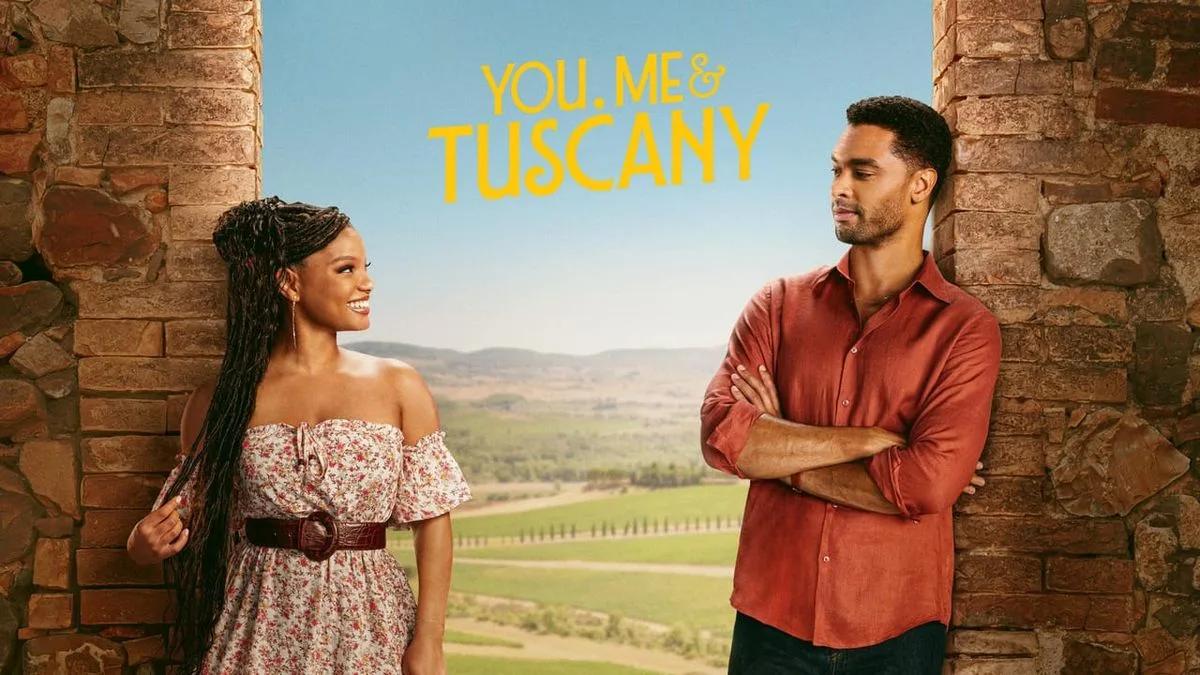

The theatrical romantic comedy has had a quiet decade. Streaming ate its lunch, prestige dramas claimed its stars, and multiplex audiences drifted toward franchises. Against that backdrop, You, Me & Tuscany arrives with the confidence of a film that has surveyed its genre and decided it simply needs a good cast, better lighting, and a Tuscan vineyard.
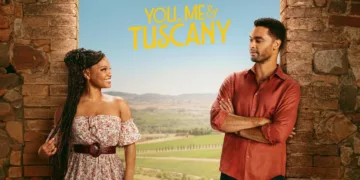
Directed by Kat Coiro and produced by Will Packer, the film stars Halle Bailey as Anna, a New York housesitter who stumbles into an Italian family’s orbit and finds herself engaged to a man she barely knows while falling for his cousin. That cousin is Michael, played by Regé-Jean Page, whose Bridgerton tenure made him something close to the platonic ideal of the brooding romantic lead. The casting is knowing and the setting is gorgeous. Ryan Engle’s screenplay leans into every trope the genre has accumulated over three decades, and the film wears its influences openly, at times even announcing them aloud. How warranted that self-confidence turns out to be is the more complicated question.
A Familiar Recipe, Assembled With Variable Skill
Anna’s setup is efficiently drawn: a lapsed culinary school dropout who abandoned her dreams after her mother, a chef, died, she now makes a living inhabiting other people’s homes and other people’s lives. The film ensures we understand the metaphor. A chance encounter in a New York hotel bar with the charming Italian Matteo (Lorenzo de Moor) leads, through a chain of cheerfully implausible events, to Anna letting herself into his empty Tuscan villa. Matteo’s mother and grandmother arrive to find her wearing a ring she idly slipped on from a bedside drawer, and what follows is the engine of the entire film: a fake engagement, a real attraction to Matteo’s cousin Michael, and a family that takes Anna in with open arms before she has any real claim on them.
The structural DNA here sits close to the 1995 Sandra Bullock film While You Were Sleeping, transposed from Chicago to the Tuscan hills. The love triangle is established so quickly and so completely that the film’s own marketing material spells it out verbatim through Anna’s best friend Claire. There is no suspense about the destination, only the ride.
Engle’s screenplay, a departure from his previous work on action thrillers, has a genuine ear for comic timing in its better moments. It also has a habit of delivering sincere emotional beats through dialogue that strains credulity, particularly in the opening act. The film finds its footing once it settles into Tuscany, and the tonal wobbles become less frequent, though they never disappear entirely.
The plot’s architecture is precise to the point of being mechanical: the cooking subplot, the village festival, the barrel-roll race in the third act, the family restaurant as the stage for Anna’s culinary redemption. Each arrives exactly when expected. Matteo’s arc, which turns him self-centred on his return and resolves in a genuinely puzzling fashion, is the screenplay’s one unresolved thread. Claire, vivid and funny in the opening scenes, fades to text messages for most of the film. Both absences leave gaps that the film’s warmth only partially fills.
The Cast That Makes It Worth the Trip
Halle Bailey carries You, Me & Tuscany with the kind of ease that makes it look effortless. Her Anna is warm, physically expressive, and magnetic in a way that keeps the character sympathetic even when the script places her in situations requiring suspended judgment from the audience. Bailey’s performance background gives her natural command of the camera, and she handles the film’s comic sequences, particularly the physical ones, with flair and precision. The film gestures toward slapstick several times without fully committing; in the moments it does, Bailey is the reason it lands. Her chemistry with Page is the film’s emotional foundation, and it holds.
Page’s Michael is written as a beautifully constructed obstacle. He spends most of the film being attractive, resistant, and occasionally brooding, which he executes with considerable skill. The quieter scenes, in which Michael and Anna bond over the shared experience of losing a parent young, give him more emotional texture to work with, and he rises to them. His Italian accent sits somewhere between approximate and aspirational, but the film’s general buoyancy makes this a minor concern. The sprinkler sequences, in which he appears shirtless and soaked with a frequency that is clearly intentional, are deployed with cheerful shamelessness by Coiro, and Page plays them with the deadpan ease of someone who knows exactly what the audience came for.
The supporting cast provides some of the film’s best moments. Marco Calvani’s Lorenzo, a Fiat-driving cabbie who attaches himself to Anna as confidant and moral compass, has a line-reading style that feels spontaneous and alive, and his scenes carry a warmth the central romance occasionally lacks. Stella Pecollo’s Francesca is the film’s funniest character, delivering lines that land with the force of something not entirely scripted. Her comedy is pitched at a different frequency than the rest of the film, which creates tonal friction, though she is never less than entertaining.
Stefania Casini’s Nonna Alessia earns her moment. Watchful and withholding for most of the film, she speaks in the final act with a weight that lands precisely because of how long she has remained silent. Lorenzo de Moor’s Matteo is a different story: thin by design, the character exists to set the plot in motion and then become an inconvenience. Aziza Scott brings energy and sharp comic timing to Claire, making her near-disappearance from the second act a genuine structural disappointment.
Tuscany as a State of Mind
Coiro directs with clean, crowd-pleasing efficiency. The emotional beats arrive where they should, the pacing stays light without becoming shallow, and the film almost never lingers past its welcome in any single scene. Her directorial flourishes are saved for the moments that earn them: a slow-motion shot of Page mid-vineyard, the romantically-lit kiss the film has been building toward, the vivid colours of the festival parade with its medieval costumes and warm late-afternoon sun. The tonal unevenness in the screenplay is managed as well as the material allows, and the film becomes noticeably more assured once it commits fully to its Tuscan setting.
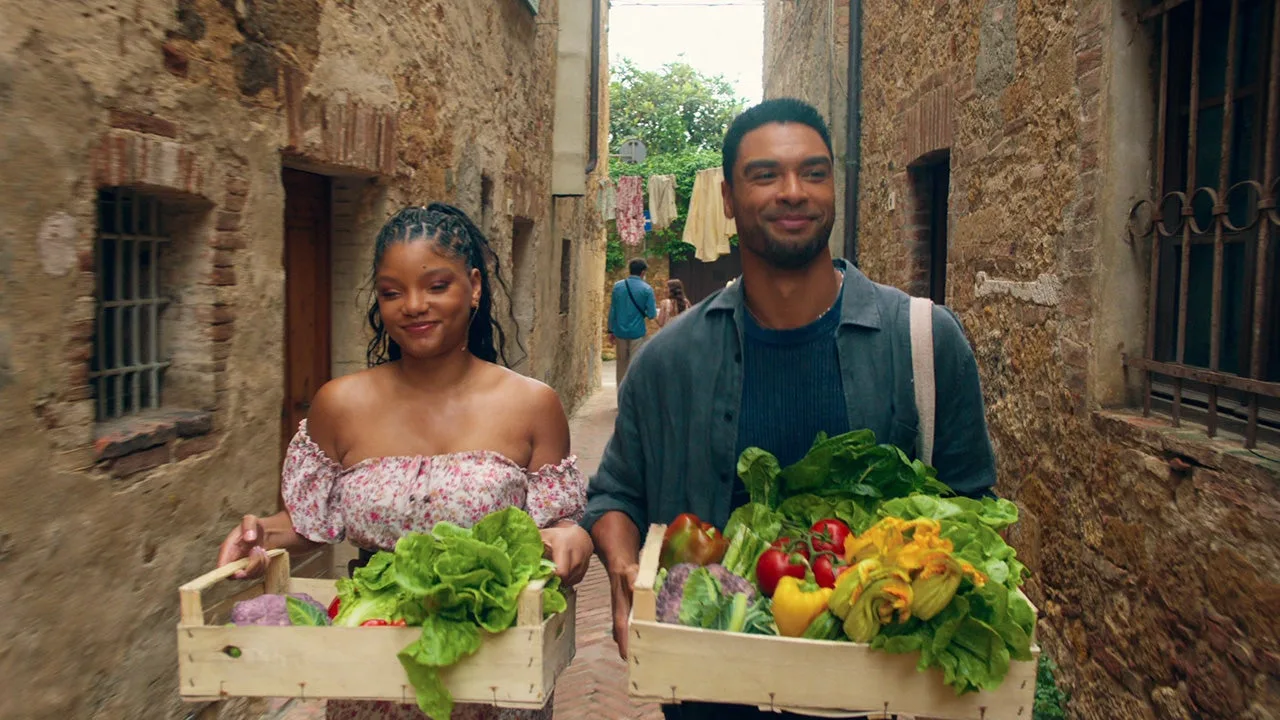
Danny Ruhlmann’s cinematography is a consistent pleasure. The camera moves through the Tuscan hills with the kind of loving attention that makes a film feel like an argument for booking a flight. The villa is rendered in sleek, tasteful tones; the family restaurant in warmer, messier light that feels lived-in by comparison. The food is photographed with care, though the film stops short of the extended culinary sequences that Anna’s backstory seems to invite. The village festival is the visual high point, a sequence that earns its colour through specificity of costume and location.
The fictional village of San Conessa, filmed largely in the hillside town of Pienza, functions as an idealised Italy where it never rains and everyone is either charming or harmlessly eccentric. The film acknowledges its own fantasy with a wink: two tourists watching Anna and Michael kiss in the vineyard compare the scene to other sun-drenched Italian fictions that came before it. The self-awareness is brief but confident.
Formula as Feature, Not Flaw
You, Me & Tuscany knows its genre with precision and operates squarely within it, which is simultaneously its greatest asset and the source of its occasional frustrations. The references to Bridgerton and Shonda Rhimes that surface mid-film feel playful rather than promotional, a wink from a movie comfortable in its own skin. The moment where tourists in the vineyard invoke Under the Tuscan Sun and Eat, Pray, Love is the most confident beat in the screenplay: the film naming its own cinematic ancestry without apology.
The tonal range is harder to defend. A PG-13 rating combined with Francesca’s brand of broad adult comedy and the film’s sincere fairy-tale romance suggest a creative team that had not entirely resolved who it was making the film for. The early scenes feel particularly uncertain in this regard. Once the film settles into its Tuscan rhythms, the inconsistency recedes but does not vanish.
As pure escapism, the case for You, Me & Tuscany is straightforward. Beautiful people in a beautiful place, a large Italian family that welcomes a stranger, food, wine, sunshine, and a happy ending that was never in doubt. The theatrical rom-com has had a difficult time sustaining itself in multiplexes over the past decade, and this film’s unashamed genre commitment reads as a deliberate act of revival. It does not reinvent the form. It asks, reasonably enough, if reinvention was ever the point.
Released in theaters on April 10, 2026, You, Me & Tuscany is a romantic comedy that follows an aspiring chef who finds herself squatting in an unoccupied Italian villa, only to cross paths with the owner’s charming brother. Set against the sun-drenched landscapes of the Italian countryside, the film stars Halle Bailey and Regé-Jean Page in a story of mistaken identity and unexpected romance. Distributed by Universal Pictures, it is currently available to watch in cinemas across the United States and international territories.
Where to Watch You, Me & Tuscany (2026) Online







Full Credits
Title: You, Me & Tuscany
Distributor: Universal Pictures
Release date: April 10, 2026
Rating: PG-13
Running time: 105 minutes
Director: Kat Coiro
Writers: Ryan Engle, Kristin Engle
Producers and Executive Producers: Will Packer, Johanna Byer, James Lopez, Korin Huggins
Cast: Halle Bailey, Regé-Jean Page, Marco Calvani, Aziza Scott, Lorenzo de Moor, Isabella Ferrari, Stefania Casini, Paolo Sassanelli
Director of Photography (Cinematographer): Danny Ruhlmann
Editors: Troy Takaki, Zene Baker
Composer: John Debney
The Review
You, Me & Tuscany
You, Me & Tuscany is a film that delivers precisely what it promises and little more. Bailey is a genuine star, the Tuscan setting is gorgeous, and the supporting cast elevates thin material with surprising regularity. The screenplay's mechanical plotting and tonal uncertainty hold it back from being something truly satisfying, but the charm of its leads and the warmth of its world carry it across the finish line. For rom-com faithful, it is a sunny, uncomplicated pleasure.
PROS
- Halle Bailey is magnetic and effortlessly watchable
- Regé-Jean Page brings easy charisma to an underwritten role
- Stunning cinematography and Tuscan locations
- Strong supporting performances, particularly Calvani and Pecollo
- Warm, self-aware tone that earns genuine laughs
CONS
- Screenplay is formulaic and mechanically structured
- Matteo's arc is poorly resolved
- Tonal inconsistency makes the target audience unclear
- Claire disappears from the story far too early
- Page's Italian accent is unconvincing