




























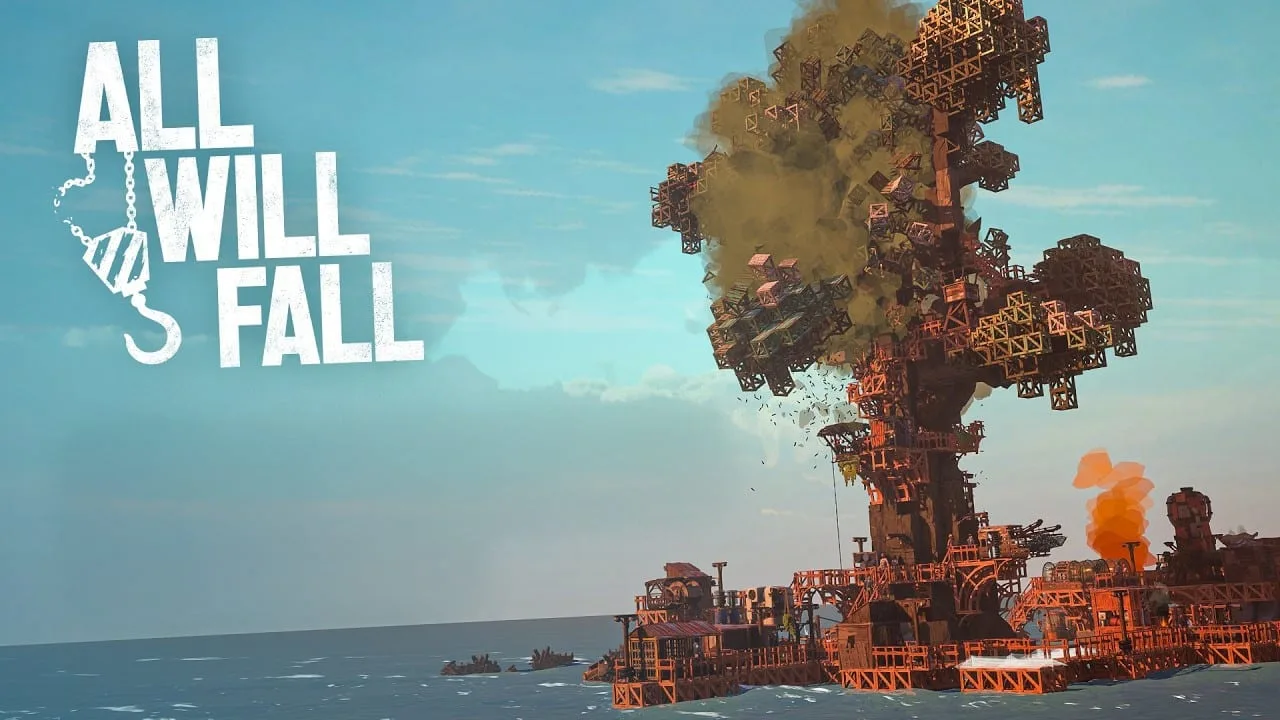

The world of ALL WILL FALL ended quietly, swallowed by a rising ocean that left almost nothing dry. Civilization survives in scraps: rusted oil rigs, half-drowned tankers, rocky outcrops barely clearing the waterline. Developed by All Parts Connected and published by tinyBuild, this post-apocalyptic colony sim tasks the player with building a vertical city from those remnants, keeping a small group of survivors alive against a sea that is indifferent to their efforts.
The genre framing is familiar on paper: gather resources, manage citizens, expand. ALL WILL FALL earns its distinction through a physics simulation that underpins every decision the player makes. Platforms carry real weight limits. Support beams hold real tension. Build carelessly and your settlement does not stagnate or decline on a spreadsheet; it physically collapses into the water.
This is a game about controlled desperation. The world is already gone. You are simply deciding, structure by structure, how long your corner of it can hold.
Weight, Tide, and the Cost of Overreach
Since land is essentially absent, ALL WILL FALL forces construction to go vertical and outward. Players anchor platforms to existing structures, run support beams underneath, and extend their settlements across open water using wood, metal, and increasingly advanced materials. Every element placed carries actual weight, and the system tracks load distribution honestly. Drop a heavy concrete smelter on a thin wooden ledge without adequate support below, and the game will not warn you with a dialogue box. The ocean provides the warning, and it is not polite.
What keeps this from feeling like punishment is pacing. Collapses rarely happen instantly. There is a slow structural deterioration that gives players just enough time to feel the dread before the damage lands. This creates space for calculated risk. A poorly supported bridge might hold long enough to get workers across to a floating resource cache and back, if you move fast. That tension between speed and safety runs through almost every building decision.
The tide system amplifies this considerably. Water levels rise and fall on a cycle, covering lower areas at high tide and exposing new resource nodes when it recedes. The mechanic carries a sting: the sea itself provides buoyancy to lower structures, and when the tide drops, buildings that were partly supported by water suddenly carry their full weight. That shift can trigger collapses without obvious warning, which keeps the player alert even during quiet stretches.
Also Read





Across a full run the sea level also drops permanently, gradually revealing new ground. This gives the game a satisfying long-term rhythm, new territory earned slowly against the constant short-term pressure of tidal cycles and structural limits.
The main friction point is feedback consistency. Structures that look stable and feel stable are sometimes flagged as structurally unsound, pushing rebuilds that feel disconnected from the actual physics at play. Early on, this can erode trust in the system.
Three Groups, One Shrinking Platform
Building a city that can physically hold itself together is one problem. The people living in it are another. ALL WILL FALL divides its population into three factions, each with distinct capabilities and distinct demands.
Workers are the only group who can deconstruct parts of the environment to salvage raw materials. Sailors are the only group capable of operating boats to reach distant floating resources. Engineers handle research and operate heavy equipment, including cranes that become critical for vertical construction. None of these roles overlap, which means neglecting any faction carries immediate practical consequences beyond a morale penalty on a management screen.
Each group has its own leader, its own happiness and loyalty tracks, and its own perks that unlock as morale improves. Food and water rations can be set per faction rather than applied globally, which sounds like a minor detail until you realize it is the primary lever for managing political tension. Favouring one group builds their goodwill while quietly eroding another’s. The pressure compounds over time.
What makes the system work is how it interacts with the map. A scenario with sparse vertical space and wide-open ocean rewards early investment in Sailors. A cramped oil rig, where vertical construction is the only viable expansion, makes Engineers essential from the start. The map actively shapes which political choices make sense, and the best runs tend to emerge from reading that correctly early.
The event and policy system adds texture to the management layer. Random events range from genuine moral dilemmas to moments of dark comedy. An influence system lets players issue policies affecting work, resource distribution, and production priorities, but every policy carries a cost. The writing leans toward gallows humour without fully abandoning the grimness of the setting, and that balance holds steadily, slipping only occasionally.
Eight Ways to Lose Everything
ALL WILL FALL ships with eight handcrafted scenarios. The first works as a structured tutorial, patient and thorough without holding the player’s hand beyond what the physics system genuinely requires. After that, the scenarios diverge sharply.
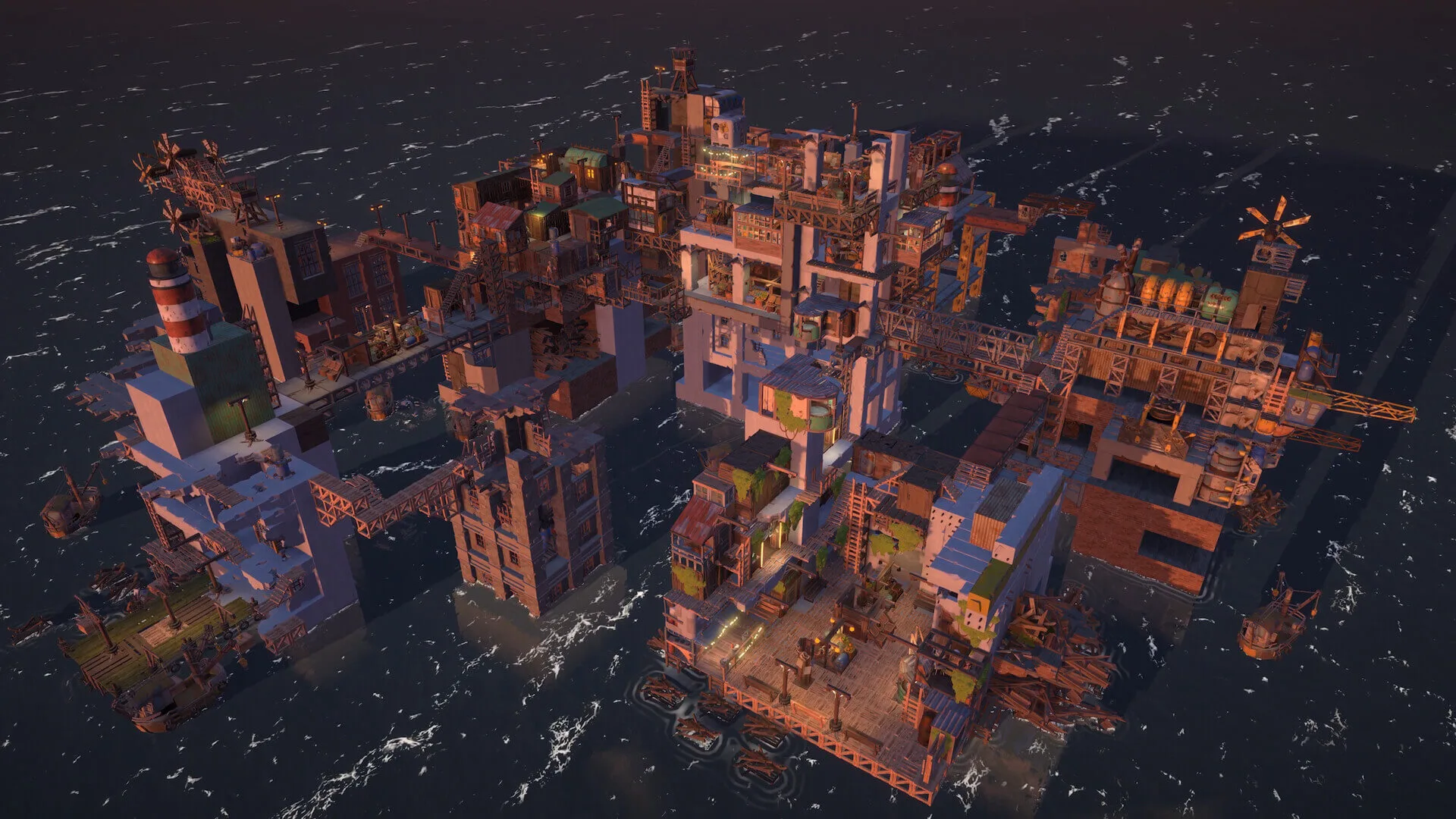
One places the player on a massive tanker ship that can be repaired and sailed across the ocean to reach new resource zones, turning the settlement itself into a moving vehicle with all the structural complications that entails. Another removes the research tree entirely, forcing the player to buy random technologies from passing traders, replacing long-term planning with adaptation. A third introduces progressive structural decay, framing every decision as a question of what to save before the platform it sits on gives way.
These are scenarios built around specific ideas about what the game can do, and they test different parts of the player’s understanding each time. The sandbox mode sits alongside them for players who want to build without survival pressure, and Steam Workshop integration extends the game’s lifespan considerably. The level editor lets the community define their own map layouts, weather patterns, and resource conditions. Early community creations already show genuine range.
The presentation suits the game well. The art style is clean and slightly cartoonish, which aids readability as settlements grow complex and layered. There is a visual calm that sits at a deliberate distance from the mechanical pressure underneath; it is almost peaceful to look at a city that is three tide cycles from collapse. The soundtrack stays in the background deliberately, which helps during long sessions. Repeated voice lines become noticeable after extended play, a minor complaint against an otherwise considered audio design.
All Will Fall is a post-apocalyptic, systems-driven survival city builder and colony simulation game where players must establish and maintain a settlement in a world overtaken by the ocean. Released on April 3, 2026, for PC via Steam, the game distinguishes itself with a unique, physics-based 3D construction system that forces players to consider weight distribution and structural integrity to prevent their buildings from collapsing. Throughout the game, players manage complex resource production chains, navigate political dilemmas, explore the flooded world for materials, and adapt to challenging scenarios and random events to ensure the survival and prosperity of their people.
The Review
ALL WILL FALL
ALL WILL FALL is a colony sim that earns its concept. The physics-based construction creates genuine tension that most games in this genre never approach, and the faction system gives the management layer real strategic weight. The eight scenarios keep the formula from growing stale. Inconsistent physics feedback and repetitive voice lines are minor blemishes on an otherwise confident debut. For players who enjoy survival builders with mechanical depth, this is one of the sharper entries in recent memory.
PROS
- Physics-based construction is genuinely innovative
- Tide system creates constant, layered tension
- Eight distinct scenarios with real mechanical variety
- Faction system rewards strategic map-reading
- Strong Steam Workshop and mod support
CONS
- Physics feedback can feel inconsistent
- UI becomes cluttered in late game
- Repeated voice lines grow noticeable over time
- Mid-game pacing slows noticeably