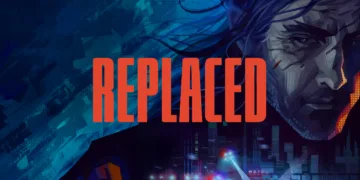









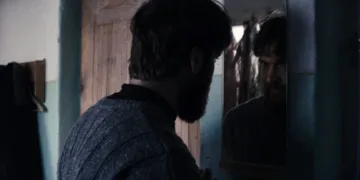
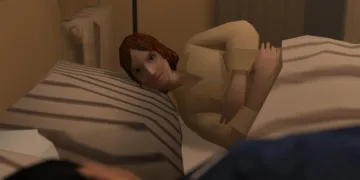







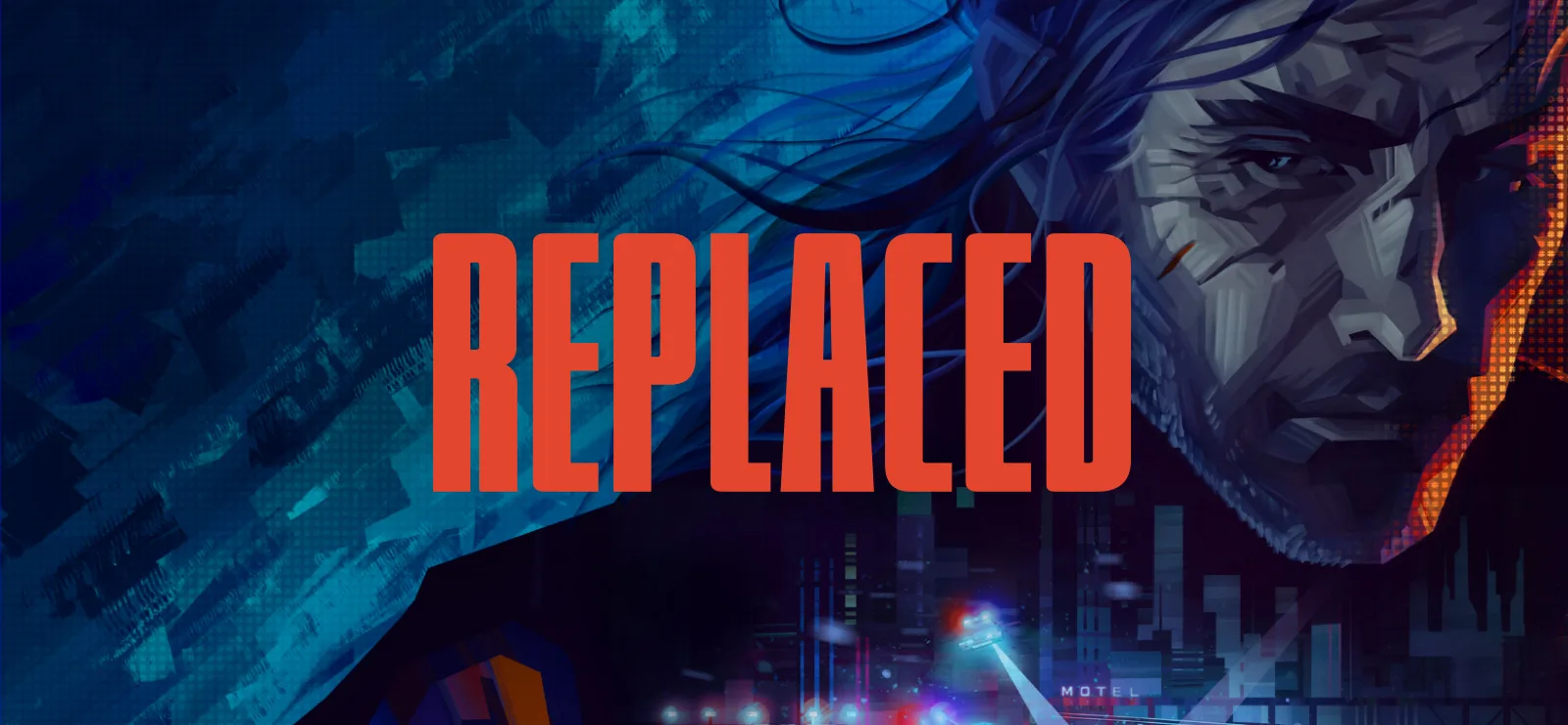

Replaced is a 2.5D side-scrolling action platformer that wears its cyberpunk influences with confidence, then filters them through an alternate 1980s America that feels half remembered and half ruined. The setup is immediate and sharp. After a catastrophic incident, an artificial intelligence finds itself trapped inside a human body, forced to move through a society built on corporate control, collapse, and routine cruelty. That premise gives the game a strong dramatic engine from the start, because the central mystery is not only what happened, but what kind of world could make such a thing feel plausible.
The mood is tense and mournful, yet the game also has a striking sense of style. It leans on cinematic framing, dense visual detail, and a sense that every location has been carefully built to tell part of the story. You are learning the rules of this broken world at the same time the protagonist is learning what it means to live inside one. That parallel gives the game an immediate emotional pull.
Corporate Ruins and Human Cost
Replaced’s setting draws much of its force from the way it rebuilds American history around disaster. A nuclear catastrophe leaves the country vulnerable, and from that wreckage rises Phoenix Corporation, a private power that steps in where government has failed. The result is a society where safety, medicine, labor, and social status all pass through one corporate hand. Phoenix City stands as the polished center of that system, while the people outside its walls are left to survive in the margins, cut off from the privileges the city protects.
That divide gives the game a strong class structure, and it never treats that structure as background decoration. The AI protagonist begins as a being of logic and programming, yet the body it inherits pushes it into fear, confusion, and curiosity. The gap between thought and feeling is where the character starts to come alive. It is a good setup for a story about identity, because the protagonist is not suddenly “human” in a simple sense. It has to learn what human behavior looks like from the inside, while facing a society that has already stripped away much of what humanity should mean.
The game’s most brutal idea is the role of the Disposals. These are the people the system has thrown away, often after their organs or body parts have been extracted for the benefit of the wealthy and connected. Organ donation here is not presented as a noble act or a medical miracle. It becomes a mechanism of class control, a way to turn the body into inventory and survival into a transaction. That idea gives the world its sharpest edge, because every act of violence seems connected to a larger economy of hunger and need.
The people the protagonist meets help soften that harshness without denying it. They give the story a human scale that the corporate machinery tries to erase. Their presence turns the game into a study of trust under pressure, since every connection has to exist inside a world that teaches people to exploit one another. The side encounters and hub moments are valuable because they show ordinary lives inside an extraordinary disaster. A small request, a memorial, a conversation, or a brief exchange can carry real weight in a setting where so much has been reduced to function.
The themes follow from all of that with a clear line of thought. Replaced keeps returning to power and empathy, artificial intelligence and human feeling, control and decay, poverty and survival, and the moral blindness that grows inside systems built to reward cruelty. It is a story about what happens when institutions keep calling themselves saviors while they quietly make desperation profitable.
Pixel Steel and Neon Shadows
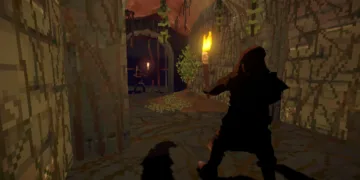
The visual design is the first thing that stays with you. Replaced uses its pixel art and 2.5D presentation with real discipline, giving the game a layered depth that feels closer to a handcrafted model than a flat side scroller. Backgrounds are packed with detail, silhouettes are clean and readable, and the world often looks like it has been posed for a camera rather than merely drawn for play. That compositional care matters because the game wants each frame to carry atmosphere on its own.
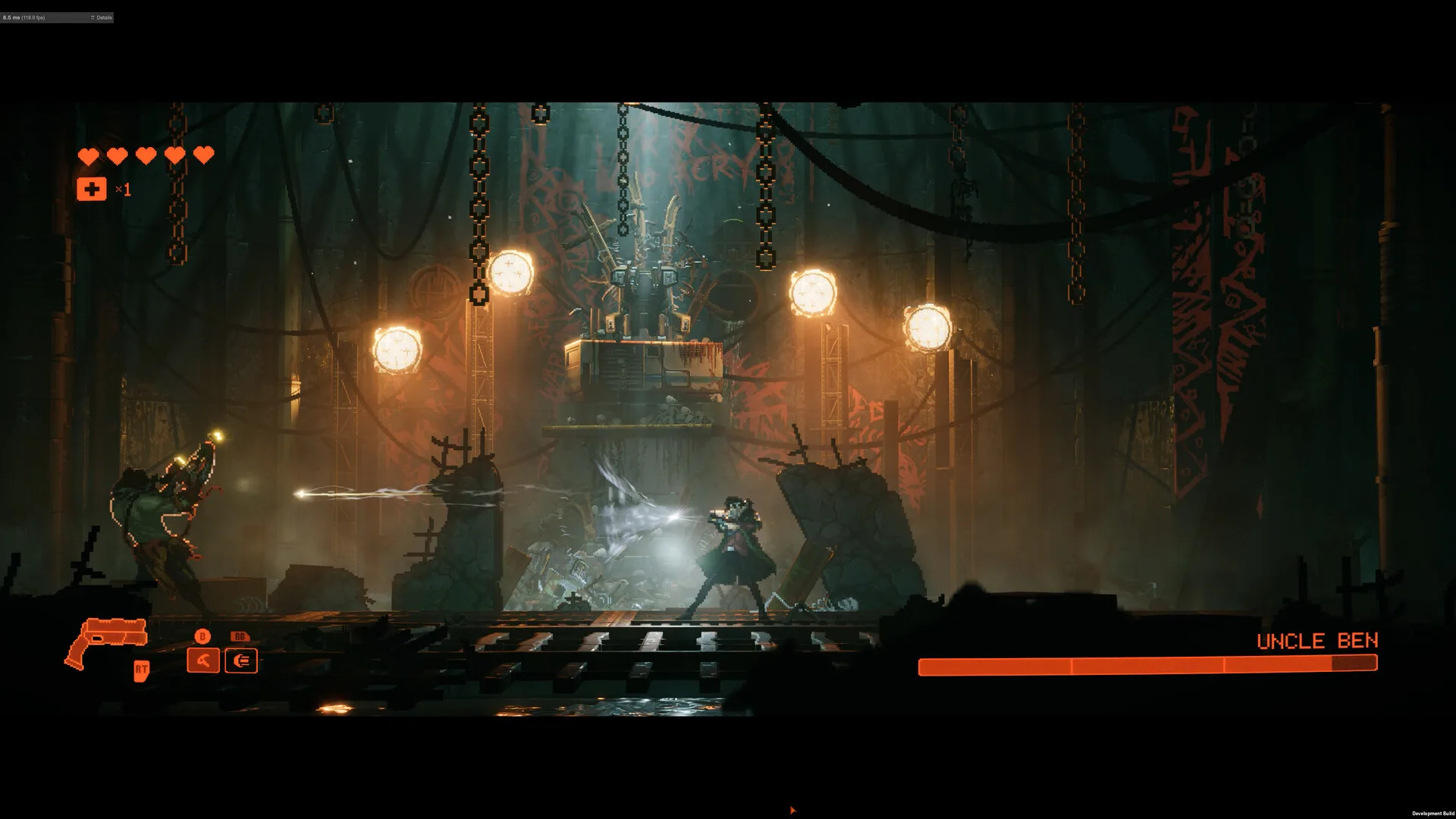
Camera movement is a major part of that effect. Replaced does not simply place the player in a scene and leave it there. It pans, shifts, and reorients the view to stress height, distance, and scale. Cutscenes use that same language, which makes the entire game feel tied together by the same visual grammar. The camera is always working, always trying to guide your eye toward a new detail or a new threat. That gives the game a film-like quality without turning it into something static. It feels alive in motion.
Lighting does a huge amount of heavy lifting. Neon signs, hard shadows, soft glows, and dim industrial spaces all help define the emotional temperature of each area. Phoenix City can feel almost seductive in its artificial brightness, while the outer settlements and rougher industrial zones look worn down, crowded, and uncertain. That contrast tells you as much about the social structure as any line of dialogue. The beauty of the image never cancels out the ugliness of the world. It makes that ugliness easier to see.
Animation sells character in a way that suits the game’s story. People move with distinctive posture and weight, and even brief appearances tend to leave an impression. Reach, Tempest, and the people around them all feel visually specific. Enemies too are easy to parse at a glance, which matters in a game that asks you to react quickly during fights and traversal. The style supports the tone even when the story quiets down. A still street or a lonely room can feel loaded with implication.
The soundtrack fits that same approach. Replaced leans on synth-heavy music that can build tension, push combat forward, or relax into a quieter mood for exploration and story beats. The score helps the game breathe. In the louder moments, it gives fights extra momentum. In the slower stretches, it keeps the world feeling haunted and alone. Ambient sound does its part too, shaping the sense that this is a place where machinery, distance, and danger never really stop humming in the background.
Deliberate Fights, Measured Movement
Replaced’s combat is built around a clear rhythm. You strike with melee attacks, read enemy tells, dodge or parry, and work toward a gun shot that can turn a fight in your favor at the right moment. The structure is simple on paper, yet the game uses timing and spacing to make encounters feel intentional. It does not chase the speed of a character action game, and it does not try to become a pure brawler either. The closest comparison is the Batman Arkham model, filtered through a side-view format and a smaller, more controlled battlefield.
That comparison is useful because the game borrows the same idea of reading an enemy wave as a sequence of reactions. Some foes demand a dodge, others need a parry, and some force you to break armor or manage ranged pressure first. Heavy enemies change the pace of a room, while quicker attackers can throw off a rhythm if you get careless. The best fights ask you to read all of that at once and respond with calm timing. When the system clicks, a fight feels clean and satisfying, like you have solved a short combat puzzle with bruises attached.
The game also keeps adding tools, which helps the combat avoid becoming flat. Charge-based gun shots change the way you think about the baton and melee sequence, since every hit can feed a stronger payoff. Later abilities widen the field of play and make some encounters feel more varied than the basic description would suggest. That sense of escalation is important. Without it, the combat could have settled into a routine long before the credits.
The difficulty options help the action reach a wider range of players, and they also shape the feel of the game. On the right setting, Replaced can make each encounter feel deliberate and readable without turning into a slog. The key is that the game rewards focus. You learn who needs to be handled first, which attacks deserve a reaction, and how to keep pressure on the field without losing the rhythm. The reward is a fight that ends with a small burst of satisfaction.
Platforming is a larger part of the experience than the opening hours suggest. Climbing, ledges, wall grabs, vents, moving machines, timed hazards, and route-based environmental puzzles all appear regularly. The game uses these sections to slow the pace and let the world speak through traversal. Sometimes you are simply making your way through a space with care. Other times you are asked to read the environment, shift an object, or figure out how to reach a new height through a small chain of steps. The design often aims for flow rather than sting. That suits the cinematic mood, though it also means the platforming rarely becomes especially demanding.
Pacing across these systems is measured. Replaced likes controlled stretches of movement, short bursts of action, and moments where the game pauses to let the setting breathe. That choice serves the atmosphere well. It can also make the game feel restrained, since some sequences repeat a familiar pattern of travel, scan the space, solve the route, and move on. Still, the balance gives the game a distinct identity. It knows it wants to feel composed, and it usually sticks to that idea.
A Guided Path with Occasional Friction
Replaced follows a largely linear structure, and that design suits its presentation. The game is carefully staged, with spaces arranged to draw the eye and direct movement through each area. There is some room to look around, pick up story fragments, and linger in a hub or settlement, yet the game rarely opens itself up in the way a broader exploration game might. That limit is part of the tradeoff. The tighter structure helps the visuals and narrative flow, though it can make the journey feel a bit constrained.
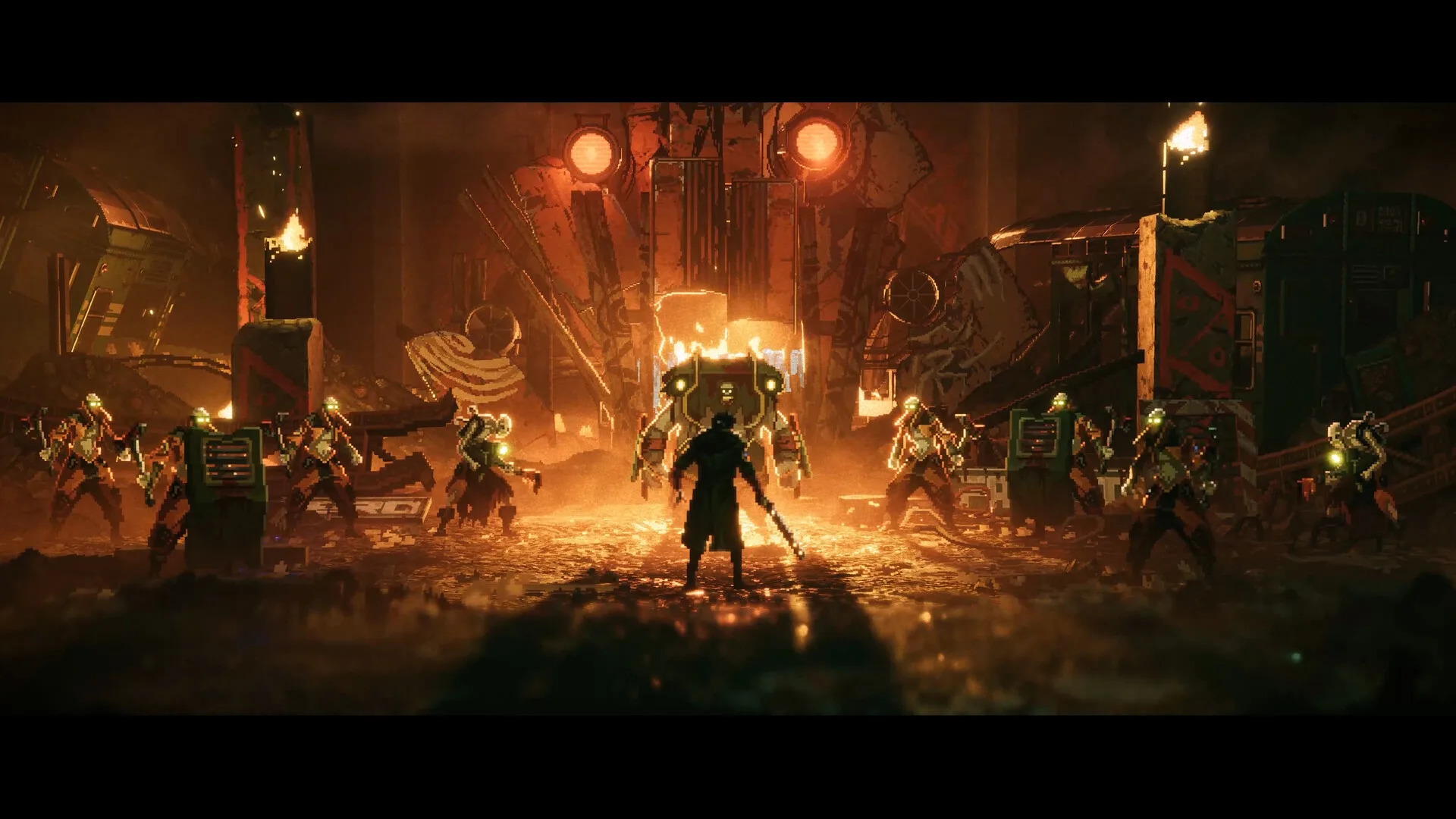
The story itself moves with a slow-burn rhythm. Replaced likes to pause, let you absorb a location, then shift back toward a bigger reveal or a sharper dramatic beat. That approach works well when the game is showing off a new settlement, a new social pocket, or a fresh corner of the world. It works less well when the pacing stalls around fetch-style errands or stretches of downtime that feel like padding. The game is strongest when every quiet moment still carries tension or meaning.
Navigation can be murky in spots. The path forward is not always obvious, and it is easy to move ahead when you are still trying to explore a side route or read the space. That can create awkward moments when a cutscene or transition locks you into the next beat before you have finished looking around. The game’s sense of flow is strong, but it comes with a strictness that can make backtracking feel limited.
Checkpoint placement also has a habit of testing patience. When the game drops you farther back than expected, especially after a traversal chain or a fight that required careful timing, the frustration is real. Those setbacks do not break the experience, yet they do sharpen the edges in places where the rest of the design feels so polished. Replaced often carries you through its strengths with style and confidence. Its weaker moments appear when the systems are asked to repeat themselves after a failure, and the seams become harder to ignore.
That leaves the game in an interesting place. Its story, art direction, and atmosphere do a lot of the heavy lifting, while the gameplay works best as a steady support structure rather than the main attraction. The mechanical side is cleaner than ambitious, and that is fine until repetition starts to show. Even then, the game’s sense of craft keeps pulling it forward.
REPLACED is a cinematic 2.5D action-platformer set in an alternative 1980s America following a catastrophic nuclear event. Players take on the role of R.E.A.C.H., an artificial intelligence trapped in a human body, as they navigate the gritty, neon-soaked streets of Phoenix-City to uncover the dark secrets of the Phoenix Corporation. The game features a striking “retro-futuristic” pixel-art aesthetic and combines fluid, free-flow combat with exploration. Developed by Sad Cat Studios and published by Thunderful Publishing, it was officially released on April 14, 2026, for PC (via Steam and Epic Games Store), Xbox Series X/S, and Xbox One, and was also made available on Xbox Game Pass.
Full Credits
Director (Creative/Game Director): Yura Zhdanovich
Writers (Lead Writer/Narrative Designer): Sad Cat Studios Team
Producers/Studio Leadership (Producers, Executive Producers, and Key Studio Heads): Igor Gritsay, Yura Zhdanovich
Art Director/Lead Artist: Yura Zhdanovich
Key Engineering/Technical Leads: Igor Gritsay
Composer/Sound Director: Igor Gritsay
Developer, Publisher: Sad Cat Studios, Thunderful Publishing (also associated with Coatsink)
Release Date: April 14, 2026
The Review
Replaced
Replaced is a striking cyberpunk platformer with superb art direction, a strong premise, and a world that feels damaged in all the right ways. Its combat is orderly and satisfying, while the story carries real emotional weight through Reach’s uneasy transformation. Some traversal and checkpoint hiccups hold it back, and the pacing can drag, yet the visual design and narrative ambition make it stand out. It is a smart, stylish game with enough mechanical friction to keep it from greatness.
PROS
- Stunning 2.5D visual design
- Strong dystopian setting and themes
- Reach’s character arc is engaging
- Combat feels deliberate and satisfying
- Excellent lighting, animation, and atmosphere
- Memorable soundtrack
CONS
- Checkpoints can be frustrating
- Some navigation is unclear
- Platforming can feel stiff at times
- Pacing slows in a few stretches