









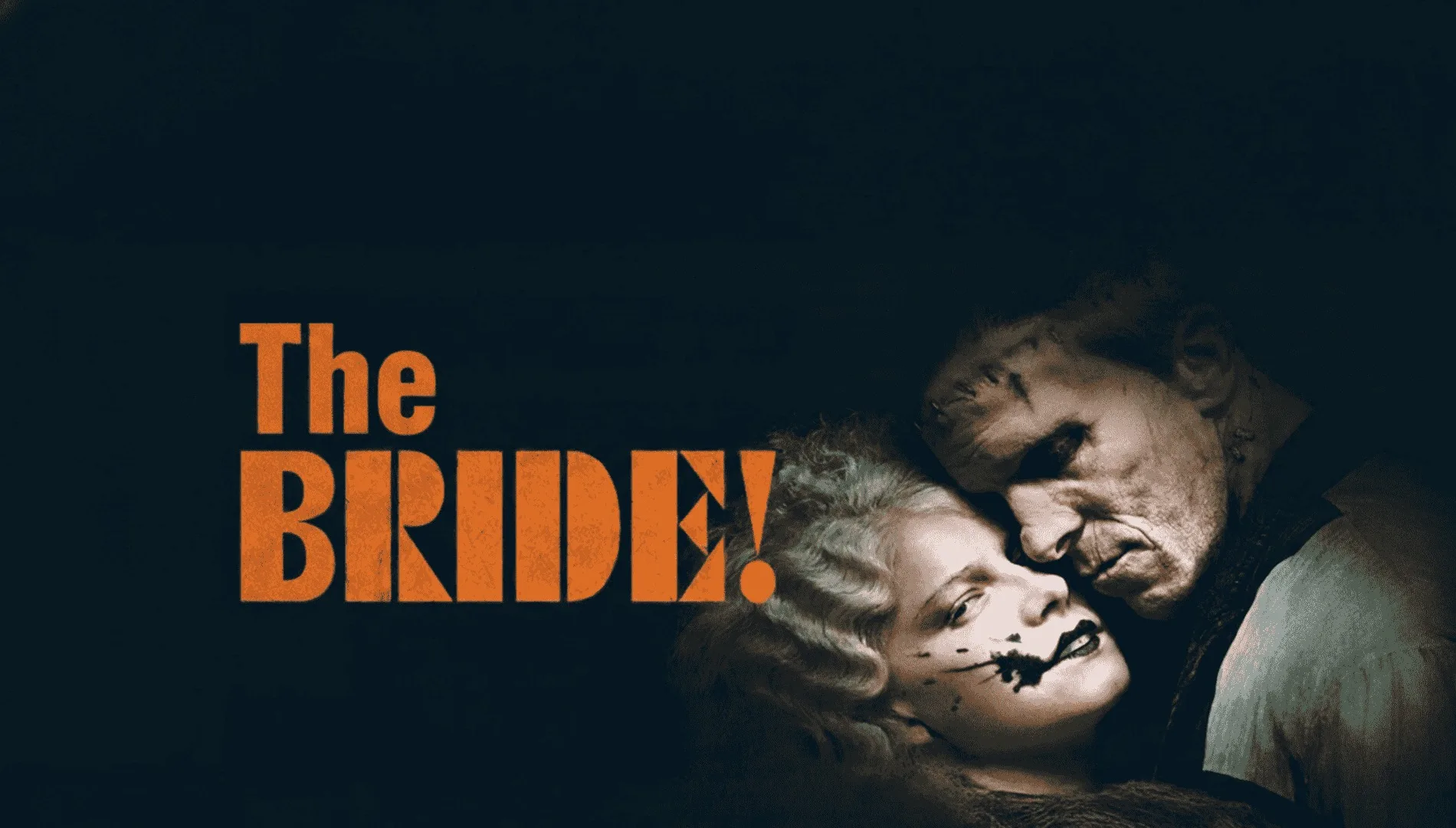

In James Whale’s 1935 Bride of Frankenstein, Elsa Lanchester’s title character arrives in the final five minutes, speaks nothing, and is given no interiority whatsoever. She hisses. She recoils. She exists to be shown, never heard. Maggie Gyllenhaal looked at that silence and decided it was worth two hours and six minutes of furious, sprawling response.
The Bride! is a punk-feminist tragicomedy set in 1930s Chicago and New York, a film that refuses to stay in one lane for longer than a few minutes at a stretch. It is gothic horror, gangster picture, road movie, musical, and feminist manifesto, sometimes all within the same scene. Mary Shelley herself, played by Jessie Buckley in a black-and-white framing device, opens the film by announcing this is a story she was never permitted to tell during her lifetime. The message is pointed: the silence given to the original Bride was no accident.
Gyllenhaal’s debut, The Lost Daughter, was precise and controlled. The Bride! goes in the opposite direction with apparent glee, and that trade-off is one the film keeps raising and only partially answering.
Brought Back, Lied To, and Expected to Be Grateful
The film plants its story in the shadows of prohibition-era Chicago, a world of neon signs, mob dinners, and underground clubs rendered with film noir atmosphere by cinematographer Lawrence Sher. It is a world where a woman voicing an opinion at a dinner table is treated as an affront. Ida (Buckley) learns this violently and fast: she speaks plainly to the men surrounding her, and within minutes, she is dead at the bottom of a staircase.
That setup is the film’s thesis statement made flesh. Ida’s body is then recovered from a pauper’s grave by Frank (Christian Bale) and the scientist Dr. Euphronious (Annette Bening), who reanimates her for Frank’s companionship. She wakes with fragmented memory, and those fragments are quickly managed. Frank tells her they were engaged before an accident. Euphronious goes along with it. From the first moment of her second life, she is being lied to about who she is and why she exists.
This is where Gyllenhaal’s feminist architecture is at its sharpest. The Bride’s erasure is structural rather than incidental. She is resurrected for a man’s needs, denied her own history, and expected to be grateful for the arrangement.
Buckley also plays Mary Shelley in a black-and-white prologue, framing the story as one suppressed in Shelley’s own lifetime. Gyllenhaal has Buckley shift between a haughty British accent and Ida’s American voice mid-sentence, suggesting possession, shared consciousness, or both. It is one of the film’s most distinctive ideas, which makes it all the more frustrating that Gyllenhaal largely drops it after the first act.
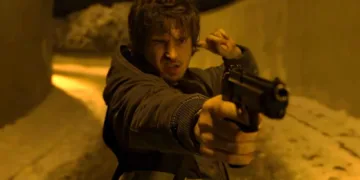
Once Frank kills two men who assault the Bride at an underground club, the film pivots into lovers-on-the-run territory. The Bride, who names herself Penelope, begins inspiring a wider uprising, with women across the city adopting her black-ink mouth markings as a symbol of solidarity. The mob resurfaces late in the story, and a rallying cry of “brain attack” becomes the revolution’s awkward slogan. The uprising is the film’s most emotionally ambitious gesture and its least fully realized one.
Buckley Burns, Bale Aches
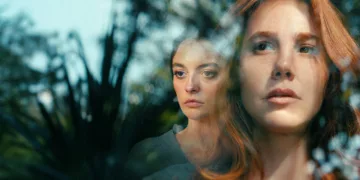
Jessie Buckley carries somewhere between two and three characters in a single body, and the film asks her to make all of them legible simultaneously. She plays Ida before death, the Bride after resurrection, and Mary Shelley bleeding through both. That is a tall order, and she meets it with a performance that is schizoid in the best possible sense: physically unpredictable, emotionally raw, and genuinely funny at moments when the film could easily have become self-serious.
The Bride functions primarily as a vessel for the film’s ideas rather than a conventionally rounded character. Buckley is aware of this and plays into it rather than against it. She makes the Bride’s anger feel earned and specific, the confusion feel real, and the dark humor feel sharp. Her “Me Too! Me Too!” outburst is the film’s most divisive moment: audiences willing to receive it as deliberate provocation will lean in, while those who want their subtext to remain subtext may feel the house lights have been turned on mid-scene.
Christian Bale’s Frank is the film’s quiet emotional anchor. He plays the creature as a century-old accumulation of loneliness, with a post-lobotomy voice and a face that belongs in a Halloween display case. His understanding of love comes entirely from the MGM musicals he watches obsessively, featuring his idol Ronnie Reed (Jake Gyllenhaal, in a piece of self-aware casting the film quietly enjoys). This is a small but genuinely touching detail: a being who learned how romance works from movie screens, then attempted to apply that learning in the real world with predictably complicated results. Where Buckley burns and shouts, Bale aches quietly, and that contrast gives the film its odd, off-kilter emotional center.
Annette Bening plays Dr. Euphronious with theatrical relish. Her choice to publish scientific work under only her first initial, concealing her gender, is exactly the kind of small telling detail the film handles well when it trusts itself to stay subtle. Penélope Cruz brings unpredictable magnetism to Detective Myrna Mallow that the script never quite rewards; her subplot gestures toward a parallel feminist argument about professional women, then trails off. Peter Sarsgaard grounds the film’s more feverish passages with a slow-burn unease that functions as the closest thing to a stable reference point in an unstable movie.
All the Costumes, Worn at Once
Gyllenhaal’s debut operated like a scalpel. Her second feature operates like a fire hose. The deliberateness of that shift is clear throughout: this is a director who chose maximalism as a creative position, not as a failure of restraint.

The film’s mood board is wide enough to cause whiplash. 1930s film noir sits alongside black-and-white Hollywood musical sequences. Rave culture bleeds into Badlands-era road movie iconography. An affectionate nod to Mel Brooks’s Young Frankenstein arrives via “Puttin’ on the Ritz” at precisely the right moment of tonal release. These genres do not always cohere; they coexist with varying degrees of comfort. That coexistence feels intentional, a formal attempt to mirror the Bride’s fragmented, channel-switching inner life.
Lawrence Sher’s cinematography shifts palette by genre. The prohibition-era underground scenes pulse with purple and shadow. The New York sequences, built on soundstages, feel populated and alive. Production designer Karen Murphy creates a world that feels like several different films occupying the same city. Fever Ray’s appearance in the underground club sequence generates genuine atmosphere, though the scene stops short of the showstopping setpiece it seems to be building toward.
The score by Hildur Guðnadóttir is bold and contemporary-feeling in ways that occasionally pull against the period setting. The musical numbers and choreographic passages create an energy that mirrors the Bride’s awakening, but they arrive at the cost of narrative momentum, particularly in the second half.
Pacing is the film’s most stubborn structural problem. Individual scenes crackle. The stretches between them can feel semi-improvised, as if the editing room was uncertain which version of the film it was assembling. The Bride! is never boring, which is a real achievement given its runtime and ambition, but it does spend significant time spinning in place.
I Would Prefer Not To
The film’s central preoccupation is female autonomy and the systematic cost of asserting it. Gyllenhaal distributes this argument across every female character. Ida is killed for speaking plainly at a dinner table. Dr. Euphronious hides her gender to be published. Detective Myrna is introduced to a room as her partner’s secretary. The Bride wakes in a world that has already decided who she is before she has had the chance to form an opinion. The erasure is institutional, and that is Gyllenhaal’s point.
Frank’s tragedy runs alongside this and provides the film’s most unexpectedly moving thread. His understanding of love is entirely derived from the MGM musicals he watches on repeat. He is a creature who absorbed cultural texts about how men and women relate to each other, then tried to act on them with guileless sincerity. Herman Melville’s Bartleby the Scrivener runs through the film as a parallel text. The Bride’s eventual manifesto is effectively “I would prefer not to.” Refusal as revolution. It is the film’s quietest and most elegant idea.
Gyllenhaal is doing something sophisticated with the notion of how cultural consumption shapes behavior. Frank’s masculinity is modeled on Fred Astaire-style movie stars. The police force operates from gendered assumptions so internalized they have become invisible. The suggestion is that we are all, to some degree, running on scripts we absorbed before we had the chance to examine them.
The themes strain most visibly at the climax. The feminist uprising that closes the film gestures toward something genuinely stirring, but the “brain attack” rallying cry lands as an unearned symbol. The revolution is sketched rather than felt. Gyllenhaal reaches for the emotional register of Bonnie and Clyde or Thelma and Louise and arrives somewhere short of both.
A Film Assembled From Spare Parts, and Proud of It
Buckley’s performance is the film’s structural spine, and the movie leans on it heavily. Without her, large sections would collapse into expensive posturing. With her, they hold. Bale’s quiet tenderness gives the film a second emotional register that it uses well whenever it trusts him to carry a scene. The Young Frankenstein homage is executed with timing and genuine affection, the visual ambition is sustained throughout, and Gyllenhaal’s willingness to make a strange, loud, risky studio film when the industry defaults to safety deserves credit on its own terms.
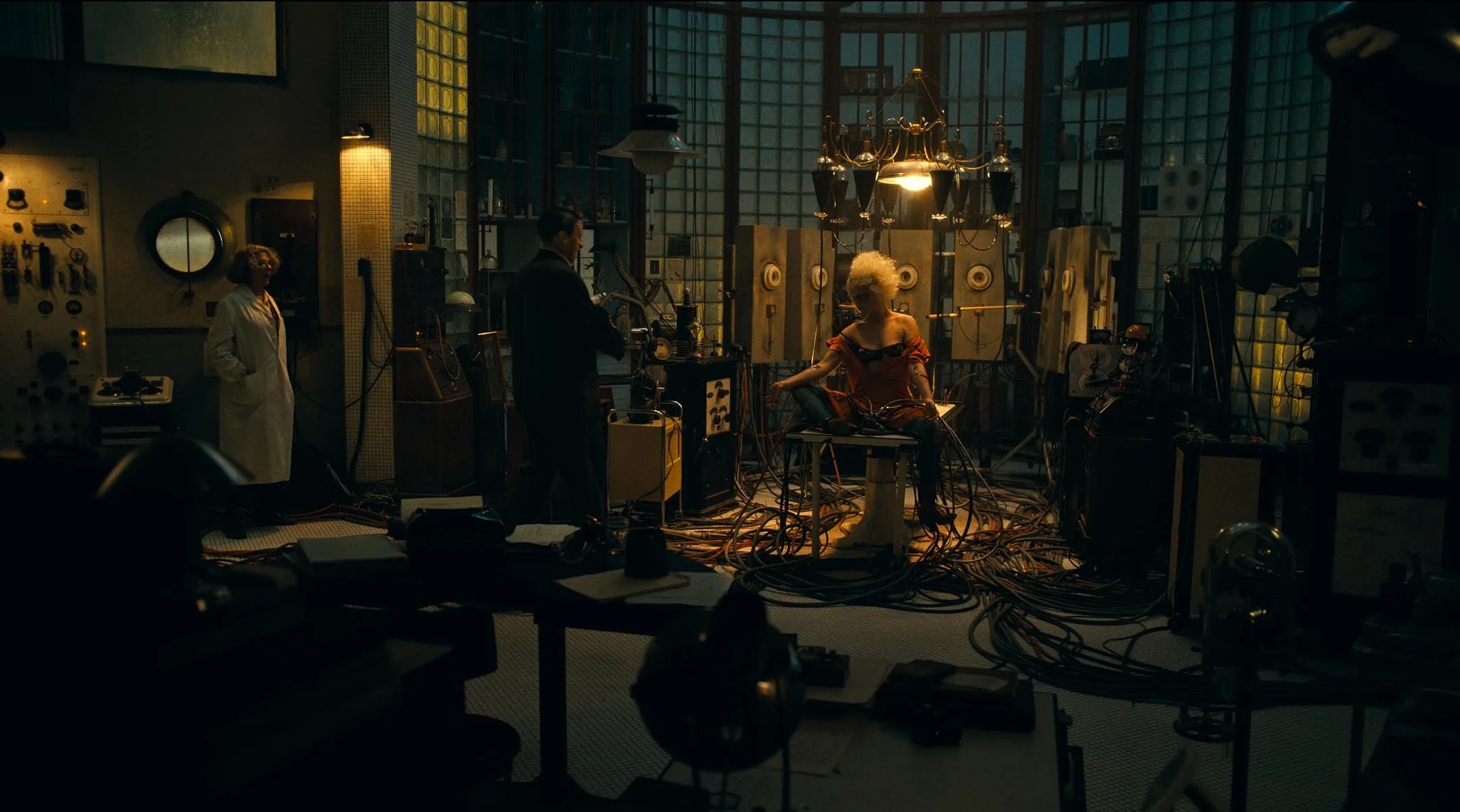
The film’s problems are structural. The detective subplot and the mob’s late reappearance accumulate without adding proportionate weight. The Mary Shelley framing device is abandoned after the first act, surrendering the film’s sharpest and most original register. The second half loses pace badly. The film’s most explicit moments, the “Me Too” outburst and the “brain attack” chant, tip the balance from subtext into statement in ways that trust the audience less than it probably deserves. The Bride! reaches hard, catches some of what it grabs, and drops the rest.
The Bride! is a 2026 Gothic romance and science-fiction film that serves as a bold reimagining of the classic Bride of Frankenstein lore. Set in 1930s Chicago, the story follows a lonely Frankenstein’s monster who seeks the help of Dr. Euphronious to create a companion. Their efforts result in the resurrection of a murdered young woman, whose newfound life as “The Bride” sparks an unexpected romance and triggers radical social change. The film premiered at the Empire Leicester Square in London on February 26, 2026, followed by its wide theatrical release in the United States on March 6, 2026. It is currently available for viewing in theaters and on digital streaming platforms as of April 2026.
Where to Watch The Bride! (2026) Online








Full Credits
Title: The Bride!
Distributor: Warner Bros. Pictures
Release date: March 6, 2026
Rating: R
Running time: 126 minutes
Director: Maggie Gyllenhaal
Writers: Maggie Gyllenhaal
Producers and Executive Producers: Maggie Gyllenhaal, Osnat Handelsman-Keren, Talia Kleinhendler, Emma Tillinger Koskoff, Pete Chiappetta, Courtney Kivowitz, Andrew Lary, Carla Raij, Anthony Tittanegro
Cast: Jessie Buckley, Christian Bale, Penélope Cruz, Peter Sarsgaard, Annette Bening, Jake Gyllenhaal, Julianne Hough, John Magaro, Jeannie Berlin, Zlatko Burić, Matthew Maher, Louis Cancelmi
Director of Photography (Cinematographer): Lawrence Sher
Editors: Dylan Tichenor
Composer: Hildur Guðnadóttir
The Review
The Bride!
The Bride! is a film that swings harder than it lands, but the swing still matters. Gyllenhaal has made something genuinely strange, visually alive, and stubbornly its own thing, held together by two performances that deserve a tighter script around them. Buckley is extraordinary. Bale is surprisingly moving. The film around them is brilliant in patches and structurally loose everywhere else. It earns its exclamation mark, even if it occasionally forgets what it was shouting about.
PROS
- Jessie Buckley's ferocious, layered central performance
- Christian Bale's unexpectedly tender portrayal of Frank
- Striking, genre-shifting cinematography and production design
- Genuine boldness and creative risk-taking
- The Young Frankenstein homage lands perfectly
CONS
- Pacing collapses noticeably in the second half
- Mary Shelley framing device abandoned too early
- Overcrowded subplots dilute the central story
- The feminist climax feels sketched rather than earned
- Explicit messaging occasionally overtakes the storytelling