






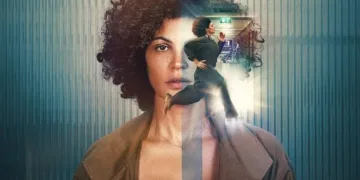
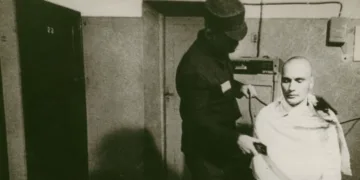









Ron Howard’s documentary chronicle Avedon follows the six-decade career of Richard Avedon, the photographer who sketched much of mid-century American celebrity’s visual grammar. Howard builds the profile with unrestricted access to the Richard Avedon Foundation archives, drawing on home movies, personal audio tracks, and thousands of static photographs.
The main arc traces a remarkable artistic mutation. A post-World War II fashion vanguard becomes an exacting fine-art portraitist. The movement runs from selling the dream to studying the dreamer under a pitiless lamp.
Howard places the public glitter of Avedon’s famous subjects beside his private fixations and difficult family history. The camera becomes his chosen means of contact with a world he found intoxicating and terrifying. He recorded history, then arranged its faces into a national mythology with cheekbones.
The Chronophotographic Leap
In 1947, Harper’s Bazaar sent Avedon to Paris to photograph the new Dior collection. The images cracked the industry’s frozen, mannequin-like standard. Avedon flung his models into the streets, sending them leaping, dancing, and sprinting through the post-war ruins. Call it kinetocentric chic, a jolt of American vitality landing inside a bruised European landscape.
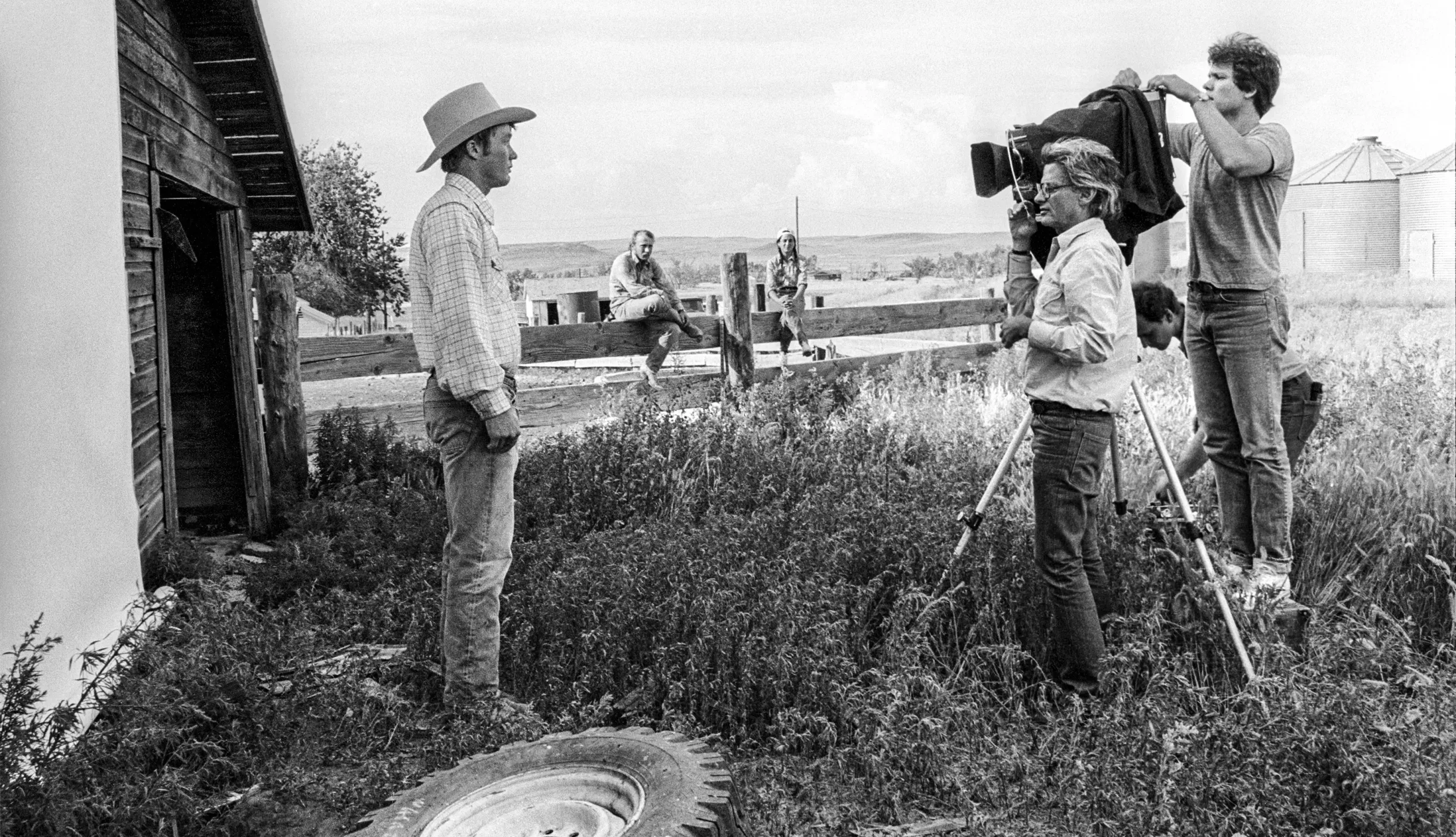
Later, he left the streets for the controlled austerity of the studio. With a large-format 8×10 camera, he created his signature visual system. Contextual clutter vanished. Subjects stood against a plain white field. Portraiture became architecture, with the human face treated as geometry, terrain, confession, and crime scene.
Howard and editor Andrew Morreale mirror that artistic shift through the film’s rhythm. They sidestep the stiff slideshow trap that weakens many documentaries about visual artists. Swift frame transitions, snapping photographic energy, and historical behind-the-scenes footage give the film a pulse of its own.
Avedon rejected flattering lighting. He hunted the split second when a subject’s public mask loosened. The results could be brutal. A weary, depleted Marilyn Monroe appears after her persona has gone slack; the Duke and Duchess of Windsor wear brittle anxiety like formal attire. Flattery gives way to existential exposure. Glamour starts sweating.
Art, Agitation, and the Page
Avedon’s career reads like a map of major twentieth-century print institutions. He spent decades shaping the visual languages of Harper’s Bazaar and Vogue, then became the first-ever staff photographer at The New Yorker. Still, he kept pressing against the commercial restrictions of those glossy empires.
His social commitments often produced friction with conservative editors. In 1959, he risked his lucrative contract by insisting on featuring China Machado, making her the first model of color to appear in a major American fashion magazine. This was active subversion from inside the cultural castle, a polished coup carried out under studio lights.
The film is strongest when it follows him beyond the studio: into the streets of the Civil Rights movement, the mental wards of Bellevue, and the battlefields of Vietnam. His collaboration with James Baldwin on Nothing Personal remains a landmark act of cultural agitation, a book shaped by anger, intimacy, and a refusal to let American surfaces behave themselves.
That crossing of artistic and social terrain brought fierce backlash. When Avedon turned his severe lens toward working-class citizens for In the American West, critics attacked the project. They saw his stark style as elitist condescension, vulnerable people displayed for affluent gallery-goers. And yes, second thought arrives wearing muddy boots: those critics may have had a point. The space between empathy and exploitation can become thin enough to cut the photographer too.
The Architecture of Perfectionism
Howard skips a standard biographical march and structures the film around artistic drive. Archival interviews create a first-person audio narration, giving Avedon room to explain his own tangled motives. The effect places us inside the head of a perfectionist. Claustrophobic? A little. Appropriate? Absolutely.
The documentary uncovers heavy psychological undertows. Avedon’s relationship with a stern, demanding father sits beside the emotional weight of his sister Louise’s severe mental illness. Louise, his earliest muse, was institutionalized, and that wound stayed active in his work. He kept searching for cracks in the armor of everyone he met, perhaps because the first crack had appeared so close to home.
Avedon’s genius remains inseparable from his damage. The film presents an emotionally ruthless man whose obsessive labor often estranged his family. He admitted he was difficult to live with. He judged acquaintances by their fitness to be photographed, a social philosophy both ridiculous and chilling. Imagine being invited to dinner and assessed as lighting potential.
The film also becomes an obituary for an era when print media held immense cultural authority. Avedon worked during a period when a single magazine cover could stop the cultural conversation. Today, his high-fashion frolics might shrink into behind-the-scenes internet clips, absorbed instantly by the algorithmic maw. Howard’s film reminds us that we consume images constantly, yet we rarely look at them with the intensity Avedon demanded.
The feature length documentary Avedon premiered as an official Special Screening at the 79th Festival de Cannes on May 17, 2026. Produced by Imagine Entertainment and Fifth Season in direct collaboration with the Richard Avedon Foundation, the film explores the massive archive, personal home movies, and audio recordings of the iconic twentieth-century photographer. Because it has just debuted on the international film festival circuit, a wide streaming or theatrical release has not been finalized yet. Audiences can expect it to become available on premium documentary platforms and digital distribution channels later in the year.
Where to Watch Avedon (2026) Online
Full Credits
Title: Avedon
Distributor: Fifth Season, Imagine Entertainment
Release date: May 17, 2026
Running time: 104 minutes
Director: Ron Howard
Writers: Doon Arbus
Producers and Executive Producers: Ron Howard, Brian Grazer, Sara Bernstein, Justin Wilkes, Mark Itkin, Michael Rosenberg, James Smith
Cast: Richard Avedon, Lauren Hutton, Isabella Rossellini, Twiggy Lawson, Calvin Klein, John F. Avedon, Tina Brown, Adam Gopnik, John Lahr, Hilton Als, Penelope Tree, Beverly Johnson
Director of Photography (Cinematographer): Lincoln Else
Editors: Andrew Morreale
Composer: Hans Zimmer
The Review
Avedon
Avedon is a masterful, intellectually sharp interrogation of a visual titan. While it occasionally softens the edges of its subject’s personal ruthlessness, Ron Howard brilliantly avoids the flat trap of a documentary slideshow. By reflecting the photographer’s own kinetic energy and structural starkness, the film becomes a haunting look at the absolute peak of print media’s cultural power. It is an essential watch for anyone interested in the anatomy of artistic obsession.
PROS
- Dynamic editing that perfectly mirrors Avedon's signature kinetic style.
- Phenomenal, immersive use of archival audio for a first-person perspective.
- Deeply analytical exploration of the intersection between art and social justice.
CONS
- Slightly protective of Avedon’s personal life, sidestepping deeper relational histories.
- The admiring tone occasionally dilutes the valid criticisms of his later work.