

























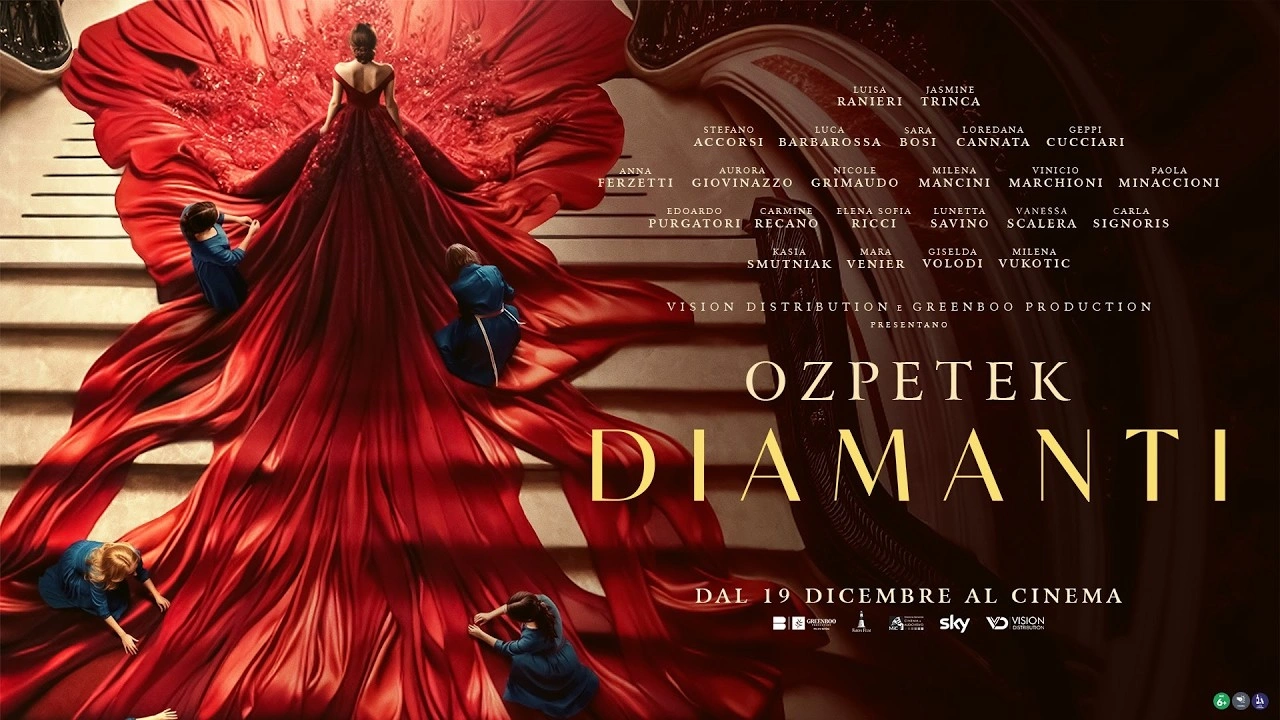

Diamonds (Diamanti) builds its cinematic architecture through a visible act of creation. Ferzan Özpetek, working from a screenplay co-authored with Elisa Casseri and Carlotta Corradi, sets aside the expected period-film entrance and opens in the contemporary era. In an open-air prologue, Italian actresses gather around a sunlit banquet table for a script read-through, creating a self-aware space where performance and lived presence begin to blur.
That modern frame becomes a threshold, then slips into the amber-toned Rome of 1974, where a legendary costume atelier runs on pressure, discipline, and the soft violence of deadlines. The workshop belongs to the Canova sisters, two opposing temperaments shaped by command and loss. Alberta, played by Luisa Ranieri with flint-edged precision, rules through posture and force. Gabriella, played by Jasmine Trinca, moves through grief with a frozen inwardness.
When Bianca Vega, an exacting Oscar-winning costume designer, arrives to commission a set of intricate 18th-century gowns on an impossible schedule, the atelier becomes a chamber of labor where every stitch tests the nerves of the women at work. The commission turns artistry into a countdown, giving each thread and fitting a sense of looming consequence.
The Atelier’s Fractured Pattern
The 1974 storyline takes the form of a crowded melodrama, with the manufacturing deadline constantly breaking open into private emergencies. The atelier functions as a living archive of wounds carried by the working-class women who keep its machinery alive. Nicoletta hides the visible evidence of domestic abuse beneath heavy makeup. Eleonora creates a quiet act of resistance by sheltering her politically radical niece, Beatrice, from law enforcement in the studio attic.
Nina endures punishing daily labor while caring for a deeply depressed child. Paolina faces single motherhood under relentless financial strain. The film asks this thick arrangement to hold camaraderie, craft, trauma, and melodramatic release in the same room, a difficult balance that often gives the workspace a charged, unstable pulse.
The execution reveals structural weaknesses that blunt the film’s thematic force. The screenplay introduces severe social struggles, including intimate partner violence and maternal grief, then treats them with narrative impatience. Complex wounds pass too quickly through group scenes, softened by fast resolutions or converted into brief signals of workplace solidarity.
A telling moment arrives at the communal lunch table, where a visible injury is acknowledged, the silence gathers, and the discomfort quickly disperses through an offer of cosmetic foundation and a shallow joke about abusive men. The script turns private suffering into ensemble business, then tidies it into episodic incidents that lose their weight before the final credits arrive.
Material Culture and Collective Rhythm
The production’s formal strengths give the ensemble a tactile world to inhabit. Ranieri commands her scenes by giving Alberta the rigid bearing and vocal authority of a military officer, a performance built around the armor required for a woman holding power in a competitive trade.
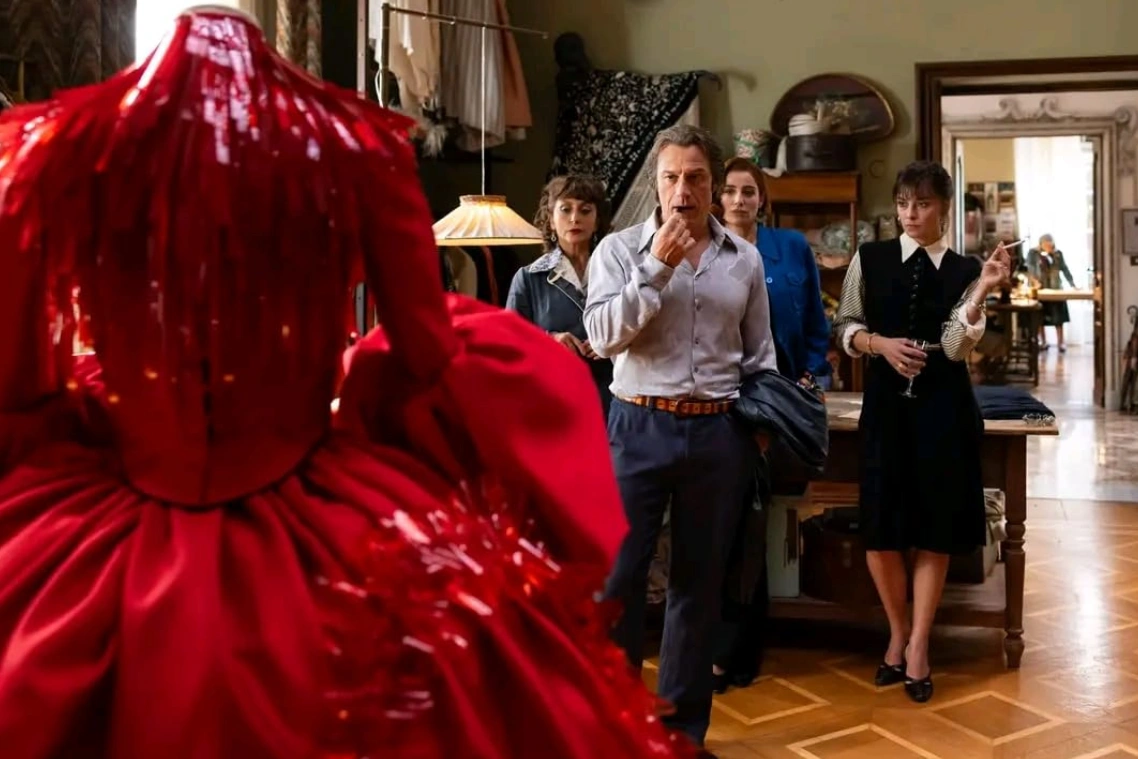
Trinca supplies the counterforce, shaping Gabriella’s emotional paralysis through magnetic stillness, where grief arrives through heavy glances and restrained movement. Their friction unfolds inside a world finely constructed by production designer Deniz Göktürk Kobanbay and set decorator Valeria Zamagni. Warm earth tones, deep yellows, and rich greens fill the frame, creating a vivid historical atmosphere with texture and restraint.
Stefano Ciammitti’s wardrobe design carries narrative force, placing bold 1970s geometric prints in visual conversation with the structured opulence of 18th-century silk silhouettes. The clothing makes the intellectual and physical labor of the trade visible, granting sewing the cinematic charge usually reserved for directors and stars.
Sound design deepens this immersion, folding the mechanical pulse of sewing machines into sudden choral outbursts as the workers sing along to classic Italian ballads by Mina and Patty Pravo. The atelier becomes an acoustic organism, a workplace where collective art turns into emotional survival.
The Architect in the Mirror
The historical narrative keeps facing interruptions from the film’s framing device, which repeatedly pulls attention back from 1974 to the contemporary director. This formal gesture carries two readings that sit uneasily together. A generous view sees the broken illusion as a way to connect the mechanics of filmmaking with the collaborative labor of garment making, casting cinema as shared human work. A stricter view reveals the cost of those detours. The meta-fictional passages stop the emotional momentum of the working-class story, shifting focus away from the women’s struggle toward the director’s self-positioning.
That tension reaches its sharpest form in the haunting finale on an abandoned soundstage, where the film lays bare its power structure. The director stands alone in the empty space, summoning disembodied voices and spectral appearances with a turn of his head. An actress from the framing sequence appears chiefly to praise him, securing his place as the source from which meaning flows.
The sequence reduces independent historical figures to instruments of a male creator’s memory, weakening the progressive ambitions of the piece and exposing its dependence on the very creative authority it seems eager to question. By the end, the working-class women remain suspended as beautiful, damaged figures under the command of a master puppeteer, their pain arranged into an image of authorship that belongs to someone else.
The Italian comedy-drama film Diamonds (Diamanti), helmed by prominent filmmaker Ferzan Özpetek, originally premiered in theaters across Italy on December 19, 2024, where it quickly became a major box office success. Spanning a rich 135-minute runtime, the movie serves as a beautifully textured love letter to retro Italian cinema and the meticulously collaborative art of costume design. The narrative tracks a massive female ensemble navigating high-stakes industry deadlines and intense personal dramas inside a prestigious 1974 Roman dressmaker’s shop. Following its successful European theatrical run, the feature has expanded its reach internationally through platforms like Prime Video in select regions and via limited specialized theatrical releases across the United Kingdom, Ireland, and North America.
Where to Watch Diamonds (2024) Online






Full Credits
Title: Diamonds (Diamanti)
Distributor: Vision Distribution, Outsider Pictures
Release date: December 19, 2024
Rating: 16+
Running time: 135 minutes
Director: Ferzan Özpetek
Writers: Ferzan Özpetek, Carlotta Corradi, Elisa Casseri
Producers and Executive Producers: Marco Belardi, Tilde Corsi
Cast: Luisa Ranieri, Jasmine Trinca, Stefano Accorsi, Luca Barbarossa, Sara Bosi, Loredana Cannata, Geppi Cucciari, Anna Ferzetti, Aurora Giovinazzo, Nicole Grimaudo, Milena Mancini, Elena Sofia Ricci, Lunetta Savino, Vanessa Scalera, Carla Signoris, Mara Venier, Giselda Volodi, Milena Vukotic
Director of Photography (Cinematographer): Gian Filippo Corticelli
Editors: Pietro Morana
Composer: Giuliano Taviani, Carmelo Travia
The Review
Diamonds
Diamonds is a visually spectacular tribute to material craftsmanship and female ensemble acting, yet it remains fundamentally compromised by its own structural execution. While the immersive 1970s aesthetic and sharp performances ground the workplace drama, the narrative routinely falters when addressing complex systemic traumas, opting for superficial resolutions. Ultimately, the director's insistence on centering his own creative presence undercuts the progressive themes of solidarity, transforming a vibrant celebration of collective womanhood into a self-indulgent exercise in memory.
PROS
- Stellar ensemble performances, led by the compelling contrast between Luisa Ranieri and Jasmine Trinca.
- Immersive production design and wardrobe that beautifully recreate 1974 Rome without relying on kitsch.
- Evocative sound design that effectively weaves workplace machinery with classic Italian music.
CONS
- Superficial handling and rapid resolution of heavy themes like domestic violence and deep grief.
- Intrusive meta-fictional framing devices that consistently break narrative immersion.
- A self-absorbed finale that reduces the female characters to instruments of directorial memory.