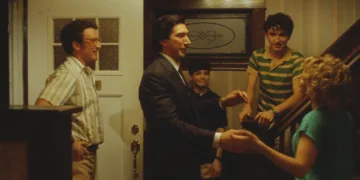





























James Gray’s crime drama Paper Tiger examines the devastating underbelly of American ambition through a tight, domestic lens. Set in Queens during the late summer of 1986, the film follows the structural collapse of the Pearl family when two ideologically opposed brothers partner on a high-stakes business venture.
Gary, a charismatic, boastful ex-cop, convinces his mild-mannered engineer brother, Irwin, to provide technical consultation for a development project along Brooklyn’s polluted Gowanus Canal. This seemingly lucrative opportunity immediately entangles them with a ruthless wing of the Russian mob, led by crime figures like Semion Bogoyavich.
Prefaced by an ancient Aeschylus quote warning against wealth built on sorrow, the narrative strips away the illusions of economic mobility in the late-Reagan era. As the mafia demands financial restitution for an accidental transgression, the family home transforms into a zone of heavy surveillance and psychological dread.
Irwin’s wife, Hester, simultaneously faces a catastrophic, hidden medical emergency, compounding the external criminal threat. The feature frames fraternal loyalty and familial duty as traps, showing how a single misstep can drain the security from an ordinary household.
The Mechanics of Fraternal Self-Delusion
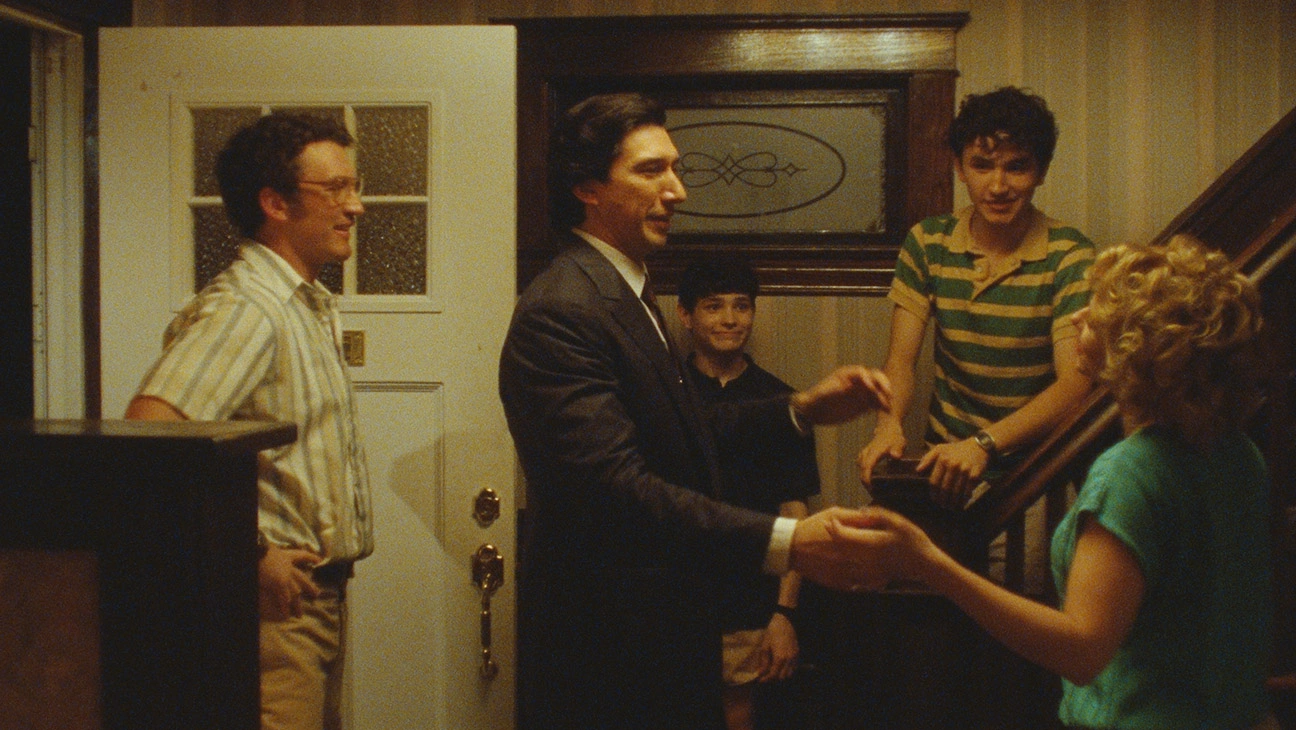
Adam Driver delivers a magnificent study in catastrophic machismo as Gary Pearl, a character suffering from what one might call status-mimicry (the exhausting performance of wealth when the bank account is screaming for mercy). Gary walks into rooms with the unearned confidence of a minor local celebrity, a divorced ex-cop draped in sharp tailored suits while driving a blue Mercedes that he almost certainly cannot afford.
The pistol strapped to his ankle serves as cheap phallic theater, a prop to dazzle his impressionable nephews. When he arrives at his brother’s house with a lavish, fully catered steak dinner from Peter Luger, it is an act of fiscal aggression masked as sibling generosity.
Driver expertly maps the micro-fissures in this facade. Watch his eyes during the tense business meetings; the slick bravado slowly calcifies into a cold, sweating panic as the deal implodes. His terminal flaw is a severe misreading of power; he foolishly brands the lethal Russian mob as a mere paper tiger. The performance radiates spectacular, hollow swagger.
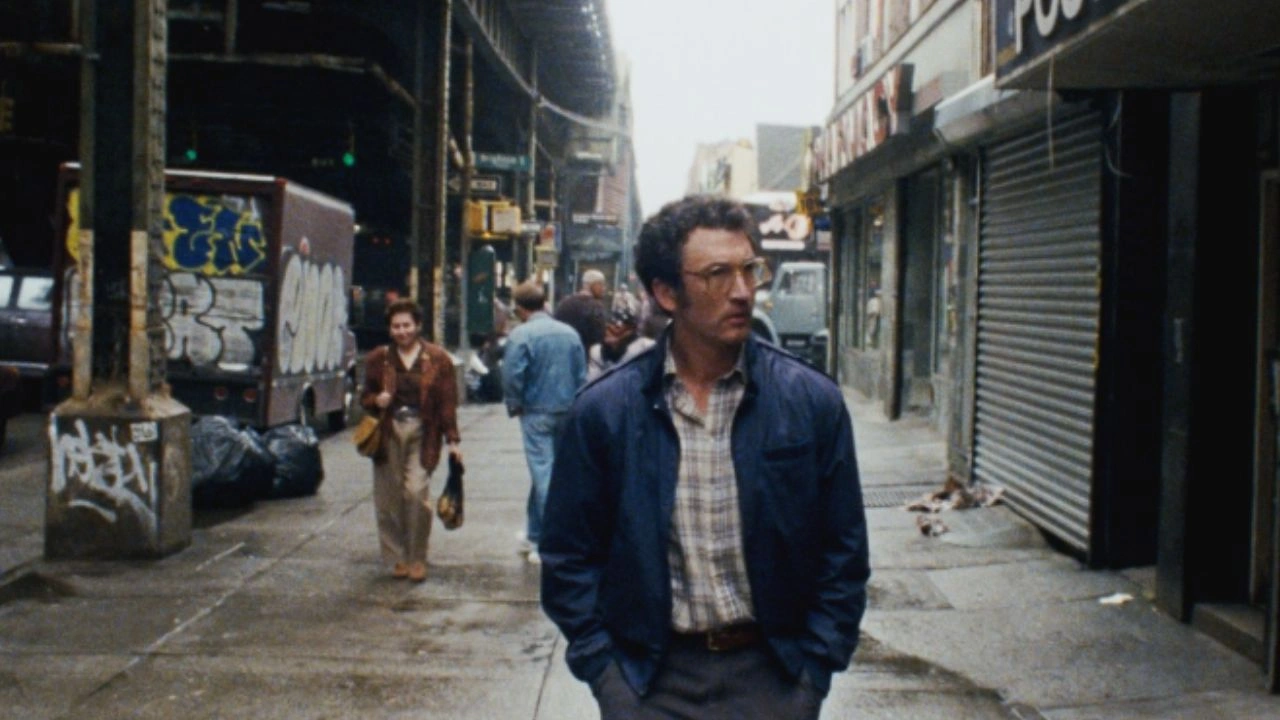
Miles Teller provides the perfect anchor, playing Irwin Pearl with a leaden, second-generation immigrant weariness. Irwin is an earnest reservoir engineer whose entire life is governed by middle-class compliance and intense assimilation anxiety.
Teller captures the physical weight of a man drowning in mundane liabilities. His performance balances crushing anxieties: funding an exorbitant party for his son’s eighteenth birthday, enduring the elite demands of a mother-in-law urging a flight to Great Neck, and trying to secure an Ivy League education for his children.
(The Ivy League ambition functions here as an expensive pass out of outer-borough anonymity.) When actual criminal violence punctures his predictable routine, Teller lets us see a regular guy completely frozen by high-stakes terror. He looks small, regular, and thoroughly out of his depth.
Scarlett Johansson undergoes an extraordinary, harrowing transformation as Hester Pearl. She begins with a razor-sharp Queens accent and a blunt, no-nonsense domestic authority, operating as the household’s actual baseline. Yet the film subjects her to an unsettling process of somatic depletion. Johansson brilliantly manages a parallel track of physical breakdown, suffering from sudden blurred vision and intense headaches while hiding the diagnostic tests from her family to avoid adding to their burdens.
When she finally receives a terminal diagnosis at the clinic, her domestic armor shatters. The volcanic rage she later directs at Irwin after learning he put their sons in the path of a mafia blade is magnificent. On second thought, the script perhaps relies a bit too much on her physical illness to wring tears, a minor narrative betrayal of an otherwise bulletproof performance.
Capitalist Obsession and the Mechanics of Fate
The historical setting of late summer 1986 serves as a lethal incubator for the film’s ideas. It is a period of intense material obsession, an era defined by a ravenous appetite for immediate economic elevation. In the background, the New York Mets are sliding toward a historic World Series victory, a cultural high point that highlights the desperate desires of the outer-borough onlookers. Everyone wants to hit it big.
Irwin’s downslide is triggered by the poisonous effects of fraternal comparison; his quiet envy of Gary’s performative wealth coaxes him into abandoning a lifetime of scientific caution. James Gray exposes a brutal paradox of the American socio-economic engine. Family is the primary catalyst for pursuing dangerous wealth, yet it is the exact asset liquidated by the pursuit.
The narrative mirrors the severe architecture of an Aeschylean tragedy, directly invoking the ancient warning against wealth obtained through tears. The absolute pivot point occurs on a random school night when Irwin drives his sons, Scott and Ben, to the polluted Gowanus Canal to show off his new venture. This single act of fatherly pride exposes them to Alexei’s mob enforcers during an illegal waste-dumping operation.
The criminal response is shocking in its immediacy. Irwin gets beaten, a bald thug presses a stiletto against his son’s throat inside the car, and the family vehicle is stolen. The script distills pure suburban paranoia into a single line delivered by Alexei after inspecting Irwin’s identification documents: “now we know where you live.” This breach of the domestic sanctuary leads directly to an extortion penalty of $150,000 imposed by the syndicate kingpin, Semion Bogoyavich.
The screenplay exhibits clear structural fractures that disrupt its realistic momentum. It stretches psychological probability to believe that a dedicated, protective father like Irwin would remain cooperative with a criminal enterprise after a mobster holds a knife to his child’s face. A normal parent flees immediately, consequences be mindful. Gary’s characterization presents a similar problem of internal logic.
He is framed as a street-smart, highly connected former detective, yet he remains completely oblivious to the lethal operations of the post-Soviet underworld. The decision to layer Hester’s sudden terminal medical diagnosis over a high-stakes mafia extortion plot forces the narrative into a state of melodramatic hyper-saturation. The film begins to feel over-engineered, a construction where structural despair outweighs genuine psychological truth.
Cinematographic Sludge and the Architecture of Terror
Visually, Paper Tiger represents a fascinating, gritty departure for the director, realized through Joaquin Baca-Asay’s exceptional 35mm cinematography. The camera adopts a deliberately unpolished, muddy visual palette, a stylistic choice that perfectly mirrors the industrial decay of the setting.
The Gowanus Canal is photographed as an active antagonist. The camera lingers on the iridescent, oily sheen of the water and the thick layer of industrial sludge, using oppressive, low-key lighting to make the environmental toxicity feel almost suffocating.
Christopher Spelman’s musical score deepens this sensory claustrophobia. His heavy, full-bodied orchestration avoids typical thriller motifs, choosing a low, continuous drone of sonic anxiety. The sudden deployment of solemn Russian choral arrangements at moments of high tension acts as an auditory trap, creating a sense of sonic incarceration that reinforces the absolute isolation of the Pearl family.
The film contains some of the finest suspense sequences of the director’s career, handled with pristine formal precision. The home invasion scene is an absolute masterclass in psychological terror. The mobsters slip inside silently at night, subtly rearrange the living room furniture, and take flash photographs of the family members sleeping in their beds. Stark shadowplay transforms the safe space of suburban domesticity into a terrifying, lawless landscape.
Equally remarkable is the climactic cat-and-mouse pursuit, where Gary attempts to escape mafia assassins inside a towering, abandoned cornfield. The camera alternates between claustrophobic ground-level tracking shots and wide, high-overhead angles that lay out the geography of the hunt like a chessboard.
(One cannot help but recall Cary Grant’s legendary cropduster escape in North by Northwest, updated for an era of urban decay.) Editor Scott Morris knits these heavy sequences together with sharp timing, keeping the entire experience under a tight two hours while allowing the thematic weight room to breathe.
Paper Tiger premiered at the Cannes Film Festival on May 16, 2026, where the production earned a ten-minute standing ovation in its initial screening. Neon holds the distribution rights for the North American market. Viewers can expect a traditional theatrical release across the country before the feature becomes available to watch on commercial digital streaming platforms.
Where to Watch Paper Tiger (2026) Online
Full Credits
Title: Paper Tiger
Distributor: Neon, SND
Release date: May 16, 2026
Rating: R
Running time: 115 minutes
Director: James Gray
Writers: James Gray
Producers and Executive Producers: Rodrigo Teixeira, Anthony Katagas, Raffaella Leone, Gary Farkas, Marco Perego, Carlo Salem, Andrea Bucko
Cast: Adam Driver, Scarlett Johansson, Miles Teller, Gavin Goudey, Roman Engel, Victor Ptak, Holden Goodman, Rosslyn Luke, Joel Marsh Garland
Director of Photography (Cinematographer): Joaquín Baca-Asay
Editors: Scott Morris
Composer: Christopher Spelman
The Review
Paper Tiger
Paper Tiger stands as a powerful, gritty domestic tragedy anchored by elite performances from Adam Driver and Miles Teller. While the narrative strains under structural implosibilities and a heavy-handed medical subplot, its raw, claustrophobic atmosphere remains undeniable. James Gray delivers a biting critique of late-capitalist desperation that sacrifices narrative logic for emotional velocity.
PROS
- Exceptional, layered performances from Adam Driver and Miles Teller that expose the toxic nature of masculine pride.
- Joaquin Baca-Asay's striking 35mm cinematography captures the oily grime and physical decay of the industrial environment.
- A masterfully orchestrated home invasion scene that delivers pure psychological terror through understated shadowplay.
CONS
- Significant narrative strain caused by the predictable inclusion of a terminal medical diagnosis.
- Frustrating lapses in character logic, particularly Irwin's decision to maintain criminal cooperation after his children face direct violence.
- Inconsistent characterization of Gary, who appears highly connected yet incredibly blind to systemic danger.