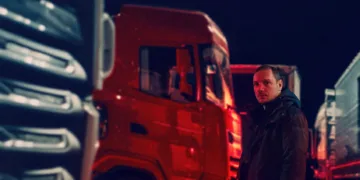




























Pierre Le Gall makes his feature directorial debut with Flesh and Fuel, an intimate romance placed inside the hard, mobile world of European long-haul trucking. The story follows Étienne, a reserved French driver played by Alexis Manenti, whose life unfolds through solitary highway stretches and disciplined routine.
That routine shifts after an evening encounter at a roadside park, where a sudden police raid sends him slipping away with Bartosz, a charismatic Polish driver played by Julian Świeżewski. Their shared flight becomes the first spark of a deep romantic attachment.
The screenplay, written by Le Gall, Camille Perton, and Martin Drouot, follows the strain of sustaining intimacy across highways, industrial zones, and delivery schedules. Their bond grows through brief phone calls and fleeting crossings on the road. The film treats their orientations as ordinary fact, free from social backlash or identity-based melodrama. Its pressure comes from work, deadlines, distance, and the geography of European shipping routes.
The Physicality of Labor and Vulnerability
Cinema often polishes romance until bodies become decorative symbols. This film gives romance weight, sweat, fatigue, and the blunt texture of working-class life. Alexis Manenti plays Étienne with a quiet, guarded stillness, giving him a physical presence shaped by restraint. One stark moment crystallizes that realism: Étienne removes his thick back brace, revealing a tired torso marked by years of highway labor.
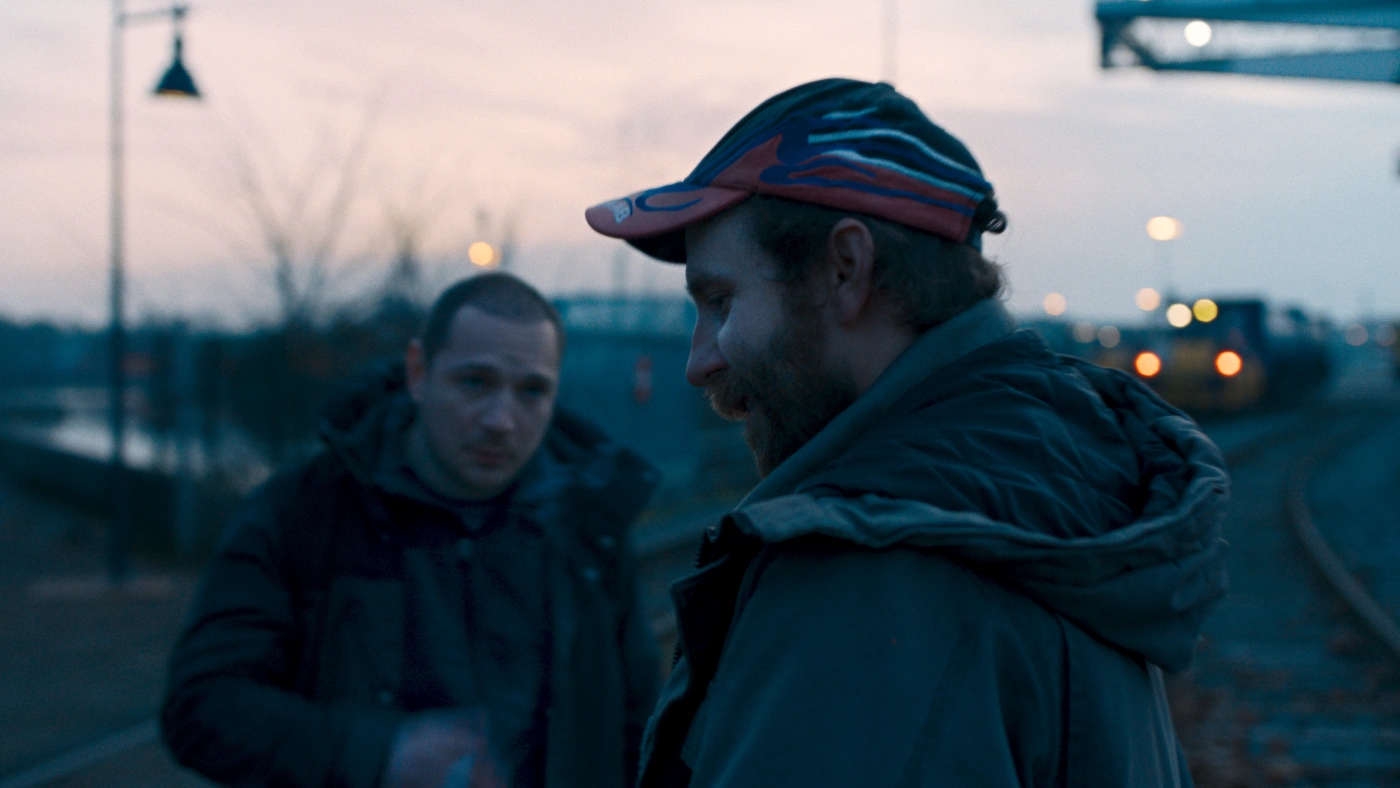
Julian Świeżewski gives Bartosz a warmer, looser charge. He is expressive, playful, and physically open, with the film allowing the visible bald spot and the worker’s hat to remain part of his texture. The details matter. They place Bartosz firmly inside the same laboring world, even as his energy cuts through Étienne’s isolation.
Their scenes move between silence and sudden humor, building attraction through friction and temperament. Bartosz becomes a buoyant foil to Étienne’s rigid life, and the actors’ chemistry rests on that charged imbalance. The film steps past familiar queer narrative machinery by letting both men exist openly in their identities. The attention lands on vulnerability, self-recognition, and the uneasy work of deciding what a shared life might demand.
Capital and the Logistical Divide
The film builds a blue-collar social world reminiscent of the Dardenne brothers, where money, schedules, and institutional pressure shape intimacy before anyone speaks of love. Villainy spreads through a commercial system designed to extract motion from bodies. Human connection becomes fragile because the work itself keeps moving.
The economic gap between Étienne and Bartosz sharpens that pressure. Étienne has a relatively stable French salary and regulated domestic schedules, though his shipping company faces fierce market pressure that pushes him toward difficult cross-border routes into England. Bartosz works as a migrant driver for a Polish shipping firm, enduring punishing international routes, long hours, and multiple borders for much lower pay.
Those labor conditions turn their schedules into a constant source of strain. Their routes become a literal barrier and a metaphorical one, making regular meetings almost impossible to arrange. The work demands movement, and that movement drains away stability, local attachment, and any easy sense of shared domestic space.
This is where the film’s critique takes shape with quiet force. Modern commerce treats the worker as a piece of distribution, a body attached to a timetable, a pulse inside a machine. Étienne and Bartosz try to protect feeling inside a system that has little use for preservation.
Mechanical Landscapes and Fleeting Synchronicities
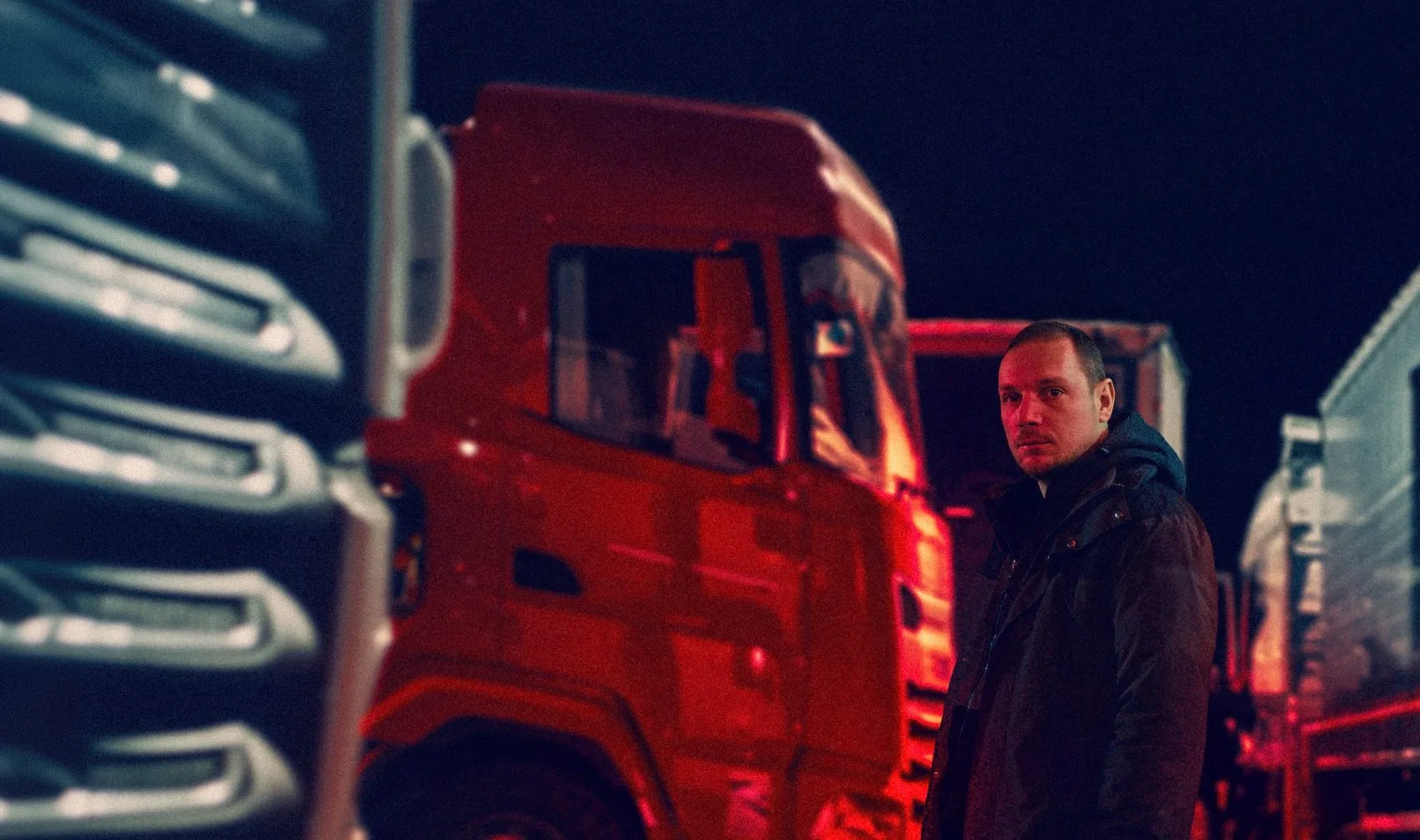
Antoine Cormier’s industrial cinematography finds austere beauty in ordinary, functional places: roadside rest stops, dense woods, factory smokestacks, and cramped truck cabins. The images give mechanical spaces a strange lyricism, softened by a careful color palette that draws tenderness out of concrete and steel.
Paul Sabin’s score deepens that mood through sweeping wind instruments. The music gives sound to Étienne’s buried emotional life and romantic hunger, carrying feelings that his stoic exterior keeps sealed away. It becomes the film’s breath, moving through the spaces his body cannot soften.
Two sequences crystallize the romance visually. On New Year’s Eve, their trucks pass each other on a large bridge, and rhythmic horn honks carry their connection across the highway divider. Later, at the Rungis wholesale food market outside Paris, Étienne searches for Bartosz on foot among massive moving vehicles, risking his safety for a brief encounter.
These moments give the film its tender pulse. Le Gall shapes romance through timing, danger, machinery, and almost impossible proximity. The film resists easy resolution, leaving its characters suspended in motion, where travel does not promise arrival and desire must survive in the narrow gaps between routes.
The film had its world premiere at the Cannes Film Festival in the Critics’ Week section on May 16, 2026. Following its festival run, the film is scheduled for a wider theatrical release via Pan Distribution, and international viewers can look to specialized streaming platforms like MUBI for future availability.
Full Credits
Title: Flesh and Fuel (Du fioul dans les artères)
Distributor: Pan Distribution
Release date: May 16, 2026
Running time: 90 minutes
Director: Pierre Le Gall
Writers: Pierre Le Gall, Camille Perton, Martin Drouot
Producers and Executive Producers: Nicolas Blanc, Patryk Sielecki, Adrianna Rędzia
Cast: Alexis Manenti, Julian Świeżewski, Armindo Alves de Sa, Mohamed Makhtoumi, Françoise Félicité, Oudesh Rughooputh, Stéphanie Chamot, Julie Duclos
Director of Photography (Cinematographer): Antoine Cormier
Editors: Xavier Sirven
Composer: Paul Sabin
The Review
Flesh and Fuel
Flesh and Fuel avoids the familiar traps of conventional romance, trading manufactured drama for the tactile realities of industrial labor. Pierre Le Gall finds genuine poetic weight in the spaces connecting these isolated lives, matching a clear socioeconomic critique with quiet emotional honesty. The film provides an unpolished, necessary perspective on affection under the weight of modern distribution networks.
PROS
- Grounded performances by Alexis Manenti and Julian Świeżewski provide an authentic portrait of working-class individuals.
- Antoine Cormier's cinematography uncovers visual lyricism within harsh industrial sites and highway stops.
- The screenplay skips standard coming-out conflicts to address systemic economic blockades instead.
CONS
- The deliberate pace might challenge viewers who prefer high-stakes dramatic escalations.
- The focus remains restricted to the central pairing, leaving supporting characters underwritten.