
























![Kingdom Hearts Collection [I-III] Review](https://gazettely.com/wp-content/uploads/2026/10/Kingdom-Hearts-Collection-I-III-1-360x180.webp "Kingdom Hearts Collection [I-III] Review: KHII Holds Steady as Newer Entries Fluctuate 37")




Bruno Dumont is the kind of filmmaker who treats audience expectation as a personal affront. His debut, The Life of Jesus (1997), announced a sensibility of bleak, unadorned rural severity — long takes, non-professional actors, a camera that watched suffering with the patience of a coroner. Then, in 2014, Li’l Quinquin arrived and upended everything: broad slapstick, deadpan absurdism, an almost affectionate relationship with the grotesque. His most recent feature before this, The Empire, was a straight-faced Star Wars parody involving a Gothic cathedral that becomes a spaceship. Make of that what you will.
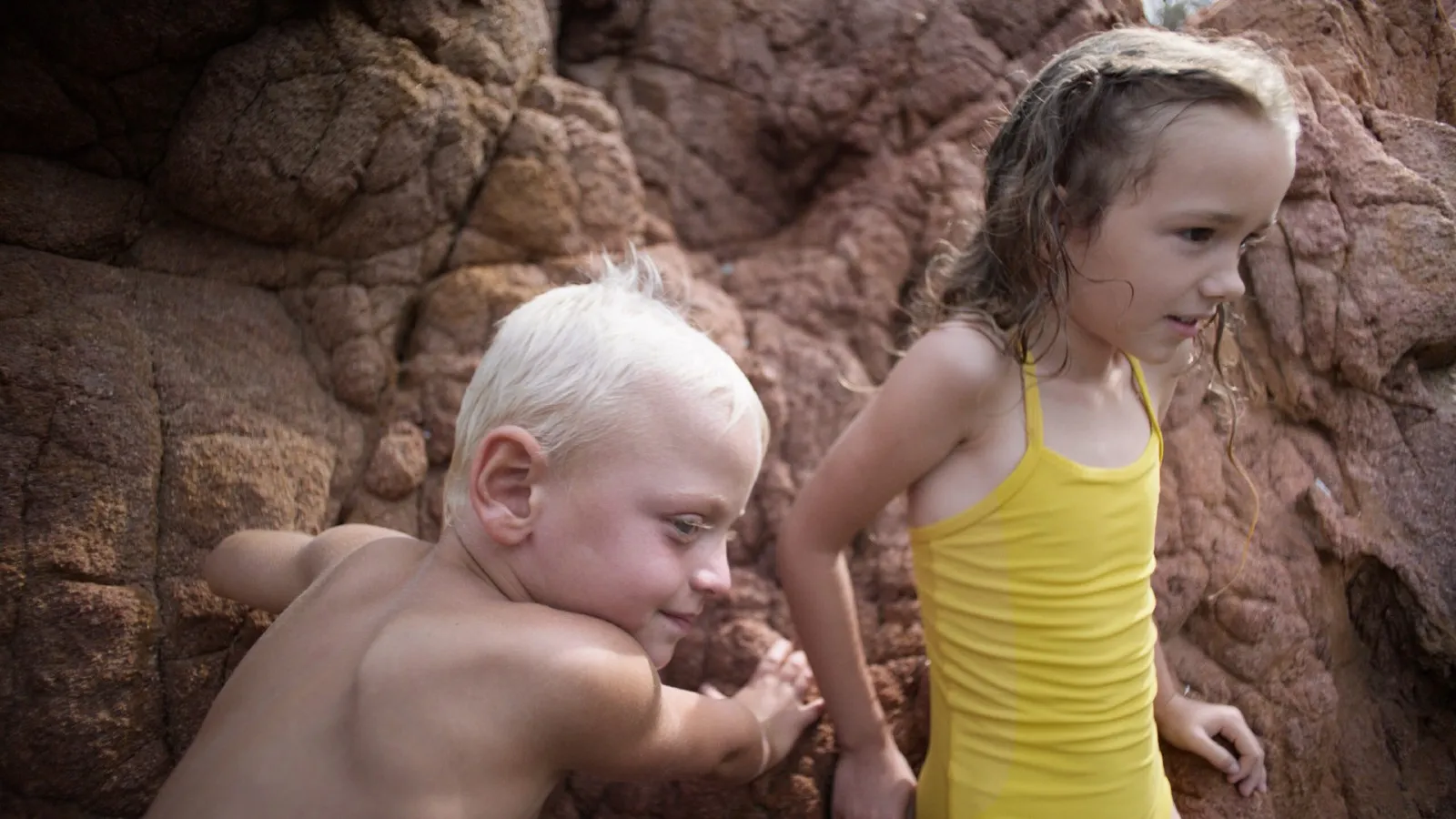
Red Rocks is his latest recalibration. Shot on the sun-hammered Mediterranean coast near the Italian border, it trades Dumont’s customary grey northern palette for terracotta, deep blue, and the blinding white of a southern French summer. The cast is almost entirely composed of children aged five to seven, all non-professional, most of them seemingly unaware that cinema has rules. At the centre is Géo, played by Kaylon Lancel — a wiry, restless five-year-old with nervous tics and the moral philosophy of a crow. He is less a realistic child than something older, a figure from landscape rather than family. The film premiered at Cannes Directors’ Fortnight. It is tender, strange, and surprisingly hard to shake.
Paradise Has No Parents
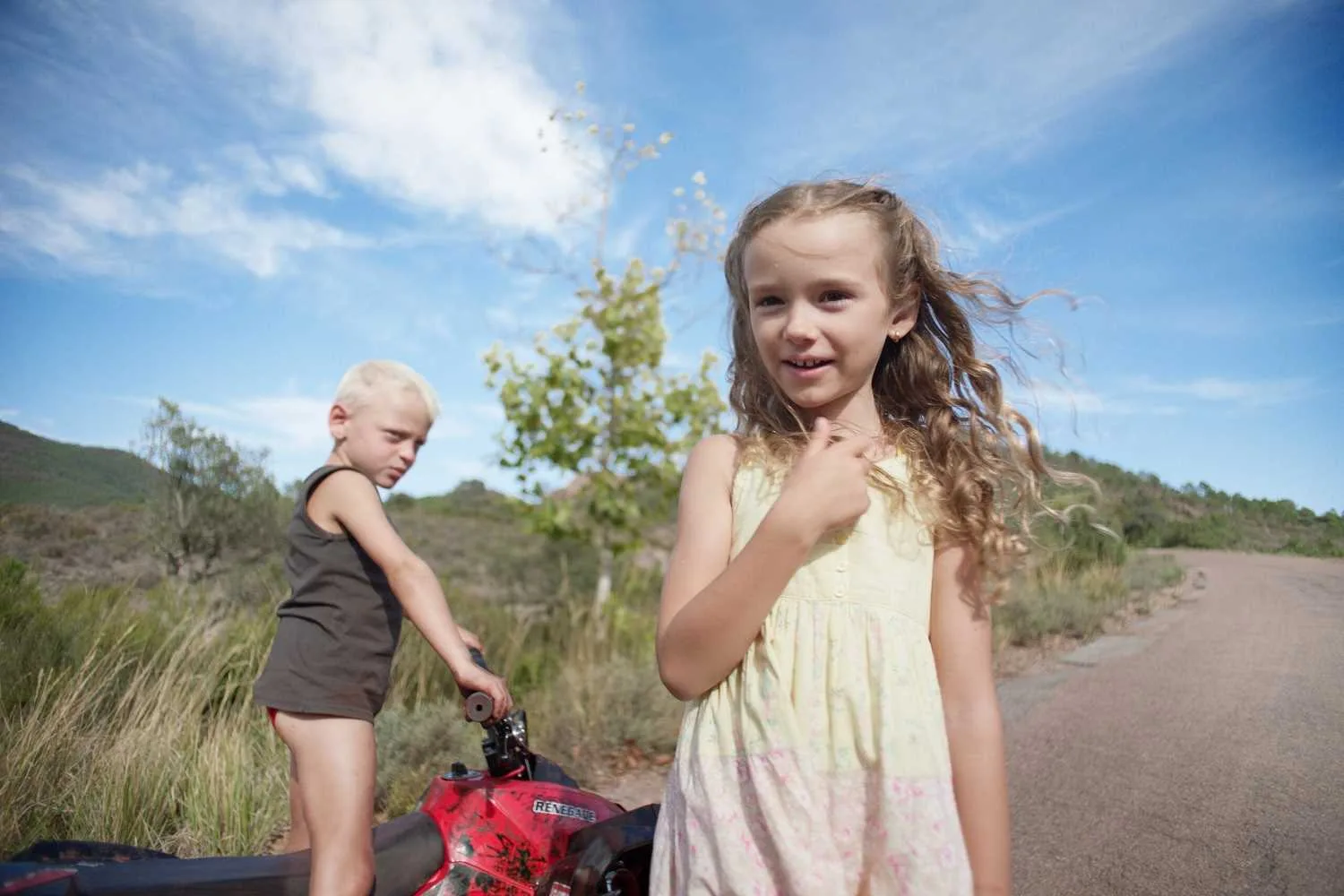
The plot, such as it is, operates on the logic of a long summer afternoon. Géo rules his small coastal town alongside two companions: Manon (Louise Podolski) and Rouben (Mohamed Coly). Their days consist of tearing around on quad bikes, committing petty theft from unlocked picnickers’ cars, and scaling the jagged red promontories that line the shore to hurl themselves into the sea below. No parents appear. No adults intervene in any meaningful way. A coast guard boat floats past and issues a warning about the rocks; the children receive this information with serene contempt.
Dumont constructs the adult world as a kind of rumour. A man on a phone laments that all the bars have closed. A train crosses the viaduct overhead at intervals, carrying, one imagines, everyone who grew up and left. The children inherit what remains, and they are entirely sufficient to it.
The film’s social architecture arrives with a second trio: B (Alessandro Piquera), Ève (Kelsie Verdeilles), and Do (Meryl Piles). Where Géo’s gang belongs to the working-class margins — mobile homes, stolen goggles — this new group orbits a grand villa. The class distinction is drawn without commentary, which is the point. Géo registers it and proceeds anyway. He and Ève are immediately, irrevocably attached to each other. B scowls. Manon watches. The love triangle is essentially Romeo and Juliet scaled down to a height of one metre.
The film’s most openly surreal sequence sends Géo and Ève alone on a train across the Italian border to visit her grandfather, who is too absorbed in his tennis lesson to notice them. Two five-year-olds, unaccompanied, on an international rail journey. Dumont earns the irrealism through an earlier platform scene in which the children simply sit and talk in their circular, fragmentary way — repetition masquerading as conversation — until the impossibility of what follows feels almost earned. Almost. Childhood here is its own sovereign jurisdiction, with no extradition treaties with the adult world.
Faces as Landscape, Rocks as Philosophy
Cinematographer Carlos Alfonso Corral (who shot Roberto Minervini’s The Damned) works in two competing registers, and the tension between them is where the film lives. Wide-angle lenses sweep across vast stretches of coastline, making the children’s small world feel geological in scale. Then Corral closes in, tight on Géo’s face, claustrophobically so, and the frame becomes a cage the boy has no idea he’s in. The contrast is not accidental. Expansiveness is freedom; proximity is the camera’s own jealous claim on him.
Lancel is extraordinary in ways that are difficult to attribute to direction alone. His facial tics and ceaseless physical motion suggest an interior life too turbulent for language. Dumont, who has always preferred performers whose bodies betray what their words conceal, channels the boy’s evident discomfort directly into character. Whether this constitutes exploitation or collaboration is a question the film has the decency to leave open.
Kelsie Verdeilles as Ève provides a warmer, more legible counterpoint — a lisp in her French, a smile that seems to find the whole enterprise delightful. The driveway sequence, in which the two children attempt to coax the family dog into leaving with them, is pure improvisational chaos, and Corral simply watches it happen. These are the film’s best moments: when Dumont loosens his grip and the children’s ramshackle energy takes over.
The cliff-jumping sequences are genuinely vertiginous. The cast appears to perform them largely for real, though visual effects extend certain sequences into something approaching the transcendental. It’s a choice that sits slightly uneasily against the documentary grain elsewhere — the CGI enhancement visible enough to snag the eye — yet the resulting images have a quality close to myth. Children, red rock, blue sea, open sky. The camera tilts up and the world becomes enormous.
The red rocks themselves function as the film’s central visual argument. Their colour is genuinely anomalous, bordering on Martian. Dumont frames them with an almost ceremonial attention, as though they predate human use and will outlast it. Against them, the children seem both very small and, paradoxically, perfectly scaled.
A Small World, Seriously Held
Red Rocks earns its place in a French cinematic lineage that treats childhood with genuine philosophical weight rather than sentimentality, Truffaut’s Pocket Money, Doillon’s Ponette, films that observe children as though they constitute a separate civilisation worth studying. Dumont belongs in that company here, particularly when he trusts pure observation over imposed structure.
Where the film stumbles is precisely when it stops trusting itself. The love-triangle plotting carries the faint odour of a dramatic scaffold erected over material that breathes better without one. Several scenes outstay their welcome. The CGI, defensible in isolation, periodically reminds you that a filmmaker’s hand is present when the film’s best instincts argue for invisibility.
Gentler and more accessible than anything Dumont has made in years, Red Rocks is recognisably his in its faith in faces over narrative, its comfort with strangeness, its refusal to condescend either to its subjects or its audience. A recalibration, then, rather than a reinvention. Quietly considerable.
Red Rocks is a 2026 drama directed by Bruno Dumont that premiered at the Cannes Film Festival in May 2026. The film follows a group of young children on the French Riviera who spend their summer engaged in perilous cliff-jumping competitions and exploring their beautiful, sun-drenched surroundings. As the children navigate their own social dynamics and the stirrings of a “Romeo and Juliet”-style romance, the film blends childhood innocence with moments of tension and surreal beauty. Currently, the film is making its debut in festival circuits like the Cannes Directors’ Fortnight.
Full Credits
Title: Red Rocks
Distributor: Luxbox (International Sales)
Release date: May 2026 (Cannes Film Festival)
Rating: Not Rated
Running time: 90-91 minutes
Director: Bruno Dumont
Writers: Bruno Dumont
Producers and Executive Producers: Joaquim Sapinho, Marta Alves, Fiorella Moretti, Jean Bréhat, Alejandro Sugich, Ines Vasiljevic, Tessalit Productions
Cast: Kaylon Lancel, Kelsie Verdeilles, Louise Podolski, Mohamed Coly, Alessandro Piquera, Meryl Pires
Director of Photography (Cinematographer): Carlos Alfonso Corral
Editors: Bruno Dumont
Composer: Laia Torrents Carulla
The Review
Red Rocks
Red Rocks confirms that Dumont, even when operating at reduced intensity, sees childhood as no other working director does — something feral, sovereign, and faintly extraterrestrial. Lancel's performance alone justifies the film's existence. The love-triangle plotting strains under its own thinness, and the CGI intrusions briefly puncture the documentary spell. A minor Dumont, perhaps, but minor Dumont still occupies territory nobody else is mapping.
PROS
- Kaylon Lancel's singular, transfixing screen presence
- Corral's cinematography — visually ravishing throughout
- Authentic, unsentimental depiction of childhood psychology
- Quietly surreal atmosphere, worn lightly
CONS
- Love-triangle plot imposes unnecessary structural weight
- Some sequences feel padded
- CGI sits uneasily against the naturalistic aesthetic