
























![Kingdom Hearts Collection [I-III] Review](https://gazettely.com/wp-content/uploads/2026/10/Kingdom-Hearts-Collection-I-III-1-360x180.webp "Kingdom Hearts Collection [I-III] Review: KHII Holds Steady as Newer Entries Fluctuate 37")





The city of Shenzhen becomes a cold, gleaming stage for a story far removed from the historical grandeur often linked to Zhang Yimou’s work. The past seems erased here, replaced by the pressure of a frantic digital present. A failed intercept by a National Security unit sets the plot in motion.
The unit loses a package containing sensitive military hardware to a group of elusive targets, creating an immediate crisis for Huang Kai and Yan Di. The two lead agents are drawn into a search for a mole inside their own agency. Director Zhao Hong takes charge through Operation Scare Out, turning the agency’s offices into a chamber of surveillance, suspicion, and professional dread.
Huang Kai and Yan Di soon understand that their own safety depends on exposing a colleague. The setting recalls the high-tech claustrophobia of modern South Asian thrillers, where the city operates like a machine of control.
The opening chase feels strained and breathless, placing the viewer in a world where information outruns the people chasing it. The leak remains the central danger, with Shenzhen standing over the action like a polished, indifferent witness.
The Decay of Trust and Personal Allegiances
The film’s psychological pressure comes from the fracture between Huang Kai and Yan Di. Their shared service history should give them stability, yet the investigation turns that past into a source of suspicion. They study each other with clinical distance, echoing the tense brotherhoods found in the parallel cinema of the 1980s.
Director Zhao Hong intensifies this unease through cold, relentless questioning. She pushes her subordinates toward collapse as she searches for the mole, and her presence gives the state apparatus a severe human face. The official mission concerns jet technology, while the drama gains force from the tangled personal lives of the men.
Huang Kai faces the needs of his pregnant wife, Xiaoyu, and carries on a secret relationship with the elusive Bai Fan. These domestic complications bring warmth, strain, and fragility into the sterile spaces of the intelligence agency. The script presents personal desire and human error as major weaknesses in any security system.
Loyalty to a friend becomes dangerous under the demands of national duty. The performances give these ideas a tired, lived-in texture. The espionage gains emotional weight because the film keeps returning to fear, guilt, and betrayal. The hunt for a traitor feels intimate, turning professional risk into a wound shared by everyone involved.
A Digital Aesthetic of Fragmentation and Surveillance
The film’s visual style is erratic, fractured, and intensely processed. Zhang Yimou moves away from his signature long takes and works with frantic editing. Rapid cuts and digital manipulation push into faces, creating a manufactured urgency that suits the film’s surveillance-driven world. The technique resembles the way monitoring systems gather information in broken bursts.
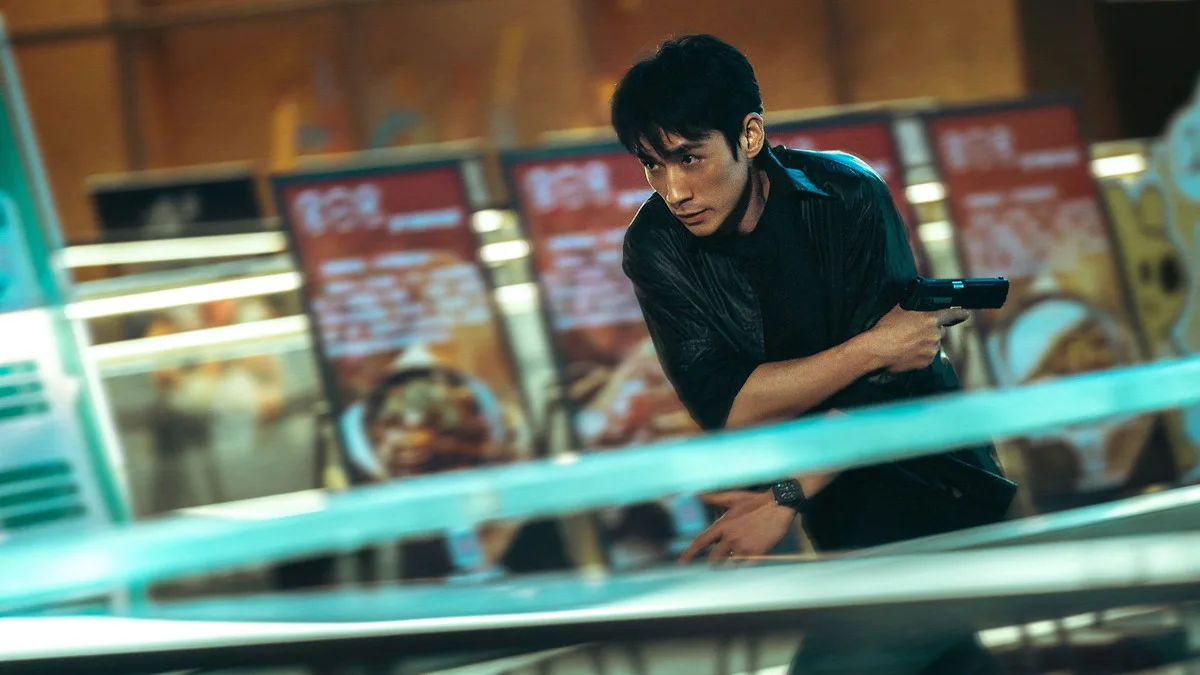
Drone shots of highway roundabouts appear again and again, giving the viewer a literal bird’s-eye view of people living under constant observation. Low-resolution camera feeds and facial recognition boxes fill the screen, making the act of watching central to the plot. This digital texture recalls the gritty surfaces associated with filmmakers like Michael Mann, with sharper attention placed on the invasive power of modern sensors.
The cinematography relies on side-to-side pans and jagged transitions, keeping the viewer unsettled from scene to scene. These choices affect the action’s clarity. An early street pursuit and a later sequence involving remotely controlled self-driving cars lose some physical impact through hyperactive cutting.
The style still serves the film’s tech-driven paranoia, creating a world where total visibility produces confusion. The camera seems to hunt the characters, mirroring the internal investigation. The viewing experience becomes deliberately exhausting, reflecting the mental state of the suspects.
Melodramatic Rhythms and the Final Revelation
The narrative moves with fierce speed, giving the viewer little room to pause as new developments pile up. That pace creates the sensation of drowning in data, a feeling closely tied to the film’s ideas about information warfare. The soundscape gives this procedural momentum a strong emotional charge. Heavy string music builds dread, and several ballads arrive during emotional scenes.
These songs bring in a traditional melodramatic rhythm, placing human feeling against the cold technology on screen. The combination recalls Indian commercial thrillers, where musical passages help political plots remain accessible through sentiment. The final twenty minutes deliver twists at the speed of an ice skater’s spin. These revelations reshape the characters’ motivations and resolve the mole hunt with sudden, calculated force.
The film closes with quiet thoughtfulness after its earlier rush of panic and suspicion. It reflects on the personal cost of a career spent in shadows, leaving behind a trace of melancholy. The ending focuses on the scars created by a system that demands absolute transparency from its people and shields its own inner workings. After the chaos of the investigation, that final shift gives the film a sharp moment of clarity.
Directed by the legendary Zhang Yimou, Scare Out (惊蛰无声) marks a significant milestone as mainland China’s first contemporary national security thriller produced with the official guidance of the Ministry of State Security. The film premiered globally on February 17, 2026, to coincide with the Lunar New Year, featuring the futuristic, high-tech cityscape of Shenzhen as its primary backdrop. The plot centers on a dedicated counter-espionage unit racing to intercept leaked military technology while navigating a web of internal distrust and suspected betrayal. As of May 2026, the film is available in theaters across international markets, including China, the United States, Canada, the United Kingdom, and Australia, under the distribution of CMC Pictures and Trinity CineAsia.
Where to Watch Scare Out (2026) Online

Full Credits
Title: Scare Out (Jīngzhé Wúshēng)
Distributor: CMC Pictures, Damai Entertainment, Trinity CineAsia, Mega Films Distribution
Release date: February 17, 2026
Rating: 13
Running time: 104 minutes
Director: Zhang Yimou
Writers: Liang Chen
Producers and Executive Producers: Pang Liwei, Li Jie, Calvin Choi, Zhang Yimou
Cast: Jackson Yee, Zhu Yilong, Song Jia, Jiayin Lei, Yang Mi, Zhang Yi, Liu Shishi, Liu Yaowen
Director of Photography (Cinematographer): Zhao Xiaoding
Editors: Li Yongyi
Composer: Peng Fei
The Review
Scare Out
Zhang Yimou exchanges his poetic brush for a digital scalpel. This thriller prioritizes tech-driven paranoia over emotional depth. The performances ground the narrative, yet the erratic editing and melodramatic score create a disjointed experience. It mirrors the transition of Indian cinema legends who swapped historical grandeur for the anxieties of the digital age. This remains a curious, often frustrating artifact of a master navigating the modern surveillance state.
PROS
- Convincing lead performances by Zhu Yilong and Jackson Yee.
- Focus on personal loyalty rather than technical details.
- Effective use of the Shenzhen cityscape to enhance the mood.
CONS
- Disorienting editing styles hinder the clarity of action scenes.
- Musical song montages feel out of place within a spy thriller.
- The narrative prioritizes high velocity over psychological depth.