

























![Kingdom Hearts Collection [I-III] Review](https://gazettely.com/wp-content/uploads/2026/10/Kingdom-Hearts-Collection-I-III-1-360x180.webp "Kingdom Hearts Collection [I-III] Review: KHII Holds Steady as Newer Entries Fluctuate 37")





In System, director Ashwiny Iyer Tiwari strips away the artificial gloss often found in mainstream cinematic representations of India’s legal capital, delivering a cold, observant look at institutional power. The narrative focuses heavily on the claustrophobic world of Delhi’s district courts, exposing how wealth, social status, and generational privilege dictate the outcomes of the legal process.
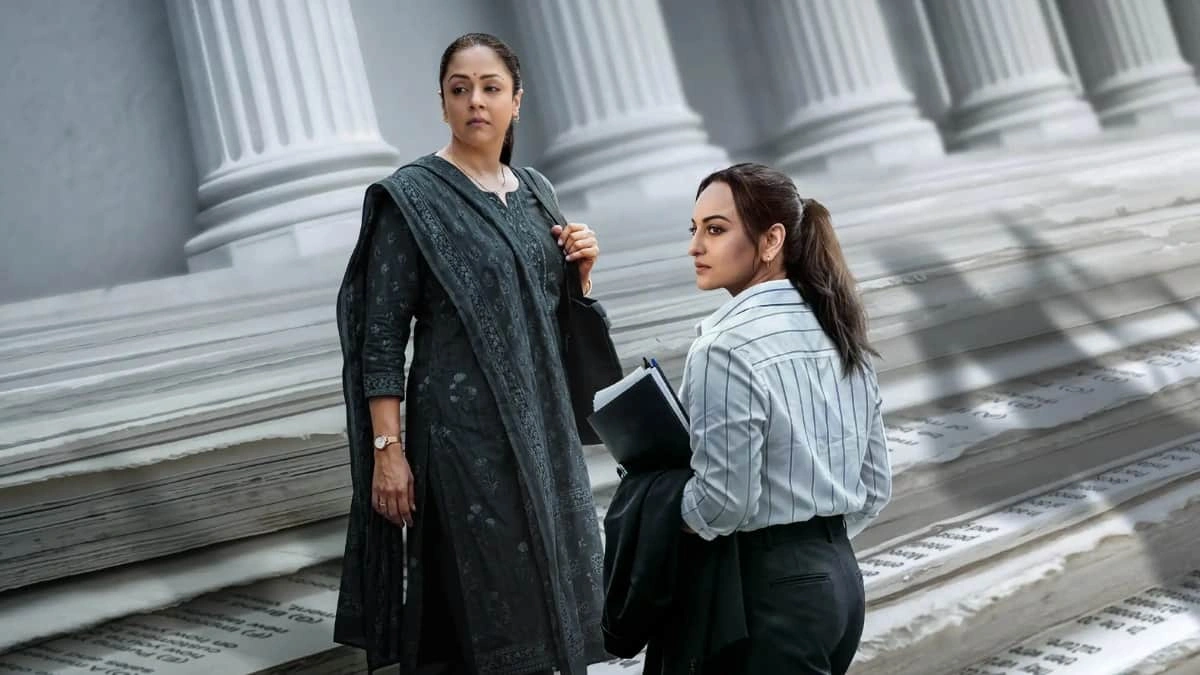
Public prosecutor Neha Rajvansh, portrayed by Sonakshi Sinha, is this world’s focal figure. Neha is an ambitious lawyer trying to establish her professional identity, yet she remains caught within the vast shadow of her father, Ravi Rajvansh, played by Ashutosh Gowariker, a prominent defense attorney known for protecting the city’s wealthy elite.
Ravi demands that his daughter prove her professional worth through a harsh ultimatum: she must secure ten consecutive courtroom victories entirely on her own merit before she can earn a place at his prestigious firm. This condition drives the plot forward, forcing Neha to seek help from an unlikely source when her early attempts falter.
She enters a hidden arrangement with Sarika Rawat, played by Jyotika, a courtroom stenographer who possesses a deep, self-taught understanding of legal strategy gained from years of recording trials. Sarika secretly guides Neha through complex cases in exchange for financial support to keep her struggling family afloat.
Their alliance works smoothly until Neha takes on a high-profile murder case involving a prominent social media influencer. When the primary suspect turns out to be a wealthy real estate developer represented by her father, the narrative shifts toward a direct confrontation between parent and child, forcing both women to confront the systemic corruption embedded within the legal machinery.
Class Dualities and the Realism of the Female Partnership
The partnership between Neha and Sarika forms the intellectual and emotional core of the film, providing a detailed look at the rigid class structures that define modern Indian society. Tiwari sidesteps the sentimental tropes common in mainstream cinema, where cross-class relationships are often idealized.
The connection between these two women is established as a strictly transactional arrangement born out of separate, urgent needs. Neha possesses immense societal privilege but lacks practical courtroom experience, while Sarika holds vast legal knowledge yet is trapped by economic survival.
Sarika serves as the sole provider for a family burdened by hardship, including a school-aged daughter and a husband who uses a wheelchair. The screenplay handles this dynamic carefully, ensuring that Sarika functions as a fully realized character with sharp awareness of her economic position, observing Neha’s wealthy lifestyle with quiet, calculating detachment. Neha views Sarika’s modest household with a naive, wide-eyed fascination, highlighting the deep social divide that persists even when two individuals share the same professional environment.
A notable strength of the characterization is the inclusion of subtle details regarding the personal independence of both women. Tiwari presents them as self-determining individuals who make their own choices outside of traditional societal expectations. Neha expresses complete independence in her romantic life, communicating with her partner in a direct manner that challenges standard cinematic conventions.
Sarika also exercises autonomy in her private personal life, managing her affairs with a matter-of-fact detachment that subverts the typical portrayal of long-suffering domesticity. These elements extend the film beyond a standard legal procedural into a complex study of women moving through restrictive environments.
The performances reinforce these character dynamics, with Sonakshi Sinha delivering a controlled portrayal of Neha. Sinha grounds her performance in internal tension and professional frustration, conveying Neha’s emotional reality through disciplined restraint. She effectively conveys the heavy emotional exhaustion of a daughter trying to break free from an overbearing family legacy, using brief pauses and hesitant gestures to indicate her growing unease.
Jyotika provides the emotional weight of the film through a performance built on stillness and quiet dignity. She projects Sarika’s deep exhaustion and suppressed bitterness through subtle expressions, capturing the weariness of a woman who has spent years absorbing the moral corruption of the legal system. Her presence commands attention without relying on dramatic speeches, anchoring the film’s social commentary in real human emotion.
Ashutosh Gowariker supports them well, portraying Ravi Rajvansh with cold, imposing authority. Gowariker presents the character as an institutional fixture who views legal ethics with complete detachment, treating the courtroom as a space governed by power, with truth as a secondary concern.
Genre Hybridity, Structural Divergences, and Pacing Faults
The screenplay, created by a writing team that includes Ashwiny Iyer Tiwari, Harman Baweja, Arun Sukumar, and Tasneem Lokhandwala, attempts to combine several distinct styles: a character study of two women from different social classes, a detailed legal procedural, and a suspenseful murder mystery. This approach reflects a global trend where filmmakers use genre frameworks to examine complex systemic issues.
The film opens with a tragic sequence showing a wrongfully convicted man who commits suicide in prison, immediately establishing a grim tone and warning the audience that the legal system is deeply flawed. This opening sets expectations for a serious critique of institutional failure before the story shifts focus to Neha’s career challenges.
The film struggles to maintain narrative momentum because of its deliberate, slow-burning pace. This quiet style allows for careful character development early on, yet causes significant pacing issues in the second half. The script introduces a major subplot involving Neha’s decision to move out of her parental home, focusing extensively on her domestic adjustment and personal independence.
This tangent disrupts the main legal narrative, stalling the momentum of the courtroom plot just as the stakes are beginning to rise. By focusing on personal domestic details at a critical moment, the film loses the tension necessary to sustain a high-stakes legal thriller.
This structural issue is worsened by a noticeable disconnect in the legal proceedings. The individual cases that Neha fights to reach her ten-victory target are often oversimplified and resolved too quickly, ranging from a restaurant fire to early criminal trials. The legal arguments and investigative steps lack the complexity expected from a serious legal drama, making Neha’s victories feel unearned and convenient.
The film often relies on quick summaries to move the plot forward, bypassing rigorous legal work entirely. The direction also drops obvious narrative clues early in the story, making the final plot twists and corporate connections highly predictable. An experienced viewer will likely anticipate the final outcome long before the characters do, which weakens the impact of the mystery element.
Technical Craft and the Visual Representation of Fatigue
The visual style of System marks a significant departure from the polished look typical of mainstream Hindi cinema, aligning with the realistic aesthetics of Indian parallel cinema and international realism. Ashwiny Iyer Tiwari deliberately foregoes glamorous lighting and pristine sets, capturing Delhi as a weary, indifferent environment. The cinematography emphasizes the suffocating nature of bureaucratic life, focusing on cramped hallways, dimly lit archive rooms, and crowded, low-ceilinged courtrooms.
The production design reinforces this mood, replacing impressive cinematic law offices with dusty desks, stacked paperwork, and worn office furniture. The film utilizes a muted, desaturated color palette dominated by gray, brown, and pale yellow tones. This color scheme serves a clear symbolic purpose, visually reinforcing the emotional exhaustion and moral decay that affects everyone working within the legal system.
The dialogue, written by Akshat Ghildial, supports this realistic approach by maintaining a naturalistic, conversational tone. The characters speak directly, avoiding the grandiloquent monologues and dramatic declarations that often define cinematic courtrooms. This understated writing style is highly effective in depicting the casual, everyday sexism that Neha encounters within the legal profession and inside her own home, showing that institutional prejudice operates through quiet exclusion, finding expression in silence and omission.
The musical choices by Kabeer Kathpalia, Ana Rehman, and Savera feel out of place within this realistic framework. The film features traditional song sequences that feel unnecessary and disruptive to the narrative flow. A story focused on institutional critique and quiet human struggle requires a subtle, atmospheric score, and the standard musical breaks undermine the director’s attempt to build a realistic world, rupturing the tension that the visual design has carefully constructed.
The editing by Charu Shree Roy attempts to restore balance, connecting earlier details to later plot developments. The editing cannot completely fix the pacing issues caused by the script’s focus on domestic subplots.
The Climax Breakdown and Themes of Survival
The final third of the film experiences a sharp shift in tone, moving away from its established realistic style and adopting the conventions of a standard Hollywood-style thriller. When Neha handles the defense of the wealthy builder accused of murdering an influencer, her behavior changes dramatically.
She stops acting like a public prosecutor bound by court procedures and begins conducting dangerous field investigations, wandering into unsafe locations at night to gather clues. This sudden transformation from a frustrated lawyer into an implausible detective figure damages the film’s credibility, shifting the narrative into a conventional cinematic space where complex social realities are replaced by dangerous confrontations.
The final courtroom battle and the subsequent exposure of the killer rely heavily on familiar genre tropes and convenient revelations. This sudden resolution feels forced and unconvincing, clashing with the realistic depiction of bureaucratic indifference that made the first half of the film effective. By choosing a neat, dramatic resolution, the film undermines its own critique of the legal system, suggesting that complex structural corruption can be easily resolved through a single moment of courtroom exposure.
These late structural flaws acknowledged, System still delivers a clear, sobering perspective on the nature of justice in an unequal society. The film shows how the legal framework is easily manipulated by wealth and social influence, serving as a tool to protect the powerful and leave the vulnerable exposed.
The narrative connects these systemic problems back to the personal histories of its characters, revealing that Sarika’s participation in the illegal arrangement is driven by her lingering grief over her late brother’s unresolved death. This detail reframes her actions, showing that her choice to bend the rules is a direct response to a system that failed her family. For those living without privilege, the legal system functions as an unforgiving environment where compliance is difficult and actions are dictated by the simple need for emotional and physical survival.
The legal drama film System premiered globally on the streaming platform Amazon Prime Video on May 22, 2026. Directed by Ashwiny Iyer Tiwari and produced under Baweja Studios, this Hindi-language narrative follows an intense, cross-class legal battle and is currently available to watch worldwide for subscribers of the service.
Full Credits
Title: System
Distributor: Amazon Prime Video
Release date: May 22, 2026
Rating: 15 (BBFC)
Running time: 123 minutes
Director: Ashwiny Iyer Tiwari
Writers: Harman Baweja, Arun Sukumar, Ashwiny Iyer Tiwari, Tasneem Lokhandwala, Akshat Ghildial
Producers and Executive Producers: Harman Baweja, Pammi Baweja, Smitha Baliga
Cast: Sonakshi Sinha, Jyotika, Ashutosh Gowariker, Adinath Kothare, Vijayant Kohli, Nishant Singh, Aatam Prakash Mishra
Director of Photography (Cinematographer): Jay Oza
Editors: Charu Shree Roy
Composer: Kabeer Kathpalia, Ana Rehman, Savera
The Review
System
System succeeds as a grounded, atmospheric character study of class disparity and institutional fatigue, but it struggles when trying to conform to the mechanics of a conventional courtroom thriller. The transactional partnership between Sonakshi Sinha and Jyotika provides genuine emotional weight, balancing out an oversimplified procedural plot and a highly contrived final act.
PROS
- A realistic, unglamorous portrayal of Delhi's legal spaces and bureaucratic fatigue.
- A complex, non-sentimental examination of class privilege and financial desperation.
- Restrained, impactful performances from Jyotika and Sonakshi Sinha.
CONS
- Oversimplified legal cases and investigative elements that lack procedural depth.
- Pacing interruptions in the second half caused by unnecessary domestic subplots.
- An implausible, formulaic climax that relies heavily on standard thriller tropes.







