


























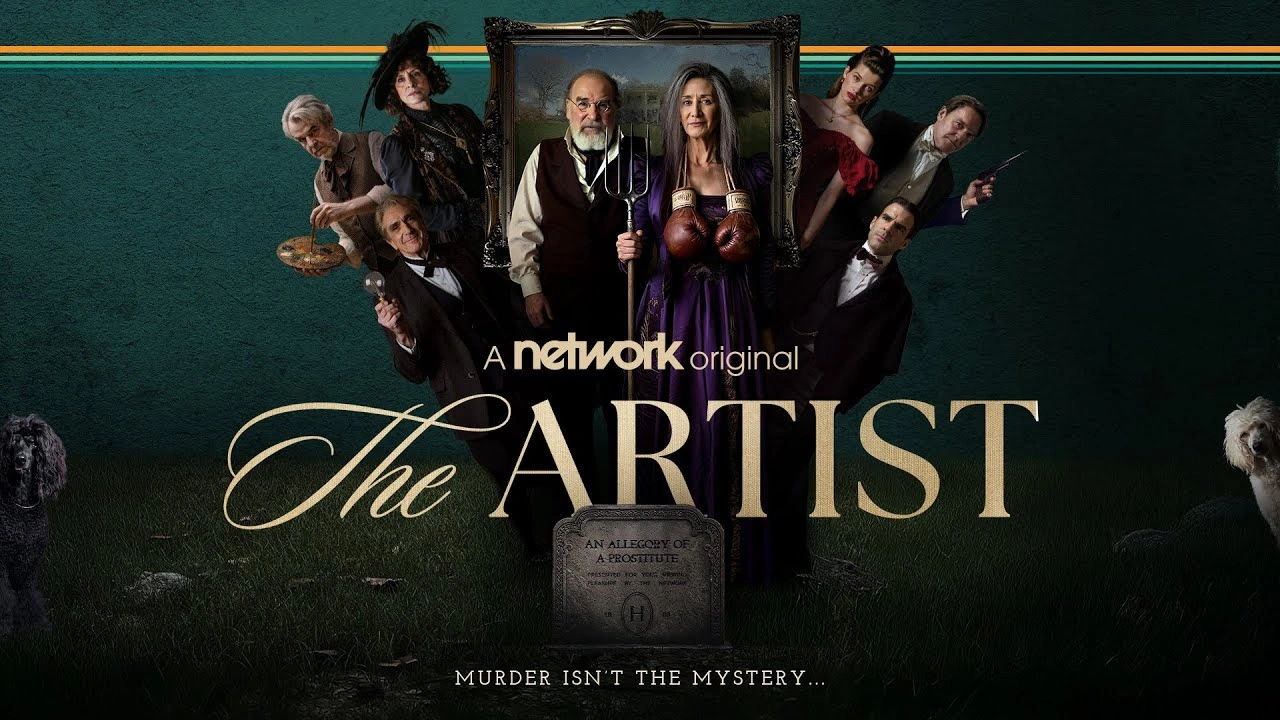

The Artist begins at the fire. Norman Henry, an eccentric robber baron played with spiky intensity by Mandy Patinkin, is carried out rolled inside a carpet and burned. His incineration closes a life built on venture capital and middleman deals, then the story pulls back to 1906 Rhode Island to examine his last days.
Marian Henry, played by Janet McTeer, becomes the narrative anchor. Her journal-based narration carries a sharp, cynical edge, warning that fact and fiction bleed into one another. Set during the Gilded Age, the series studies a period shaped by obscene economic inequality and the sudden birth of modern technology.
The subtitle, An Allegory of a Prostitute, points toward a severe study of social and creative exploitation. Wealthy tycoons possess power that dwarfs political influence, and every exchange carries a hidden price. The murder sits in view from the start, turning the drama toward the gradual collapse of a powerful family.
Architecture of Domestic Discord
The Henry estate functions as a physical expression of domestic rot and absurdist theater. Much of the staff lives in a ring of tents on the front lawn, while the kitchen sits detached from the main house. Norman and Marian summon help through a primitive arrangement of ropes and bells.
Each pull travels through the corridors to reach specific figures such as the Maid or the Doctor. The house feels engineered from psychic fracture. Norman and Marian live inside sustained mutual loathing, their marriage shaped by verbal cruelty and old disappointment.
Janet McTeer gives Marian’s eruptions a strange rhythmic poetry, often sending her into a boxing ring to beat her rage into the air. A young ballerina named Lilith entertains Norman, positioned as a protégée caught in a world built from lies.
The show speaks in a loud, hostile register, filling its rooms with profanity and sudden flashes of slapstick violence. Dinner conversation becomes a collision of voices, a festival of excellent swearing where everyone talks past everyone else. The Henrys have crossed out of polite society and entered a harsher social space, stripped of polish, ceremony, and restraint. Gilded Age etiquette has burned away, leaving raw aggression in its place.
The Playground of Historical Distortion
Aram Rappaport treats history as theatrical material, reshaping the Henry mansion into a stage crowded with stylized versions of real-life icons. Danny Huston appears as the titular artist, a nearly blind and erratic Edgar Degas. He wanders through Rhode Island after accepting a commission to paint the family poodles, becoming a bewildered witness to the household’s disorder. Thomas Edison, played by Hank Azaria, arrives with a pitch for his Kinetophone, an early precursor to virtual reality promising immersive entertainment.
These figures embody the shifting forces of the period, where art and invention answer to the desires of the wealthy. The series draws on rumors and historical conspiracy theories to sharpen its drama, especially through Evelyn Nesbit, who seeks refuge after a high-profile murder in New York. A large section of the story returns to the past connection between Marian and Edison.
Those flashbacks expose the systemic barriers women faced in higher education and professional circles. Marian’s history of betrayal and isolation gives the story a feminist charge, framing her bitterness as a response to a deeply patriarchal society. These characters function as archetypes, used to examine the messy crossing of fame, greed, and creative survival.
Technical Chaos and Creative Endurance
Luca Fantini gives the series a visual language that matches the script’s frantic pulse, using a camera that moves with rollercoaster intensity. The imagery recalls the aesthetic of Poor Things, with earthy beige tones and popping neutrals grounding the story in a period of economic uncertainty. The technical design creates a sensory experience built to deny calm. Score and rapid editing strike several senses at once, echoing the internal hurricane driving the characters.
Beneath the overload sits a meditation on creative endurance. The show presents artistic life as brutal and lonely, attentive to the cost of making art in a world that demands constant justification for its existence. Marian’s movement toward what some might call madness reads as rebirth and survival. Her outbursts and disheveled appearance become signs of refusal, the behavior of someone rejecting life as a silent spectator.
The lead actors embrace a heightened, community theater energy that favors emotional force over subtlety. That performative style underlines how these characters exist under constant display, fighting for relevance in a world that values status over soul. Expression becomes a survival instinct, a stubborn act of defiance in a social order that treats people as commodities to be traded or discarded.
The Artist premiered on November 27, 2025, as a centerpiece production for the ad-supported streaming platform The Network. Set in 1906 Rhode Island, this Gilded Age murder mystery follows the eccentric tycoon Norman Henry as his life ends in a mysterious, fiery death, prompting a non-linear investigation into his final days among historical icons. The series is currently available to stream for free on The Network app and website.
Where to Watch The Artist Online
Full Credits
Title: The Artist
Distributor: The Network, Fifth Season
Release date: November 27, 2025
Rating: TV-MA
Running time: 42–50 minutes
Director: Aram Rappaport
Writers: Aram Rappaport
Producers and Executive Producers: Aram Rappaport, Hilary Shor
Cast: Mandy Patinkin, Janet McTeer, Danny Huston, Patti LuPone, Hank Azaria, Zachary Quinto, Clark Gregg, Katharine McPhee, Jill Hennessy, Ever Anderson, Ana Mulvoy Ten, David Pittu
Director of Photography (Cinematographer): Luca Fantini
Editors: Aram Rappaport
Composer: Aram Rappaport
The Review
The Artist
The Artist functions as a jagged, uncompromising piece of historical fiction. It demands patience for its overstimulating technical choices and rewards that effort with a fierce exploration of creative agency. While the sensory barrage might alienate those seeking a traditional period drama, the series succeeds through its commitment to a singular, chaotic vision. It stands as a visceral examination of social and artistic endurance within a world that treats people as commodities.
PROS
- Powerful, physical performances by Janet McTeer and Mandy Patinkin.
- Visually daring cinematography that mirrors the internal state of the characters.
- A sharp, subversive reimagining of historical figures like Degas and Edison.
- Clear, unapologetic thematic focus on feminist rebellion and the cost of creation.
CONS
- Frequent sensory overload caused by the dense score and rapid editing.
- The absurdist tone occasionally risks feeling disjointed.
- Specific supporting subplots lack the narrative fluidity found in the central household drama.