
























Five years is a long time in television. Long enough for streaming libraries to bloat, for audiences to cycle through trends, and for a genuinely good show to calcify into mythology. The Chestnut Man debuted on Netflix in September 2021 and did something rare: it earned its reputation. Now, with Hide and Seek, the Danish crime series returns for a second season, arriving May 7, 2026, based on Søren Sveistrup’s follow-up novel, published in Danish in 2024, with the English edition following in March 2026.
The premise shifts while the bones remain familiar. A serial killer targets women caught in brutal divorce and custody proceedings, stalking them digitally before closing in, announcing each move with a children’s counting rhyme. Six episodes. Two returning investigators: Naia Thulin (Danica Curcic) and Mark Hess (Mikkel Boe Følsgaard), now carrying far more personal history between them than when we last said goodbye.
Hide and Seek is darker, more action-driven, and emotionally heavier than its predecessor. It earns every bit of that weight.
Count to Two, and Then You’re Done
The case begins with a missing 41-year-old woman who had been stalked for months by an unseen figure who sent her surveillance footage of herself, each message tagged with a children’s counting rhyme: “Count to One, Count to Two” (Tælle til en, tælle til to), drawn from a Halfdan Rasmussen poem. The rhyme is the killer’s signature and a literal countdown. When the number runs out, so does the victim. Police understand the clock is ticking. They feel the cost of being late.
Her murder connects to an older cold case: Emma Holst, seventeen years old, killed two years earlier. A pattern emerges. All of the killer’s targets share one circumstance: they are caught in, or freshly out of, bitter divorces and custody disputes. The show frames this as socio-political commentary delivered through the genre’s familiar machinery. Families fracturing, courts grinding slowly, children caught in the middle. The killer’s selection of targets is systematic in a way that makes an uncomfortable kind of sense. This is a show that wants you to feel the world it is drawing from.
The counting rhyme, as a hook, invites comparison to Season 1’s chestnut figurines. Those small handmade objects had a physical menace, something you could photograph and place in an evidence bag. The rhyme is intangible, a sound that lives inside the head, which arguably makes it more insidious. It does not carry quite the same eerie visual charge, and the show is honest enough to feel that gap occasionally. Its function as a ticking clock, though, gives the investigation a tightness the chestnut figures never imposed. Children’s rhymes repurposed for adult dread have a long and effective tradition. The show knows this. It uses it accordingly.
A 1992 prologue shows schoolchildren on a nature field trip discovering a body in marshland. The show is not subtle about planting this seed. Its eventual connection to the present-day case is more satisfying than it is formulaic, fitting the season’s larger argument about the long shadows violence casts across decades.
The digital footprint theme is the season’s most contemporary anxiety made literal. Victims’ location data, their communications, their private online lives are turned against them. Audiences will feel this one. Most of us leave exactly the kind of trail the killer exploits. The show converts that abstract discomfort into something approaching genuine dread, and it does so without lecturing.
Mid-season, something happens that reshapes everything. It arrives without warning and lands hard. The episodes that follow carry a grief and urgency that the first half was quietly building toward. The final reveal is less telegraphed than Season 1’s, arriving with both internal logic and earned emotional weight.
The People Who Have to Live With Each Other
Naia Thulin has shifted from homicide to cybercrime in the years between seasons, a career move that positions her neatly for a case built on digital surveillance. Danica Curcic plays her with the same warm intensity she brought to Season 1, but the character has deepened. She is a single mother with a teenage daughter, an investigator whose professional edge occasionally costs her privately, and, by the season’s midpoint, a target herself. Curcic never oversells any of this. She layers it, quietly, across every scene. Accessible without being simplistic. Magnetic without being showy.
Mark Hess returned to Denmark for family reasons and, predictably, found himself pulled back into a murder investigation. Mikkel Boe Følsgaard brings something new to the role this season: emotional exposure. The man who deflected with competence in Season 1 now has nowhere to hide. He dated Thulin for six months and then left the country without explanation. The show does not soften this. It sits with the awkwardness of it, lets other characters react to it with appropriate irritation, and gives Følsgaard the room to play a man who is considerably better at pursuing killers than facing the people he has hurt. His commitment issues, in a lesser performance, would read as tiresome. Here, they feel like a genuine wound being kept open deliberately.
Le, Thulin’s daughter, now a teenager played by Ester Birch, gets significantly more to do this season and earns every moment. Her resentment toward Hess is specific, justified, and performed without sentimentality. The relationship that forms between them across the six episodes is one of Hide and Seek’s most quietly affecting threads. It does not resolve too neatly. It probably should not.
Sofie Gråbøl joins the cast as Marie Holst, Emma’s grieving mother. Her performance is raw without being theatrical. The determination to find justice for her daughter, even as it strains her presence for her surviving children, gives the procedural plot a human anchor it badly needs. Gråbøl brings decades of genre credibility to this role and does not coast on it for a single scene.
The broader ensemble is largely competent. There are occasional moments where supporting dialogue tilts toward the staged: a detective telling a colleague to hurry over and examine some police reports reads as written rather than spoken. A minor friction in an otherwise well-cast season, but noticeable.
Grey Skies and Loaded Guns
The show’s muted palette and claustrophobic visual grammar carry over from Season 1 with visible evolution. Muted greys, tight interiors, the particular cold of Scandinavian daylight that never quite reaches warmth. Director Milad Alami handles three episodes; Roni Ezra directs the other three. The result is visually consistent: controlled, atmospheric, occasionally beautiful in a bleak and specific way.
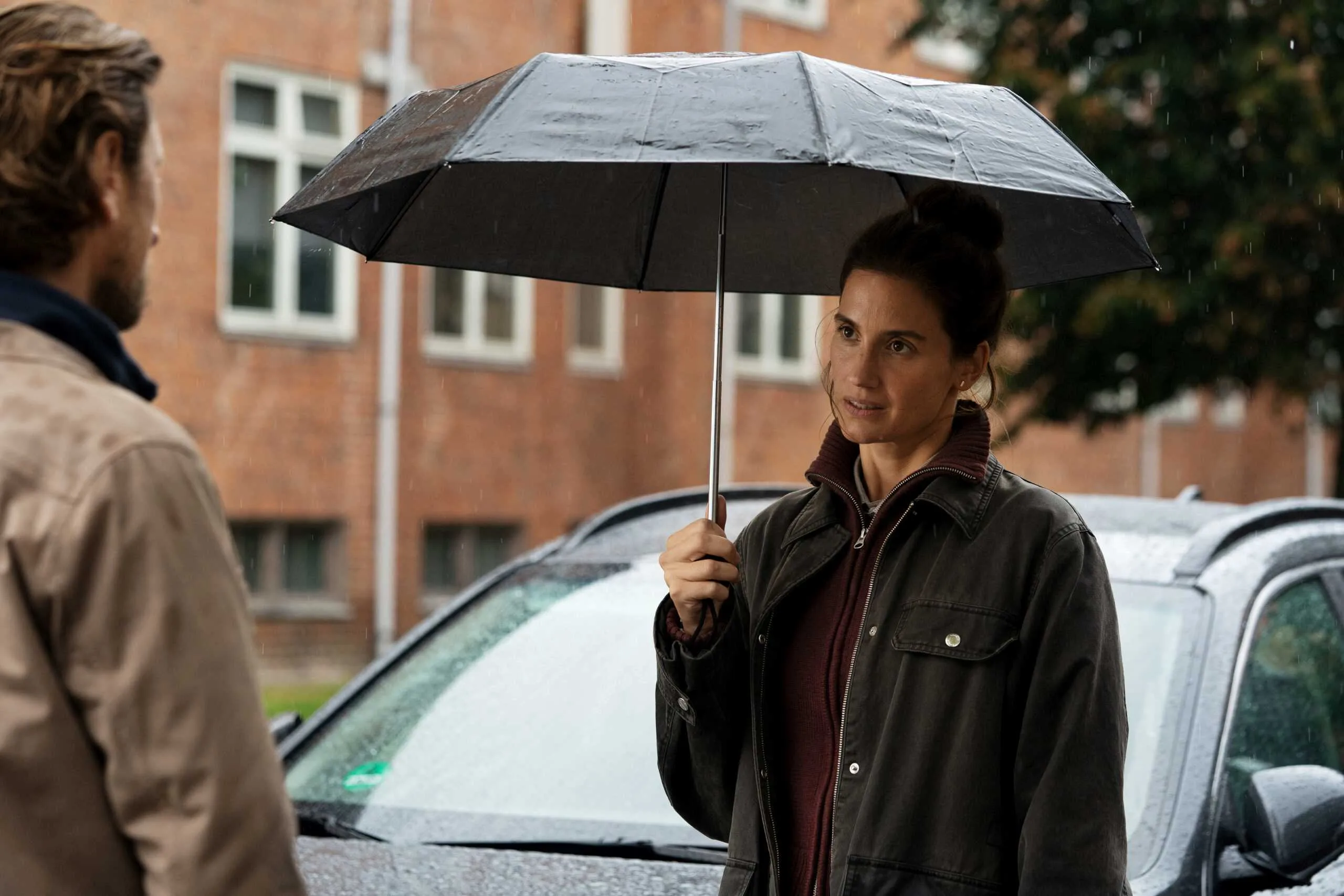
Alami’s opening sequence pulls viewers in immediately. Strong imagery. No easing in.
The season’s most significant formal achievement is a mid-season action set piece that relocates the threat from the genre’s familiar remote woodland into a public institution during business hours. This is a meaningful choice. Nordic noir, by convention, stages its worst moments at night, in forests, in isolated locations. Darkness does half the atmospheric work. Moving violence into a lit, populated, institutional space strips away that cover entirely. The threat becomes immediate in a different register. It feels real. Alami’s direction is tight, unpleasantly realistic, and formally precise. It stands as some of the most genuinely tense television produced in Denmark in recent memory.
The show draws on a lineage of psychological thriller filmmaking: Fincher’s procedural austerity (Se7en, Zodiac), Thomas Harris’s exploration of predatory psychology, and, in its horror-register moments, the slasher genre’s trick of making familiar spaces feel unsafe. Characters walk into dark houses without turning on lights. You can call this a cliché. You can read it, equally, as a deliberate genre signal to an audience that has absorbed enough of this tradition to understand its grammar. Hide and Seek is aware of its own conventions and, for the most part, uses them rather than being used by them.
Season 2 is more action-driven than Season 1. Shootouts, physical confrontations, life-threatening altercations. This escalation occasionally strains against the show’s grounded procedural instincts. Does a Nordic noir need a gunfight? Hide and Seek’s answer is: yes, if it earns one. Mostly, it does.
The real five-year gap between seasons is used intelligently. The show’s world has moved. Characters have aged, changed jobs, damaged relationships. Nothing has been preserved in amber waiting for the cameras to return.
The Book, the Show, and What Comes Next
Søren Sveistrup’s novel Hide and Seek was published in Danish in 2024, with the English edition arriving in March 2026. The television adaptation was produced before the book was finished, which created notable divergences between page and screen. Screenwriters Dorte W. Høgh and Emilie Lebech Kaae (the latter known for Ragnarok) made deliberate choices with those gaps. Some differences function as plot twists, arriving on screen in ways the source material does not anticipate. Others represent character decisions that serve the adaptation’s pacing and emotional logic rather than the novel’s.
This is, frankly, how adaptation should work. A novel and a television series are different instruments. Playing one score on the other rarely produces anything worth watching. Høgh and Kaae understand the screen’s rhythms.
Hide and Seek can be watched without Season 1. The show provides enough context. New viewers will absorb the emotional history between Hess and Thulin, Le’s growth, and the procedural world quickly enough. Familiarity with the first season deepens the experience considerably, particularly in feeling the weight of what has passed between the characters off-screen in the years we did not see.
The show sits within a long tradition of Danish crime television stretching back through The Killing (Forbrydelsen), The Bridge, and Department Q. What Hide and Seek offers is a formula it knows well, executed with visible craft and occasional genuine daring. The mid-season turn is the evidence for daring. The rest is evidence for craft. A third season would require the formula to stretch further still. The show has the talent to do it.
The Chestnut Man: Hide and Seek is the highly anticipated second season of the Danish Nordic noir thriller based on the novels by Søren Sveistrup. Premiering on Netflix on May 7, 2026, the series re-teams detectives Naia Thulin and Mark Hess as they confront a chilling new case involving a stalker who uses nursery rhymes to terrorize victims. This standalone sequel continues the dark, atmospheric legacy of the 2021 original, and will be available for streaming exclusively on Netflix.
Where to Watch The Chestnut Man: Hide and Seek Online


Full Credits
Title: The Chestnut Man: Hide and Seek
Distributor: Netflix
Release date: May 7, 2026
Rating: TV-MA
Running time: 52–59 minutes
Director: Roni Ezra, Mikkel Serup, Kasper Barfoed
Writers: Søren Sveistrup, Dorte Warnøe Høgh, David Sandreuter, Emilie Lebech Kaae
Producers and Executive Producers: Morten Kjems Hytten Juhl, Stine Meldgaard Madsen, Søren Sveistrup, Meta Louise Foldager Sørensen, Mikkel Serup
Cast: Danica Curcic, Mikkel Boe Følsgaard, Sofie Gråbøl, Katinka Lærke Petersen, David Dencik, Iben Dorner, Lars Ranthe, Esben Dalgaard Andersen
Director of Photography (Cinematographer): Sine Vadstrup Brooker, Louise McLaughlin
Editors: Cathrine Ambus, Anja Farsig, Martin Schade, Lars Therkelsen
Composer: Kristian Eidnes Andersen
The Review
The Chestnut Man: Hide and Seek
Hide and Seek is a confident, often outstanding second season that deepens its characters, sharpens its tension, and takes at least one genuinely brave narrative swing. It carries familiar genre DNA without being paralyzed by it. Curcic and Følsgaard remain one of television's most watchable investigative pairings, Gråbøl's addition strengthens the emotional core, and Milad Alami's direction produces sequences that will be difficult to forget. The formula shows its seams occasionally. It does not matter much.
PROS
- Curcic and Følsgaard's chemistry remains electric
- Bold, unexpected mid-season twist reframes the entire story
- Sofie Gråbøl's performance is a genuine highlight
- Alami's direction, particularly the mid-season action sequence, is exceptional
- The digital stalking theme feels timely and genuinely unsettling
- Character development across the five-year gap is handled with care
CONS
- The counting rhyme lacks the visual menace of Season 1's chestnut figurines
- Some supporting dialogue feels written rather than spoken
- The escalating action occasionally strains the show's procedural grounding
- Hess's emotional evasiveness can test patience