






























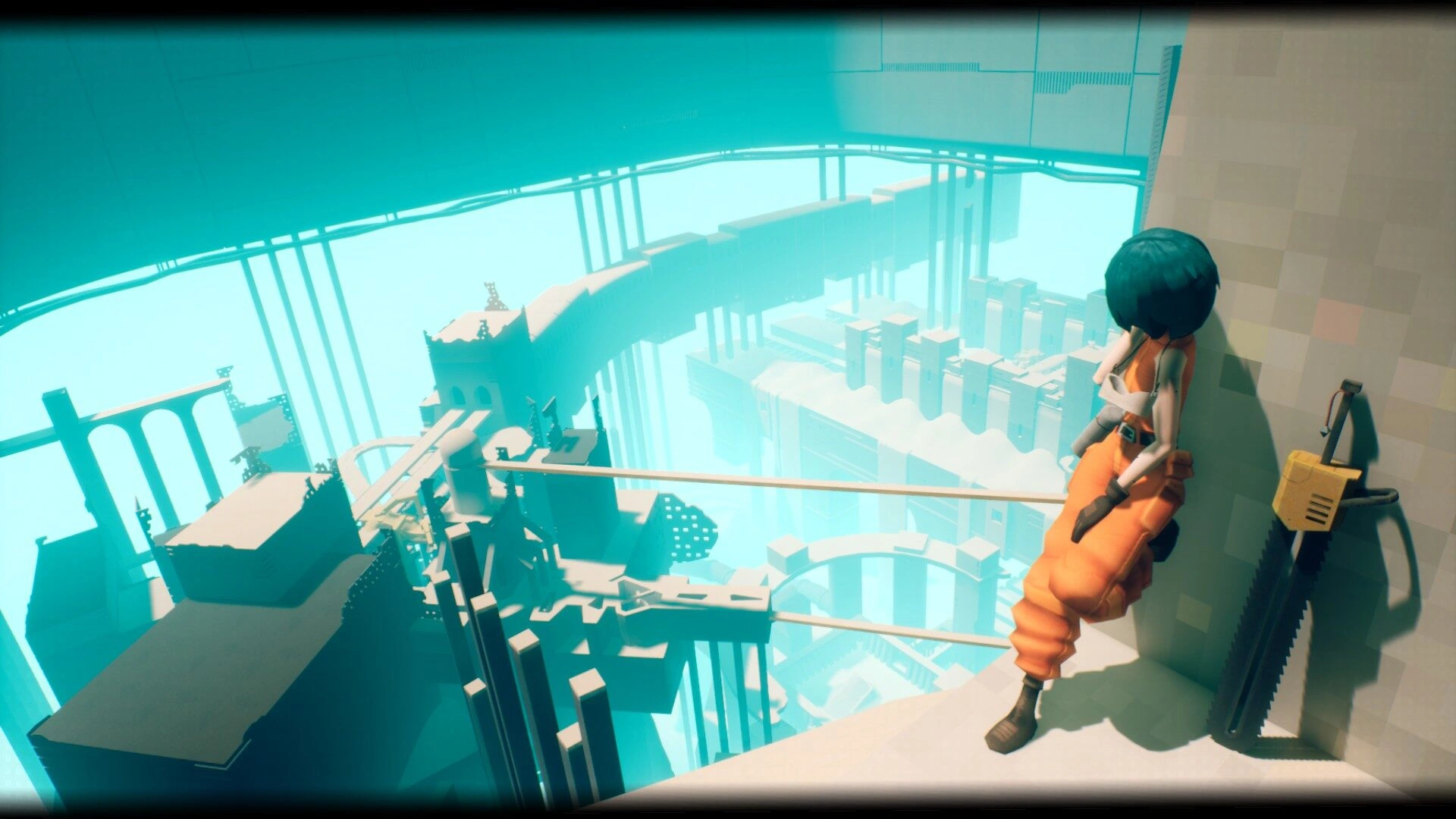
MOTORSLICE understands the power of making a character look small. Its setting, the Megastructure, is a towering vertical maze of concrete, metal, decay, and hostile machinery. P, the quiet Slicer at the center of the game, feels almost swallowed by the world around her. That size contrast does a lot of narrative work before the plot even has to speak. The environment tells you that this place was built for systems, machines, and industrial purpose, while P moves through it like a human error in the architecture.
The third-person camera gains a clever in-world explanation through Orbie, the small drone that follows P through the ruins. Framing the viewpoint through Orbie’s lens gives the game a practical narrative trick: the camera feels like part of the fiction instead of a detached player tool. It also makes Orbie feel present during quiet stretches.
When P loses contact with her handler, G, the sense of abandonment lands harder because Orbie becomes the only steady presence left. P’s monologues and her reactions to Orbie’s mechanical beeps create a strange emotional rhythm, half survival story and half lonely climb through a dead machine.
That setup recalls the isolation of Shadow of the Colossus, where scale becomes an emotional pressure rather than simple spectacle. It also has traces of ICO in how companionship is expressed with limited language. P and Orbie do not need elaborate dialogue to establish their dynamic. The game trusts physical presence, sound cues, and environmental silence to carry the mood.
Movement as Commitment
The traversal system is where MOTORSLICE becomes most demanding. Its movement clearly draws from Prince of Persia and Mirror’s Edge, especially in the way P chains together wall runs, vaults, ledge grabs, and vertical climbs. A single button handles many of these actions, with the result changing based on nearby geometry. That approach gives movement a clean surface, yet it also creates friction because the game asks the player to read space with precision.
The central mechanic, the Motorslice, gives the game its sharpest mechanical identity. P can drive her chainsaw into orange metal surfaces and use them as paths. Hit one straight on and she climbs upward. Strike at an angle and she cuts across horizontally.
This turns the chainsaw into a traversal tool before it becomes a weapon. It is a smart mechanical choice because it ties the game’s identity to one object. P’s chainsaw is her method of movement, her defense, her attack, and her way of understanding the Megastructure.
The tradeoff is rigidity. Once P leaves the ground, air control is limited, so every jump carries weight. You cannot casually correct a bad angle after takeoff. That design makes the platforming tense in a way closer to classic precision games than modern forgiving action adventures. The player has to read the route, commit, and accept the cost of a poorly judged leap.
The context-sensitive controls can cut both ways. When the system works, P flows across the environment with satisfying clarity. When it misreads intent, the punishment can feel harsh. Accidentally triggering a wall run while trying to grab a ledge is the kind of mistake that can send P into the void. This is where MOTORSLICE shows its rougher edge. The challenge is often fair in concept, yet the overlap between actions can make some failures feel like a negotiation with the input system rather than the level itself.
The quieter interactions help balance that severity. P can stop in scenic areas, spend time with Orbie, take selfies, or react to the world around her. These pauses matter. They prevent the Megastructure from becoming pure obstacle design. They give P a body and personality outside of failure states, jumps, and combat timing. In a game built around height, danger, and machinery, those small breaks make the world feel lived in.
Combat Built Around Timing, Fear, and One Clean Hit
Combat follows the same philosophy as traversal: precision first, forgiveness later. Enemies are repurposed construction machines, including bulldozers, excavators, and flying drones that fire saw blades. Their industrial form fits the setting neatly. These are not monsters invading the Megastructure. They feel like the Megastructure defending itself with its own broken tools.
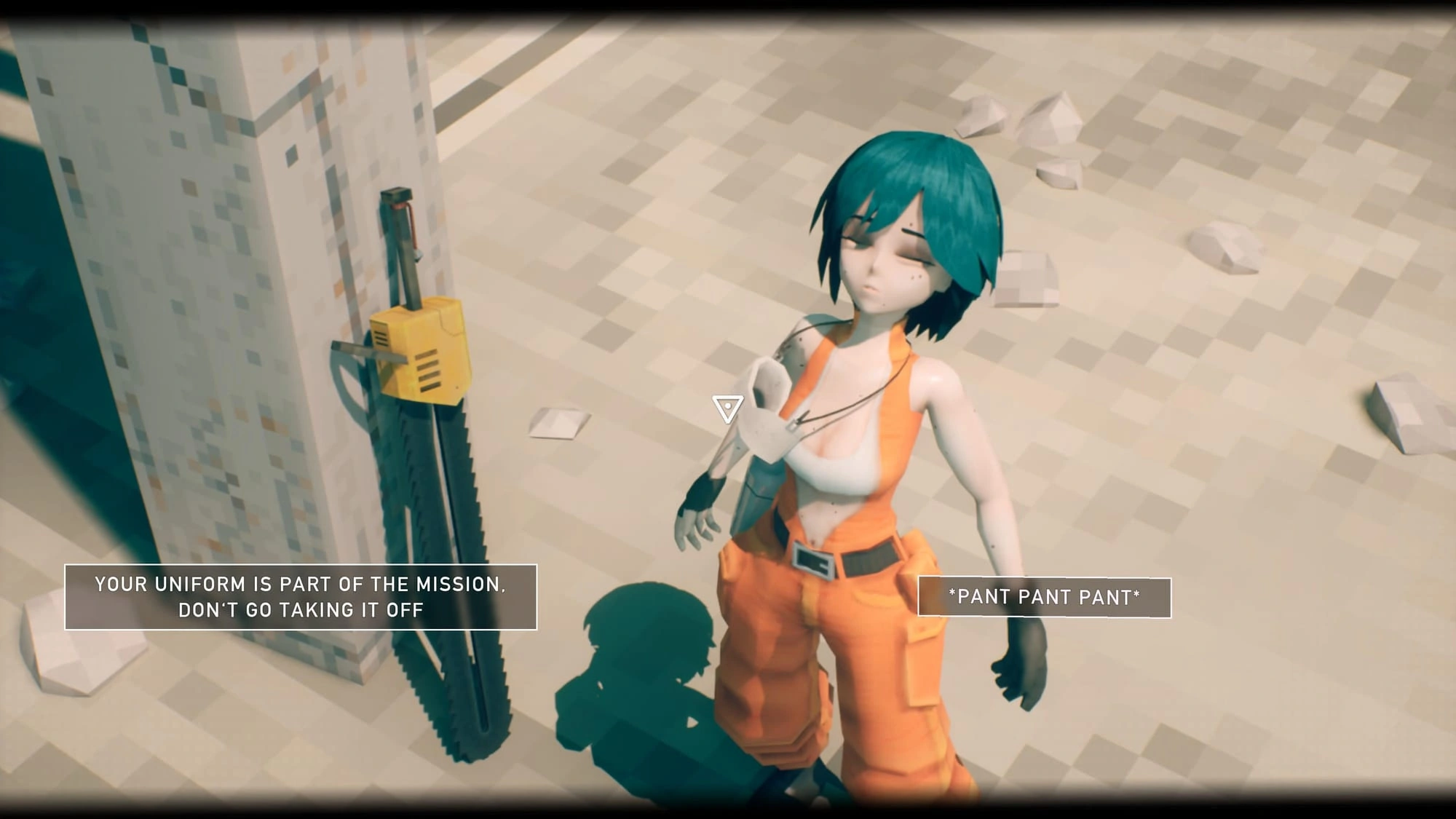
The one-hit death rule changes the feel of every encounter. P can die from almost any hazard in a single blow, while many enemies fall to one strike from her chainsaw. That mutual lethality creates a fast, brittle rhythm. Fights rarely become drawn-out exchanges. They play closer to compact mechanical tests where the player has to identify the threat, read the timing, and execute correctly.
The parry system sits at the center of that combat loop. P can clash with melee attacks or send projectiles back toward enemies, which makes defense feel active. This is closer to the tight timing language of Sekiro than a standard action-platformer, though MOTORSLICE uses that idea in a leaner form. You are not studying long combo strings or managing a broad move set. You are watching for the decisive moment, then making the chainsaw answer.
Armored enemies add a second layer through the revved charge attack. Their guard has to be broken before they become vulnerable, which gives combat a puzzle-like structure. The scanner mode supports that by letting players identify threats through walls and locate hidden items or orbs. It is a practical tool, and it fits the game’s focus on reading environments before acting.
The optional orb challenges push this design further. Collecting orbs and returning them to specific points asks for mastery without blocking the main path. These missions are built for players who want to test movement consistency, timing, and route planning. Their separation from the main route is important because it lets the game remain punishing without turning every player into a completionist hostage.
Bosses as Moving Architecture
The boss encounters are the clearest expression of the game’s fascination with scale. Each chapter builds toward a massive machine that fills the screen, turning combat into a vertical platforming puzzle. The comparison to Shadow of the Colossus is direct and useful. You are not simply fighting a large enemy from the ground. You are solving the body of the enemy as a level.
These battles ask players to climb onto the boss, avoid attacks, stay attached as it shifts, then locate orange heat sinks and destroy them with the chainsaw. The orange surfaces create a strong visual grammar across the game. They tell the player where the chainsaw can become a path, a weapon, or a solution. That consistency helps the boss fights feel like an extension of the core traversal system instead of a separate mode.
The best part of this structure is how it turns the boss into moving terrain. A shoulder, a limb, or a surface becomes a temporary platform. The machine’s movement changes the route under your feet. This gives the fights a sense of physical danger that a health bar alone could not provide. The threat comes from impact, height, shifting angles, and the knowledge that one mistake can end the attempt.
The forgiving checkpoint system keeps these encounters from becoming exhausting. Losing less than a minute after death changes the emotional tone of failure. You still feel the sting of a mistimed jump or missed parry, yet the game invites another attempt quickly. That balance matters in a precision platformer. Harsh mechanics need fast recovery, and MOTORSLICE appears to understand that.
Retro Texture, Industrial Sound, and Uneven Visibility
The PSX-style visual design gives MOTORSLICE a strong identity. Low-poly geometry and pixelated textures suit the harsh concrete world, especially during exterior shots where the Megastructure’s vertical scale can dominate the frame. The retraux style works best when the game uses broad shapes, towering silhouettes, and hard industrial lines. In those moments, the old-school texture treatment gives the world a raw, oppressive beauty.

Interior spaces sound less consistent. Muddy textures and poor lighting can make some corridors harder to parse, which is a serious issue in a game built around precision. Visual ambiguity can be atmospheric in horror or exploration games, yet here it risks interfering with mechanical clarity. If a player cannot read the next jump, ledge, or surface, the failure can feel avoidable in the wrong way.
The fact that the game runs on Unreal Engine 5 while keeping its retro look gives it an interesting tension. It uses modern tools to chase an older visual language, and that choice fits the theme of a decaying industrial world. The clean power of the engine does not erase the grime. It sharpens the contrast between huge spaces and deliberately rough surfaces.
The audio helps sell that contrast. Pizza Hotline’s Drum ‘n’ Bass soundtrack gives action scenes a hard pulse, matching the speed of traversal and the danger of combat. The music brings energy to spaces that might otherwise feel cold and static. Against concrete, rebar, drones, and saw blades, those beats make the ascent feel like a race through machinery that has started dreaming in percussion.
The Review
MOTORSLICE
MOTORSLICE is a striking achievement in atmospheric world-building and momentum-driven platforming. While the rigid air control and context-sensitive inputs can lead to occasional frustration, the satisfaction of scaling a building-sized machine remains unmatched. The brutalist architecture and haunting soundtrack create a singular mood that lingers long after the credits. It successfully channels the DNA of early 3D classics while carving out a distinct identity through its high-stakes lethality. For those who value atmosphere and precision over narrative depth, this journey through the Megastructure is essential.
PROS
- Breathtaking brutalist world design and scale.
- Thrilling, puzzle-like boss encounters.
- High-energy Drum 'n' Bass soundtrack.
- Snappy, rewarding parkour flow.
CONS
- Finicky context-sensitive controls.
- Minimalist story may feel thin to some.
- Occasional muddy interior textures.
- Brutal one-hit death mechanics.