





























The freezer door opens at last, and Hershel Wilk is pushed back into a world that has spent five years erasing her from memory. Inside the Opera’s archives, she carries the glacial codename CASCADE. In practice, she is a burned-out intelligence operative dropped onto the floor of a decaying safehouse with little ceremony and even less guidance.
Beyond those walls sits Portofiro, a maritime slab of concrete scarred by decades of erratic local autocracy and pressured by three rival models of global power. The communist Superbloc wants to block the rise of a single hegemon. EMTERR’s technocratic boardrooms weaponize predatory debt. La Luz, a technofascist empire with polished branding instincts, pushes high-gloss consumer culture into Portofiro’s social tissue until the indigenous fabric begins to fray.
Hershel’s return to fieldwork starts with institutional collapse at room scale. Her local contact, Pseudopod, sits in his underwear beside a grimy window, permanently unresponsive. The briefing is empty. The journal is shattered. Hershel must reconstruct her mission from fragments while walking straight into the damage left by her previous life. Her search leads toward the estranged members of the Whole Sick Crew, assets she abandoned during a catastrophic extraction five years earlier.
The Anatomy of Agent Degradation
The game’s mechanical framework discards traditional roleplaying health bars and uses systems that track the physical and mental breakdown of a professional operative under pressure. Hershel’s agency training is divided into three tactical faculties, with five specific skills attached to each one. Action governs physical execution, kinetic reflexes, and stealth through abilities such as Shadowplay.
Relation handles interpersonal maneuvering, manipulation, and psychological dominance through stats such as Personalism. Intellect covers logic, empirical deduction, and structural observation through Grey Matter. These statistics feed directly into internal stress meters. Action connects to physical Fatigue, Relation to rising Anxiety, and Intellect to spreading Delirium.
Those indicators shift with nasty volatility. Hershel’s stress climbs when she studies the catatonic body of her partner or probes an unsettling geopolitical conspiracy. It falls when she secures rare pockets of environmental resolution. Managing this decline turns inventory use into a constant tactical negotiation.
The player steadies Hershel with field consumables: canned coffee, cheap cigarettes, hard alcohol, and black-market stimulants. Each item creates a chemical tradeoff. A beer may soften active Anxiety and raise physical Fatigue, so the next conversation begins before the dice roll, in the player’s calculation of what Hershel can still survive.
The main resolution loop uses a standard two-dice system, sharpened by a punishing exertion mechanic. During a critical check, the player can flood Hershel’s system with stress, accepting a heavy immediate hit to an ailment meter in exchange for a third die.
The design draws its tension from failure pressure. If Fatigue, Anxiety, or Delirium reaches its ceiling, Hershel suffers a permanent psychological break, reducing her baseline faculty skills from that point forward. Every exchange becomes a risk assessment. The mechanic captures the grim sensation of an operative operating on fumes, survival reflexes, and the remains of professional discipline.
The Geopolitics of the Bootleg Bazaar
The game’s thematic architecture reaches past simple geopolitical allegory and studies material value, imitation culture, and manufactured consumer desire with unusual precision. La Luz conquers Portofiro through cultural saturation. It floods local markets with luxury aesthetics, hyper-trendy streetwear, and state-sanctioned animated programs such as Sixty-Six Wolves, which slip imperial propaganda into the minds of children.

The Bootleg Bazaar gives that ideological pressure its clearest physical form. Its sprawling paths run on grainy video discs, replicated garments, and hand-me-down cultural trends. As these imported signals move away from the imperial core, they warp into strange regional variations with their own secondhand logic.
The Conditioning system reinforces this pressure at the mechanical level, replacing the static perk trees familiar from many roleplaying games. As Hershel explores Portofiro, interactions unlock ideological fixations that she can internalize. Each conditioned thought provides major mechanical benefits and punishes behavior that breaks from its guiding thesis.
Latest Synthetic Desires, for example, gives Hershel a temporary blueprint buff and lowers active Fatigue whenever she drinks premium imported canned coffee. If the player buys cheap bootleg goods from a local vendor to save money, the thought is suppressed and locked for twelve hours.
The writing uses this system to frame a sharp critique of generational alienation. Tomio, an aging housing janitor, becomes one of its clearest human examples. He cannot communicate across the emotional distance separating him from his debt-ridden son.
The young man has been pushed into financial ruin by the pursuit of the latest imported fashion trends from La Luz. Consumer desire functions here as political engineering. It detaches people from their own history and replaces indigenous solidarity with the ache of wanting approval from an empire that cannot even place their home on a map.
Synapses and Spotlights in the Field
The investigation structure favors narrative reactivity. Players receive several loose routes through questlines, and failed dice rolls can open fresh story paths without triggering a conventional game-over screen. Character networks overlap in clever, occasionally startling ways.

An eccentric figure met in a back alley during the opening hours may later become the missing piece in an unrelated political crisis near the endgame. The internal quest log shows less finesse. It sometimes links separate investigative threads too early, spoiling reveals before Hershel has reached them through logical deduction.
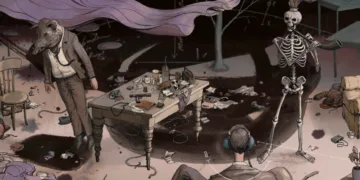
This loose, text-heavy exploration shifts sharply during a Dramatic Encounter, the game’s strongest structural break from traditional isometric RPG design. When a conversation erupts into physical danger, the dialogue interface disappears. The environment turns deep monochrome, a harsh spotlight pins Hershel in place, and the screen fills with grotesque street-art imagery resembling modern neo-medieval tattoos.
Time slows almost to stillness. Hershel’s rambling neuroses, private anxieties, and ideological debates fall away. Her early Operant Bureau conditioning takes command of her damaged psyche, and the player must choose immediate, irreversible tactical actions driven by bone-deep survival reflexes.
These cinematic spikes reveal a productive creative tension between the writing and the game’s mechanical ambitions. Outside the setpieces, the script often lets Hershel behave with an absurdity that weakens her identity as a trained covert agent. She wanders through Portofiro giving out her real name, tells ordinary citizens that she is a foreign spy, and asks random pedestrians where to find secret government detention facilities.
The world rarely answers these breaches with immediate operational blowback. The prose remains witty, sharp, and analytically rich from scene to scene. The game’s structure frequently gives priority to personal, melancholic soul-searching, reducing the role of the discretion, patience, and information control that classic espionage fiction demands.
The Review
ZERO PARADES: For Dead Spies
ZERO PARADES: For Dead Spies succeeds as a dense, text-driven espionage RPG, even when its mechanics clash with classic spy craft. The deep psychological tracking systems and cinematic Dramatic Encounters perfectly capture the exhaustion of a burned-out operative. While the narrative occasionally stumbles into undisciplined blustering, the game delivers an analytical exploration of postcolonial consumerism wrapped in brilliant prose. For players seeking a mechanically rich, highly reactive narrative experience, this journey into the wreckage of Portofiro is exceptional.
PROS
- Deep, innovative psychological stress and exertion systems.
- Stunning, cinematic Dramatic Encounters with vivid visual flair.
- Brilliant, analytical commentary on postcolonial material culture.
CONS
- Narrative friction caused by the protagonist routinely breaking cover.
- Occasional journal bugs that prematurely spoil plot reveals.