
























![Kingdom Hearts Collection [I-III] Review](https://gazettely.com/wp-content/uploads/2026/10/Kingdom-Hearts-Collection-I-III-1-360x180.webp "Kingdom Hearts Collection [I-III] Review: KHII Holds Steady as Newer Entries Fluctuate 37")




Charles de Gaulle’s first great victory here is grammatical: he speaks in the present tense about a France that, politically speaking, has already surrendered. Antonin Baudry’s De Gaulle: Résistance begins its historical argument in June 1940, after Marshal Philippe Pétain’s government accepts an armistice with Germany and the French state starts reorganizing itself around defeat.
De Gaulle, played by Simon Abkarian, escapes to London carrying remarkably little that qualifies as conventional power. No meaningful army. No secure mandate. No reason for foreign governments to treat him as the embodiment of anything except stubbornness. He behaves like the leader of France anyway.
There is something almost metaphysical about this arrangement. Nations exist through territory, institutions and force, yet they also exist because enough people agree to keep imagining them. De Gaulle’s gamble is that the second kind can survive the destruction of the first. His BBC broadcasts are political acts, certainly, but Baudry films them like exercises in conjuration. Speak France into existence frequently enough and perhaps soldiers, bureaucrats and governments will eventually arrive to occupy the noun.
Abkarian understands the faint absurdity buried inside this grandeur. His De Gaulle stands rigidly, speaks with clipped certainty and carries indignation like an item of formal dress. The less authority he possesses, the greater his manner of authority becomes. It would be comic if history had not eventually rewarded the performance. Call this retrospective sovereignty: behaving as though history has already agreed with you.
Churchill, Champagne and Manufactured Legitimacy
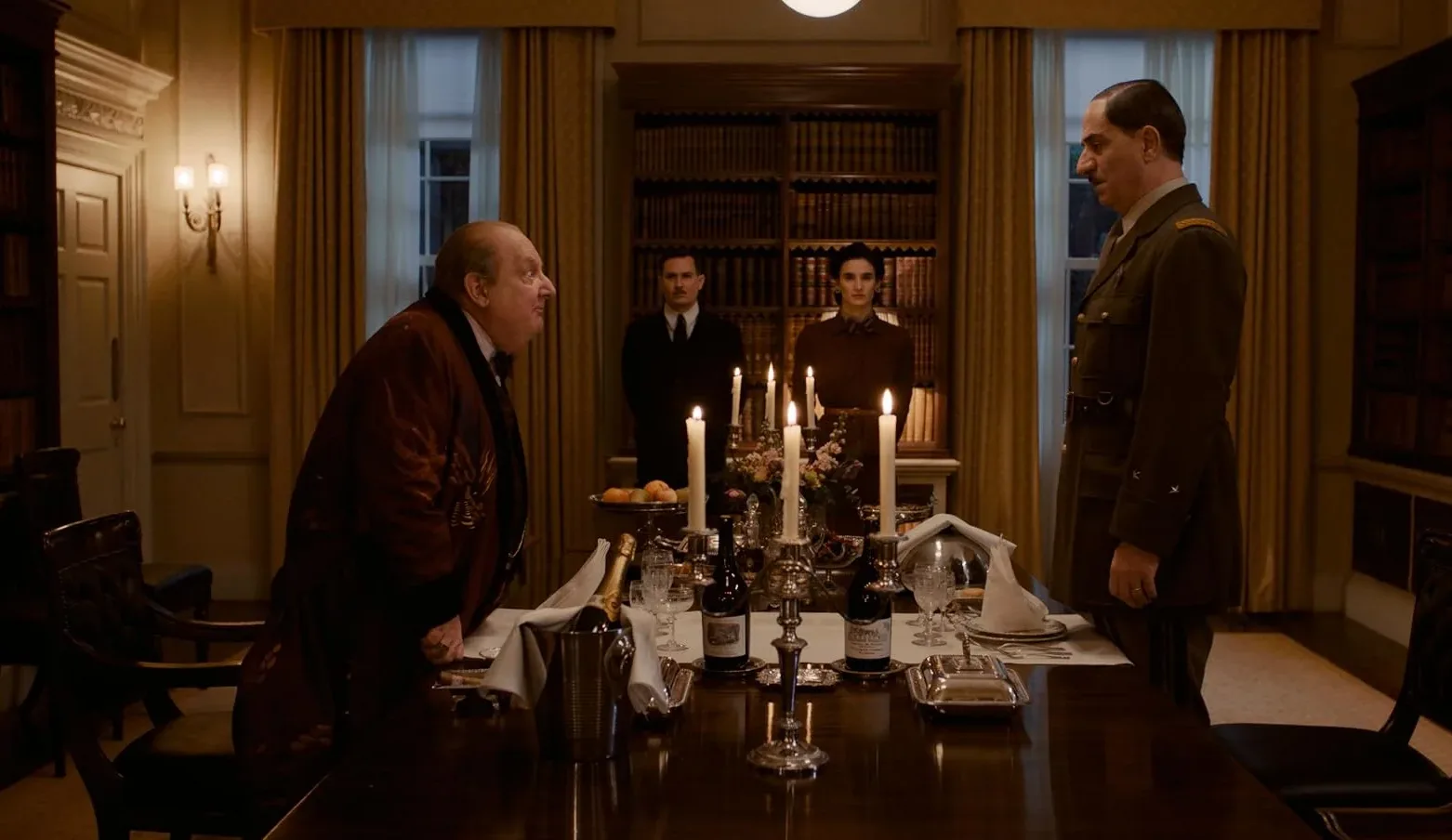
Simon Russell Beale’s Winston Churchill understands De Gaulle’s performance because he is running one of his own. The film’s best dialogue scenes place Beale and Abkarian together while Britain tries to decide what useful purpose this uncompromising French general might serve. Churchill sees political value in presenting De Gaulle as an alternative to Vichy, giving him access to broadcasts, staff and institutional support. De Gaulle receives these advantages with the gratitude of a man convinced Britain should feel honored to provide them.
Their relationship gives Baudry a sharp comic mechanism. Churchill can admire De Gaulle’s nerve, curse his obstinacy and pour him champagne before the argument has properly cooled. Beale avoids reducing Churchill to cigars, growls and familiar impersonation cues. His scenes with Abkarian have theatrical elasticity, particularly when the two conduct much of their diplomacy in French. Each man wants cooperation while refusing the emotional inconvenience of appearing dependent upon the other.
Mers-el-Kébir strips the charm from that arrangement. Britain attacks the French fleet in Algeria to stop the ships from falling under German control, killing roughly 1,300 French servicemen. De Gaulle’s response exposes the severity beneath his romantic idea of France. He absorbs the horror because preserving his British alliance matters to the Free French project. Here the film briefly finds the contradiction it too often protects him from. Patriotism sounds pure at a microphone. In government rooms, it becomes arithmetic.
Baudry gets considerable tension from these rooms. Campbell Scott’s Franklin D. Roosevelt introduces another problem, since British officials fear De Gaulle’s unpredictability could complicate American relations. The conversations work when political personalities collide through concrete decisions. They falter when characters explain history with the confidence of people who have already read their own biographies.
The June 18 appeal suffers from this habit. De Gaulle delivers the speech, and its refusal of surrender already communicates its historical function. The screenplay then feels obliged to explain the significance again. Apparently even history needs a meeting after the meeting.
Fernand and the France Without a Microphone
Florian Lesieur’s Fernand Bonnier de La Chapelle offers the film a different definition of resistance. Where De Gaulle can transform defeat through language, Fernand encounters occupation through streets, crowds and physical danger. Baudry introduces him as a young man listening to France collapse and gradually converts that frustration into action. His political identity has none of De Gaulle’s ceremonial certainty. It is still forming, which makes it less monumental and considerably less protected.
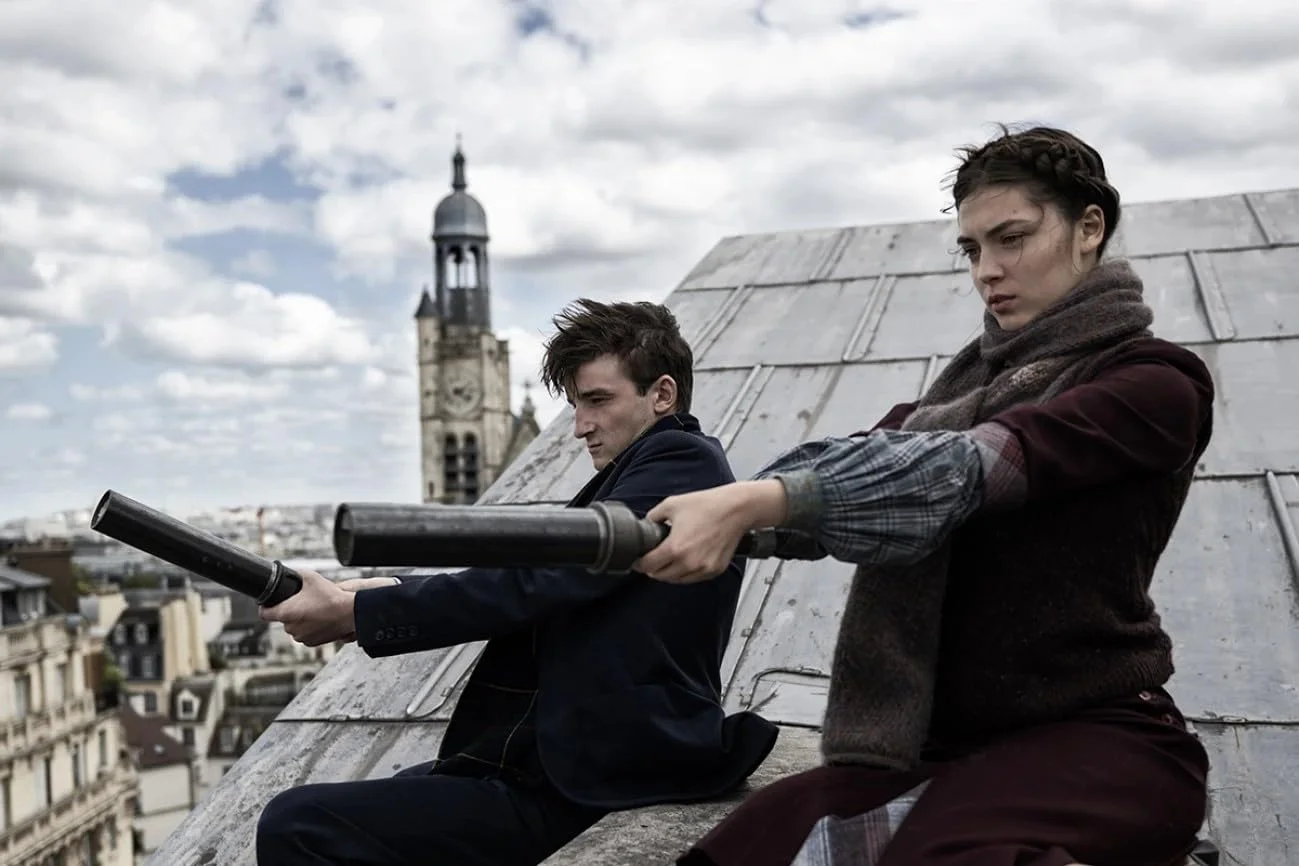
Lesieur plays him with nervous energy beside Abkarian’s imposing stillness. The pairing gives the film its strongest structural idea. Both men believe in a France separate from Vichy, but one tries to create it through international legitimacy while the other risks his body inside the country that has surrendered.
Fernand’s scenes with Livia, played by Anamaria Vartolomei, push Résistance toward political thriller territory. During the November 11 protest in Paris, mass defiance quickly meets German repression. Baudry’s crowds matter because they return the word “France” to ordinary bodies. Patriotism here carries consequences measured in arrests, pursuit and death rather than speeches.
Jean Moulin’s arrival expands that resistance network, while Fernand’s path points toward his assassination of Admiral François Darlan in Algiers and his execution by firing squad at 20. The film knows where Fernand is going, yet his scenes retain uncertainty because he has not been transformed into a national monument. That distinction is quietly devastating.
De Gaulle’s future reputation changes how every gesture is read. Fernand receives no such historical armor. His impulsiveness can remain impulsiveness. His idealism can fail. The editing connecting the two men suggests shared purpose while exposing wildly unequal relationships with history itself.
I found myself thinking Fernand’s material was the film’s richer political story, then reconsidered. It works precisely because De Gaulle’s narrative exists beside it. One man is learning how power is constructed. The other is discovering what power costs those who never get to sit at its table.
Bir Hakeim and the Physical Proof of an Idea
De Gaulle can call himself the representative of Free France for only so long before somebody has to make the phrase visible. Africa provides that proof. His attempts to secure support in Chad, Cameroon and other French territories have an improvised quality that plays nicely against the polished diplomatic rooms in London. Churchill sometimes regards these maneuvers as reckless, and the film allows a sliver of comedy into De Gaulle’s seemingly inexhaustible confidence. Yet each territorial success converts rhetoric into infrastructure. Then comes Bir Hakeim.
Benoît Magimel’s General Marie-Pierre Kœnig commands outnumbered Free French forces against Rommel’s better-equipped troops in the North African desert. Baudry stages the battle with clear geography, artillery, tanks and large formations, resisting the contemporary temptation to make combat legible only as noise. We understand the strategic purpose: the French position must hold long enough for British troops to withdraw and reorganize.
The scene matters because it solves De Gaulle’s philosophical problem through bodies. A government in exile can be dismissed as theatre. Soldiers holding ground under bombardment are harder to treat as fiction.
Baudry, whose The Wolf’s Call found tension inside confined military spaces, appears almost delighted by the enlarged canvas. Demonstrations around the Arc de Triomphe, desert vistas and grand government interiors belong to an older tradition of historical spectacle in which scale itself carries ideological meaning. Here, size says France has returned.
Volker Bertelmann’s pounding score frequently supplies the exclamation mark. Its aggressive strings give conversations nearly the same pressure as battlefield sequences, which works until every decision starts arriving pre-certified as Historic.
Karim Leklou’s Polish plumber turned aide offers separate comic relief, though Churchill has already claimed that department with superior efficiency. Bir Hakeim needs none of these reminders. Baudry’s images communicate exactly what De Gaulle has spent the film trying to prove: an imagined France has acquired people willing to die for it.
The Statue Arrives Before the Doubt
The central weakness of De Gaulle: Résistance comes from knowing that its protagonist eventually wins the argument. Baudry repeatedly presents De Gaulle’s stubbornness as evidence of vision because history will validate his refusal to accept France’s defeat.
That makes for pleasurable drama. Watching an obscure general force himself into Allied politics through sheer conviction has the satisfying shape of legend. Legends are dangerous houseguests for biographical cinema. Once invited in, they start rearranging the furniture.
The film rarely presses De Gaulle hard enough on the political implications of his self-appointed authority. Pétain and Darlan occupy clearer moral positions, while De Gaulle’s ambition receives the warmer language of destiny. His certainty becomes prophetic because the audience already knows the destination. This is historical inevitability syndrome, the tendency to turn every successful figure’s earlier gamble into evidence that success was always waiting for him.
The problem becomes sharper across a 160-minute first installment designed to lead into De Gaulle: Liberté. Darlan, Fernand, Jean Moulin and the changing Allied balance are still moving toward events reserved for the second film. Résistance can feel extended because it is constructing half an argument, particularly when exposition states meanings that the drama has already supplied.
Yet Baudry’s patriotism becomes interesting whenever the film accidentally exposes its instability. De Gaulle insists France survives because someone must behave as if surrender lacks the authority to define it. Fernand believes France survives because people living under occupation refuse obedience. Kœnig’s soldiers give the idea military form at Bir Hakeim. Churchill supports that imagined nation partly because Britain needs it. These are different Frances temporarily sharing a name.
The film prefers to merge them into the emerging De Gaulle legend. Its finest scenes resist that simplification long enough to reveal something stranger: nations may depend upon myths, but myths depend upon people agreeing to forget how uncertain they once were.
De Gaulle: Résistance premiered in cinemas on August 28, 2026, distributed by companies such as Entertainment Film Distributors. This biographical war drama chronicles Charles de Gaulle’s monumental journey during World War II, tracking his emergence as a military leader and political figure from 1940 to 1945.
Where to Watch De Gaulle: Résistance (2026) Online
Full Credits
Title: De Gaulle: Résistance
Distributor: Entertainment Film Distributors, Pathé
Release date: August 28, 2026
Running time: 2 hours 38 minutes
Director: Antonin Baudry
Writers: Antonin Baudry, Bérénice Vila, Julian T. Jackson
Producers and Executive Producers: Jérôme Seydoux, Axelle Boucaï, Ardavan Safaee
Cast: Simon Abkarian, Simon Russell Beale, Florian Lesieur, Benoît Magimel, Loïc Corbery, Anamaria Vartolomei, Niels Schneider, Karim Leklou
Director of Photography (Cinematographer): Giora Bejach, Pierre Cottereau
Editors: Rehman Nizar Ali, Katie Mcquerrey
Composer: Volker Bertelmann
The Review
De Gaulle: Résistance
De Gaulle: Résistance turns political legitimacy into an act of collective imagination: De Gaulle behaves like France still exists because admitting otherwise would make defeat permanent. Antonin Baudry stages that conviction with tremendous scale, especially at Bir Hakeim, while Simon Abkarian and Simon Russell Beale make diplomacy feel suspiciously close to competitive theatre. The film’s weakness is its own reverence. Call it historical inevitability syndrome: once we know the statue will be built, every stubborn gesture starts looking prophetic. Fernand’s less protected storyline supplies the uncertainty De Gaulle lacks.
PROS
- Abkarian’s imposing De Gaulle
- Beale’s superb Churchill
- Powerful Bir Hakeim sequence
- Strong Fernand parallel narrative
- Impressive historical scale
CONS
- Reverential treatment of De Gaulle
- Occasional heavy exposition
- Nationalist rhetoric grows repetitive
- 160-minute structure feels stretched







