































Sixty arrives with a slap, a missing father, and a pot of beans burning through whatever illusion the Murphy family had left about independence. The premiere moves from Leanne’s miscounted birthday to John’s disappearance with the efficient panic of a sitcom that knows every family emergency begins as someone else’s inconvenience. By the time the kitchen catches fire, the jokes have produced a consequence serious enough to reorganize the entire season.
That escalation gives Leanne a stronger comic engine for its second year. The divorce that powered Season 1 has lost its urgency, leaving Leanne to decide what freedom means after the initial shock of starting over. Margaret and John’s move into her home supplies an answer, or at least a crowded obstacle to one. Leanne can date, reconsider her relationship with Bill, and imagine a different future, provided everyone else in the house permits her five uninterrupted minutes.
The parents’ arrival works because the show grants them enough resistance to disrupt the caregiving narrative. John goes missing because he has become trapped in combat with a dollar-store self-checkout, cursing at a pack of socks while his family searches Costco, the dump, and the VFW hall. Later attempts to reclaim some independence, including a plan to escape in their daughters’ cars, keep Margaret and John from becoming helpless figures arranged around Leanne’s compassion. They remain stubborn participants in their own predicament. Aging has diminished their control without improving their willingness to take instructions. Fair enough.
Leanne and Carol initially disagree over what should happen next. Carol favors a senior community, preferably one located beyond shouting distance. Leanne changes course after imagining the sisters facing the same arrangement in their own future and brings their parents home instead. The decision is tender, frightened, and impractical in equal measure. It also reveals the series’ favorite shortcut: a complicated family problem can usually be resolved once affection speaks loudly enough.
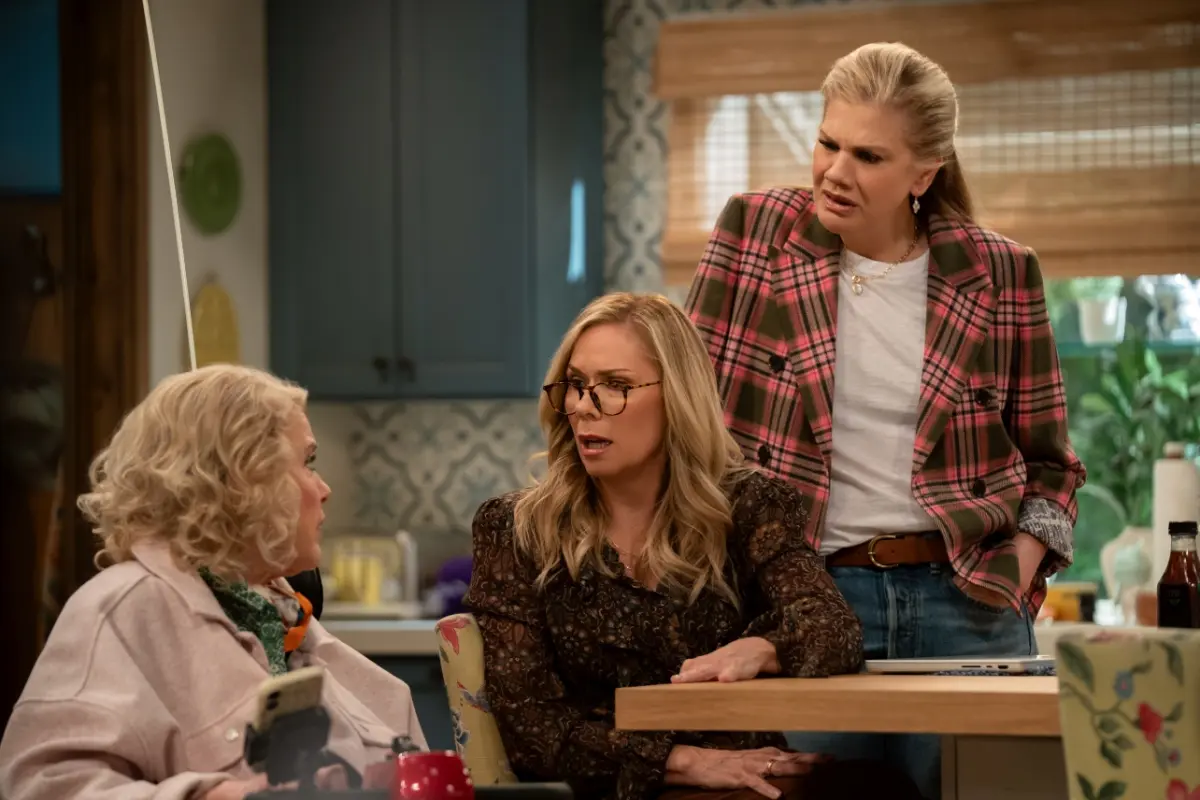
Leanne Morgan and Kristen Johnston prevent that warmth from becoming shapeless. Morgan’s conversational delivery carries the lingering rhythm of stand-up, building jokes through elaboration and mild disbelief. Johnston plays Carol as an instrument designed to puncture elaboration. Her opening remark about Leanne eating as though she were headed for the electric chair turns an ordinary breakfast into a judgment before the real crisis has even arrived.
Their timing depends on contrast, yet the relationship has enough flexibility to avoid a simple sensible-sister-versus-chaotic-sister routine. Carol can be abrasive and perceptive within the same exchange. Leanne can be compassionate while making decisions driven by her own fear of aging. The affection survives irritation because neither character needs every disagreement polished into a lesson. They bicker with the confidence of people who expect to resume the argument tomorrow.
Giving Celia Weston and Blake Clark more room broadens that rhythm. Margaret’s sunny certainty and John’s grumbling bewilderment introduce another tempo into the house, forcing Leanne and Carol to switch between daughters, caretakers, and exasperated authority figures. The generational reversal produces the season’s best friction. Leanne, still determining how to manage her own life, has suddenly become responsible for two people who reject the premise that they require management.
The bright sets, audible audience response, and clean joke-and-button construction leave no doubt about the show’s allegiance to traditional multi-camera comedy. Chuck Lorre’s familiar machinery is visible in the scene architecture: establish an irritation, escalate it through entrances and interruptions, allow one sincere beat, then finish with a line sharp enough to release the pressure. Leanne benefits from that discipline. The show rarely mistakes silence for depth or drags a modest emotional turn beyond its natural weight.
Familiarity becomes a weaker asset when specific family behavior gives way to stock Southern shorthand. Jell-O, hair, food, church, and regional manners can locate these characters quickly, though repetition sometimes makes those details feel preselected. Morgan’s persona brings genuine specificity to the series. The writing occasionally treats the accessories of that persona as a replacement for further characterization.
The same caution applies to the season’s emotional resolutions. Caring for aging parents involves fear, resentment, money, lost privacy, and questions of autonomy that cannot be settled by a loving speech or a repaired quarrel. Season 2 acknowledges several of those pressures, then frequently returns the household to equilibrium before the strain can alter its comfortable shape. The approach preserves warmth, though it also protects the series from the roughest implications of its premise.
A reduced ten-episode order limits some of the sprawl that marked the first season. Bill can complicate Leanne’s new life without pulling the story back into the original marital wound, while Andrew gives her romantic future weight beyond a procession of dating jokes. Some extended-family threads remain lightly developed, but the season keeps returning to its most productive arrangement: several generations competing for space while each insists that someone else is the difficult one.
Starting over at sixty therefore becomes a negotiation conducted at full household volume. Leanne has gained the freedom to choose what comes next just as Margaret and John begin losing choices of their own. Bringing them into her home gives the season its comic abundance, its tenderness, and its hardest question. Everyone has somewhere to belong. Leanne still has to find room for a life.
Leanne Season 2 premiered globally on Netflix on August 27, 2026. You can stream the hit multi-camera sitcom exclusively on Netflix. The plot follows a middle-aged southern woman attempting to rebuild her life and venture back into dating after her husband of 33 years unexpectedly leaves her for another woman via email.
Where to Watch Leanne Season 2 Online





Full Credits
Title: Leanne
Distributor: Netflix, Warner Bros. Television, Chuck Lorre Productions
Release date: August 27, 2026 (Season 2 Premiere)
Rating: TV-14
Running time: 22–28 minutes
Director: Andy Ackerman, Beth McCarthy-Miller
Writers: Susan McMartin, Chuck Lorre, Leanne Morgan, Nick Bakay, Mark Gross, Julie Bean
Producers and Executive Producers: Chuck Lorre, Susan McMartin, Leanne Morgan, Nick Bakay, Judi Marmel, Mark Gross
Cast: Leanne Morgan, Kristen Johnston, Celia Weston, Blake Clark, Ryan Stiles, Tim Daly, Graham Rogers, Hannah Pilkes
Director of Photography (Cinematographer): Jamie Barber
Editors: Joseph White
Composer: John Swihart
The Review
Leanne Season 2
Leanne Season 2 finds its strongest material in a home crowded with aging parents, old frustrations, and competing definitions of independence. Leanne Morgan and Kristen Johnston keep the family comedy lively, while the traditional multi-camera format gives its sentimental turns a dependable rhythm. Familiar Southern shorthand and tidy resolutions sometimes soften the caregiving conflicts too quickly, but the shorter season remains warm, specific, and consistently funny.
PROS
- Morgan and Johnston’s comic timing
- Stronger caregiving premise
- Lively multigenerational ensemble
- Efficient multi-camera rhythm
CONS
- Repetitive Southern shorthand
- Overly tidy emotional resolutions
- Thin extended-family threads