















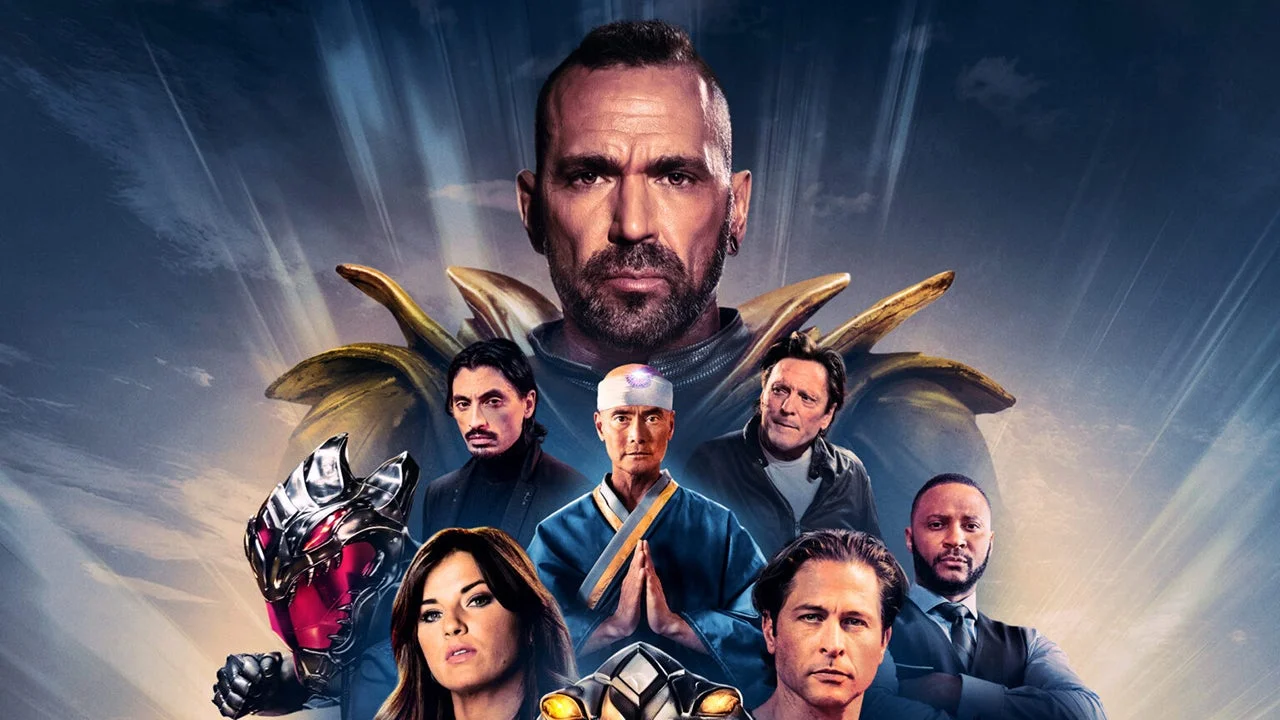

A superhero blamed for 1,263 deaths should have no room left for mythology. His city has burned, his powers have failed, his family thinks he may be dead, and the public has transformed him from savior into mass murderer. Legend of the White Dragon already has its story before the first mystical explanation arrives.
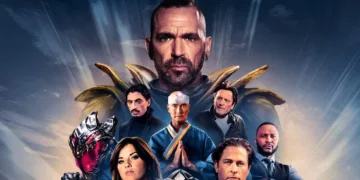
Jason David Frank plays Erik Reed, a treasure hunter who inherited a strange crystal from his imprisoned father Max, played by Michael Madsen. The crystal transformed Erik into the White Dragon, protector of Virtuo City, until a battle with the masked Ashtagor devastated the city on what became known as Dark Day. Erik lost the fight, the crystal broke, and 1,263 people died. Ashtagor escaped public blame. Erik received all of it.
Three years later, Erik is hiding in a makeshift home while his wife Rebecca and daughter Ashley live without answers. His former partners Connor and Iris eventually find him and reveal that one surviving recharging pit could restore the crystal. Pharmaceutical magnate Jai Katua, whose wife and unborn child died on Dark Day, has acquired the other fragment and wants Erik punished.
Co-directors Aaron and Sean Schoenke have enough material here for a compact film about public disgrace, private guilt, and the fantasy of heroic redemption. Instead, the screenplay keeps expanding. Cosmic dragons appear. Ancient protectors arrive. Police conspiracies spread. Holographic mentors explain lore. Another armored villain emerges. The film keeps building a universe while Erik Reed remains stranded inside the most interesting story it has.
The Man Jason David Frank Came to Play
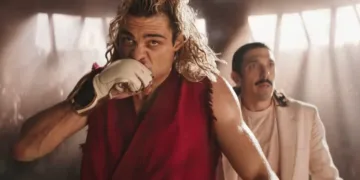
Erik’s hideout says plenty about him before the screenplay starts explaining. Newspaper clippings about Dark Day cover the walls. Family photographs remain within reach. He trains alone, makes a protein shake, punches a bag, and rides a motorcycle that hardly seems designed for inconspicuous fugitive life. The sequence has all the brooding visual shorthand expected from post-Dark Knight superhero cinema, right down to Daughtry’s “Heavy Is the Crown,” yet Frank gives the material a tiredness that occasionally cuts through the cliché.
His posture has changed from the buoyant martial-arts hero associated with his earlier screen career. Erik moves like someone still prepared for combat and poorly prepared for conversation. Frank’s best moments come when that physical confidence collides with emotional paralysis.
The family story should dominate the film. Rebecca has spent three years unsure if her husband is alive. Ashley has spent those years converting uncertainty into anger. Jenna Rae Frank, Jason David Frank’s real-life daughter, plays Ashley, which gives their scenes an emotional charge the screenplay barely uses. An extended confrontation between father and daughter could have forced Erik to account for the choice to vanish. Instead, their relationship receives fragments while other characters explain crystal mechanics.
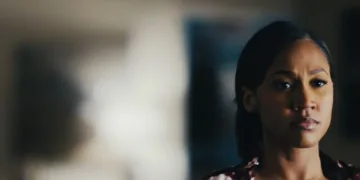
Cerina Vincent faces the same limitation as Rebecca. Her scenes suggest a marriage carrying injuries far deeper than superhero disgrace, yet the script rarely lets her and Erik remain together long enough for those injuries to become dramatic action.
Michael Madsen gets closer. Max Reed’s history with Erik is immediately legible when father and son speak. The old thief passed the crystal to Erik, meaning the White Dragon identity itself comes from a compromised inheritance. That could have connected Erik’s heroism to family history, guilt, and the burden of becoming what a father could never be. Madsen brings a relaxed, weathered quality to their exchanges, while Frank responds with guarded frustration. For a few minutes, cosmic destiny becomes a conversation between two damaged men. Then somebody has to explain the crystal again.
Ninety Minutes of Franchise Architecture
The film’s strangest achievement is making a running time under 100 minutes feel overloaded and underdeveloped at once. Dark Day is explained through the opening battle, televised interviews, newspaper clippings, dialogue, flashbacks, and repeated references to the 1,263 dead. Jai’s grief receives a similar treatment. Flashbacks show his courtship and domestic life with Vanessa, played by Ciara Hanna, before her death. The intention is clear: Jai should function as Erik’s emotional mirror, another man destroyed by the same catastrophe.
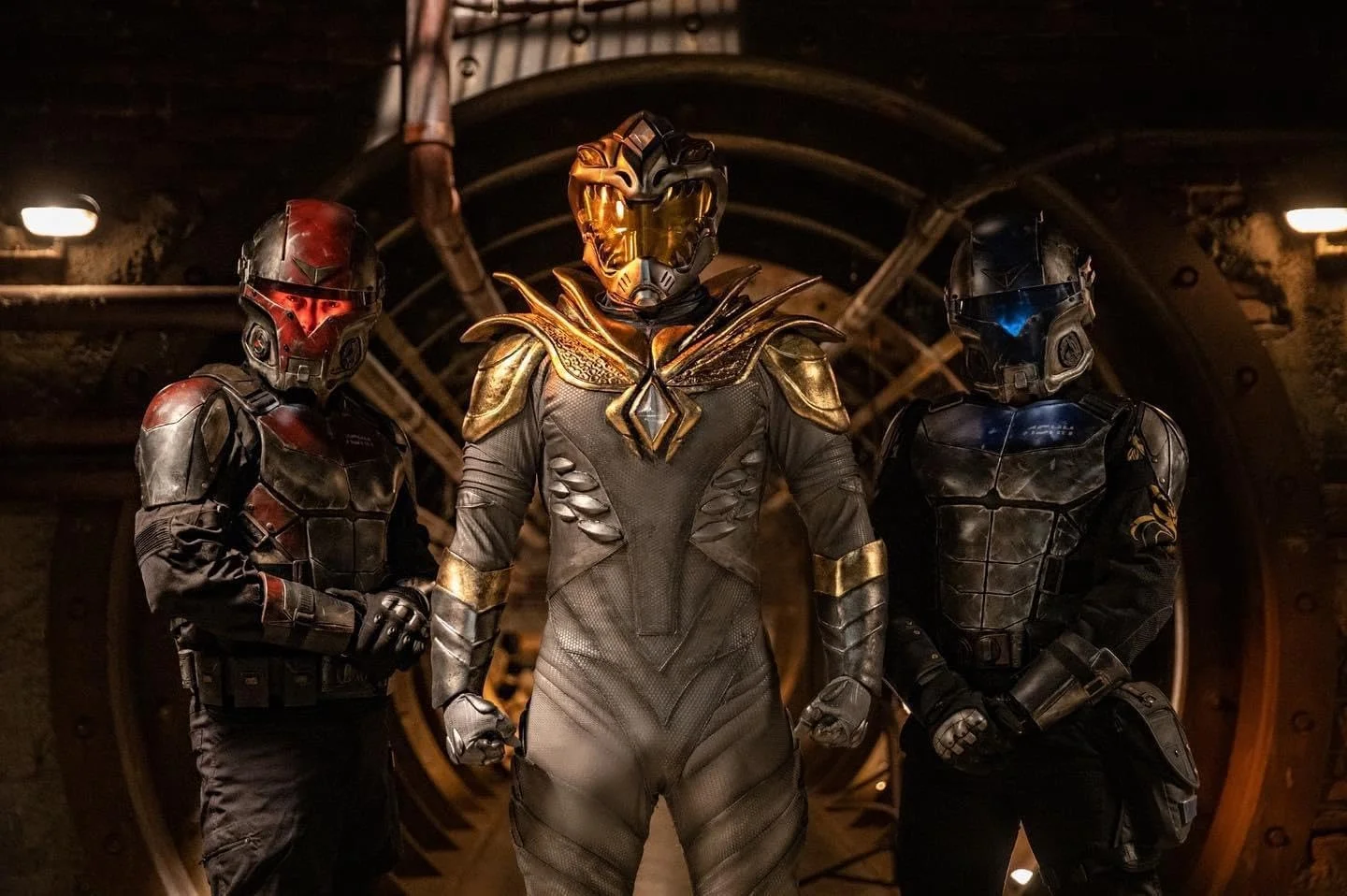
The idea collapses because Jai rarely develops past revenge. Aaron Schoenke, who co-wrote and co-directed the film while playing Jai, gives the character a strained gravelly delivery that turns grief into a single sustained note. A scientist warns him about the danger of adapting his body to the crystal. Jai demands the formula. Later, empowered as Dragon Prime, he demonstrates molten-looking abilities capable of killing people from within. These scenes establish capability. They reveal little about the person using it.
Erik responds to Dark Day by disappearing. Jai responds by transforming mourning into punishment. That parallel could have given their eventual fight moral weight. The script substitutes repeated motivation for development.
Around them, supporting mythology multiplies. Connor and Iris rescue Erik when Detective Beaumont’s armed team raids his hideout. Their bickering hints at romantic history, and Jason Faunt and Rachele Brooke Smith occasionally find an easier rhythm than the film around them, yet their connection to Erik is mostly treated as established information.
URI, Andrew Bachelor’s holographic mentor, supplies jokes and explanations. Mayor Treyvon Stearns brings political pressure. Xang and Jade arrive with spiritual mythology surrounding the Cosmic Dragon and the final energy pit. Each addition seems designed for a future franchise bible. Few deepen the movie currently on screen.
This is a familiar disease in contemporary superhero storytelling: the pilot-film syndrome, where a feature behaves as an advertisement for several hypothetical sequels. Legend of the White Dragon carries the syndrome with unusual visibility. Its dramatic present keeps losing screen time to infrastructure for stories that have not happened.
Action Without Character
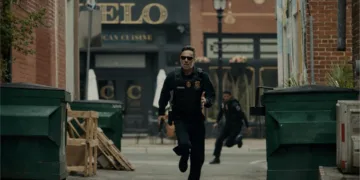
The warehouse raid should be the moment the film wakes up. Erik is cornered by police, tries to escape by motorcycle, and finally has to fight after years spent hiding. Frank still moves with conviction. His heavier striking gives Erik a style distinct from the cleaner heroic poses tied to Tommy Oliver. Yet the sequence works against that physical skill. Shaky framing and aggressive cutting obscure the choreography. At one point, a cinder block crashes onto Erik’s motorcycle helmet, a stunt beat so visibly constructed around protection that the impact disappears.
For filmmakers with a background in superhero fight videos, that lack of clarity is especially surprising. Action cinema depends on readable cause and effect. A strike lands because the camera lets the audience understand distance, timing, resistance, and consequence. Here, bodies often appear to be completing choreography while the camera records evidence that choreography occurred.
Mark Dacascos arrives later as Xang and immediately carries a different relationship to movement. Decades of screen combat experience are visible in the way he occupies space, which only makes the surrounding staging feel stiffer.
The White Dragon and Dragon Prime confrontation raises the technical ambition. The two fly, exchange energy attacks, crash through digital landscapes, and turn the climax toward the language of Dragon Ball and modern superhero spectacle. Dragon Prime’s molten orange effects create a clear visual opposition to the White Dragon’s cooler energy.
Yet Erik’s restored powers never become an emotional transformation. The film has spent considerable time presenting him as ashamed, isolated, and uncertain, but his fighting style does not meaningfully change when he returns to the armor. The action communicates power level, not psychology.
The same issue shapes the visual design outside combat. Conversations often settle into functional medium-shot coverage. Erik has spent three years estranged from his wife and child, yet the camera rarely uses distance, framing, or blocking to make that separation visible. Smoke, embers, holograms, ruined skylines, and digital environments work overtime to manufacture scale while the human relationships remain visually plain. Limited money can explain imperfect effects. It cannot explain choosing spectacle as the place to spend dramatic attention.
Nostalgia Wearing Adult Clothes
The film’s relationship with Power Rangers is less an easter egg than an unresolved identity crisis. Erik Reed is explicitly conceived as a different kind of hero from Tommy Oliver. He is older, angrier, disgraced, married, and burdened by choices that cannot be repaired through a clean victory. Yet he wears white-and-gold armor, fights beside color-coded teammates, receives guidance from a holographic mentor, and shares the screen with several performers associated with Power Rangers. A restaurant reference to Tommy Oliver removes any remaining doubt about the intended audience.
The R-rated gestures are similarly cosmetic. Characters swear. Violence produces bloodier results. Jai’s powers kill with greater cruelty. Brief sexual material signals that this world is aimed at viewers who have aged since Saturday-morning superhero television. Adulthood, though, is not profanity added to childhood iconography. It is consequence.
The film touches that idea whenever Erik faces the wreckage of his personal life. Rebecca does not need a darker costume design from him. Ashley does not need a stronger energy blast. They need an explanation from a man who disappeared for three years. Max does not need a cosmic prophecy. He needs to reckon with what he handed his son.
Jason David Frank seems ready for those scenes. His Erik carries fatigue, embarrassment, anger, and the stubborn physical confidence of a man who remembers being admired. The performance suggests an actor trying to complicate the heroic image that followed him for decades. The movie around him keeps restoring that image instead.
Frank’s death in 2022 inevitably changes the experience of watching his final starring role. The memorial dedication and behind-the-scenes footage during the credits carry a tenderness separate from the fictional drama. They show the communal affection surrounding a project clearly made with great personal investment. That affection deserves recognition without turning criticism into obligation. A final performance can be cherished while the film containing it remains dramatically unsuccessful.
The painful part is how often Legend of the White Dragon reveals the stronger movie within reach. Erik sits opposite Max and suddenly the mythology recedes. He looks toward the family he abandoned and the costume becomes irrelevant. Frank allows shame to replace superhero certainty, and for a moment this ceases to resemble a franchise launch. Then the armor returns, the lore starts talking, and the man disappears beneath the White Dragon again.
Legend of the White Dragon arrived in theaters on August 28, 2026, distributed by Well Go USA Entertainment. The independent superhero feature follows a former hero forced into hiding as a fugitive who must return to clear his name and protect his family from an old enemy.
Where to Watch Legend of the White Dragon (2026) Online






Full Credits
Title: Legend of the White Dragon
Distributor: Well Go USA Entertainment
Release date: August 28, 2026
Rating: PG
Running time: 1 hour 38 minutes
Director: Aaron Schoenke, Sean Schoenke
Writers: Alex Kellerman, Aaron Schoenke
Producers and Executive Producers: Chris Jay, Aaron Schoenke, Sean Schoenke, Jason David Frank, Ben Dukes
Cast: Jason David Frank, Aaron Schoenke, Jason Faunt, Rachele Brooke Smith, Michael Madsen, Andrew Bachelor, David Ramsey, Mark Dacascos
Director of Photography (Cinematographer): Aric Abraham
Editors: Aaron Schoenke
Composer: Sean Schoenke
The Review
Legend of the White Dragon
Legend of the White Dragon wants to transform childhood superhero nostalgia into an adult reckoning with failure, yet its most promising idea keeps disappearing beneath franchise machinery. Jason David Frank finds real weariness in Erik Reed, especially around Max and the family he abandoned, while the screenplay prefers crystal mythology, repeated Dark Day exposition, and sequel bait. Flat coverage and weightless fights further expose the gap between ambition and execution. Frank reaches for a wounded man beneath the armor. The film keeps handing him another costume.
PROS
- Frank’s weary central performance
- Stronger scenes with Michael Madsen
- Ambitious final aerial fight
- Genuine affection behind the production
CONS
- Relentless exposition and flashbacks
- Thin family relationships
- Weak Dragon Prime performance
- Flat action staging
- Overloaded franchise mythology