


















Occupation changes the moral status of an empty room. A house can look abandoned while still carrying the shape of the family forced out of it, and Wild, Wild East understands this before it understands almost anything else. Its village in Nazi-occupied Poland is full of spaces whose owners have vanished, possessions awaiting new claimants, and men who have learned to treat catastrophe as an opportunity. The film borrows the posture of a Western, complete with a black-clad stranger arriving in a frozen town, then quietly poisons the fantasy beneath it. This frontier was not discovered. It was manufactured through expulsion.
Martin Wolff enters Małe Zalesie in 1943 looking for a missing lawyer and a cache of gold connected to deported Jewish residents. Itay Tiran plays him with the discipline of a man who knows that silence can sound like authority. He does not need to threaten everyone explicitly because the uniformed machinery behind him has already done the threatening. A pause, a stare, a question repeated once: the town fills in the rest.
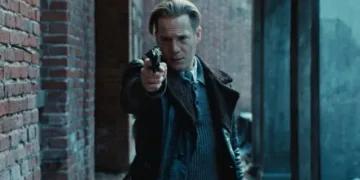
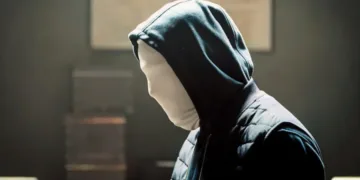
That makes Wolff a useful contradiction. He resembles the classic gunslinger, yet his apparent power comes from one of history’s most murderous bureaucracies. He is both lone rider and institutional shadow. Jan Holoubek leans into the image, framing Tiran in dark silhouettes and giving his thin, severe figure the iconography of a genre hero. The effect is intentionally uncomfortable. We know the visual grammar. We are less certain that we want to cheer when it appears.

At first I thought this was the film’s cleverest trick. I am less sure after sitting with it. Call it the vacancy economy: the moral system that forms when people begin treating forced absence as available inventory. Kaim manages homes left behind by deported Jewish families. Kuliś and his household occupy rooms tied to the missing lawyer. Others circle the gold, the vodka trade, and whatever information might be turned into leverage. Every empty building becomes evidence and temptation at once.
The film is strongest when it lets that system speak through physical space. A former synagogue becomes a tennis court where Kurt, a Nazi officer and former hairdresser, tries to draw Wolff into strained conversation about Jewish art. The grotesque joke is already built into the setting. A culture has been attacked, its people removed, and its building reassigned for leisure. Holoubek does not need a speech to explain the obscenity. He merely needs two men volleying a ball across the room.
Bartek Kaczmarek’s cinematography gives these spaces a cold, scraped quality. Frozen streets and emptied homes do not function as decorative misery. They turn absence into something tactile. Wolff moves through them like a detective in a noir town that has suffered a crime too large for the genre’s usual vocabulary. The Western influence matters for the same reason. Westerns often mythologize territory as open, contested, waiting to be claimed. Here, every claim is haunted by the fact that someone had to be removed first. The gold becomes a moral accelerant.
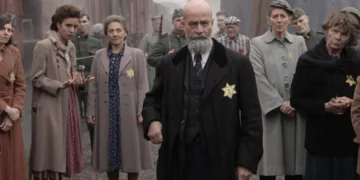
The film’s collection of opportunists is richer than a conventional suspect list. Kaim’s illicit business, Kuliś’s suspicious domestic arrangement, roaming criminals, a Ukrainian outlaw, and an innkeeper sketching a graphic account of the Holocaust all occupy different points on the spectrum between survival, complicity, theft, and witness. Nobody fits comfortably into the role of hero because the town itself has made clean positions almost impossible. That does not absolve anyone. It makes their choices harder to file away.
The screenplay’s gamble is to make Wolff the least readable person in the room. Aleksandra Takuska withholds enough about his motives to keep every interrogation unstable, and Tiran makes the blankness productive for a long stretch. His performance is compressed rather than vacant. Small shifts in posture and attention suggest that the man beneath the role is taking in details he cannot safely acknowledge.
Still, concealment has a cost. The film spends so much time protecting what Wolff knows and why he knows it that suspense occasionally hardens into delay. Mystery requires missing information, but a character can remain mysterious while still accumulating emotional pressure. Wild, Wild East sometimes treats those as the same problem. They are not. Then the film changes shape.
The late revelation gives Tiran room to expose the vulnerability hidden inside the earlier performance, and some of the prior restraint gains retrospective force. Actions that looked merely procedural begin to read differently. The film’s genre machinery also becomes more active, with shootouts and survivalist violence breaking the glacial rhythm. A cemetery confrontation shows how effectively Holoubek can tighten the film once the story stops pretending it is content to remain a chamber mystery.
Yet the final movement also weakens the very quality that made the earlier sections unsettling. The Holocaust had existed through absence: confiscated rooms, missing families, corrupted institutions, casual desecration. The climax turns that historical horror into a far more literal experience for Wolff, then presses the symbolism harder with the image of a departing train. I understand the desire. After so much withholding, perhaps the film fears that implication will look like timidity.
I think the opposite happens. The earlier restraint was already an argument. Those vacant homes had spoken. The synagogue had spoken. The gold had spoken. By forcing Wolff, and by extension the audience, through a more explicit symbolic reckoning, the film narrows meanings it had previously allowed to remain morally unstable. It exchanges dread for explanation.
That does not erase the force of what Holoubek and Tiran build. Wild, Wild East remains an unusually intelligent piece of genre theft, using the Western to expose a world where the very idea of “unclaimed” property has become obscene. Its best images understand that history survives inside ownership, architecture, and routine long after people learn to describe theft as administration. The frustrating part is that the film eventually stops trusting those images and reaches for louder symbols, as though the empty houses had not already told us who was missing.
Wild, Wild East premiered in the Platform section of the Toronto International Film Festival on September 14, 2026. Set in occupied Poland in 1943, the war drama follows a German officer who arrives in a remote village to investigate the disappearance of a Jewish lawyer.
Full Credits
Title: Wild, Wild East
Distributor: Warner Bros. Pictures
Release date: September 14, 2026 (Toronto International Film Festival)
Running time: 1 hour 45 minutes (105 minutes)
Director: Jan Holoubek
Writers: Not publicly specified
Producers and Executive Producers: Ewa Puszczyńska, Klaudia Śmieja-Rostworowska, Bogna Szewczyk-Skupień
Cast: Itay Tiran, Joanna Kulig, Robert Więckiewicz, Jan Bülow, Piotr Trojan, Janusz Chabior, Jacek Beler, Magdalena Różczka
The Review
Wild, Wild East
Wild, Wild East works best when it trusts absence. Its frozen streets, emptied homes, corrupted spaces, and morally compromised treasure hunt turn the Western into something bitterly historical. Itay Tiran gives Martin Wolff enough restraint to keep the mystery alive, while Jan Holoubek repeatedly finds sharper meaning in architecture and silence than in exposition. The late turn still lands, but the climax presses its symbolism so hard that it weakens the ambiguity the film had carefully earned.
PROS
- Strong Western reinterpretation
- Itay Tiran's restrained performance
- Excellent use of occupied spaces
- Rich moral ambiguity
- Cold, expressive cinematography
CONS
- Wolff is withheld for too long
- Mystery occasionally becomes delay
- Climax overexplains its symbolism
- Final imagery lacks earlier restraint